Paper II — Q4
(a) Do you subscribe to the view that private sector is a key driver to economic development of India? Give reasons in support of…
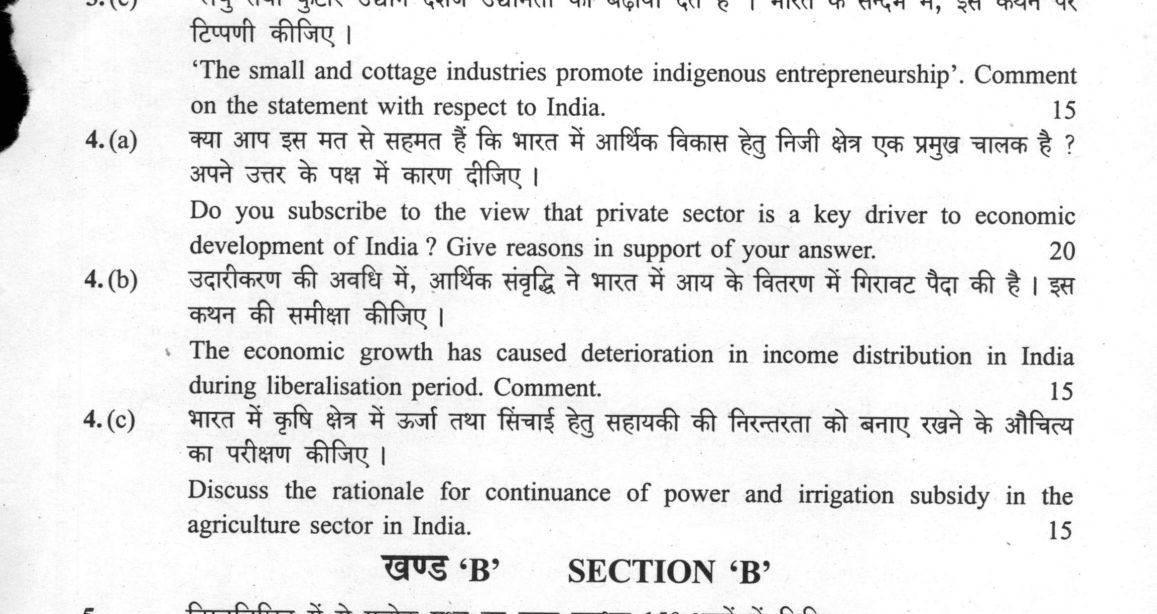
Do you subscribe to the view that private sector is a key driver to economic development of India? Give reasons in support of your answer. 20 marks
The economic growth has caused deterioration in income distribution in India during liberalisation period. Comment. 15 marks
Discuss the rationale for continuance of power and irrigation subsidy in the agriculture sector in India. 15 marks
हिंदी में प्रश्न पढ़ें
क्या आप इस मत से सहमत हैं कि भारत में आर्थिक विकास हेतु निजी क्षेत्र एक प्रमुख चालक है ? अपने उत्तर के पक्ष में कारण दीजिए। (20 अंक)
उदारीकरण की अवधि में, आर्थिक संवृद्धि ने भारत में आय के वितरण में गिरावट पैदा की है। इस कथन की समीक्षा कीजिए। (15 अंक)
भारत में कृषि क्षेत्र में ऊर्जा तथा सिंचाई हेतु सहायकी की निरंतरता को बनाए रखने के औचित्य का परीक्षण कीजिए। (15 अंक)
Model answer
Written by UPSC Answer Check against this question's marking rubric, to the expected length. UPSC does not publish answers for Mains — this is one way to score well, not an official key.
Private sector: a necessary but incomplete driver I partially subscribe to the view that the private sector is a key driver of India’s economic development. After 1991, liberalisation, privatisation and globalisation allowed private capital to expand in IT, telecom, manufacturing and services, and World Bank data show private investment’s share of gross fixed capital formation often above 70 per cent in post-reform years. This has accelerated growth, created jobs, improved productivity, and brought innovation, competition and efficiency that the state alone could not deliver. Private firms also respond faster to demand, mobilise savings, and generate exports and tax revenue. It has also strengthened linkages with global value chains and improved consumer choice.
However, the private sector is not sufficient. Its investment is often capital-intensive and regionally concentrated, favouring urban India, skilled labour and profitable sectors. Profit motive may crowd out public goods such as health, education, sanitation and rural infrastructure. Post-reform growth has coexisted with persistent informal employment, jobless growth in some sectors, and concerns about crony capitalism and weak regulatory capture. Thus the state remains essential for infrastructure, human capital, social protection and market regulation. A balanced verdict is that the private sector is a key engine, but development requires a strong developmental state.
Growth and distribution The claim that growth caused deterioration in income distribution during liberalisation needs nuance. World Inequality Lab estimates of income shares show rising income Gini coefficient and Palma ratio, with higher top-decile shares, while Oxfam reports highlight wealth concentration. NSSO and PLFS data, however, measure consumption expenditure, employment and wages rather than directly providing income Gini or Palma ratios; they show that consumption inequality was more muted and that poverty fell substantially, depending on the poverty line used. This distinction matters because consumption can be smoothed by credit, remittances and public transfers. The Tendulkar Committee line implied a larger fall in poverty than the Rangarajan Committee line, but both indicate that growth was not poverty-free.
The deterioration was not simply caused by growth. Skill-biased technological change, globalisation and the rise of high-productivity services increased returns to education and urban assets, while informalisation and weak social protection left low-skilled workers vulnerable. Regional disparities also widened. Therefore, growth was accompanied by rising inequality, but it also reduced absolute poverty; the distributional outcome depended on policy, not growth alone.
Power and irrigation subsidies Continuance of power and irrigation subsidies in agriculture has a clear rationale. Power subsidy—providing electricity below cost for tubewell pumping—reduces input costs for small and marginal farmers, supports food production and rural employment, prevents a sharp rise in food prices, and reflects political economy compulsions from the Green Revolution’s expansion of irrigated agriculture. Irrigation subsidy is distinct: under-pricing of canal water, often charged below cost or free, reflects equity considerations, its public-good character, the need to ensure affordable water for smallholders, and the state’s responsibility for food security and rural livelihoods. Both subsidies protect vulnerable farmers from market shocks and maintain agricultural output.
Yet their continuance is problematic. Power-intensive groundwater pumping has accelerated aquifer depletion in Punjab, Haryana and parts of Rajasthan, while fiscal burdens and inefficient water use persist. Canal subsidies can encourage over-cultivation of water-intensive crops. Reform is needed: direct benefit transfers to farmers, metering and time-bound power supply, crop diversification, and solar pumps under PM-KUSUM. Irrigation policy should shift from cheap water to efficient water, with user charges, watershed management and equitable allocation.
In sum, India’s development requires a state-market balance: private dynamism for growth, state action for equity, and agricultural subsidies reformed to protect small farmers without exhausting public finances or natural resources.
What "Evaluate" is asking you to do
Judge how well something has performed against the standard it set for itself — its stated aim, mandate or promise — and commit to a verdict. Name the yardstick before you judge; an unanchored judgement reads as opinion.
Structure that answers it
Name the yardstick — stated aim, mandate or benchmark → performance against it → shortfall against it → why the gap exists → verdict
Where marks are lost
Presenting both sides and then declining to decide, or delivering a verdict against a standard you never stated, which makes it look arbitrary.
How this answer will be evaluated
Approach
Framework: Economics Paper II (Indian Economy). (4(a)) justify: claim > 3-4 reasons > evidence > conclusion | (4(b)) comment: context > arguments both sides > judgment > close | (4(c)) discuss: intro > 3-4 dimensions > example > balanced close Full marks: Comprehensive, data-driven, balanced, and well-structured with specific examples and references.
Key points expected
- Define the role of private sector in GDP growth
- Cite FDI inflows and private investment data
- Link private sector to employment generation
- Mention specific sectors (IT, manufacturing, services)
- Define income distribution and Gini coefficient
- Present data on income inequality pre- and post-1991
- Discuss regional disparities (urban vs rural)
- Provide a balanced judgment on the claim
Evaluation rubric
Each sub-part is marked on its own, against the marks and word limit printed on the paper.
- (4(a)) Justify the view that the private sector is a key driver of India's economic development. 20 marks
justify— claim → 3-4 reasons → evidence → conclusion
Must cover
- Define the role of private sector in GDP growth
- Cite FDI inflows and private investment data
- Link private sector to employment generation
- Mention specific sectors (IT, manufacturing, services)
Loses marks
- Generic statements without data
- Ignoring the role of public sector
- No link to economic development metrics
Earns more
- Reference to NITI Aayog or RBI reports
- Comparison with public sector performance
- Mention of specific policies (Make in India, PLI)
Extra mark
- Specific FDI figures from recent years
- Reference to specific economists or reports
- (4(b)) Comment on the claim that economic growth during liberalisation worsened income distribution in India. 15 marks
comment— context → arguments both sides → judgment → close
Must cover
- Define income distribution and Gini coefficient
- Present data on income inequality pre- and post-1991
- Discuss regional disparities (urban vs rural)
- Provide a balanced judgment on the claim
Loses marks
- One-sided argument without counter-evidence
- No data or statistics
- Confusing growth with distribution
Earns more
- Reference to NSSO data or World Bank reports
- Mention of specific sectors driving inequality
- Discussion of poverty reduction vs inequality
Extra mark
- Specific Gini coefficient values
- Reference to specific studies or economists
- (4(c)) Discuss the rationale for continuing power and irrigation subsidies in India's agriculture sector. 15 marks
discuss— intro → 3-4 dimensions → example → balanced close
Must cover
- Define power and irrigation subsidies
- Explain the economic rationale (food security, rural employment)
- Discuss the political rationale (voter base, social equity)
- Mention the fiscal burden and inefficiencies
Loses marks
- Ignoring the fiscal cost
- No mention of food security
- Generic discussion without specific examples
Earns more
- Reference to specific schemes (PM-KISAN, PM-KUSUM)
- Discussion of environmental impact
- Mention of state-wise variations
Extra mark
- Specific subsidy figures from recent budgets
- Reference to specific committees or reports
Practice this exact question
Write your answer and it is marked point by point against the model answer above — what you covered, what you missed, what you got wrong.
Evaluate my answer →More from Economics 2022 Paper II
- Q1 Answer the following questions in about 150 words each: (a) Outline the factors that caus…
- Q2 (a) Highlight the major features of National Income trend and its sectoral composition du…
- Q3 (a) Do you think that Multi Dimensional Poverty Index (MPI) is a better measure of povert…
- Q4 (a) Do you subscribe to the view that private sector is a key driver to economic developm…
- Q5 Answer the following questions in about 150 words each: (a) Do you think that Indian deve…
- Q6 (a) What is the objective of exchange rate management? Do you think that the present regi…
- Q7 (a) Critically examine the various poverty alleviation programmes in India since 1970's.…