Paper I — Q1
Answer the following questions in about 150 words each: (a) Examine the role of price elasticity of demand in determining the…
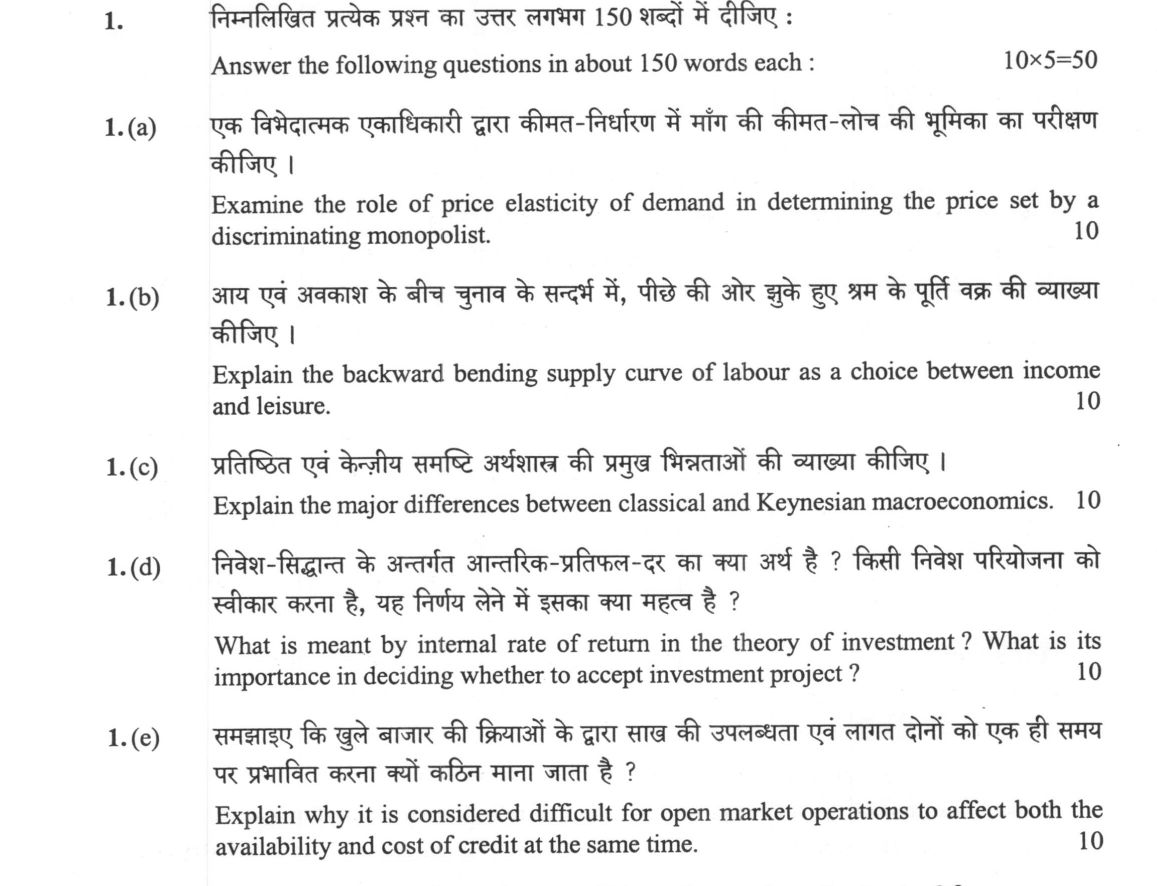
Answer the following questions in about 150 words each:
Examine the role of price elasticity of demand in determining the price set by a discriminating monopolist. 10 marks
Explain the backward bending supply curve of labour as a choice between income and leisure. 10 marks
Explain the major differences between classical and Keynesian macroeconomics. 10 marks
What is meant by internal rate of return in the theory of investment? What is its importance in deciding whether to accept investment project? 10 marks
Explain why it is considered difficult for open market operations to affect both the availability and cost of credit at the same time. 10 marks
हिंदी में प्रश्न पढ़ें
निम्नलिखित प्रत्येक प्रश्न का उत्तर लगभग 150 शब्दों में दीजिए :
एक विभेदात्मक एकाधिकारी द्वारा कीमत-निर्धारण में माँग की कीमत-लोच की भूमिका का परीक्षण कीजिए। (10 अंक)
आय एवं अवकाश के बीच चुनाव के संदर्भ में, पीछे की ओर झुके हुए श्रम के पूर्ति वक्र की व्याख्या कीजिए। (10 अंक)
प्रतिष्ठित एवं कैंजीय समष्टि अर्थशास्त्र की प्रमुख भिन्नताओं की व्याख्या कीजिए। (10 अंक)
निवेश-सिद्धान्त के अन्तर्गत आन्तरिक-प्रतिफल-दर का क्या अर्थ है? किसी निवेश परियोजना को स्वीकार करना है, यह निर्णय लेने में इसका क्या महत्व है? (10 अंक)
समझाइए कि खुले बाजार की क्रियाओं के द्वारा साख की उपलब्धता एवं लागत दोनों को एक ही समय पर प्रभावित करना क्यों कठिन माना जाता है? (10 अंक)
Model answer
Written by UPSC Answer Check against this question's marking rubric, to the 150-word length. UPSC does not publish answers for Mains — this is one way to score well, not an official key.
(a) Price Elasticity and Price Discrimination
In third-degree price discrimination, a monopolist segments the aggregate market into distinct sub-markets to maximize total profit. The equilibrium condition across markets requires equating marginal revenue in each market to the common marginal cost (MR₁ = MR₂ = MC).
Using the relationship MR = P(1 - 1/|e|), the pricing rule becomes: P₁(1 - 1/(|e₁|)) = P₂(1 - 1/(|e₂|)) = MC
This formulation reveals that the price charged is inversely related to the price elasticity of demand (|e|). In the sub-market with relatively inelastic demand (|e₁| < |e₂|), consumers are less responsive to price hikes, allowing the monopolist to charge a higher price (P₁ > P₂) to extract a larger share of consumer surplus. Conversely, in the elastic sub-market, a lower price is set to stimulate sales volume.
Thus, demand elasticity does not merely modulate prices; it serves as the necessary criterion for discriminatory pricing. If elasticities across sub-markets are identical, price discrimination yields no additional profit over uniform monopoly pricing.
(b) Backward Bending Labour Supply Curve
The supply of labour reflects an individual's constrained utility maximization between income (representing market goods) and leisure. A change in the wage rate (w) produces two simultaneous opposing forces:
The Substitution Effect (SE) raises the opportunity cost of leisure as wages rise, inducing the worker to substitute leisure with work, thereby increasing hours worked (an upward-sloping supply).
The Income Effect (IE) operates because higher wages increase real income for the same hours worked. Assuming leisure is a normal good, higher income induces greater demand for leisure, incentivizing fewer hours of work.
At lower wage levels, the substitution effect dominates (|SE| > |IE|), making the labour supply curve positively sloped. However, beyond a threshold wage (w^*), the income effect becomes dominant (|IE| > |SE|). At this point, the worker prioritizes leisure over marginal income gains, causing the labour supply curve to bend backward.
(c) Major Differences Between Classical and Keynesian Macroeconomics
Classical and Keynesian macroeconomics diverge fundamentally on market clearing, the role of aggregate demand, and policy intervention:
Say's Law versus Effective Demand: Classical economics adheres to Say’s Law ("supply creates its own demand"), assuming all income is spent. Keynes rejected this, arguing that output and employment are determined by the level of effective aggregate demand (AD = C + I + G + NX).
Wage-Price Flexibility versus Rigidity: Classicals assumed complete, instantaneous price and nominal wage flexibility, ensuring that labour markets automatically clear. Keynes posited nominal wage rigidity downwards due to institutional factors, contracts, and money illusion.
Equilibrium State: Classical models postulate that the economy automatically self-corrects to a full-employment equilibrium (Y = Y_f). Keynes demonstrated that economies can settle at a stable underemployment equilibrium with persistent involuntary unemployment.
Policy Stance: Classical economists advocated laissez-faire, viewing money as neutral (Classical Dichotomy). Keynes advocated discretionary state intervention, particularly counter-cyclical fiscal policy, to manage aggregate demand.
(d) Internal Rate of Return (IRR) in Investment Theory
The Internal Rate of Return (IRR) is the endogenous discount rate (r) that equates the present value of expected future net cash flows from an investment project to its initial capital outlay (C₀). Formally, it is the rate at which Net Present Value (NPV) equals zero: Σₜ₌₁ⁿ (Rₜ)/((1 + r)^t) - C₀ = 0
Importance and Decision Rule: IRR represents the marginal efficiency of capital (MEC). The investment criterion dictates that a project is accepted if its IRR > k (where k is the market cost of capital or hurdle rate), and rejected if IRR < k. In aggregate investment theory, projects are ranked by IRR to construct the investment demand schedule.
Limitations: IRR assumes cash flows are reinvested at the project's internal rate rather than the cost of capital. Furthermore, non-conventional cash flows (alternating signs) produce multiple IRRs, and for mutually exclusive projects of different scales, IRR can conflict with NPV rankings.
(e) Open Market Operations: Availability versus Cost of Credit Dilemma
Open Market Operations (OMOs) involve the purchase or sale of government securities by the central bank to influence monetary aggregates. Affecting both the availability (quantity of credit) and the cost of credit (interest rate) simultaneously is difficult due to the interdependence of price and quantity in money markets.
When the central bank purchases securities, it injects reserve money into commercial banks, augmenting credit availability via the money multiplier. Simultaneously, bond purchases drive up bond prices, lowering yields and reducing the cost of credit.
However, the central bank cannot simultaneously fix both an exogenous reserve quantity target and an interest rate target. If it targets a specific credit volume, the market-clearing interest rate must adjust freely, inducing volatility in borrowing costs. Conversely, if it targets an interest rate (cost channel), it must supply or absorb whatever quantity of reserves the market demands at that rate, surrendering control over credit availability.
This conflict is exacerbated in a liquidity trap or at the zero lower bound, where expanding reserves via OMOs fails to reduce borrowing costs further due to an infinitely elastic demand for money.
What "Examine" is asking you to do
Test the proposition the question puts to you and return a finding on how far it holds. Examine stems carry a claim, or ask whether something has happened, and expect evidence weighed both ways before the extent is stated — often with remedial measures attached.
Structure that answers it
Restate the claim as the question frames it → evidence that supports it → evidence that undercuts it → the conditions under which it holds → verdict on how far it stands
Where marks are lost
Stopping at description. An examination has to reach a finding, and “examine with justification” means the extent must be stated, not implied.
How this answer will be evaluated
Approach
Framework: Micro/Macro Theory & Policy. (a) examine: intro > how/why with reasoning > evidence > conclusion | (b) explain: definition/context > points in order > small example > short close | (c) explain: definition/context > points in order > small example > short close | (d) explain: definition/context > points in order > small example > short close | (e) explain: definition/context > points in order > small example > short close Full marks: Clear definitions, logical reasoning, correct application of economic models, and relevant examples.
Key points expected
- Define price elasticity of demand (PED)
- State monopolist's profit-maximizing condition (MR=MC)
- Explain relationship between PED and markup
- Apply to discriminating monopolist (different prices for different groups)
- Define labor supply curve
- Explain substitution effect of wage increase
- Explain income effect of wage increase
- Show how income effect dominates at high wages
Evaluation rubric
Each sub-part is marked on its own, against the marks and word limit printed on the paper.
- (a) Link price elasticity of demand to price-setting in a discriminating monopoly. 10 marks · 150 words
examine— intro → how/why with reasoning → evidence → conclusion
Must cover
- Define price elasticity of demand (PED)
- State monopolist's profit-maximizing condition (MR=MC)
- Explain relationship between PED and markup
- Apply to discriminating monopolist (different prices for different groups)
Loses marks
- Confusing price discrimination with perfect competition
- Ignoring the role of elasticity in price setting
- Verbal answer without economic reasoning
Earns more
- Mention Lerner Index
- Distinguish between different types of price discrimination
- Explain how lower PED allows higher price
- Reference to consumer surplus extraction
Extra mark
- Named economist (e.g., Robinson, Pigou)
- Simple diagram showing different demand curves
- (b) Explain backward-bending labor supply curve as income-leisure choice. 10 marks · 150 words
explain— definition/context → points in order → small example → short close
Must cover
- Define labor supply curve
- Explain substitution effect of wage increase
- Explain income effect of wage increase
- Show how income effect dominates at high wages
Loses marks
- Confusing labor supply with labor demand
- Ignoring the income effect
- Verbal answer without economic reasoning
Earns more
- Mention indifference curve analysis
- Distinguish between normal and inferior goods
- Reference to leisure as a normal good
- Explain the kink in the supply curve
Extra mark
- Diagram showing indifference curves and budget lines
- Named economist (e.g., Marshall)
- (c) Explain major differences between classical and Keynesian macroeconomics. 10 marks · 150 words
explain— definition/context → points in order → small example → short close
Must cover
- Define classical macroeconomics
- Define Keynesian macroeconomics
- Contrast views on price/wage flexibility
- Contrast views on role of government
Loses marks
- Confusing classical with neoclassical
- Ignoring the role of aggregate demand
- Verbal answer without economic reasoning
Earns more
- Mention Say's Law vs. Effective Demand
- Contrast views on unemployment
- Reference to IS-LM model
- Mention long-run vs. short-run focus
Extra mark
- Named economists (e.g., Adam Smith, Keynes)
- Reference to specific policy recommendations
- (d) Define internal rate of return and its importance in investment decisions. 10 marks · 150 words
explain— definition/context → points in order → small example → short close
Must cover
- Define internal rate of return (IRR)
- Explain IRR as discount rate where NPV=0
- State IRR decision rule (accept if IRR > cost of capital)
- Explain importance in comparing investment projects
Loses marks
- Confusing IRR with NPV
- Ignoring the time value of money
- Verbal answer without economic reasoning
Earns more
- Mention Net Present Value (NPV)
- Explain limitations of IRR (e.g., multiple IRRs)
- Reference to payback period
- Mention risk-adjusted IRR
Extra mark
- Simple numerical example
- Named economist or financial theorist
- (e) Explain difficulty of open market operations affecting credit availability and cost simultaneously. 10 marks · 150 words
explain— definition/context → points in order → small example → short close
Must cover
- Define open market operations (OMO)
- Explain how OMO affects money supply
- Explain how OMO affects interest rates
- Discuss the trade-off between availability and cost
Loses marks
- Confusing OMO with other monetary policy tools
- Ignoring the role of interest rates
- Verbal answer without economic reasoning
Earns more
- Mention central bank's role
- Reference to liquidity management
- Explain the transmission mechanism
- Mention the role of reserve requirements
Extra mark
- Reference to specific central bank (e.g., RBI, Fed)
- Mention recent OMO operations
Practice this exact question
Write your answer and it is marked point by point against the model answer above — what you covered, what you missed, what you got wrong.
Evaluate my answer →More from Economics 2023 Paper I
- Q1 Answer the following questions in about 150 words each: (a) Examine the role of price ela…
- Q2 (a) Explain the Cournot model of duopoly using reaction functions and interpret it as a N…
- Q3 (a) "Under rational expectation hypothesis, systematic monetary policy is ineffective." E…
- Q4 (a) Explain the concept of "sterilization" in the context of monetary approach to balance…