Paper I — Q4
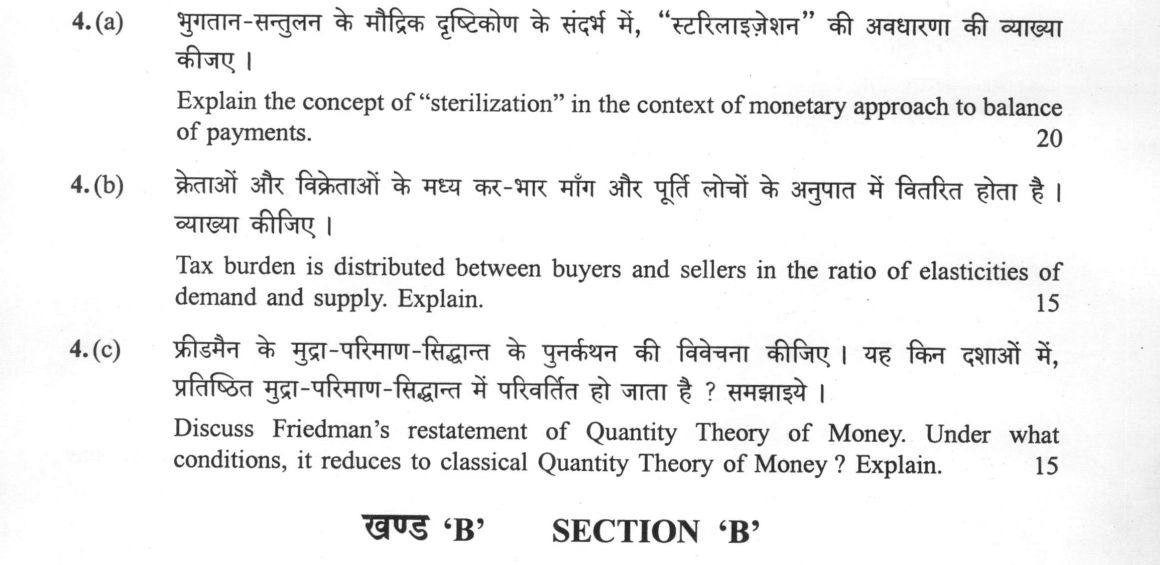
(a) Explain the concept of "sterilization" in the context of monetary approach to balance of payments. (20 marks) (b) Tax burden…
Explain the concept of "sterilization" in the context of monetary approach to balance of payments. 20 marks
Tax burden is distributed between buyers and sellers in the ratio of elasticities of demand and supply. Explain. 15 marks
Discuss Friedman's restatement of Quantity Theory of Money. Under what conditions, it reduces to classical Quantity Theory of Money? Explain. 15 marks
हिंदी में प्रश्न पढ़ें
भुगतान-संतुलन के मौद्रिक दृष्टिकोण के संदर्भ में, "स्टरिलाइजेशन" की अवधारणा की व्याख्या कीजिए। (20 अंक)
क्रेताओं और विक्रेताओं के मध्य कर-भार मांग और पूर्ति लोचों के अनुपात में वितरित होता है। व्याख्या कीजिए। (15 अंक)
फ्रिडमैन के मुद्रा-परिमाण-सिद्धांत के पुनर्कथन की विवेचना कीजिए। यह किन दशाओं में, प्रतिष्ठित मुद्रा-परिमाण-सिद्धांत में परिवर्तित हो जाता है? समझाइए। (15 अंक)
Model answer
Written by UPSC Answer Check against this question's marking rubric, to the expected length. UPSC does not publish answers for Mains — this is one way to score well, not an official key.
Part (a) In the monetary approach, money supply is M = NDA + NFA, where NDA is domestic credit and NFA foreign reserves. If capital inflows arrive, the RBI may buy foreign exchange to keep the rupee stable. The T-account shows the unsterilized effect: assets—foreign reserves rise; liabilities—currency/bank deposits rise, so M expands. Sterilization is the offsetting domestic operation that leaves M unchanged: the RBI sells government securities, reducing NDA by the same amount, so the reserve gain is neutralized. The sterilized T-account would show NFA +Δ, NDA -Δ, M unchanged. Non-sterilized intervention allows the monetary base to move. Sterilization is linked to the impossible trinity: with free capital mobility and a fixed exchange rate, monetary autonomy is lost; sterilization tries to retain it. It is effective only when flows are temporary, the exchange-rate regime is credible, and the central bank can operate without crowding out or excessive interest differentials. Costs include quasi-fiscal costs (paying higher interest on sterilization bonds/forex swaps) and interest-rate distortions. India’s post-2003 experience used Market Stabilisation Scheme (MSS) sterilization bonds and forex swaps to absorb large inflows, but persistent flows made sterilization costly, prompting greater reliance on reserves management.
Part (b) A specific tax t creates a wedge: buyers pay Pd, sellers receive Ps, Pd = Ps + t. Equilibrium requires D(Pd)=S(Ps). Let the pre-tax price be P0. If the tax raises the buyer price by ΔPb and lowers the seller price by ΔPs, then t = ΔPb + ΔPs. The quantity reduction must be the same from demand and supply: Ed(P0)ΔPb/P0 = Es(P0)ΔPs/P0, so EdΔPb = EsΔPs, where Ed and Es are price elasticities of demand and supply. Hence ΔPb/ΔPs = Es/Ed. The buyer’s share of the tax is ΔPb/t = Es/(Ed+Es); the seller’s share is ΔPs/t = Ed/(Ed+Es). Graphically, a tax shifts demand down or supply up by t; the new equilibrium shows the price wedge. If demand is perfectly inelastic (Ed=0), buyers bear the whole tax; if supply is perfectly inelastic (Es=0), sellers bear it. If demand is perfectly elastic, buyers bear none; if supply is perfectly elastic, sellers bear none. Statutory incidence—who remits the tax—differs from economic incidence—who bears it. In GST debates, the statutory burden lies on the registered supplier, but economic incidence depends on sectoral elasticities, input tax credits and compliance costs; inelastic consumer goods may pass more to buyers, while competitive sectors may retain more.
Part (c) Friedman restated the quantity theory as a stable money-demand function: M/P = L(Yp, rb−rm, re−rm, πe−rm), where Yp is permanent income and the other terms are opportunity costs of holding money relative to bonds, equity and expected inflation. Unlike classical theory, Friedman treated money as one asset in a portfolio, demanded for transactions and precautionary motives, but emphasized that permanent income is smoother than current income, making money demand stable. The theory reduces to the classical quantity theory when substitution elasticities between money and other assets approach zero, so money demand is interest-inelastic and depends mainly on permanent income. Then M/P ≈ kYp; if Yp is proportional to current output, M = kPY, the Cambridge form. This is equivalent to Fisher’s MV = PT when velocity V is stable. Under those conditions, a rise in M causes a proportional rise in nominal income or, in the long run with output fixed, prices. Thus the transmission is from money to prices through stable velocity, while Friedman’s broader framework allows short-run interest-rate and asset-price channels. Together, these mechanisms show that monetary policy transmission depends on the credibility of sterilization, the elasticities that allocate tax burdens, and the stability of money demand.
What "Explain" is asking you to do
Make the working of something clear — what sets it off, what follows from what, and what it produces. Explain is the Commission's mechanism word: it dominates the technical papers and the “explain why” stems, where the marks sit in the causal chain and not in the label.
Structure that answers it
State what it is → the initiating condition → the chain of cause, step by step → an instance where it plays out → what the chain produces
Where marks are lost
Describing what something looks like instead of why it works that way. Naming the stages without linking them reads as description too.
How this answer will be evaluated
Approach
Framework: Monetary Approach to Balance of Payments (Mundell-Fleming). (a) explain: definition/context > points in order > small example > short close | (b) explain: definition/context > points in order > small example > short close | (c) discuss: intro > 3-4 dimensions > example > balanced close Full marks: Rigorous derivation, clear diagrams, and precise economic terminology.
Key points expected
- Define sterilization as offsetting central bank open market operations.
- Explain the mechanism of sterilizing foreign exchange inflows.
- Discuss the impact on domestic money supply and interest rates.
- State the assumptions of the monetary approach to BoP.
- State the relationship between elasticity and tax burden.
- Explain the case of inelastic demand (buyer pays more).
- Explain the case of inelastic supply (seller pays more).
- Use a supply-demand diagram to show the tax wedge.
Evaluation rubric
Each sub-part is marked on its own, against the marks and word limit printed on the paper.
- (a) Define sterilization and explain its mechanism in the monetary approach to BoP. 20 marks
explain— definition/context → points in order → small example → short close
Must cover
- Define sterilization as offsetting central bank open market operations.
- Explain the mechanism of sterilizing foreign exchange inflows.
- Discuss the impact on domestic money supply and interest rates.
- State the assumptions of the monetary approach to BoP.
Loses marks
- Confusing sterilization with direct exchange rate intervention.
- Failing to link sterilization to the money supply identity.
- Verbal description without explaining the transmission mechanism.
Earns more
- Mention the Mundell-Fleming model context.
- Discuss the limits of sterilization under floating rates.
- Reference the 'monetary model' of exchange rates.
- Mention the role of the central bank balance sheet.
Extra mark
- Cite a specific RBI sterilization operation or bond issuance.
- Reference a specific economist like Mundell or Fleming.
- (b) Explain how tax incidence is distributed based on demand and supply elasticities. 15 marks
explain— definition/context → points in order → small example → short close
Must cover
- State the relationship between elasticity and tax burden.
- Explain the case of inelastic demand (buyer pays more).
- Explain the case of inelastic supply (seller pays more).
- Use a supply-demand diagram to show the tax wedge.
Loses marks
- Asserting the result without showing the elasticity logic.
- Failing to draw or describe the supply-demand diagram.
- Confusing tax incidence with tax revenue.
Earns more
- Define price elasticity of demand and supply.
- Discuss the extreme cases of perfectly elastic/inelastic curves.
- Mention the concept of deadweight loss.
Extra mark
- Cite a specific real-world tax example (e.g., excise duty).
- Reference a specific economist like Pigou or Musgrave.
- (c) Discuss Friedman's restatement of Quantity Theory and its reduction to the classical form. 15 marks
discuss— intro → 3-4 dimensions → example → balanced close
Must cover
- State Friedman's equation of demand for money.
- Explain the role of interest rates and wealth in Friedman's model.
- Identify the conditions for reduction to the classical theory.
- Explain the classical equation MV = PY.
Loses marks
- Failing to distinguish Friedman's model from the classical one.
- Not specifying the conditions for the reduction.
- Verbal description without the mathematical formulation.
Earns more
- Compare Friedman's model with the Cambridge equation.
- Discuss the stability of the velocity of money.
- Mention the role of inflation expectations.
Extra mark
- Cite a specific Friedman paper or book title.
- Reference a specific monetary policy implication.
Practice this exact question
Write your answer and it is marked point by point against the model answer above — what you covered, what you missed, what you got wrong.
Evaluate my answer →More from Economics 2023 Paper I
- Q1 Answer the following questions in about 150 words each: (a) Examine the role of price ela…
- Q2 (a) Explain the Cournot model of duopoly using reaction functions and interpret it as a N…
- Q3 (a) "Under rational expectation hypothesis, systematic monetary policy is ineffective." E…
- Q4 (a) Explain the concept of "sterilization" in the context of monetary approach to balance…
- Q5 Answer the following questions in about 150 words each: (a) "Factor intensity reversal is…
- Q6 (a) Consider the market for good X for Country 1 and Country 2. The supply and demand fun…
- Q7 (a) Human capital and components of research and development are determining factors of e…