Paper I — Q5
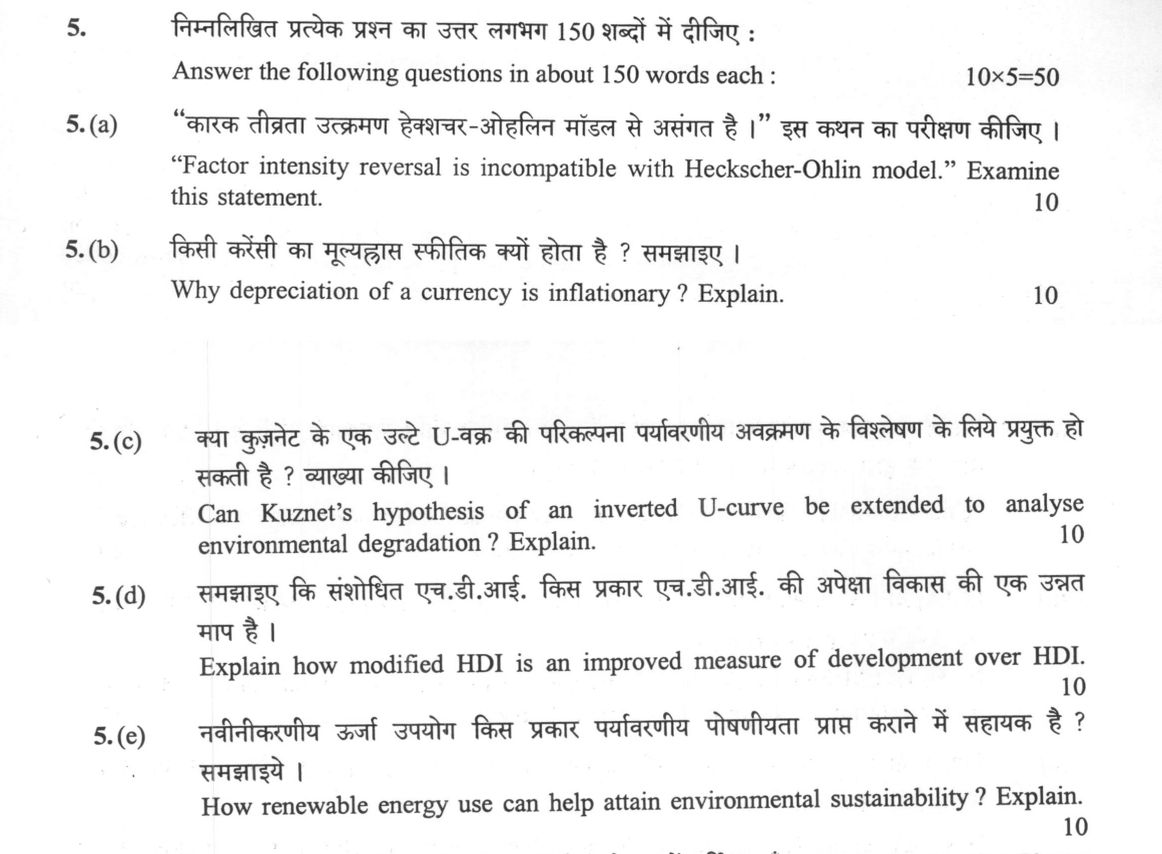
Answer the following questions in about 150 words each: (a) "Factor intensity reversal is incompatible with Heckscher-Ohlin…
Answer the following questions in about 150 words each:
"Factor intensity reversal is incompatible with Heckscher-Ohlin model." Examine this statement. 10 marks
Why depreciation of a currency is inflationary? Explain. 10 marks
Can Kuznet's hypothesis of an inverted U-curve be extended to analyse environmental degradation? Explain. 10 marks
Explain how modified HDI is an improved measure of development over HDI. 10 marks
How renewable energy use can help attain environmental sustainability? Explain. 10 marks
हिंदी में प्रश्न पढ़ें
निम्नलिखित प्रत्येक प्रश्न का उत्तर लगभग 150 शब्दों में दीजिए :
"कारक तीव्रता उत्क्रमण हेक्शर-ओहलिन मॉडल से असंगत है।" इस कथन का परीक्षण कीजिए। (10 अंक)
किसी करेंसी का मूल्यह्रास स्फीतिक क्यों होता है? समझाइए। (10 अंक)
क्या कुज़नेट के एक उल्टे U-वक्र की परिकल्पना पर्यावरणीय अवक्षरण के विश्लेषण के लिए प्रयुक्त हो सकती है? व्याख्या कीजिए। (10 अंक)
समझाइए कि संशोधित एच.डी.आई. किस प्रकार एच.डी.आई. की अपेक्षा विकास की एक उन्नत माप है। (10 अंक)
नवीनीकरणीय ऊर्जा उपयोग किस प्रकार पर्यावरणीय पोषणीयता प्राप्त करने में सहायक है? समझाइये। (10 अंक)
Model answer
Written by UPSC Answer Check against this question's marking rubric, to the 150-word length. UPSC does not publish answers for Mains — this is one way to score well, not an official key.
(a) Factor intensity reversal means the same good is capital-intensive in one country and labour-intensive in another because relative factor prices, technology or input mixes differ. The Heckscher–Ohlin model assumes a fixed factor-intensity ranking, so a capital-abundant country exports the capital-intensive good and a labour-abundant country exports the labour-intensive good. If reversal occurs, the same good can be labour-intensive in the capital-abundant country and capital-intensive in the labour-abundant country, allowing trade patterns that contradict H–O predictions. Leontief’s paradox—U.S. exporting labour-intensive goods—was partly explained by factor-intensity reversal; Minhas and later Leontief found evidence that intensity rankings can reverse across countries. It can also arise from differences in factor quality, not just prices. This complicates empirical tests. Thus the statement is true only for the textbook H–O model with fixed intensities; reversal is not logically impossible, but it makes H–O predictions ambiguous and weakens its explanatory power.
(b) Currency depreciation is inflationary mainly through cost-push and demand channels. When the rupee falls, imported crude oil, capital goods and intermediate inputs become dearer; firms pass higher costs to prices, raising CPI and PPI. The effect is stronger when imported inputs are essential and pass-through is high in India. A weaker currency also makes exports cheaper and imports costlier, which can increase export-led demand and create demand-pull inflation if the economy is near capacity. The J-curve effect means the trade balance may worsen before improving, so imported inflation can persist. If RBI intervenes to defend the rupee, it sells foreign exchange, absorbing domestic liquidity; without sterilization this is contractionary, not inflationary. However, if it sterilizes by buying government securities, liquidity is re-injected, and if fiscal deficits are monetized, inflationary pressure rises. India’s 2013 taper-tantrum episode showed how capital outflows, rupee depreciation and imported inflation can interact.
(c) Kuznets’ inverted-U hypothesis can be extended to environment as the Environmental Kuznets Curve: pollution first rises with per-capita income and later falls. The mechanism rests on three effects. Scale effects increase pollution as output expands; composition effects shift activity from agriculture to industry and then to services; technique effects bring cleaner technology, stronger regulation and higher willingness to pay for environmental quality. Grossman and Krueger found that trade and income could reduce some pollutants in richer countries. Yet Stern and others critique the EKC as empirically fragile, dependent on indicators and time periods. India shows mixed evidence: SO2 emissions have fallen with cleaner coal, scrubbers and regulation, while CO2 and energy intensity remain high. The turning point is not automatic; it depends on policy, technology and institutions, and public demand for cleaner air and water over time. Hence the EKC is a useful heuristic, not a law.
(d) The modified HDI, especially the Inequality-adjusted HDI introduced from 2010, improves on HDI by making development sensitive to distribution. The original HDI combined life expectancy, education and income into an average; if treated as an arithmetic mean, high achievement in one dimension could compensate for deprivation in another. The modified approach uses non-compensatory geometric-mean logic and inequality-adjusted means, so inequality in health, education and income lowers the index. This captures that average growth may coexist with large deprivation. This is important for India, where state-level HDI gaps reveal uneven development across states, especially in health, education and skills. It is complemented by the Gender Development Index, which measures gender gaps in health, education and empowerment, and the Multidimensional Poverty Index, which identifies overlapping deprivations at the household level. Together they show that development is not only higher averages but also broader access, equity and freedom from poverty.
(e) Renewable energy supports environmental sustainability by substituting fossil fuels, reducing carbon emissions and air pollution. Solar, wind, hydro and biomass lower dependence on coal and oil, weakening fossil-fuel lock-in and improving energy security. It also reduces health costs from air pollution, lowers import bills, and supports climate targets while creating green jobs in India. Decentralized renewables—rooftop solar, mini-grids and solar pumps—extend electricity and productive energy to rural areas, supporting livelihoods without proportional emissions growth. For sustainability, renewables must be paired with demand management, efficiency, storage, grid reform, local manufacturing, resilience, security and rural jobs in India. India’s target of 500 GW non-fossil capacity by 2030 illustrates policy commitment to clean growth. However, sustainability also requires managing the full lifecycle: battery storage, grid integration, land use and circular-economy challenges such as solar-panel and battery disposal. With recycling, responsible mining and storage, renewables can reconcile growth with ecological limits. Overall, these mechanisms and measures are useful but conditional on assumptions, institutions, implementation and data.
What "Examine" is asking you to do
Test the proposition the question puts to you and return a finding on how far it holds. Examine stems carry a claim, or ask whether something has happened, and expect evidence weighed both ways before the extent is stated — often with remedial measures attached.
Structure that answers it
Restate the claim as the question frames it → evidence that supports it → evidence that undercuts it → the conditions under which it holds → verdict on how far it stands
Where marks are lost
Stopping at description. An examination has to reach a finding, and “examine with justification” means the extent must be stated, not implied.
How this answer will be evaluated
Approach
Framework: Heckscher-Ohlin Model. (a) examine: intro > how/why with reasoning > evidence > conclusion | (b) explain: definition/context > points in order > small example > short close | (c) explain: definition/context > points in order > small example > short close | (d) explain: definition/context > points in order > small example > short close | (e) explain: definition/context > points in order > small example > short close Full marks: Clear, concise, and accurate with all required elements and some bonus points.
Key points expected
- Define factor intensity reversal (FIR)
- State H-O model's assumption of fixed factor intensities
- Explain how FIR violates the model's consistency
- Conclude on the incompatibility
- Define currency depreciation
- Explain the pass-through to import prices
- Link to the aggregate price level
- Mention the J-curve effect
Evaluation rubric
Each sub-part is marked on its own, against the marks and word limit printed on the paper.
- (a) Assess the claim that factor intensity reversal contradicts the H-O model. 10 marks · 150 words
examine— intro → how/why with reasoning → evidence → conclusion
Must cover
- Define factor intensity reversal (FIR)
- State H-O model's assumption of fixed factor intensities
- Explain how FIR violates the model's consistency
- Conclude on the incompatibility
Loses marks
- Confusing factor intensity with factor abundance
- Failing to state the H-O assumption
Earns more
- Mention the Stolper-Samuelson theorem
- Reference the Leontief paradox
- Use a 2x2 model diagram
Extra mark
- Cite specific empirical evidence of FIR
- (b) Explain the mechanism by which currency depreciation leads to inflation. 10 marks · 150 words
explain— definition/context → points in order → small example → short close
Must cover
- Define currency depreciation
- Explain the pass-through to import prices
- Link to the aggregate price level
- Mention the J-curve effect
Loses marks
- Confusing depreciation with devaluation
- Ignoring the import price channel
Earns more
- Discuss the monetary channel
- Mention the balance of payments
- Reference the Marshall-Lerner condition
Extra mark
- Cite a specific country's experience
- (c) Explain the extension of Kuznets' hypothesis to environmental degradation. 10 marks · 150 words
explain— definition/context → points in order → small example → short close
Must cover
- Define the Environmental Kuznets Curve (EKC)
- Describe the inverted U-shape relationship
- Explain the turning point mechanism
- Mention the role of income and technology
Loses marks
- Confusing the EKC with the original Kuznets curve
- Failing to explain the turning point
Earns more
- Cite specific pollutants (e.g., CO2, SO2)
- Mention the role of environmental regulation
- Reference the work of Grossman and Krueger
Extra mark
- Cite a specific country's data
- (d) Explain how the modified HDI improves upon the standard HDI. 10 marks · 150 words
explain— definition/context → points in order → small example → short close
Must cover
- Define the standard HDI
- Identify the limitations of the standard HDI
- Explain the components of the modified HDI
- Highlight the improvements in measurement
Loses marks
- Confusing HDI with GNI
- Failing to mention the inequality adjustment
Earns more
- Mention the Inequality-adjusted HDI (IHDI)
- Reference the Gender Inequality Index (GII)
- Cite the UNDP report
Extra mark
- Cite a specific country's HDI ranking
- (e) Explain how renewable energy use contributes to environmental sustainability. 10 marks · 150 words
explain— definition/context → points in order → small example → short close
Must cover
- Define renewable energy
- Explain the reduction in greenhouse gas emissions
- Mention the reduction in air and water pollution
- Link to the concept of sustainability
Loses marks
- Confusing renewable with non-renewable energy
- Failing to link to environmental sustainability
Earns more
- Cite specific renewable sources (solar, wind, hydro)
- Mention the role in energy security
- Reference the Paris Agreement
Extra mark
- Cite a specific country's renewable energy target
Practice this exact question
Write your answer and it is marked point by point against the model answer above — what you covered, what you missed, what you got wrong.
Evaluate my answer →More from Economics 2023 Paper I
- Q2 (a) Explain the Cournot model of duopoly using reaction functions and interpret it as a N…
- Q3 (a) "Under rational expectation hypothesis, systematic monetary policy is ineffective." E…
- Q4 (a) Explain the concept of "sterilization" in the context of monetary approach to balance…
- Q5 Answer the following questions in about 150 words each: (a) "Factor intensity reversal is…
- Q6 (a) Consider the market for good X for Country 1 and Country 2. The supply and demand fun…
- Q7 (a) Human capital and components of research and development are determining factors of e…
- Q8 (a) How important is rent from extraction of renewable and non-renewable resources to dis…