Paper I — Q7
(a) Human capital and components of research and development are determining factors of economic growth. Explain using…
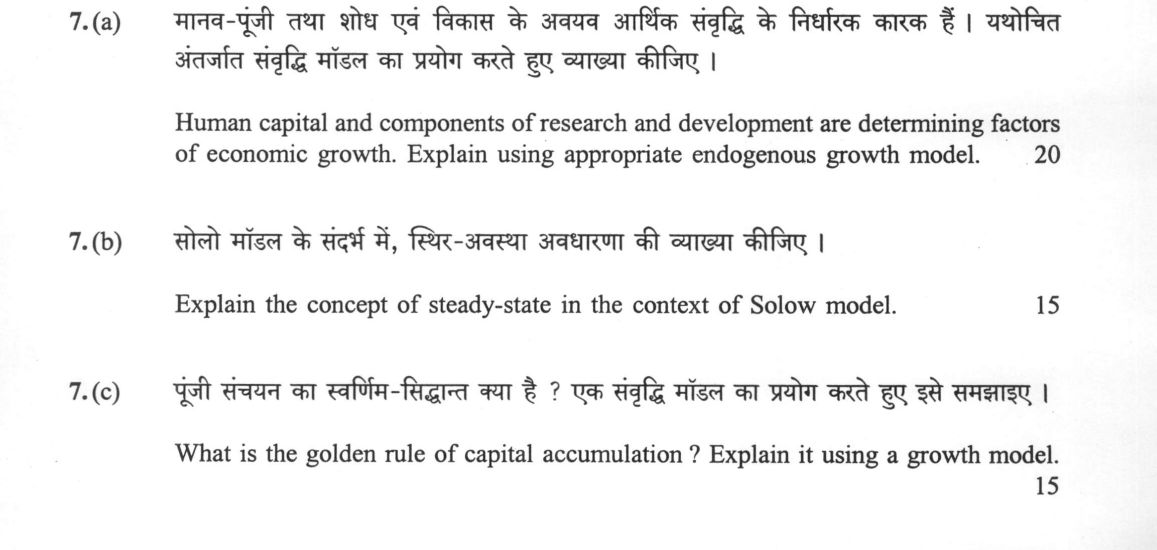
Human capital and components of research and development are determining factors of economic growth. Explain using appropriate endogenous growth model. 20 marks
Explain the concept of steady-state in the context of Solow model. 15 marks
What is the golden rule of capital accumulation? Explain it using a growth model. 15 marks
हिंदी में प्रश्न पढ़ें
मानव-पूँजी तथा शोध एवं विकास के अवयव आर्थिक संवृद्धि के निर्धारक कारक हैं। यथोचित अन्तर्जात संवृद्धि मॉडल का प्रयोग करते हुए व्याख्या कीजिए। (20 अंक)
सोलो मॉडल के सन्दर्भ में, स्थिर-अवस्था अवधारणा की व्याख्या कीजिए। (15 अंक)
पूँजी संचयन का स्वर्णिम-सिद्धान्त क्या है? एक संवृद्धि मॉडल का प्रयोग करते हुए इसे समझाइए। (15 अंक)
Model answer
Written by UPSC Answer Check against this question's marking rubric, to the expected length. UPSC does not publish answers for Mains — this is one way to score well, not an official key.
Endogenous growth Growth theory moved from Solow’s exogenous technical progress to models in which knowledge and human capital are produced. In Romer’s model, knowledge A is a reproducible factor made by R&D: dot A = δ L_A A^φ, and sustained growth requires φ=1, so dot A = δ L_A A; if 0<φ<1 growth dies out and if φ>1 it is explosive. A therefore grows at δ L_A, and output Y=K^α (A L)¹-α can grow indefinitely without assuming A is given. R&D expenditure determines L_A; patent systems protect the private return to invention; education quality raises the productivity of researchers; learning-by-doing raises A through production experience. Because A is accumulated, aggregate production has increasing returns even if firms face constant returns. In India, ISRO’s space technology programme illustrates this: satellite data, remote sensing and disaster-management systems raise A for agriculture and public services. Lucas internalises human capital h. Let Y=K^α (u h L)¹-α, where u is time spent in production. Human capital accumulates by dot h = δ h(1-u): time not used in production is used in education. If education quality raises δ, h grows, raising output. With externalities from average human capital, returns to education spill over, generating sustained endogenous growth. Thus R&D and human capital are not background assumptions but choices that determine long-run growth.
Solow steady state In the Solow model, let k=K/L and f(k)=k^α. Capital per worker evolves as dot k = s f(k) - (n+δ)k, where s is the savings rate, n population growth and δ depreciation. The steady state is defined by Δk=0, so s f(k*)=(n+δ)k*. Economically, investment per worker equals break-even investment: enough to equip new workers and replace worn-out capital. Graphically, the concave sf(k) curve intersects the linear break-even line (n+δ)k at k*. If k<k*, investment exceeds break-even and k rises; if k>k*, it falls. At k*, per capita output, consumption and capital are constant, while aggregate variables grow at n. The steady state is therefore a long-run equilibrium of the capital-labour ratio, not of per capita growth. This is the neoclassical result: convergence to k* but no permanent per capita growth unless A changes.
Golden rule The golden rule is the savings rate that maximises steady-state consumption. Steady-state consumption is c*=(1-s)f(k*). Maximising c* with respect to s gives the first-order condition f'(k*)=n+δ: the marginal product of capital equals the break-even rate. If MPK>n+δ, the economy is dynamically efficient but under-accumulated; more saving raises future consumption. If MPK<n+δ, it is over-accumulated and dynamically inefficient, because consumption can be raised by reducing capital. In the Cobb-Douglas Solow model, f'(k)=α k^α-1; using the steady-state condition s k^α-1=n+δ, the golden-rule savings rate simplifies to s_gold=α, or, in a general specification with an additional break-even term θ, s_gold = α(n+δ)/(n+δ+θ), which reduces to α when θ=0. Actual economies may deviate because of precautionary saving, financial constraints, demographics and policy. The golden rule is a long-run welfare benchmark, not a short-run target. If India’s actual savings rate is below s_gold, more saving can raise steady-state consumption; if above, it may be over-accumulated. The post-1991 savings debate is therefore not about saving more per se, but about the marginal product of capital.
The two frameworks are complementary. Solow shows that savings and capital accumulation can move an economy toward a higher steady state, but cannot by themselves explain sustained per capita growth. Endogenous models show that R&D, patents, education and human capital can generate increasing returns and long-run growth. For India, policies that raise ISRO-style R&D spillovers, strengthen Skill India and education expenditure, and improve the allocation of savings toward innovation are needed; Skill India raises δ, while patent and research policy raise L_A. The golden rule disciplines the level of saving; endogenous growth disciplines its quality.
What "Explain" is asking you to do
Make the working of something clear — what sets it off, what follows from what, and what it produces. Explain is the Commission's mechanism word: it dominates the technical papers and the “explain why” stems, where the marks sit in the causal chain and not in the label.
Structure that answers it
State what it is → the initiating condition → the chain of cause, step by step → an instance where it plays out → what the chain produces
Where marks are lost
Describing what something looks like instead of why it works that way. Naming the stages without linking them reads as description too.
How this answer will be evaluated
Approach
Framework: Endogenous Growth Theory (Romer/Acemoglu) and Solow-Swan Model. (a) explain: definition/context > points in order > small example > short close | (b) explain: definition/context > points in order > small example > short close | (c) explain: definition/context > points in order > small example > short close Full marks: Rigorous derivation, clear diagrams, named economists, policy links
Key points expected
- Define endogenous growth model (e.g., Romer or Lucas)
- Derive production function including H and A
- Show R&D sector equation (A-dot = delta*A)
- State assumptions (constant returns to knowledge)
- Define steady-state (k* where sf(k) = (n+delta)k)
- Draw Solow diagram with axes k and f(k)
- Label investment and break-even lines
- Explain convergence to steady state
Evaluation rubric
Each sub-part is marked on its own, against the marks and word limit printed on the paper.
- (a) Explain how human capital and R&D drive growth using an endogenous model. 20 marks
explain— definition/context → points in order → small example → short close
Must cover
- Define endogenous growth model (e.g., Romer or Lucas)
- Derive production function including H and A
- Show R&D sector equation (A-dot = delta*A)
- State assumptions (constant returns to knowledge)
Loses marks
- Using Solow model instead of endogenous
- Verbal explanation without equations
- Ignoring R&D component
Earns more
- Diagram of steady state or growth path
- Mention of spillover effects
- Comparison with Solow model
- Policy implication for education/R&D
Extra mark
- Cite Romer (1990) or Lucas (1988)
- Specific Indian R&D expenditure data
- (b) Explain the concept of steady-state in the Solow model. 15 marks
explain— definition/context → points in order → small example → short close
Must cover
- Define steady-state (k* where sf(k) = (n+delta)k)
- Draw Solow diagram with axes k and f(k)
- Label investment and break-even lines
- Explain convergence to steady state
Loses marks
- No diagram or unlabelled axes
- Confusing steady state with golden rule
- Ignoring depreciation or population growth
Earns more
- Mention golden rule level
- Effect of change in s or n
- Per capita vs aggregate variables
- Long-run growth rate is zero
Extra mark
- Cite Solow (1956)
- Numerical example of convergence
- (c) Define and explain the golden rule of capital accumulation. 15 marks
explain— definition/context → points in order → small example → short close
Must cover
- Define golden rule (maximizes steady-state consumption)
- Derive condition: MPK = n + delta
- Show diagram with consumption line
- Explain optimal savings rate
Loses marks
- Confusing with steady state
- No derivation of MPK = n + delta
- Verbal answer without model
Earns more
- Comparison with actual savings rate
- Policy implication for savings
- Dynamic inefficiency concept
- Transition path to golden rule
Extra mark
- Cite Ramsey (1928) or Cass (1965)
- Indian savings rate vs golden rule
Practice this exact question
Write your answer and it is marked point by point against the model answer above — what you covered, what you missed, what you got wrong.
Evaluate my answer →More from Economics 2023 Paper I
- Q4 (a) Explain the concept of "sterilization" in the context of monetary approach to balance…
- Q5 Answer the following questions in about 150 words each: (a) "Factor intensity reversal is…
- Q6 (a) Consider the market for good X for Country 1 and Country 2. The supply and demand fun…
- Q7 (a) Human capital and components of research and development are determining factors of e…
- Q8 (a) How important is rent from extraction of renewable and non-renewable resources to dis…