Paper I — Q8
(a) How important is rent from extraction of renewable and non-renewable resources to distinguish between Net Domestic Product…
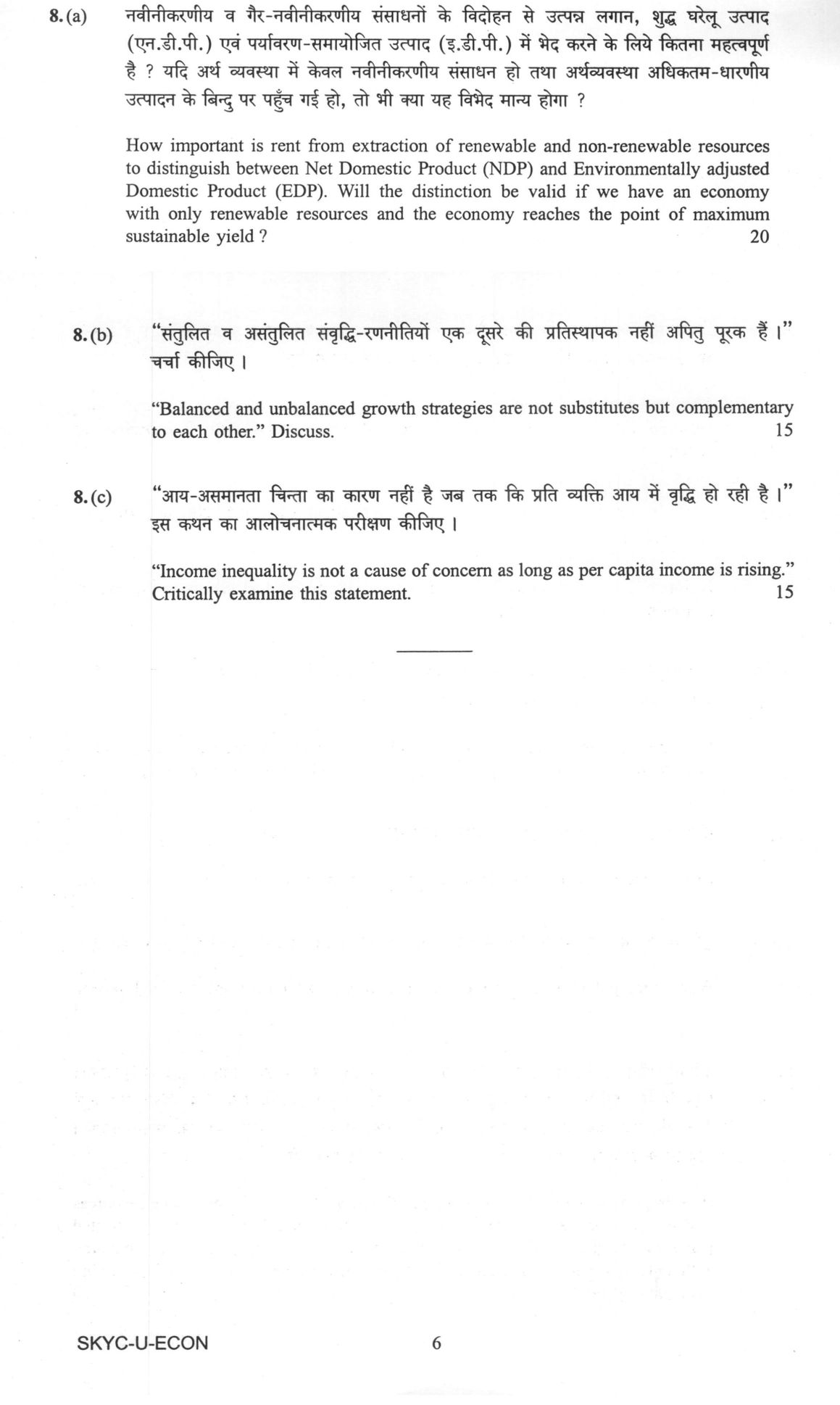
How important is rent from extraction of renewable and non-renewable resources to distinguish between Net Domestic Product (NDP) and Environmentally adjusted Domestic Product (EDP). Will the distinction be valid if we have an economy with only renewable resources and the economy reaches the point of maximum sustainable yield? 20 marks
"Balanced and unbalanced growth strategies are not substitutes but complementary to each other." Discuss. 15 marks
"Income inequality is not a cause of concern as long as per capita income is rising." Critically examine this statement. 15 marks
हिंदी में प्रश्न पढ़ें
नवीनीकरणीय व गैर-नवीनीकरणीय संसाधनों के विदोहन से उत्पन्न लगान, शुद्ध घरेलु उत्पाद (एन.डी.पी.) एवं पर्यावरण-समायोजित उत्पाद (ई.डी.पी.) में भेद करने के लिये कितना महत्वपूर्ण है? यदि अर्थ व्यवस्था में केवल नवीनीकरणीय संसाधन हों तथा अर्थव्यवस्था अधिकतम-धारणीय उत्पादन के बिन्दु पर पहुँच गई हो, तो भी क्या यह विभेद मान्य होगा? (20 अंक)
"संतुलित व असंतुलित संवृद्धि-रणीतियों एक दूसरे की प्रतिस्थापक नहीं अपितु पूरक हैं।" चर्चा कीजिए। (15 अंक)
"आय-असमानता चिंता का कारण नहीं है जब तक कि प्रति व्यक्ति आय में वृद्धि हो रही है।" इस कथन का आलोचनात्मक परीक्षण कीजिए। (15 अंक)
Model answer
Written by UPSC Answer Check against this question's marking rubric, to the expected length. UPSC does not publish answers for Mains — this is one way to score well, not an official key.
Resource Rents, NDP, and Green Accounting
Traditional Net Domestic Product (NDP) deducts only the depreciation of manufactured capital from Gross Domestic Product, ignoring the liquidation of natural wealth. Environmentally adjusted Net Domestic Product (EDP) rectifies this by subtracting the depletion of natural capital and environmental degradation from NDP (EDP = NDP - Natural Capital Depletion).
Resource rent—the economic surplus generated above extraction costs and normal profits—is central to this distinction. For non-renewable resources, extraction permanently depletes finite reserves. Following the El Serafy method, a significant fraction of resource rent constitutes a "user cost" (capital consumption) rather than true income. According to the Hartwick-Solow rule, constant consumption requires reinvesting these resource rents into reproducible human and physical capital. If rents are consumed rather than reinvested, natural wealth declines, causing EDP to fall substantially below NDP.
In an economy possessing solely renewable resources harvested precisely at the Maximum Sustainable Yield (MSY), the rate of extraction equals the biological rate of regeneration. Under this steady state, the net stock of natural capital remains constant, rendering the user cost of extraction zero. Consequently, no capital depletion deduction is warranted. While the conceptual distinction between NDP and EDP remains theoretically valid as an accounting framework, it becomes empirically trivial at MSY, as EDP ≡ NDP.
Complementarity of Balanced and Unbalanced Growth
Balanced and unbalanced growth strategies represent complementary phases of structural transformation rather than mutually exclusive paradigms. Rosenstein-Rodan and Ragnar Nurkse advocated balanced growth via a "Big Push"—simultaneous, coordinated investments across interdependent consumer goods sectors and social overhead capital (SOC)—to overcome demand indivisibilities and limited domestic market size. Conversely, Albert Hirschman argued that underdeveloped nations face a critical shortage of capital and decision-making capabilities, necessitating an unbalanced growth strategy that deliberately creates sectoral imbalances to induce dynamic investments through forward and backward linkages.
These doctrines operate as sequential complements. Balanced investment is essential to establish foundational SOC, power, and agriculture, preventing immediate supply-side bottlenecks. Once this base exists, unbalanced growth accelerates dynamic efficiency by channelling scarce capital into high-linkage leading sectors. India’s early planning illustrates this complementarity: the First Five-Year Plan adopted a balanced approach, prioritizing agriculture, irrigation, and community development, which generated the wage-goods surplus and stability necessary for the Second Five-Year Plan (Mahalanobis strategy) to pursue unbalanced, heavy-industry-led industrialization.
Inequality, Growth, and Capability Formation
The proposition that inequality is benign if per capita income rises draws on the Kuznets inverted-U hypothesis and traditional trickle-down economics, presuming that capital accumulation by top earners automatically diffuses through the economy. This claim is analytically and empirically untenable.
Piketty and Chancel, alongside Deaton and Drèze, demonstrate that rapid per capita GDP growth in India has coincided with extreme concentration of wealth, with top income shares reaching historic highs while real median wages stagnated. Mean per capita income masks these distributional skews, obscuring "jobless growth" where productivity gains bypass the labour force.
From Amartya Sen’s capability perspective, persistent inequality impairs development by depriving marginalized segments of substantive freedoms, access to quality education, healthcare, and nutrition. This depresses human capital accumulation, lowers long-term Total Factor Productivity, and compresses domestic aggregate demand. Extreme inequality also fuels political capture and institutional fragility.
Conclusion
A critical examination reveals that rising per capita income cannot substitute for distributional equity. A viable macroeconomic strategy must integrate green national accounting to safeguard the natural asset base, sequence balanced infrastructure with dynamic unbalanced linkages, and enforce explicit redistributive and capability-enhancing policies.
What "Critically examine" is asking you to do
Test the proposition the question puts to you and return a finding on how far it holds. Examine stems carry a claim, or ask whether something has happened, and expect evidence weighed both ways before the extent is stated — often with remedial measures attached. “Critically” is not a section added at the end: name the yardstick you are judging by — the evidence, the stated objective, a constitutional principle, a rival explanation — and let a verdict close each part of the body. Where the question quotes a claim, that verdict must land on the claim itself, accepted, qualified or rejected, and not on the theme in general.
Structure that answers it
Restate the claim as the question frames it → evidence that supports it → evidence that undercuts it → the conditions under which it holds → verdict on how far it stands
Where marks are lost
Merits in one paragraph, demerits in the next, and a conclusion calling for a balanced and holistic approach. That is a survey with the judgement left out and it holds the answer in the middle band. The opposite error is reading “critically” as permission to attack — and with the odd pairings, critically describe or critically explain, the exposition still carries most of the marks, the judgement being a layer on it rather than a substitute for it.
How this answer will be evaluated
Approach
Framework: Environmental Economics & Development Theory. (a) explain: definition/context > points in order > small example > short close | (b) discuss: intro > 3-4 dimensions > example > balanced close | (c) critique: the claim > its strengths > its weaknesses > your judgment Full marks: Rigorous application of economic models, clear distinction of concepts, and strong critical analysis with relevant examples.
Key points expected
- Define NDP and EDP with specific adjustments
- Distinguish rent from renewable vs non-renewable resources
- Analyze the 'maximum sustainable yield' condition
- Conclude on the validity of the distinction
- Define balanced growth (Rosenstein-Rodan)
- Define unbalanced growth (Hirschman)
- Explain the 'complementary' argument
- Provide a real-world example
Evaluation rubric
Each sub-part is marked on its own, against the marks and word limit printed on the paper.
- (a) Explain the role of resource rent in distinguishing NDP from EDP and analyze the validity of this distinction at maximum sustainable yield. 20 marks
explain— definition/context → points in order → small example → short close
Must cover
- Define NDP and EDP with specific adjustments
- Distinguish rent from renewable vs non-renewable resources
- Analyze the 'maximum sustainable yield' condition
- Conclude on the validity of the distinction
Loses marks
- Confusing rent with profit
- Ignoring the 'maximum yield' constraint
- Verbal answer without economic logic
Earns more
- Mention Hartwick rule or capital depletion
- Reference environmental depreciation
- Use a diagram for resource extraction
- Cite specific environmental taxes
Extra mark
- Reference Stern Review or Dasgupta
- Mention specific Indian environmental policy
- (b) Discuss the complementary nature of balanced and unbalanced growth strategies. 15 marks
discuss— intro → 3-4 dimensions → example → balanced close
Must cover
- Define balanced growth (Rosenstein-Rodan)
- Define unbalanced growth (Hirschman)
- Explain the 'complementary' argument
- Provide a real-world example
Loses marks
- Treating them as mutually exclusive
- Lack of theoretical grounding
- Ignoring the 'complementary' aspect
Earns more
- Mention 'Big Push' theory
- Reference 'Linkage' effects
- Discuss infrastructure bottlenecks
- Cite Indian Five Year Plans
Extra mark
- Reference specific Indian industrial policy
- Mention modern growth theory
- (c) Critically examine the statement that income inequality is not a concern if per capita income is rising. 15 marks
critique— the claim → its strengths → its weaknesses → your judgment
Must cover
- Define the 'trickle-down' argument
- Present arguments for the statement
- Present arguments against (inequality traps)
- Provide a balanced conclusion
Loses marks
- One-sided argument
- Ignoring the 'critical' aspect
- Lack of economic reasoning
Earns more
- Mention Kuznets curve
- Reference 'Inequality Trap' (World Bank)
- Discuss social stability implications
- Cite specific inequality indices
Extra mark
- Reference Piketty's work
- Mention specific Indian inequality data
Practice this exact question
Write your answer and it is marked point by point against the model answer above — what you covered, what you missed, what you got wrong.
Evaluate my answer →More from Economics 2023 Paper I
- Q5 Answer the following questions in about 150 words each: (a) "Factor intensity reversal is…
- Q6 (a) Consider the market for good X for Country 1 and Country 2. The supply and demand fun…
- Q7 (a) Human capital and components of research and development are determining factors of e…
- Q8 (a) How important is rent from extraction of renewable and non-renewable resources to dis…