Paper I — Q6
(a) Consider the market for good X for Country 1 and Country 2. The supply and demand functions for Country 1 are given as P = Q…
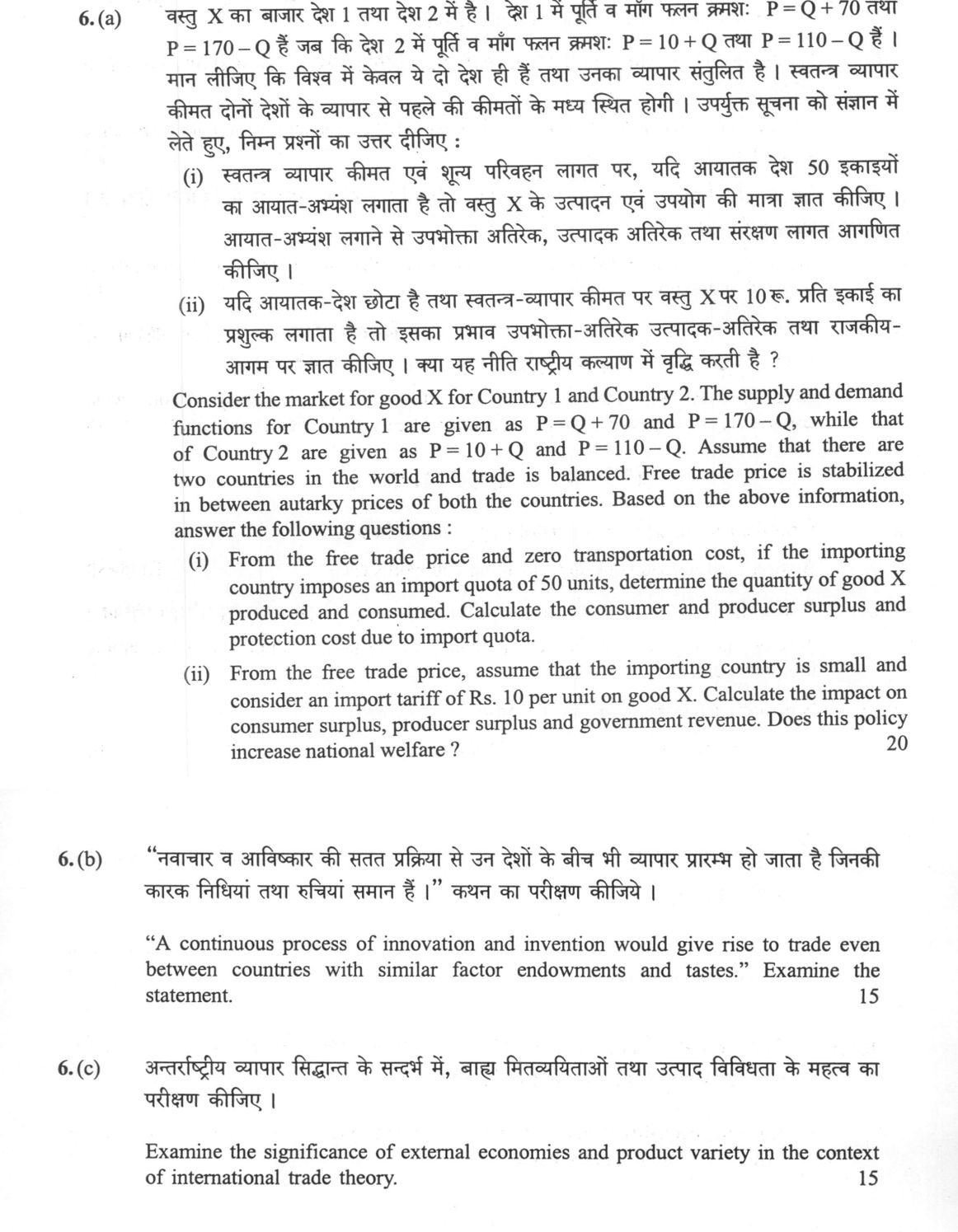
Consider the market for good X for Country 1 and Country 2. The supply and demand functions for Country 1 are given as P = Q + 70 and P = 170 – Q, while that of Country 2 are given as P = 10 + Q and P = 110 – Q. Assume that there are two countries in the world and trade is balanced. Free trade price is stabilized in between autarky prices of both the countries. Based on the above information, answer the following questions:
From the free trade price and zero transportation cost, if the importing country imposes an import quota of 50 units, determine the quantity of good X produced and consumed. Calculate the consumer and producer surplus and protection cost due to import quota.
From the free trade price, assume that the importing country is small and consider an import tariff of Rs. 10 per unit on good X. Calculate the impact on consumer surplus, producer surplus and government revenue. Does this policy increase national welfare? 20 marks
"A continuous process of innovation and invention would give rise to trade even between countries with similar factor endowments and tastes." Examine the statement. 15 marks
Examine the significance of external economies and product variety in the context of international trade theory. 15 marks
हिंदी में प्रश्न पढ़ें
वस्तु X का बाजार देश 1 तथा देश 2 में है। देश 1 में पूर्ति व माँग फलन क्रमशः: P = Q + 70 तथा P = 170 – Q है जब कि देश 2 में पूर्ति व माँग फलन क्रमशः: P = 10 + Q तथा P = 110 – Q है। मान लीजिए कि विश्व में केवल ये दो देश ही हैं तथा उनका व्यापार संतुलित है। स्वतंत्र व्यापार कीमत दोनों देशों के व्यापार से पहले की कीमतों के मध्य स्थित होगी। उपर्युक्त सूचना को संज्ञान में लेते हुए, निम्न प्रश्नों का उत्तर दीजिए:
स्वतंत्र व्यापार कीमत एवं शून्य परिवहन लागत पर, यदि आयातक देश 50 इकाइयों का आयात-अभ्यर्थ लगाता है तो वस्तु X के उत्पादन एवं उपयोग की मात्रा ज्ञात कीजिए। आयात-अभ्यर्थ लगाने से उपभोक्ता अतिरेक, उत्पादक अतिरेक तथा संरक्षण लागत आगणित कीजिए।
यदि आयातक-देश छोटा है तथा स्वतंत्र-व्यापार कीमत पर वस्तु X पर 10 रु. प्रति इकाई का प्रशुल्क लगाता है तो इसका प्रभाव उपभोक्ता-अतिरेक उत्पादक-अतिरेक तथा राजकीय-आगम पर ज्ञात कीजिए। क्या यह नीति राष्ट्रीय कल्याण में वृद्धि करती है? (20 अंक)
"नवाचार व आविष्कार की सतत प्रक्रिया से उन देशों के बीच भी व्यापार प्रारम्भ हो जाता है जिनकी कारक निधियां तथा रुचियां समान हैं।" कथन का परीक्षण कीजिये। (15 अंक)
अन्तर्राष्ट्रीय व्यापार सिद्धान्त के सन्दर्भ में, बाह्य मितव्ययिताओं तथा उत्पाद विविधता के महत्व का परीक्षण कीजिए। (15 अंक)
Model answer
Written by UPSC Answer Check against this question's marking rubric, to the expected length. UPSC does not publish answers for Mains — this is one way to score well, not an official key.
(a)(i) Autarky is found by equating supply and demand. Country 1: P = Q + 70 and P = 170 − Q give P = 120 Rs. per unit, Q = 50 units. Country 2: P = 10 + Q and P = 110 − Q give P = 60 Rs. per unit, Q = 50 units. Hence Country 1 imports and Country 2 exports.
For free trade, import demand of Country 1 is MD1 = (170 − P) − (P − 70) = 240 − 2P. Export supply of Country 2 is ES2 = (P − 10) − (110 − P) = 2P − 120. Balanced trade requires MD1 = ES2: 240 − 2P = 2P − 120, so Pw = 90 Rs. per unit. Trade = 60 units. At Pw = 90, Country 1 consumes Qd = 80 units and produces Qs = 20 units. CSft = 1/2 × (170 − 90) × 80 = 3200 Rs. PSft = 1/2 × (90 − 70) × 20 = 200 Rs.
With an import quota of 50 units, set MD1 = 50: 240 − 2P = 50, so domestic price in the importer is Pdom = 95 Rs. per unit. Then Qd = 170 − 95 = 75 units and Qs = 95 − 70 = 25 units. The exporter price follows from ES2 = 50: 2P − 120 = 50, so Pexp = 85 Rs. per unit. Quota rent = (95 − 85) × 50 = 500 Rs.
At P = 95, CS = 1/2 × (170 − 95) × 75 = 2812.5 Rs. PS = 1/2 × (95 − 70) × 25 = 312.5 Rs. Protection cost as deadweight loss is production distortion + consumption distortion = 1/2 × (25 − 20) × (95 − 90) + 1/2 × (80 − 75) × (95 − 90) = 12.5 + 12.5 = 25 Rs. If quota rent is lost abroad, it is an additional national transfer cost; if retained domestically, it is not deadweight loss. Produced = 25 units, consumed = 75 units.
(a)(ii) Small-country tariff: the world price remains Pw = 90 Rs. per unit. With tariff t = 10 Rs. per unit, domestic price Pd = Pw + t = 100 Rs. per unit. At P = 100: Qd = 170 − 100 = 70 units, Qs = 100 − 70 = 30 units. Imports = 40 units. Tariff revenue = 10 × 40 = 400 Rs.
CS at P = 100: 1/2 × (170 − 100) × 70 = 2450 Rs. PS at P = 100: 1/2 × (100 − 70) × 30 = 450 Rs. From free trade: ΔCS = 2450 − 3200 = −750 Rs.; ΔPS = 450 − 200 = +250 Rs.; government revenue = +400 Rs. National welfare change = ΔCS + ΔPS + revenue = −750 + 250 + 400 = −100 Rs. Equivalently, deadweight loss = 1/2 × (80 − 70) × 10 + 1/2 × (30 − 20) × 10 = 50 + 50 = 100 Rs. No, the tariff does not increase national welfare; it reduces it by 100 Rs. in the small-country case.
(b) The statement is central to technology-gap and product-cycle theories. In the Heckscher–Ohlin framework, similar factor endowments and tastes imply little trade. Posner’s technology-gap model shows that continuous innovation gives a country temporary technical superiority, creating exports of new goods. Vernon’s product cycle then explains how production shifts abroad as imitation occurs, while fresh innovations generate new exports. Thus trade becomes dynamic and sequential, even between similar economies.
Linder’s overlapping-demand hypothesis also allows similar tastes to support trade in differentiated products. New trade theory strengthens the argument: with monopolistic competition and scale economies, firms innovate to create varieties, and consumers value variety. This explains intra-industry trade among advanced countries with similar endowments. Empirical evidence from OECD trade and R&D-intensive sectors supports this. However, innovation alone is not sufficient: trade costs, intellectual property rights, absorptive capacity, market size and scale economies matter. Imitation lags and policy also shape outcomes. Hence the statement is substantially valid for manufactured and technology-intensive goods, but it complements rather than fully replaces comparative advantage.
(c) External economies arise from labor-market pooling, specialized suppliers and knowledge spillovers. In trade theory, they create increasing returns at the industry level, making comparative advantage partly created and path-dependent. A country may gain a lasting export advantage in a cluster even without natural factor abundance. This can produce multiple equilibria and justify strategic trade policy, though spillovers may be local and not automatic.
Product variety is central to Krugman–Dixit–Stiglitz trade models. Under monopolistic competition, trade enlarges the market, allowing firms to exploit scale economies and offer more varieties at lower average cost. Gains from trade then arise even between similar countries through intra-industry trade. Consumers gain from greater variety and lower prices; firms gain from larger markets. Melitz extends this by showing that trade reallocates resources to more productive firms, raising average productivity. Thus external economies and product variety explain why similar countries trade, why intra-industry trade is large, and why gains from trade exceed traditional comparative-advantage gains. Their limits are adjustment costs, possible loss of some domestic varieties, and local rather than global spillovers.
What "Calculate" is asking you to do
Apply the standard formula or schedule to data the question has already supplied — a table of readings, cost records, a balance sheet — and produce the number. The method is rarely in doubt; the marks sit in the named intermediate quantities, each of which has to appear as a labelled line.
Structure that answers it
Data as given → formula or standard treatment, named → substitution → each intermediate, labelled → result with units
Where marks are lost
Omitting an intermediate the marking scheme pays for separately, or rounding at an intermediate line so the final figure drifts. In commerce and accountancy, any figure in a statement that no numbered working note supports is treated as unearned.
How this answer will be evaluated
Approach
Framework: Standard International Trade Theory (Welfare Analysis). (a(i)) calculate: given > formula > substitution > result with units > interpretation | (a(ii)) calculate: given > formula > substitution > result with units > interpretation | (b) examine: intro > how/why with reasoning > evidence > conclusion | (c) examine: intro > how/why with reasoning > evidence > conclusion Full marks: Precise derivations for (a); clear theoretical linkage for (b) and (c) with named models.
Key points expected
- Derive free trade price (P=90) from supply/demand functions
- Calculate domestic production and consumption at quota price
- Compute consumer and producer surplus using geometric areas
- Calculate protection cost (deadweight loss) from quota
- Calculate new domestic price (P=100) after tariff imposition
- Compute change in consumer surplus (loss)
- Compute change in producer surplus (gain)
- Calculate government revenue and net welfare effect
Evaluation rubric
Each sub-part is marked on its own, against the marks and word limit printed on the paper.
- (a(i)) Determine production/consumption and calculate surpluses/costs under a 50-unit quota.
calculate— given → formula → substitution → result with units → interpretation
Must cover
- Derive free trade price (P=90) from supply/demand functions
- Calculate domestic production and consumption at quota price
- Compute consumer and producer surplus using geometric areas
- Calculate protection cost (deadweight loss) from quota
Loses marks
- Fails to derive the free trade equilibrium price first
- Confuses the supply and demand curves of the two countries
- Calculates surplus without showing the geometric derivation
Earns more
- Correctly identifies Country 1 as the importer
- Shows step-by-step algebraic substitution for Q values
- Labels surplus areas (A, B, C, D) on a diagram
Extra mark
- Explicitly states the assumption of zero transportation cost
- (a(ii)) Calculate welfare impacts of a Rs. 10 tariff and determine net national welfare change.
calculate— given → formula → substitution → result with units → interpretation
Must cover
- Calculate new domestic price (P=100) after tariff imposition
- Compute change in consumer surplus (loss)
- Compute change in producer surplus (gain)
- Calculate government revenue and net welfare effect
Loses marks
- Forgets to add government revenue to the welfare calculation
- Uses the wrong price level for the tariff calculation
- Fails to explicitly answer if national welfare increases
Earns more
- Identifies the production and consumption distortion triangles
- Clearly distinguishes between transfer and deadweight loss
- Concludes correctly that national welfare decreases
Extra mark
- Mentions the 'small country' assumption explicitly in the derivation
- (b) Examine the role of innovation in generating trade between similar countries. 15 marks
examine— intro → how/why with reasoning → evidence → conclusion
Must cover
- Define the context of similar factor endowments and tastes
- Explain how innovation creates differences in relative costs
- Link innovation to the generation of comparative advantage
- Provide a logical conclusion on the statement's validity
Loses marks
- Relies solely on the Heckscher-Ohlin model (which assumes static endowments)
- Fails to address the 'similar endowments' constraint
- Vague generalities without linking innovation to trade flows
Earns more
- References the 'New Trade Theory' or 'Innovation Cycle' (e.g., Vernon)
- Distinguishes between process and product innovation
- Uses a specific example of technology-driven trade
Extra mark
- Mentions a specific economist like Vernon or Krugman
- (c) Examine the significance of external economies and product variety in trade theory. 15 marks
examine— intro → how/why with reasoning → evidence → conclusion
Must cover
- Define external economies of scale in a trade context
- Explain how product variety benefits consumers (welfare gain)
- Link these factors to intra-industry trade
- Contrast with traditional inter-industry trade models
Loses marks
- Confuses external economies with internal economies of scale
- Fails to connect product variety to consumer surplus
- Ignores the significance of these factors for similar countries
Earns more
- References the 'New Trade Theory' (Krugman)
- Explains the 'love of variety' concept
- Mentions the role of increasing returns to scale
Extra mark
- Cites a specific model like the Dixit-Stiglitz model
Practice this exact question
Write your answer and it is marked point by point against the model answer above — what you covered, what you missed, what you got wrong.
Evaluate my answer →More from Economics 2023 Paper I
- Q3 (a) "Under rational expectation hypothesis, systematic monetary policy is ineffective." E…
- Q4 (a) Explain the concept of "sterilization" in the context of monetary approach to balance…
- Q5 Answer the following questions in about 150 words each: (a) "Factor intensity reversal is…
- Q6 (a) Consider the market for good X for Country 1 and Country 2. The supply and demand fun…
- Q7 (a) Human capital and components of research and development are determining factors of e…
- Q8 (a) How important is rent from extraction of renewable and non-renewable resources to dis…