Paper I — Q3
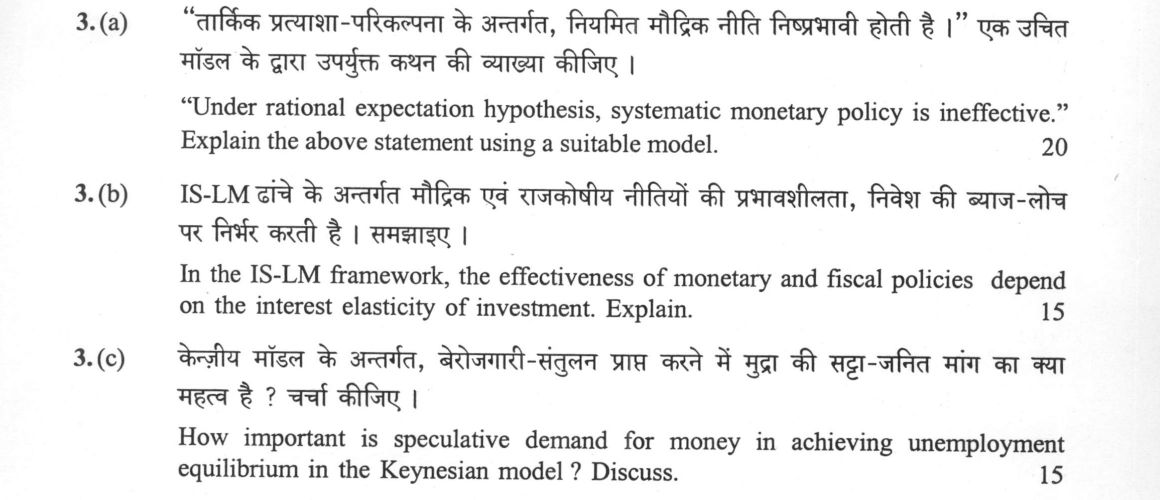
(a) "Under rational expectation hypothesis, systematic monetary policy is ineffective." Explain the above statement using a…
"Under rational expectation hypothesis, systematic monetary policy is ineffective." Explain the above statement using a suitable model. 20 marks
In the IS-LM framework, the effectiveness of monetary and fiscal policies depend on the interest elasticity of investment. Explain. 15 marks
How important is speculative demand for money in achieving unemployment equilibrium in the Keynesian model? Discuss. 15 marks
हिंदी में प्रश्न पढ़ें
"तार्किक प्रत्याशा-परिकल्पना के अंतर्गत, नियमित मौद्रिक नीति निष्प्रभावी होती है।" एक उचित मॉडल के द्वारा उपर्युक्त कथन की व्याख्या कीजिए। (20 अंक)
IS-LM ढांचे के अंतर्गत मौद्रिक एवं राजकोषीय नीतियों की प्रभावशीलता, निवेश की ब्याज-लोच पर निर्भर करती है। समझाइए। (15 अंक)
कैंजीय मॉडल के अंतर्गत, बेरोजगारी-संतुलन प्राप्त करने में मुद्रा की सट्टा-जनित मांग का क्या महत्व है? चर्चा कीजिए। (15 अंक)
Model answer
Written by UPSC Answer Check against this question's marking rubric, to the expected length. UPSC does not publish answers for Mains — this is one way to score well, not an official key.
Part (a) Rational expectations, associated with Muth and Lucas, assume agents forecast using their information sets and the true model, so forecast errors are random and cannot be predicted by any systematic rule. In a simple New Classical model with log variables, aggregate demand is yₜ=mₜ-pₜ. The Lucas supply curve is yₜ=yₙ+α(pₜ-Eₜ₋₁pₜ), where yₙ is the natural rate and α>0. Combining gives (1+α)pₜ=mₜ+αEₜ₋₁pₜ. Subtracting Eₜ₋₁pₜ yields (1+α)(pₜ-Eₜ₋₁pₜ)=mₜ-Eₜ₋₁mₜ, so yₜ-yₙ=[α/(1+α)](mₜ-Eₜ₋₁mₜ). If monetary policy is systematic, mₜ is a known function of past variables, so Eₜ₋₁mₜ=mₜ; the surprise term is zero and output remains at yₙ, with only price-level effects. Only unanticipated money surprises can temporarily move output away from the natural rate. This is the policy ineffectiveness proposition: anticipated, rule-based policy is neutral for real variables because markets clear and agents adjust prices and expectations. The Lucas critique is distinct: it warns that structural parameters may change when policy rules change, while the proposition follows from rational expectations and market clearing. Empirically, RBI inflation targeting and forward guidance are expected to anchor prices rather than produce persistent output gains; only surprise liquidity shocks may have short-run real effects.
Part (b) In IS-LM, investment is I=I₀-br, where b is the interest elasticity of investment. With C=c(Y-T) and G, the IS curve is Y=A-br, so dr/dY=-1/b: low b makes IS steep, high b flat. The LM curve from M/P=kY-hr is r=(kY-M/P)/h. Substituting gives Y(1+bk/h)=A+(b/h)(M/P). The fiscal multiplier is dY/dG=1/(1+bk/h); the monetary multiplier is dY/d(M/P)=(b/h)/(1+bk/h). As b rises, the fiscal multiplier falls because expansion raises interest rates more strongly and crowds out private investment; the monetary multiplier rises because a given rate cut induces more investment. Diagrammatically, with steep IS (low b), fiscal expansion shifts IS right; the rise in r crowds out little investment so fiscal policy is effective; monetary expansion shifts LM right but produces little extra investment so it is weak. With flat IS (high b), fiscal expansion raises r and crowds out a large amount of investment, while monetary expansion lowers r and strongly stimulates investment, making it effective. In India, rate-sensitive private investment makes RBI repo-rate cuts potent, while capacity, policy, or credit constraints make fiscal capex more effective.
Part (c) Keynes divided money demand into transactions demand L1(Y), rising with income, and speculative demand L2(r), falling with the interest rate. The liquidity preference schedule L1(Y)+L2(r) intersects M/P to determine r; LM slope depends on h=-dL2/dr. Speculative demand is important because it transmits money-supply changes into interest-rate changes and hence into investment and aggregate demand. If L2 is relatively inelastic, a small increase in money supply lowers r appreciably, raising investment and output, so monetary policy can help remove unemployment. If L2 becomes highly elastic at low r—the liquidity trap—LM is horizontal, additional money is held rather than spent, r cannot fall, and monetary policy becomes ineffective. In that case an unemployment equilibrium can persist despite abundant liquidity, making fiscal activism, such as public works or direct demand support, more relevant. However, speculative demand is not the only source of underemployment equilibrium. Keynesian unemployment can also arise from deficient effective demand, a low marginal efficiency of capital, or investment that is interest-inelastic, even when L2 is finite and LM is not horizontal. Thus speculative demand is a crucial channel and a limiting case for monetary policy, but not a necessary condition for unemployment equilibrium. In India, weak credit demand after the 2020 rate cuts shows low rates alone may not eliminate unemployment if investment and consumption remain weak. Overall, the consensus has shifted from Keynesian demand management to New Classical caution about systematic policy, while retaining Keynesian channels for unanticipated shocks and liquidity traps.
What "Explain" is asking you to do
Make the working of something clear — what sets it off, what follows from what, and what it produces. Explain is the Commission's mechanism word: it dominates the technical papers and the “explain why” stems, where the marks sit in the causal chain and not in the label.
Structure that answers it
State what it is → the initiating condition → the chain of cause, step by step → an instance where it plays out → what the chain produces
Where marks are lost
Describing what something looks like instead of why it works that way. Naming the stages without linking them reads as description too.
How this answer will be evaluated
Approach
Framework: Keynesian Macroeconomics. (a) explain: definition/context > points in order > small example > short close | (b) explain: definition/context > points in order > small example > short close | (c) discuss: intro > 3-4 dimensions > example > balanced close Full marks: Rigorous model derivation, clear diagrams, and precise economic reasoning.
Key points expected
- Define rational expectations hypothesis (REH)
- State the model (e.g., Lucas supply function)
- Derive the output gap equation
- Show output gap is zero for anticipated policy
- Define interest elasticity of investment
- Show the slope of the IS curve
- Analyze the multiplier effect of fiscal policy
- Analyze the crowding-out effect
Evaluation rubric
Each sub-part is marked on its own, against the marks and word limit printed on the paper.
- (a) Demonstrate the ineffectiveness of systematic monetary policy under rational expectations using a model. 20 marks
explain— definition/context → points in order → small example → short close
Must cover
- Define rational expectations hypothesis (REH)
- State the model (e.g., Lucas supply function)
- Derive the output gap equation
- Show output gap is zero for anticipated policy
Loses marks
- Verbal explanation without a mathematical model
- Confusing rational with adaptive expectations
- Failing to define 'systematic' policy
Earns more
- Distinguish between systematic and unanticipated policy
- Mention the Lucas Critique
- Reference the Phillips curve under REH
Extra mark
- Name Robert Lucas or Thomas Sargent
- Draw the aggregate supply diagram
- (b) Analyze how the interest elasticity of investment affects the effectiveness of fiscal and monetary policies in IS-LM. 15 marks
explain— definition/context → points in order → small example → short close
Must cover
- Define interest elasticity of investment
- Show the slope of the IS curve
- Analyze the multiplier effect of fiscal policy
- Analyze the crowding-out effect
Loses marks
- Ignoring the slope of the LM curve
- Failing to link investment elasticity to IS slope
- Confusing the direction of the shift
Earns more
- Draw the IS-LM diagram with shifting curves
- Discuss the impact on the interest rate
- Compare the relative effectiveness of both policies
Extra mark
- Mention the extreme cases (vertical/horizontal IS)
- Reference the Keynesian vs Classical debate
- (c) Discuss the role of speculative demand for money in achieving unemployment equilibrium in the Keynesian model. 15 marks
discuss— intro → 3-4 dimensions → example → balanced close
Must cover
- Define speculative demand for money
- Explain the LM curve derivation
- Link money supply to interest rates
- Connect interest rates to investment and output
Loses marks
- Ignoring the transaction demand for money
- Failing to link money to the goods market
- Confusing speculative with precautionary demand
Earns more
- Mention the liquidity preference theory
- Discuss the liquidity trap
- Explain the transmission mechanism
Extra mark
- Name John Maynard Keynes
- Draw the money market diagram
Practice this exact question
Write your answer and it is marked point by point against the model answer above — what you covered, what you missed, what you got wrong.
Evaluate my answer →More from Economics 2023 Paper I
- Q1 Answer the following questions in about 150 words each: (a) Examine the role of price ela…
- Q2 (a) Explain the Cournot model of duopoly using reaction functions and interpret it as a N…
- Q3 (a) "Under rational expectation hypothesis, systematic monetary policy is ineffective." E…
- Q4 (a) Explain the concept of "sterilization" in the context of monetary approach to balance…
- Q5 Answer the following questions in about 150 words each: (a) "Factor intensity reversal is…
- Q6 (a) Consider the market for good X for Country 1 and Country 2. The supply and demand fun…