Paper II — Q1
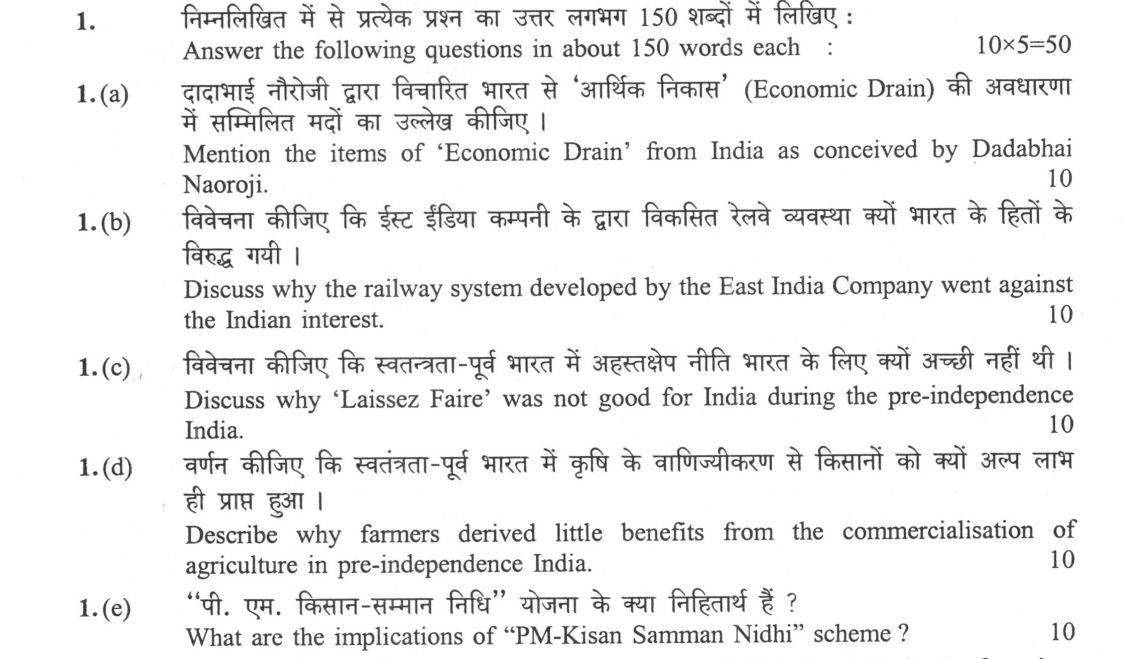
Answer the following questions in about 150 words each: (a) Mention the items of 'Economic Drain' from India as conceived by…
Answer the following questions in about 150 words each: Mention the items of 'Economic Drain' from India as conceived by Dadabhai Naoroji. 10 marks
Discuss why the railway system developed by the East India Company went against the Indian interest. 10 marks
Discuss why 'Laissez Faire' was not good for India during the pre-independence India. 10 marks
Describe why farmers derived little benefits from the commercialisation of agriculture in pre-independence India. 10 marks
What are the implications of "PM-Kisan Samman Nidhi" scheme ? 10 marks
हिंदी में प्रश्न पढ़ें
निम्नलिखित में से प्रत्येक प्रश्न का उत्तर लगभग 150 शब्दों में लिखिए : दादाभाई नौरोजी द्वारा विचारित भारत से 'आर्थिक निकास' (Economic Drain) की अवधारणा में सम्मिलित मदों का उल्लेख कीजिए । (10 अंक)
विवेचना कीजिए कि ईस्ट इंडिया कंपनी के द्वारा विकसित रेलवे व्यवस्था क्यों भारत के हितों के विरुद्ध गयी । (10 अंक)
विवेचना कीजिए कि स्वतंत्रता-पूर्व भारत में अहस्तक्षेप नीति भारत के लिए क्यों अच्छी नहीं थी । (10 अंक)
वर्णन कीजिए कि स्वतंत्रता-पूर्व भारत में कृषि के वाणिज्यीकरण से किसानों को क्यों अल्प लाभ ही प्राप्त हुआ । (10 अंक)
"पी. एम. किसान-सम्मान निधि" योजना के क्या निहितार्थ हैं ? (10 अंक)
Model answer
Written by UPSC Answer Check against this question's marking rubric, to the 150-word length. UPSC does not publish answers for Mains — this is one way to score well, not an official key.
(a) Items of 'Economic Drain' as Conceived by Dadabhai Naoroji
Dadabhai Naoroji, in Poverty and Un-British Rule in India (1901), conceptualised the 'Economic Drain' as the unrequited unilateral transfer of wealth and resources from India to Britain without any material or commercial equivalent in return. The core components of this drain, broadly categorised under 'Home Charges' and private transfers, included:
First, administrative remittances by European officials in the form of savings, family maintenance, and transfer of wealth to Britain. Second, pensions, furloughs, and gratuities paid to civil and military officers residing in the United Kingdom. Third, the expenses of maintaining the India Office and the Secretary of State's establishment in London. Fourth, guaranteed interest and profits remitted on foreign capital invested in Indian railways and irrigation works. Fifth, interest on public debt incurred by the colonial administration in London. Sixth, private remittances of profits, dividends, and interest by British agency houses, merchants, and planters. Finally, the financial burden and military costs of Britain's imperial foreign wars (such as the Afghan and Burmese wars) charged to the Indian revenues. Naoroji estimated this drain at 30 to 40 million pounds annually, which systematically depleted domestic investible capital, culminating in structural poverty and chronic underdevelopment.
(b) British Railways and Indian Interests
The introduction of the railway network under the East India Company and the subsequent Crown administration primarily served imperial military and British mercantile interests, systematically undermining India's domestic economy.
Under the 'Guarantee System' (1849), British private investors were guaranteed a minimum return of 4.5 to 5 percent on capital raised entirely in London, backed by Indian tax revenues. This eliminated incentives for cost efficiency and created a massive financial drain, as the colonial state covered persistent operating deficits. Furthermore, the railway freight rate structure was deliberately skewed: telescopic rates made the transport of raw materials from the hinterlands to ports, and manufactured British goods from ports to the interior, substantially cheaper than internal traffic between indigenous production centres. Consequently, the railways penetrated traditional craft clusters, accelerating deindustrialisation and destroying indigenous handloom and metallurgy enterprises. Indian capital goods industries saw negligible forward and backward linkages, as all equipment, rolling stock, and steel rails were imported from Britain. Additionally, railway administration maintained racial discrimination in employment, relegating Indians to menial posts while reserving managerial and technical positions for Europeans. Thus, railways operated as an extractive infrastructure rather than an engine of domestic modern industrial growth.
(c) Inadequacy of Laissez-Faire in Pre-Independence India
The dogmatic application of 'Laissez-Faire' by the colonial administration in pre-independence India acted as an instrument of underdevelopment rather than market-driven modernisation.
While Britain built its own industrial hegemony through centuries of mercantilist protection, it imposed unilateral free trade on India. The absence of protective tariffs left vulnerable infant domestic industries exposed to mechanised British imports, precipitating severe deindustrialisation and the 'ruralisation' of the workforce. Moreover, during devastating famines—such as the Great Famine of 1876–78 and the Bengal Famine of 1943—the colonial state adhered rigidly to non-intervention and free-market grain trading, permitting commercial grain exports while millions starved due to entitlement failure. The colonial state systematically neglected public investment in vital social and economic overheads, particularly minor irrigation, agricultural credit, and technical education. In contrast to Meiji Japan or contemporary Germany, where the state actively mobilised domestic capital, built infrastructure, and nurtured domestic manufacturing, colonial laissez-faire in India dismantled indigenous mechanisms without establishing supportive institutional arrangements, resulting in persistent stagnation.
(d) Commercialisation of Agriculture and Peasant Distress
The commercialisation of agriculture in pre-independence India was a forced, regressive process driven by colonial extraction rather than a spontaneous, capitalist market transition, yielding minimal gains for the peasantry.
High and inflexible land revenue demands under the Permanent, Ryotwari, and Mahalwari settlements compelled cultivators to shift from food grains to export-oriented cash crops like indigo, opium, cotton, and jute. Because peasants possessed little bargaining power, they were entrapped in the 'Dadni' system of advance contracts, becoming subservient to British planters and indigenous moneylenders (mahajans). Peasant households were squeezed by unequal terms of trade; while global price booms enriched middlemen, international price crashes—such as the post-American Civil War cotton bust and the Great Depression of 1929—transferred the entire burden of market volatility onto indebted cultivators. Moreover, commercialisation led to the export of agricultural surplus instead of building local buffer stocks, degrading crop diversity and inducing frequent subsistence crises and food insecurity. Consequently, commercialisation exacerbated rural indebtedness, land alienation, and tenant rack-renting, alienating the primary producer from the fruits of commercial production.
(e) Implications of the PM-KISAN Scheme
The Pradhan Mantri Kisan Samman Nidhi (PM-KISAN), launched in 2019, represents a major paradigm shift toward unconditional direct income support for agrarian households.
The scheme provides direct financial assistance of Rs. 6,000 per annum in three equal instalments to over 11 crore beneficiary farmers. Empirical evaluations by NABARD and IFPRI demonstrate that PM-KISAN has significantly eased liquidity constraints during peak sowing seasons, enabling timely purchases of quality seeds, fertilisers, and other critical inputs, thereby reducing dependence on high-cost informal credit. Furthermore, the direct cash injections provide a vital counter-cyclical consumption stimulus in the rural economy. Leveraging the JAM (Jan Dhan-Aadhaar-Mobile) trinity, PM-KISAN has fortified transparent digital payment delivery, drastically curbing leakages and intermediary rent-seeking. However, structural limitations persist. The scheme's tie-in with formal land-title records disproportionately excludes landless tenant farmers, sharecroppers, and female cultivators, who contribute substantial labour without possessing de jure ownership. To maximise developmental outcomes, PM-KISAN requires institutional integration with tenant verification frameworks and synergistic alignment with existing interventions like the PM Fasal Bima Yojana and the Kisan Credit Card scheme.
What "Discuss" is asking you to do
Lay the issue out from more than one side — how it arose, what is claimed for it, what is held against it, and where it now stands. UPSC attaches discuss to broad topics with several live dimensions, so coverage of the dimensions earns more than the strength of your opinion.
Structure that answers it
Set the issue up → the case as it is made → the case against → the dimension both sides leave out → where the balance now lies
Where marks are lost
Listing facts with no thread between them, or arguing one side throughout and calling it a discussion.
How this answer will be evaluated
Approach
Framework: UPSC Economic History & Policy Analysis. (a) highlight: name the salient points > one line of substance each > close | (b) discuss: intro > 3-4 dimensions > example > balanced close | (c) discuss: intro > 3-4 dimensions > example > balanced close | (d) describe: define > structure or process in order > labelled diagram > significance | (e) analyse: intro > causes > effects > stakeholders/linkages > way forward Full marks: Precise, specific, and analytical; uses correct terminology and historical context.
Key points expected
- Identify Dadabhai Naoroji as the originator
- Mention 'Home Charges' (interest, pensions, military)
- Cite profit remittances by British firms
- Note the lack of return on capital invested
- Explain 'radial' layout for resource extraction
- Mention underdevelopment of internal transport (roads)
- Note the destruction of indigenous transport (bullock carts)
- Highlight the import of British goods via rail
Evaluation rubric
Each sub-part is marked on its own, against the marks and word limit printed on the paper.
- (a) List the specific components of the 'Drain of Wealth' theory. 10 marks · 150 words
highlight— name the salient points → one line of substance each → close
Must cover
- Identify Dadabhai Naoroji as the originator
- Mention 'Home Charges' (interest, pensions, military)
- Cite profit remittances by British firms
- Note the lack of return on capital invested
Loses marks
- Confusing drain with general trade deficit
- Vague listing without specific items
- Ignoring the 'unearned' nature of the drain
Earns more
- Reference to 'Poverty and Un-British Rule in India'
- Distinction between trade and drain
- Mention of 'unearned income' concept
Extra mark
- Specific figures from Naoroji's estimates
- Reference to R.C. Dutt's corroboration
- (b) Explain the structural and economic reasons railways harmed India. 10 marks · 150 words
discuss— intro → 3-4 dimensions → example → balanced close
Must cover
- Explain 'radial' layout for resource extraction
- Mention underdevelopment of internal transport (roads)
- Note the destruction of indigenous transport (bullock carts)
- Highlight the import of British goods via rail
Loses marks
- Claiming railways had no benefits at all
- Focusing only on military use
- Ignoring the economic structure of the network
Earns more
- Reference to 'de-industrialization' via rail
- Mention of high freight rates for Indian goods
- Contrast with 'developmental' railway planning
Extra mark
- Specific data on freight rates
- Reference to specific colonial railway policies
- (c) Analyze why free-market policies failed the Indian economy. 10 marks · 150 words
discuss— intro → 3-4 dimensions → example → balanced close
Must cover
- Define 'Laissez Faire' in the colonial context
- Explain the 'drain' as a result of free trade
- Mention the destruction of Indian handicrafts
- Note the lack of industrial protection for India
Loses marks
- Defining Laissez Faire in a modern context
- Ignoring the asymmetry of trade policies
- Failing to link policy to economic outcome
Earns more
- Reference to 'free trade' as a weapon
- Mention of 'de-industrialization' of India
- Contrast with protectionism in Britain
Extra mark
- Reference to specific tariff policies
- Mention of 'colonial capitalism' theory
- (d) Explain the economic reasons for farmer exploitation in commercialization. 10 marks · 150 words
describe— define → structure or process in order → labelled diagram → significance
Must cover
- Mention the role of 'middlemen' and 'moneylenders'
- Explain the 'price scissors' (low buy, high sell)
- Note the lack of processing industries in India
- Highlight the risk of crop failure on farmers
Loses marks
- Blaming farmers for lack of commercialization
- Ignoring the role of colonial policy
- Failing to explain the 'drain' from agriculture
Earns more
- Reference to 'commercialization' vs 'subsistence'
- Mention of 'land revenue' pressure
- Note the 'debt trap' for farmers
Extra mark
- Specific examples of cash crops (indigo, opium)
- Reference to 'agricultural stagnation' data
- (e) Evaluate the economic and social impact of the PM-Kisan scheme. 10 marks · 150 words
analyse— intro → causes → effects → stakeholders/linkages → way forward
Must cover
- Define the scheme (direct income support)
- Explain the 'transfer' mechanism (DBT)
- Analyze the impact on rural demand
- Note the 'fiscal cost' to the government
Loses marks
- Confusing with 'crop insurance' schemes
- Ignoring the 'exclusion' of certain farmers
- Failing to analyze the 'demand-side' impact
Earns more
- Reference to 'income support' vs 'input subsidy'
- Mention of 'leakage' reduction
- Note the 'political economy' of the scheme
Extra mark
- Specific data on 'rural consumption' growth
- Reference to 'fiscal deficit' impact
Practice this exact question
Write your answer and it is marked point by point against the model answer above — what you covered, what you missed, what you got wrong.
Evaluate my answer →More from Economics 2024 Paper II
- Q1 Answer the following questions in about 150 words each: (a) Mention the items of 'Economi…
- Q2 (a) What schemes are launched by the Government to deal with the problem of unemployment…
- Q3 (a) Highlight the role of MSMEs in Indian Economy. What steps have been taken by the Gove…
- Q4 (a) Discuss the changes made by the Government of India in the fiscal policy since libera…