Paper II — Q8
(a) What are the main objectives of monetary policy adopted by the R.B.I. during last 5 years ? Discuss the steps taken by the…
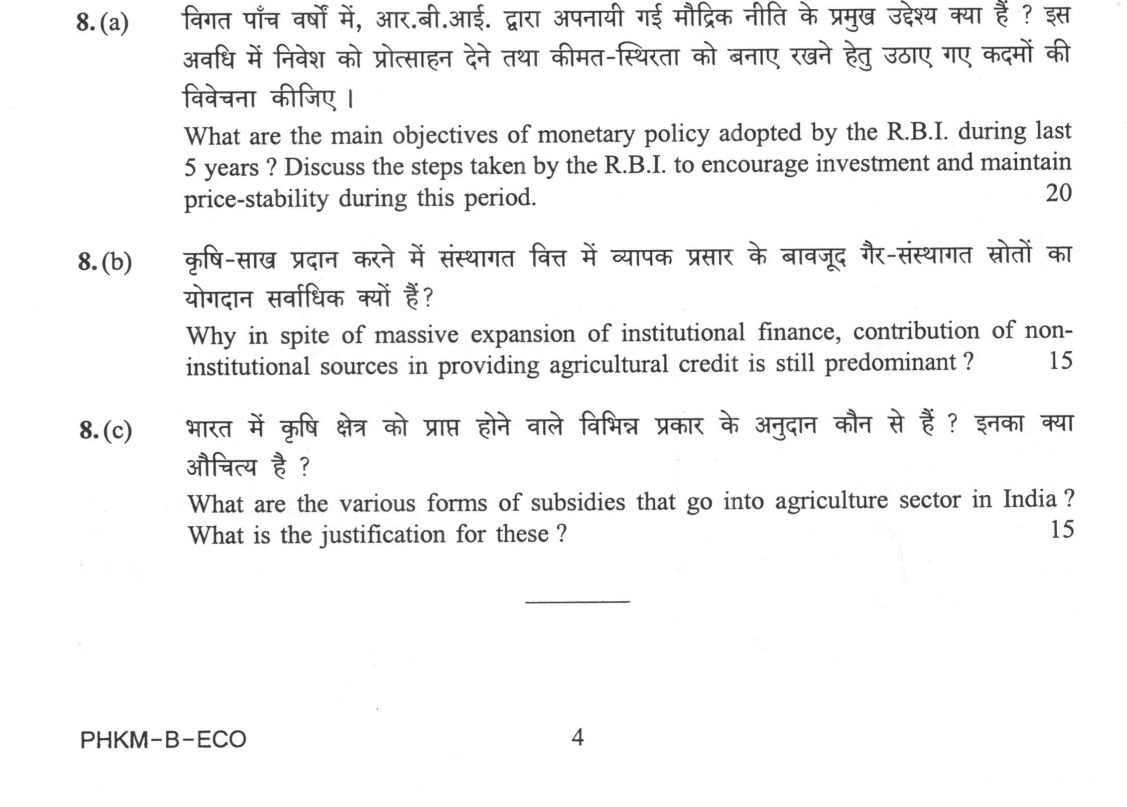
What are the main objectives of monetary policy adopted by the R.B.I. during last 5 years ? Discuss the steps taken by the R.B.I. to encourage investment and maintain price-stability during this period. 20 marks
Why in spite of massive expansion of institutional finance, contribution of non-institutional sources in providing agricultural credit is still predominant ? 15 marks
What are the various forms of subsidies that go into agriculture sector in India ? What is the justification for these ? 15 marks
हिंदी में प्रश्न पढ़ें
विगत पांच वर्षों में, आर.बी.आई. द्वारा अपनायी गई मौद्रिक नीति के प्रमुख उद्देश्य क्या हैं ? इस अवधि में निवेश को प्रोत्साहन देने तथा कीमत-स्थिरता को बनाए रखने हेतु उठाए गए कदमों की विवेचना कीजिए । (20 अंक)
कृषि-साख प्रदान करने में संस्थागत वित्त में व्यापक प्रसार के बावजूद गैर-संस्थागत स्रोतों का योगदान सर्वाधिक क्यों है? (15 अंक)
भारत में कृषि क्षेत्र को प्राप्त होने वाले विभिन्न प्रकार के अनुदान कौन से हैं ? इनका क्या औचित्य है ? (15 अंक)
Model answer
Written by UPSC Answer Check against this question's marking rubric, to the expected length. UPSC does not publish answers for Mains — this is one way to score well, not an official key.
Monetary Policy Objectives and Steps by the RBI (2019–2024)
Over the past five years, the Reserve Bank of India’s (RBI) monetary policy has operated under the Flexible Inflation Targeting (FIT) framework under Section 45ZB of the RBI Act, mandating a headline CPI target of 4% (±2%) while explicitly factoring in economic growth. During this period, the primary objectives were stabilizing output during the COVID-19 pandemic, preserving macroeconomic and financial stability, and re-anchoring medium-term inflation expectations amidst global geopolitical turbulence.
To encourage investment and revive growth during the pandemic downturn, the Monetary Policy Committee (MPC) cut the repo rate aggressively from 5.15% to an accommodative 4.00%. The RBI deployed unconventional liquidity measures including Targeted Long-Term Repo Operations (TLTRO), on-tap liquidity windows for contact-intensive and healthcare sectors, and special refinance facilities to institutions like NABARD and SIDBI alongside the Emergency Credit Line Guarantee Scheme. On the structural side, private investment was catalyzed through the development of the corporate bond market, the implementation of Scale-Based Regulation for Non-Banking Financial Companies (NBFCs) to mitigate systemic risk, the rollout of a regulatory sandbox for fintech innovations, and the aggressive expansion of digital payments infrastructure via UPI.
To maintain price stability amidst post-pandemic supply shocks and commodity price spikes, the MPC pivoted toward withdrawal of accommodation, hiking the repo rate by 250 basis points to 6.50%. The RBI utilized Variable Rate Reverse Repo (VRRR) auctions to absorb durable surplus liquidity, conducted proactive foreign exchange interventions to prevent disorderly rupee depreciation and curb imported inflation, and closely coordinated monetary stance with fiscal buffer stock releases of essential food items.
Persistence of Non-Institutional Agricultural Credit
Despite substantial institutional credit expansion through commercial banks, Cooperatives, and Regional Rural Banks, non-institutional sources (moneylenders, commission agents, and landlords) remain predominant for several structural reasons.
First, severe regional disparities persist in branch penetration, leaving states like Bihar, eastern Uttar Pradesh, and central tribal belts underserved compared to southern states. Second, rigid land tenancy laws and informal leasing arrangements prevent oral lessees, tenant farmers, and sharecroppers from demonstrating formal land titles or legal mortgageability to obtain bank loans. Third, high inherent production and climate risks lead risk-averse institutional lenders to enforce cumbersome documentation hurdles, strict collateral norms, and lengthy procedural delays. In contrast, non-institutional lenders offer immediate, documentation-free, and flexible credit lines. Furthermore, moneylenders readily finance consumption, social, and emergency needs that formal banks exclude, operating via interlinked credit-commodity-labor markets that provide customized accessibility despite usurious interest rates.
Agricultural Subsidies: Forms and Justifications
Subsidies in Indian agriculture are channeled via input support and price interventions:
- Input Subsidies: Statutory price controls on urea alongside the Nutrient-Based Subsidy (NBS) for phosphatic and potassic fertilizers; subsidized power and canal irrigation charges provided by state governments; concessional credit under the Interest Subvention Scheme through Kisan Credit Cards (KCC); seed and farm mechanization subsidies; and premium subventions under the Pradhan Mantri Fasal Bima Yojana (PMFBY).
- Price Support: Minimum Support Prices (MSP) backed by procurement via the Food Corporation of India, and the Market Intervention Scheme (MIS) for non-cereal crops.
The economic justification rests on correcting pervasive market failures in agriculture, where high yield variability, lumpy capital investments, and systemic price volatility depress private capital formation. Subsidies lower the cost of cultivation, preserving farm incomes and ensuring equity for small and marginal farmers who comprise over 86% of operational holdings. They underpin national food security by maintaining high aggregate output for public distribution. While these supports face scrutiny under WTO Amber Box disciplines regarding trade distortion, India justifies them under public stockholding for food security and development provisions. However, untargeted input subsidies create tensions with environmental sustainability, causing soil degradation and groundwater depletion.
A coherent policy way forward requires aligning the RBI's localized financial deepening with agricultural policy reforms. Transitioning from distortionary input subsidies toward direct income support, digitizing land records for tenancy credit, and expanding targeted rural credit will crowd in private agrarian investment and dismantle informal debt reliance.
What "Discuss" is asking you to do
Lay the issue out from more than one side — how it arose, what is claimed for it, what is held against it, and where it now stands. UPSC attaches discuss to broad topics with several live dimensions, so coverage of the dimensions earns more than the strength of your opinion.
Structure that answers it
Set the issue up → the case as it is made → the case against → the dimension both sides leave out → where the balance now lies
Where marks are lost
Listing facts with no thread between them, or arguing one side throughout and calling it a discussion.
How this answer will be evaluated
Approach
Framework: Monetary Policy Framework (Inflation Targeting) & Agricultural Credit/Subsidy Analysis. (a) discuss: intro > 3-4 dimensions > example > balanced close | (b) explain: definition/context > points in order > small example > short close | (c) justify: claim > 3-4 reasons > evidence > conclusion Full marks: Precise, data-driven, covers all dimensions with specific examples and clear justification.
Key points expected
- Identify Inflation Targeting (4% +/- 2%) as primary objective
- Explain MPC structure and its role in policy decisions
- Detail steps for price stability (Repo rate, CRR, SLR)
- Detail steps for investment (Liquidity management, credit policy)
- Identify 'institutional' vs 'non-institutional' sources clearly
- Explain 'last mile' connectivity failure of banks
- Discuss the 'convenience' and 'speed' of informal credit
- Mention the role of moneylenders in distress situations
Evaluation rubric
Each sub-part is marked on its own, against the marks and word limit printed on the paper.
- (a) Objectives of RBI policy (last 5 yrs) and steps for investment/price stability. 20 marks
discuss— intro → 3-4 dimensions → example → balanced close
Must cover
- Identify Inflation Targeting (4% +/- 2%) as primary objective
- Explain MPC structure and its role in policy decisions
- Detail steps for price stability (Repo rate, CRR, SLR)
- Detail steps for investment (Liquidity management, credit policy)
Loses marks
- Failing to distinguish between price stability and investment goals
- Listing tools without explaining their mechanism
- Ignoring the 'last 5 years' timeframe constraint
Earns more
- Mention shift from M3 to Inflation Targeting (2016)
- Reference specific RBI circulars or MPC minutes
- Link investment steps to sectoral credit growth
- Mention macroprudential measures (LTV, RAROC)
Extra mark
- Cite specific Repo rate changes in the last 5 years
- Reference the 6th MPC meeting or specific Governor's speech
- (b) Reasons for dominance of non-institutional sources in agri credit. 15 marks
explain— definition/context → points in order → small example → short close
Must cover
- Identify 'institutional' vs 'non-institutional' sources clearly
- Explain 'last mile' connectivity failure of banks
- Discuss the 'convenience' and 'speed' of informal credit
- Mention the role of moneylenders in distress situations
Loses marks
- Failing to define 'non-institutional' sources
- Ignoring the 'massive expansion' of institutional finance
- Providing a generic answer without agri-specific context
Earns more
- Cite RBI data on institutional vs non-institutional share
- Discuss the 'credit gap' in remote areas
- Mention the lack of collateral in formal banking
- Reference the 'Kisan Credit Card' (KCC) scheme limitations
Extra mark
- Cite specific RBI Annual Report figures on agri credit
- Mention the 'Priority Sector Lending' (PSL) targets
- (c) Forms of agri subsidies in India and their justification. 15 marks
justify— claim → 3-4 reasons → evidence → conclusion
Must cover
- List major subsidies (Input, Output, Credit, Insurance)
- Explain the 'Input' subsidy (Fertilizer, Power, Water)
- Explain the 'Output' subsidy (MSP, Procurement)
- Provide the 'justification' (Food security, Income support)
Loses marks
- Listing subsidies without providing the 'justification'
- Ignoring the 'various forms' (only listing one type)
- Failing to link subsidies to the 'agriculture sector' specifically
Earns more
- Mention the 'Fertilizer Subsidy Scheme' (NBS)
- Discuss the 'PM-KISAN' scheme as income support
- Reference the 'National Agricultural Insurance Scheme' (NAIS)
- Mention the 'Minimum Support Price' (MSP) mechanism
Extra mark
- Cite specific budget allocations for agri subsidies
- Mention the 'Swachh Bharat' or 'Soil Health' card schemes
Practice this exact question
Write your answer and it is marked point by point against the model answer above — what you covered, what you missed, what you got wrong.
Evaluate my answer →More from Economics 2024 Paper II
- Q5 Answer the following questions in about 150 words each: (a) Examine the alternative model…
- Q6 (a) Evaluate the policy of Government of India with regard to foreign investment in the c…
- Q7 (a) Distinguish between fiscal federalism, fiscal consolidation and cooperative federalis…
- Q8 (a) What are the main objectives of monetary policy adopted by the R.B.I. during last 5 y…