Paper II — Q2
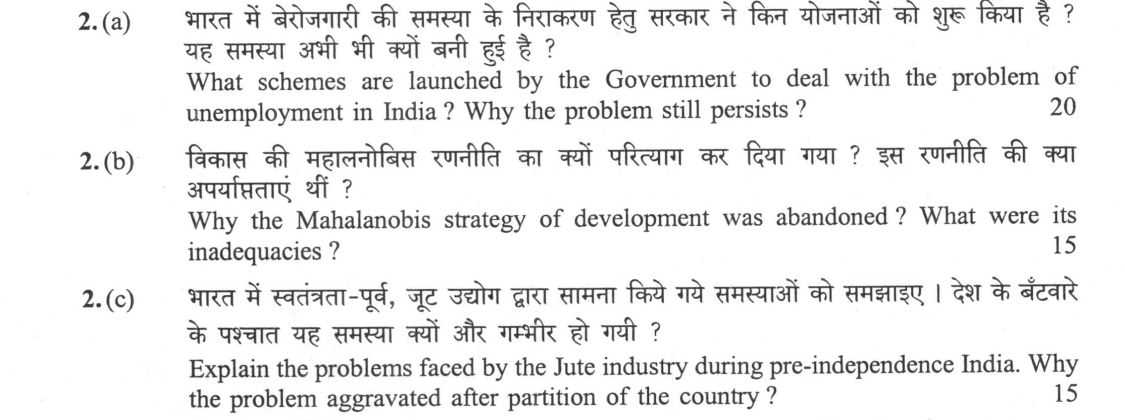
(a) What schemes are launched by the Government to deal with the problem of unemployment in India ? Why the problem still…
What schemes are launched by the Government to deal with the problem of unemployment in India ? Why the problem still persists ? 20 marks
Why the Mahalanobis strategy of development was abandoned ? What were its inadequacies ? 15 marks
Explain the problems faced by the Jute industry during pre-independence India. Why the problem aggravated after partition of the country ? 15 marks
हिंदी में प्रश्न पढ़ें
भारत में बेरोजगारी की समस्या के निराकरण हेतु सरकार ने किन योजनाओं को शुरू किया है ? यह समस्या अभी भी क्यों बनी हुई है ? (20 अंक)
विकास की महालनोबिस रणनीति का क्यों परित्याग कर दिया गया ? इस रणनीति की क्या अपर्याप्तताएं थीं ? (15 अंक)
भारत में स्वतंत्रता-पूर्व, जूट उद्योग द्वारा सामना किये गये समस्याओं को समझाइए । देश के बंटवारे के पश्चात् यह समस्या क्यों और गंभीर हो गयी ? (15 अंक)
Model answer
Written by UPSC Answer Check against this question's marking rubric, to the expected length. UPSC does not publish answers for Mains — this is one way to score well, not an official key.
India’s structural transformation has been shaped by historical trade distortions, post-independence heavy-industry planning, and modern challenges in labour absorption.
Employment Schemes and Persistent Unemployment
To tackle unemployment, the Government has deployed multifaceted interventions. For rural wage-security, the Mahatma Gandhi National Rural Employment Guarantee Act (MGNREGA) provides a statutory guarantee of 100 days of unskilled manual work to rural households. For skill formation, the Pradhan Mantri Kaushal Vikas Yojana (PMKVY) under Skill India imparts industry-aligned technical training to youth. Enterprise creation and self-employment are promoted through the Prime Minister’s Employment Generation Programme (PMEGP), which provides credit-linked subsidies for micro-enterprises; the Micro Units Development and Refinance Agency (MUDRA) Yojana, which extends collateral-free institutional credit to non-corporate micro-units; and Start-up India, which fosters innovation-driven entrepreneurship. Concurrently, the National Career Service acts as an integrated digital portal bridging jobseekers and employers.
Despite these interventions, unemployment and underemployment persist due to structural rigidities. First, India experienced "jobless growth", where output expansion occurred largely via productivity gains rather than employment elasticity. Second, industrial policy favored capital-intensive technologies rather than labor-intensive manufacturing, limiting factory-floor absorption. Third, a deep skill mismatch exists where educational curricula fail to match modern industry requirements. Fourth, the economy is dominated by the informal sector—accounting for over 85% of total employment—characterized by disguised unemployment and lack of social security. Fifth, acute demographic pressure continuously adds millions of young entrants to the labor force annually, outstripping the slow pace of formal manufacturing expansion, which prematurely ceded ground to capital-intensive services.
Abandonment and Inadequacies of the Mahalanobis Strategy
The Mahalanobis strategy, introduced in the Second Five-Year Plan, prioritized the heavy-industry and capital-goods sectors, established public sector dominance over the "commanding heights" of the economy, and relied on an import-substitution industrialization model. By the 1980s and the 1990 balance-of-payments crisis, this strategy was abandoned in favor of market-oriented liberalization.
Its fundamental inadequacy lay in the acute neglect of agriculture and the consumer wage-goods sector. This caused severe foodgrain shortages, necessitating emergency food imports (such as under US PL-480) and triggering structural inflation. Furthermore, capital-intensive heavy industries had long gestation periods and low employment-absorption capacity, failing to absorb surplus rural labor. The public sector suffered from bureaucratic inefficiencies, unviable cost structures, and persistent losses without market discipline. Additionally, export pessimism and strict import substitution created severe foreign exchange constraints and technological obsolescence, while centralized licensing exacerbated regional industrial imbalances rather than mitigating them.
Problems of the Jute Industry: Pre-Independence and Post-Partition
In pre-independence India, the jute industry around the Hooghly basin suffered from systemic colonial distortions. It was monopolized by British managing agencies that prioritized short-term extraction over long-term capital re-investment. Indian peasant cultivators were trapped in exploitative dependency under the baldadari and dadan financing systems, where layers of intermediaries pocketed profits while growers received unremunerative prices. The sector faced excessive exposure to global trade volatility due to heavy raw jute export dependence, suffered from technological stagnation and a lack of mill modernization, and was penalized by discriminatory colonial railway freight tariffs that subsidized the export of raw fiber over finished domestic manufactures.
Partition in 1947 severely aggravated these structural problems. The Radcliffe Line inflicted a spatial decoupling: approximately 75% to 80% of the superior raw-jute-producing acreage went to East Pakistan (now Bangladesh), whereas all 108 processing mills remained in West Bengal (India). This truncated supply chains overnight, plunging Indian mills into an acute raw-material famine, driving input costs up, and forcing mills to operate below capacity. The crisis was exacerbated by a massive influx of refugees into West Bengal, straining the provincial economy. Simultaneously, Pakistan developed its own modern processing mills using superior local raw fiber, drastically eroding India’s international competitive advantage in global packaging markets.
India’s economic trajectory demonstrates that structural bottlenecks—whether colonial spatial ruptures, planning-era supply neglect, or contemporary skill-job mismatches—require coordinated industrial and human capital policies to achieve sustained labor absorption.
What "Explain" is asking you to do
Make the working of something clear — what sets it off, what follows from what, and what it produces. Explain is the Commission's mechanism word: it dominates the technical papers and the “explain why” stems, where the marks sit in the causal chain and not in the label.
Structure that answers it
State what it is → the initiating condition → the chain of cause, step by step → an instance where it plays out → what the chain produces
Where marks are lost
Describing what something looks like instead of why it works that way. Naming the stages without linking them reads as description too.
How this answer will be evaluated
Approach
Framework: UPSC Economics Paper II. (a) explain: definition/context > points in order > small example > short close | (b) critique: the claim > its strengths > its weaknesses > your judgment | (c) explain: definition/context > points in order > small example > short close Full marks: Precise scheme names, clear structural analysis, and specific historical context for Jute.
Key points expected
- Name at least 3-4 specific schemes (e.g., MGNREGA, PMEGP, Skill India).
- Explain the mechanism of one scheme (e.g., wage guarantee).
- Identify structural causes (e.g., skill mismatch, informal sector).
- Link causes to the persistence of the problem.
- Define the core of the Mahalanobis strategy (heavy industry focus).
- State the reason for abandonment (e.g., 1991 reforms, balance of payments).
- List at least 3 inadequacies (e.g., neglect of agriculture, high capital intensity).
- Mention the shift to the New Economic Policy (NEP) 1991.
Evaluation rubric
Each sub-part is marked on its own, against the marks and word limit printed on the paper.
- (a) List major government schemes and analyze the structural reasons for persistent unemployment. 20 marks
explain— definition/context → points in order → small example → short close
Must cover
- Name at least 3-4 specific schemes (e.g., MGNREGA, PMEGP, Skill India).
- Explain the mechanism of one scheme (e.g., wage guarantee).
- Identify structural causes (e.g., skill mismatch, informal sector).
- Link causes to the persistence of the problem.
Loses marks
- Listing schemes without explaining their mechanism.
- Vague causes like 'lack of education' without detail.
Earns more
- Reference to PLI scheme or recent budget allocations.
- Distinction between rural and urban unemployment.
- Mention of 'disguised unemployment' in agriculture.
Extra mark
- Cite specific PLI scheme name (e.g., Electronics).
- Reference to specific PLI scheme name (e.g., Electronics).
- (b) Explain the rationale for abandoning the Mahalanobis model and list its specific inadequacies. 15 marks
critique— the claim → its strengths → its weaknesses → your judgment
Must cover
- Define the core of the Mahalanobis strategy (heavy industry focus).
- State the reason for abandonment (e.g., 1991 reforms, balance of payments).
- List at least 3 inadequacies (e.g., neglect of agriculture, high capital intensity).
- Mention the shift to the New Economic Policy (NEP) 1991.
Loses marks
- Confusing Mahalanobis with the Five Year Plan structure.
- Failing to link inadequacies to the 1991 crisis.
Earns more
- Reference to the 'two-sector model' (consumer goods vs capital goods).
- Mention of the 'trickle-down' effect failure.
Extra mark
- Reference to the 'two-sector model' (consumer goods vs capital goods).
- Mention of the 'trickle-down' effect failure.
- (c) Detail pre-independence problems of the Jute industry and the impact of Partition. 15 marks
explain— definition/context → points in order → small example → short close
Must cover
- Identify pre-independence issues (e.g., British monopoly, low wages).
- Explain the impact of Partition (loss of raw jute from East Pakistan).
- Mention the 'raw jute crisis' or 'jute crisis' of the 1950s.
- Note the shift of the industry's center of gravity.
Loses marks
- Failing to distinguish between pre- and post-independence issues.
- Ignoring the geographical aspect of the raw material supply.
Earns more
- Reference to the 'Jute Mills Act' or specific government interventions.
- Mention of the 'Jute Board'.
Extra mark
- Reference to the 'Jute Mills Act' or specific government interventions.
- Mention of the 'Jute Board'.
Practice this exact question
Write your answer and it is marked point by point against the model answer above — what you covered, what you missed, what you got wrong.
Evaluate my answer →More from Economics 2024 Paper II
- Q1 Answer the following questions in about 150 words each: (a) Mention the items of 'Economi…
- Q2 (a) What schemes are launched by the Government to deal with the problem of unemployment…
- Q3 (a) Highlight the role of MSMEs in Indian Economy. What steps have been taken by the Gove…
- Q4 (a) Discuss the changes made by the Government of India in the fiscal policy since libera…
- Q5 Answer the following questions in about 150 words each: (a) Examine the alternative model…