Paper II — Q3
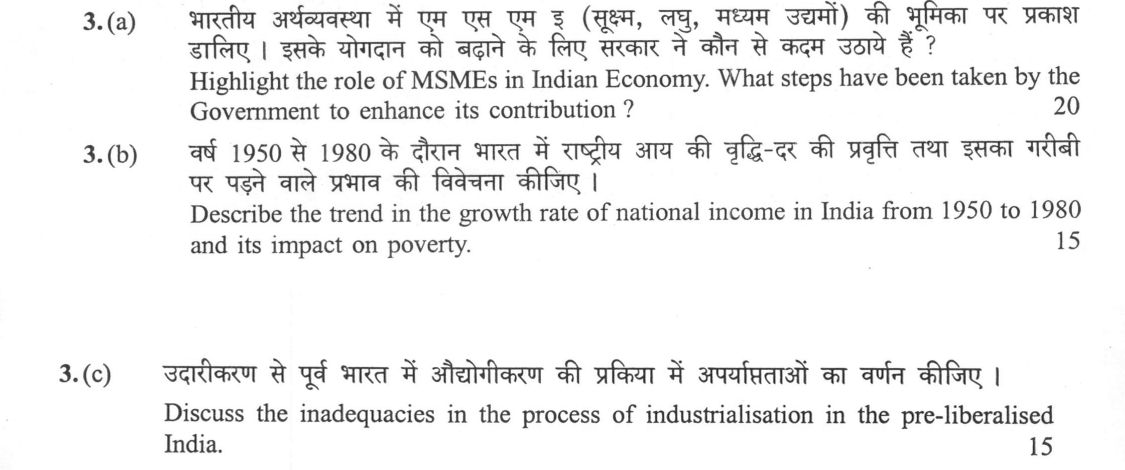
(a) Highlight the role of MSMEs in Indian Economy. What steps have been taken by the Government to enhance its contribution ? (20…
Highlight the role of MSMEs in Indian Economy. What steps have been taken by the Government to enhance its contribution ? 20 marks
Describe the trend in the growth rate of national income in India from 1950 to 1980 and its impact on poverty. 15 marks
Discuss the inadequacies in the process of industrialisation in the pre-liberalised India. 15 marks
हिंदी में प्रश्न पढ़ें
भारतीय अर्थव्यवस्था में एम एस एम ई (सूक्ष्म, लघु, मध्यम उद्यमों) की भूमिका पर प्रकाश डालिए । इसके योगदान को बढ़ाने के लिए सरकार ने कौन से कदम उठाये हैं ? (20 अंक)
वर्ष 1950 से 1980 के दौरान भारत में राष्ट्रीय आय की वृद्धि-दर की प्रवृत्ति तथा इसका गरीबी पर पड़ने वाले प्रभाव की विवेचना कीजिए । (15 अंक)
उदारीकरण से पूर्व भारत में औद्योगीकरण की प्रक्रिया में अपर्याप्तताओं का वर्णन कीजिए । (15 अंक)
Model answer
Written by UPSC Answer Check against this question's marking rubric, to the expected length. UPSC does not publish answers for Mains — this is one way to score well, not an official key.
MSMEs are the connective tissue between India’s industrialisation and inclusive growth: they translate macroeconomic expansion into household incomes, while their pre-1991 neglect shows why growth alone did not remove poverty.
Role of MSMEs and policy response The salient contributions of MSMEs are best highlighted by their scale, employment effect and spatial reach. They contribute about 30 per cent of GDP, generate over 11 crore jobs, account for more than 45 per cent of exports, and disperse industrial activity to towns and rural areas, thereby reducing regional concentration. Their small size allows them to use local raw materials, absorb unskilled and semi-skilled labour, and provide backward and forward linkages to large industry. They also support rural non-farm employment and enable entrepreneurship in areas where large capital-intensive units cannot operate profitably. This is especially important because MSMEs are numerous, geographically scattered and responsive to local demand. To enhance this contribution, the Government has used PMEGP for self-employment, MUDRA for small credit, the Credit Guarantee Fund (CGTMSE) to reduce collateral constraints, ZED certification to improve environmental performance, and the MSME Champions Portal to connect buyers and suppliers. These measures address the main constraints of capital, market access and compliance, moving policy from mere protection to facilitation. Post-1991 deregulation and post-2015 emphasis on credit, technology and market access have made MSMEs a central target of industrial policy, unlike the reserved-list approach that earlier treated them as protected but under-supported units.
Growth and poverty, 1950-80 From 1950 to 1980, national income grew at roughly 3.5 per cent a year, the “Hindu rate of growth”. The 1960s saw stagnation, while the 1970s recorded a slight rise, but growth remained too low to absorb the labour force or raise incomes rapidly. The trend was therefore one of slow, uneven growth rather than sustained take-off. With a large population, this rate left per capita income growth low, and the sectoral composition shifted away from agriculture as industry and services gained weight. Yet poverty reduction was limited. Ahluwalia’s findings show that rural poverty persisted because growth was jobless and inequality remained high; rising national income did not automatically translate into broad-based consumption or asset formation among the poor. In other words, aggregate growth was not enough unless it created employment and reached the rural majority.
Inadequacies of pre-liberalisation industrialisation The pre-liberalisation process was structurally incomplete. The Mahalanobis model’s capital-intensive heavy-industry bias crowded out labour-intensive consumer goods, leaving employment generation weak. The licensing regime under the MRTP Act and FERA created entry barriers, rent-seeking and inefficient allocation of capital. Public sector units often suffered from overstaffing, soft budgets and delayed investment, while import-substitution policies protected domestic producers from competition and produced costly, non-competitive industries. This also reinforced regional imbalance, with industry concentrated in a few states and cities and limited backward linkages in less developed regions. The result was an industrial structure that was heavy, protected and disconnected from mass employment. MSMEs were neglected through a reserved list that protected markets without providing credit, technology or scale.
Critical assessment and way forward Post-1991 reforms removed many licensing bottlenecks and opened markets, and later MSME-specific measures have improved visibility, credit access and market linkages. But continuing challenges remain: a credit gap, delayed payments by large buyers, and technology obsolescence. The growth-poverty relationship in 1950-80 was not purely statistical; it was shaped by policy choices that favoured capital over labour and urban industry over rural livelihoods. Thus, the lesson of 1950-80 is that industrial policy must be employment-oriented, and the lesson of MSME policy is that protection must be converted into capability. A stronger MSME strategy must therefore combine easier credit, enforceable payment norms, technology upgradation and regional dispersal, so that industrialisation becomes both faster and more inclusive.
What "Highlight" is asking you to do
Bring the notable features of the named material forward and make their weight visible — what each feature is, and what gives it importance. Highlight expects substantive coverage of the features, not a thin selection from them.
Structure that answers it
The material and what makes a feature notable within it → feature, with the point that gives it weight → the same for each further feature → the composite picture they form
Where marks are lost
Naming features flatly as a list and never showing why any one of them signifies.
How this answer will be evaluated
Approach
Framework: UPSC Economics Paper II. (a) highlight: name the salient points > one line of substance each > close | (b) describe: define > structure or process in order > labelled diagram > significance | (c) discuss: intro > 3-4 dimensions > example > balanced close Full marks: Precise data, specific policy names, and clear logical flow.
Key points expected
- Employment generation and rural industrialization
- Contribution to GDP and exports
- Credit access measures (e.g., CGTMSE, MUDRA)
- Policy reforms (e.g., Udyam Registration, 2020 criteria)
- Identification of 'Hindu Rate of Growth' (approx 3.5%)
- Linkage between low growth and stagnant poverty
- Reference to Five Year Plans (1st-4th)
- Population growth outpacing income growth
Evaluation rubric
Each sub-part is marked on its own, against the marks and word limit printed on the paper.
- (a) Salient points on MSME role and specific government measures to enhance contribution. 20 marks
highlight— name the salient points → one line of substance each → close
Must cover
- Employment generation and rural industrialization
- Contribution to GDP and exports
- Credit access measures (e.g., CGTMSE, MUDRA)
- Policy reforms (e.g., Udyam Registration, 2020 criteria)
Loses marks
- Generic points without Indian context
- Ignoring the 'steps taken' part of the question
Earns more
- Regional distribution of MSMEs
- Role in import substitution
- Digitalization initiatives (ONDC, Udyam)
Extra mark
- Specific MSME data from Economic Survey
- Reference to Udyam Act 2019
- (b) Trend of national income growth (1950-1980) and its specific impact on poverty. 15 marks
describe— define → structure or process in order → labelled diagram → significance
Must cover
- Identification of 'Hindu Rate of Growth' (approx 3.5%)
- Linkage between low growth and stagnant poverty
- Reference to Five Year Plans (1st-4th)
- Population growth outpacing income growth
Loses marks
- Failing to link growth rate to poverty
- Ignoring the specific 1950-1980 timeframe
Earns more
- Mention of Green Revolution impact on rural income
- Comparison of growth rates across plans
Extra mark
- Specific data points from NSSO or RBI
- Reference to Dadabhai Naoroji's drain theory
- (c) Inadequacies in the industrialization process of pre-liberalized India. 15 marks
discuss— intro → 3-4 dimensions → example → balanced close
Must cover
- License Raj and bureaucratic bottlenecks
- Inefficiency of Public Sector Undertakings (PSUs)
- Neglect of private sector and FDI
- Import substitution leading to low competitiveness
Loses marks
- Focusing on post-1991 reforms instead of pre-liberalization
- Vague criticism without specific institutional examples
Earns more
- Reference to Monopolies and Restrictive Trade Practices Act
- Discussion of 'Unit 80' or 'Unit 22' cases
Extra mark
- Reference to B.C. Roy Committee
- Specific examples of industrial failures
Practice this exact question
Write your answer and it is marked point by point against the model answer above — what you covered, what you missed, what you got wrong.
Evaluate my answer →More from Economics 2024 Paper II
- Q1 Answer the following questions in about 150 words each: (a) Mention the items of 'Economi…
- Q2 (a) What schemes are launched by the Government to deal with the problem of unemployment…
- Q3 (a) Highlight the role of MSMEs in Indian Economy. What steps have been taken by the Gove…
- Q4 (a) Discuss the changes made by the Government of India in the fiscal policy since libera…
- Q5 Answer the following questions in about 150 words each: (a) Examine the alternative model…
- Q6 (a) Evaluate the policy of Government of India with regard to foreign investment in the c…