Paper II — Q4
(a) Discuss the changes made by the Government of India in the fiscal policy since liberalisation. How far these changes proved…
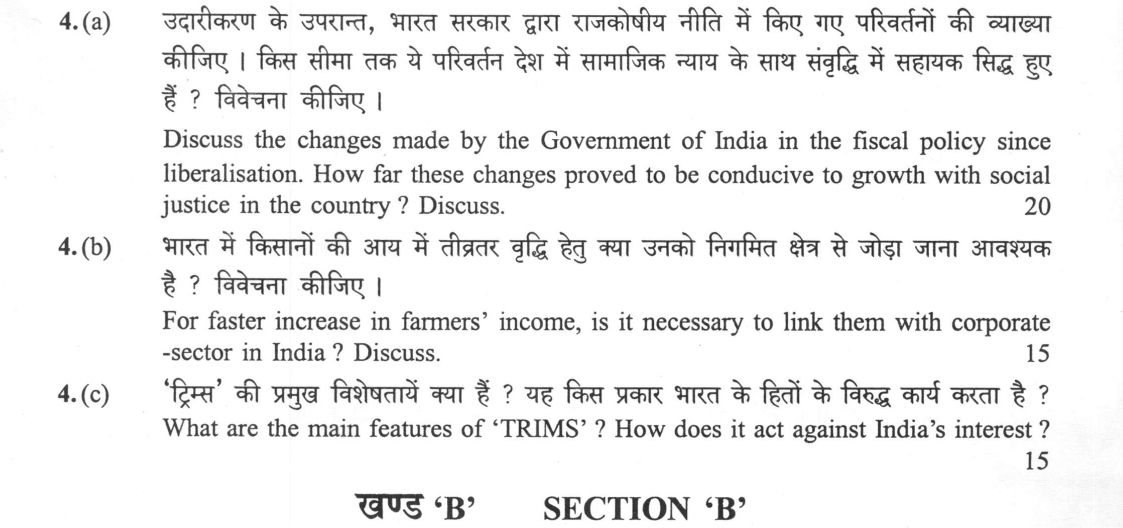
Discuss the changes made by the Government of India in the fiscal policy since liberalisation. How far these changes proved to be conducive to growth with social justice in the country ? Discuss. 20 marks
For faster increase in farmers' income, is it necessary to link them with corporate sector in India ? Discuss. 15 marks
What are the main features of 'TRIMS' ? How does it act against India's interest ? 15 marks
हिंदी में प्रश्न पढ़ें
उदारीकरण के उपरान्त, भारत सरकार द्वारा राजकोषीय नीति में किए गए परिवर्तनों की व्याख्या कीजिए । किस सीमा तक ये परिवर्तन देश में सामाजिक न्याय के साथ संवृद्धि में सहायक सिद्ध हुए हैं ? विवेचना कीजिए । (20 अंक)
भारत में किसानों की आय में तीव्रतर वृद्धि हेतु क्या उनको निगमित क्षेत्र से जोड़ा जाना आवश्यक है ? विवेचना कीजिए । (15 अंक)
'ट्रिम्स' की प्रमुख विशेषताएं क्या हैं ? यह किस प्रकार भारत के हितों के विरुद्ध कार्य करता है ? (15 अंक)
Model answer
Written by UPSC Answer Check against this question's marking rubric, to the expected length. UPSC does not publish answers for Mains — this is one way to score well, not an official key.
Fiscal policy since liberalisation Since 1991, India’s fiscal policy moved from a high-subsidy, plan-dominated model to deficit discipline, tax-base expansion and targeted welfare. Fiscal deficits were brought down from double-digit levels to single digits, and the FRBM Act, 2003 introduced a 3 per cent fiscal-deficit target, later amended in 2018 to 4.5 per cent by 2022-23 and a 40 per cent debt ceiling, with deviation clauses. Customs duties were progressively reduced, integrating India into global value chains; GST in 2017 broadened the indirect-tax base and reduced cascading taxes; and subsidies for food, fertiliser and LPG were rationalised through targeted delivery. The plan/non-plan classification was dropped, and recent budgets have raised capital expenditure as a share of revenue expenditure for infrastructure.
These changes supported growth, with GDP growth accelerating in the 2000s, by reducing inflationary pressure, improving credit availability and attracting investment. Yet social justice remains uneven. Growth has been jobless in parts, and inequality indicators such as the Palma ratio and Oxfam estimates show widening income gaps. MGNREGA and Ayushman Bharat act as corrective safety nets, but rising debt and revenue deficits constrain fiscal space for welfare. Fiscal consolidation improved macro stability, but inclusion requires stronger social spending, progressive taxation and public investment in health, education and rural infrastructure. FRBM targets improved market confidence but sometimes constrained public investment; recent capex push aims to crowd in private investment. Subsidy rationalisation freed resources but required compensatory schemes.
Corporate linkage for farmers’ income Linking farmers with the corporate sector can raise income through contract farming under the Model APMC Act, 2003 and the Farm Acts, 2020 (later repealed), FPOs, agri-startups, food-processing linkages and e-NAM. Corporates can provide technology, credit, quality inputs, cold chains, export-market access and assured markets, reducing marketing risk. FPOs can aggregate smallholdings, improve bargaining power and access credit. e-NAM can improve price discovery across mandis, while food-processing linkages under PM Kisan SAMPADA can add value to perishables.
However, corporate farming may favour large, irrigated farms and create crop-suitability mismatches. Small and marginal farmers, especially landless labourers, may face contract exploitation, input cost pressure, single-buyer dependence and weak enforcement. Hence corporate linkage is useful but not sufficient. State-led cooperatives such as Amul, SHG-based collectives, PM-KISAN, Bhavantar Bhugtan Yojana and public investment in irrigation, storage and rural infrastructure are equally necessary. Before deeper corporate integration, land records, irrigation, credit and contract enforcement must be strengthened. A mixed model—corporate efficiency with cooperative protection and direct income support—is more likely to raise farmers’ income inclusively.
TRIMs and India’s interest The WTO Agreement on TRIMs disciplines trade-related investment measures inconsistent with GATT Articles III and XI. It applies to goods, not services. Prohibited measures include local-content requirements, trade-balancing requirements, foreign-exchange restrictions, and restrictions on exports of goods for local production. It does not per se prohibit export-performance requirements, though export-linked measures must not operate as prohibited trade-balancing or export restrictions. TRIMs does not ban all investment incentives; it bans only those that distort trade, allowing WTO-consistent R&D, skill development and infrastructure support.
TRIMs constrains India’s policy space for infant-industry protection, technology transfer and domestic value addition. India had to phase out indigenous-content requirements in the auto sector, and its EPZ export incentives and software promotion policies were not per se TRIMs violations, but had to be designed so that they did not operate as prohibited trade-balancing or export restrictions; software as a service is outside TRIMs. Residual tensions appear in solar domestic-content disputes and Make in India/Atmanirbhar Bharat measures. In bilateral investment treaties, India must avoid TRIMs-like local-content or trade-balancing obligations. India should use subsidies that are specific but trade-compliant, and negotiate technology transfer through voluntary FDI, not local-content mandates. Therefore, while TRIMs promotes trade discipline, it limits India’s ability to use investment-linked industrial policy for inclusive manufacturing growth. The way forward is to pair fiscal consolidation with social spending, cooperative-corporate farming, and trade-compliant industrial policy.
What "Discuss" is asking you to do
Lay the issue out from more than one side — how it arose, what is claimed for it, what is held against it, and where it now stands. UPSC attaches discuss to broad topics with several live dimensions, so coverage of the dimensions earns more than the strength of your opinion.
Structure that answers it
Set the issue up → the case as it is made → the case against → the dimension both sides leave out → where the balance now lies
Where marks are lost
Listing facts with no thread between them, or arguing one side throughout and calling it a discussion.
How this answer will be evaluated
Approach
Framework: UPSC Economics Paper II Rubric. (a) discuss: intro > 3-4 dimensions > example > balanced close | (b) discuss: intro > 3-4 dimensions > example > balanced close | (c) explain: definition/context > points in order > small example > short close Full marks: Comprehensive analysis with data, balanced arguments, and clear policy implications.
Key points expected
- Define fiscal policy changes (taxation/expenditure) post-1991
- Explain shift from direct to indirect tax reliance
- Link fiscal changes to GDP growth figures
- Critically evaluate impact on social justice (inequality)
- Define corporate-farmer linkage (contract farming)
- Identify benefits: market access, technology, credit
- Identify risks: exploitation, dependency, land issues
- Provide a balanced conclusion on necessity
Evaluation rubric
Each sub-part is marked on its own, against the marks and word limit printed on the paper.
- (a) Analyze post-1991 fiscal policy shifts and their impact on growth vs. social justice. 20 marks
discuss— intro → 3-4 dimensions → example → balanced close
Must cover
- Define fiscal policy changes (taxation/expenditure) post-1991
- Explain shift from direct to indirect tax reliance
- Link fiscal changes to GDP growth figures
- Critically evaluate impact on social justice (inequality)
Loses marks
- Focusing only on monetary policy
- Ignoring the social justice dimension
- Listing changes without analyzing impact
Earns more
- Mention GST implementation and its fiscal impact
- Reference specific budget allocations for social sectors
- Cite data on Gini coefficient or poverty lines
- Discuss the role of fiscal deficit in growth
Extra mark
- Reference specific Economic Survey data
- Mention named economists (e.g., Raghuram Rajan)
- (b) Evaluate the necessity of corporate-farmer linkage for income growth. 15 marks
discuss— intro → 3-4 dimensions → example → balanced close
Must cover
- Define corporate-farmer linkage (contract farming)
- Identify benefits: market access, technology, credit
- Identify risks: exploitation, dependency, land issues
- Provide a balanced conclusion on necessity
Loses marks
- Ignoring the risks of corporate dominance
- Focusing only on small-scale farming
- Failing to address the 'income' aspect specifically
Earns more
- Mention specific schemes (e.g., PMFME)
- Discuss the role of FPOs (Farmer Producer Organizations)
- Reference the Agricultural Produce Market Committee (APMC) reforms
- Cite examples of successful corporate linkages
Extra mark
- Reference specific contract farming laws
- Mention specific corporate players in agri
- (c) Define TRIMS and explain its negative impact on India's interests. 15 marks
explain— definition/context → points in order → small example → short close
Must cover
- Define TRIMS (Trade-Related Investment Measures)
- List main features (local content, trade balancing)
- Explain how TRIMS restricts FDI inflows
- Analyze impact on India's industrial growth
Loses marks
- Confusing TRIMS with TRIPS
- Failing to explain the 'against interest' part
- Listing features without explaining their impact
Earns more
- Mention the WTO TRIMS Agreement
- Discuss the impact on infant industries
- Reference specific sectors affected (e.g., auto)
- Explain the conflict with national interest
Extra mark
- Reference specific WTO dispute cases
- Mention specific Indian policy responses
Practice this exact question
Write your answer and it is marked point by point against the model answer above — what you covered, what you missed, what you got wrong.
Evaluate my answer →More from Economics 2024 Paper II
- Q1 Answer the following questions in about 150 words each: (a) Mention the items of 'Economi…
- Q2 (a) What schemes are launched by the Government to deal with the problem of unemployment…
- Q3 (a) Highlight the role of MSMEs in Indian Economy. What steps have been taken by the Gove…
- Q4 (a) Discuss the changes made by the Government of India in the fiscal policy since libera…
- Q5 Answer the following questions in about 150 words each: (a) Examine the alternative model…
- Q6 (a) Evaluate the policy of Government of India with regard to foreign investment in the c…
- Q7 (a) Distinguish between fiscal federalism, fiscal consolidation and cooperative federalis…