Paper II — Q7
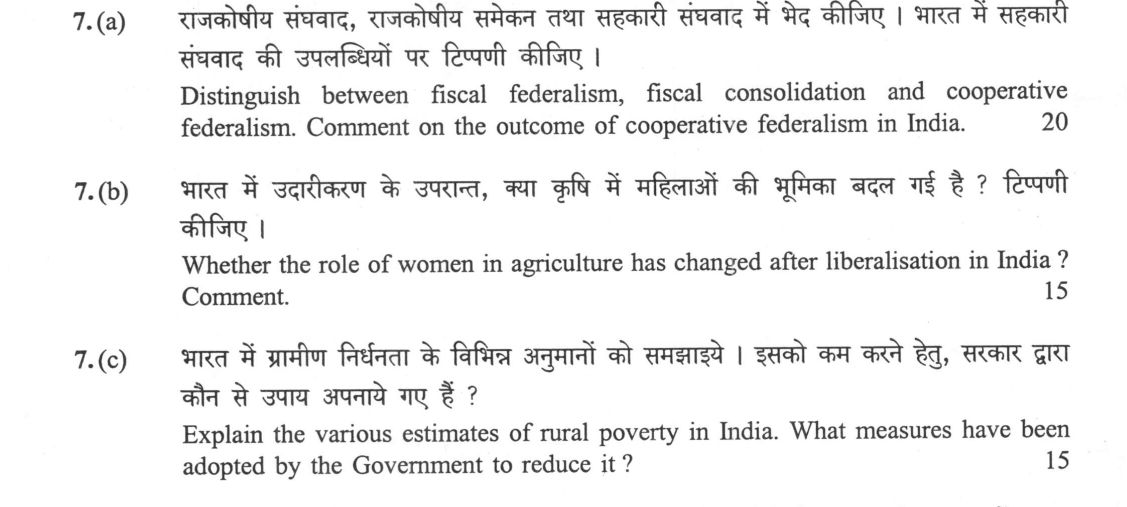
(a) Distinguish between fiscal federalism, fiscal consolidation and cooperative federalism. Comment on the outcome of cooperative…
Distinguish between fiscal federalism, fiscal consolidation and cooperative federalism. Comment on the outcome of cooperative federalism in India. 20 marks
Whether the role of women in agriculture has changed after liberalisation in India ? Comment. 15 marks
Explain the various estimates of rural poverty in India. What measures have been adopted by the Government to reduce it ? 15 marks
हिंदी में प्रश्न पढ़ें
राजकोषीय संघवाद, राजकोषीय समेकन तथा सहकारी संघवाद में भेद कीजिए । भारत में सहकारी संघवाद की उपलब्धियों पर टिप्पणी कीजिए । (20 अंक)
भारत में उदारीकरण के उपरांत, क्या कृषि में महिलाओं की भूमिका बदल गई है ? टिप्पणी कीजिए । (15 अंक)
भारत में ग्रामीण निर्धनता के विभिन्न अनुमानों को समझाइये । इसको कम करने हेतु, सरकार द्वारा कौन से उपाय अपनाये गए हैं ? (15 अंक)
Model answer
Written by UPSC Answer Check against this question's marking rubric, to the expected length. UPSC does not publish answers for Mains — this is one way to score well, not an official key.
Conceptual Distinctions and Outcomes of Cooperative Federalism
Fiscal federalism is characterized by the constitutional division of revenue-raising powers and expenditure responsibilities across government tiers to resolve vertical and horizontal imbalances—a structural property absent in the other two concepts. Fiscal consolidation, by contrast, uniquely possesses the property of time-bound macroeconomic targets for deficit reduction and debt sustainability (e.g., the FRBM Act). Cooperative federalism uniquely embodies institutionalized consensus-building and collaborative decision-making between the Union and States.
In India, the outcomes of cooperative federalism present a mixed record. Institutional shifts include the replacement of the Planning Commission with NITI Aayog, the 15th Finance Commission maintaining a high tax devolution of 41%, and the creation of the GST Council as a constitutional joint decision-making body (Article 279A). Key successes include the historic implementation of the nationwide GST regime and unified crisis management during the COVID-19 pandemic under the Disaster Management Act.
However, structural limitations persist. The proliferation of tied Centrally Sponsored Schemes (CSS) imposes rigid conditionalities on state priorities. The Union’s increasing reliance on cesses and surcharges shrinks the net divisible tax pool, while extensive resort to Article 282 for discretionary grants bypasses statutory Finance Commission channels. Furthermore, past frictions over delayed GST compensation cess payments and curbs on state off-budget borrowings demonstrate that cooperative federalism remains constrained by central dominance.
Changing Role of Women in Agriculture Post-Liberalisation
Post-1991 economic reforms transformed the agrarian economy, transitioning women’s roles from subsistence unpaid family labor to complex, casualized participation. Male distress out-migration to urban informal sectors catalyzed a "feminization of farm management," wherein women increasingly manage operational holdings despite lacking formal land titles, institutional credit, and extension access. Concurrently, NSSO and Periodic Labour Force Survey (PLFS) data reflect a long-term withdrawal of women from conventional agricultural workforce participation alongside informal casualization.
Macroeconomic structural adjustments also impacted female labor negatively through reduced public agricultural investment and land acquisitions for Special Economic Zones (SEZs), which displaced female agricultural laborers. On the other hand, commercialization expanded female engagement in non-crop allied sectors, particularly livestock, dairy, and poultry farming. Women have also integrated into newer supply chains through contract farming, export agro-processing units, and women-led Farmer Producer Organisations (FPOs) mobilized under the Deendayal Antyodaya Yojana-NRLM.
Rural Poverty: Estimates and Mitigation Measures
Rural poverty estimation methodologies have transitioned from expenditure thresholds to multidimensional deprivations:
- Tendulkar Committee (2009): Moved away from calorie norms to a uniform poverty line basket (PLB) incorporating health and education expenditures using the Mixed Reference Period (MRP), estimating rural poverty at 25.7% for 2011-12.
- Rangarajan Committee (2014): Recalibrated poverty lines using separate nutrient norms and essential non-food expenses via the Modified Mixed Reference Period (MMRP), determining rural poverty at a higher 30.9% for 2011-12.
- NITI Aayog Multidimensional Poverty Index (MPI 2021): Utilizing the Alkire-Foster method across 12 indicators spanning health, education, and living standards, the MPI demonstrated a decline in multidimensional rural poverty from 32.59% (NFHS-4) to 19.28% (NFHS-5).
Government anti-poverty interventions deploy a lifecycle social-safety approach:
- Livelihood and Income: Mahatma Gandhi National Rural Employment Guarantee Act (MGNREGA) provides guaranteed wage employment; PM-KISAN offers direct income support to landholding farmers.
- Basic Needs and Health: National Food Security Act (NFSA) ensures subsidized grain entitlements; Pradhan Mantri Awas Yojana-Gramin delivers pucca housing; Ayushman Bharat (PM-JAY) provides catastrophic health risk protection.
- Community-led Models: Sub-national innovations like Kerala’s Kudumbashree showcase poverty eradication through women-led micro-enterprises and local governance.
Sustainable poverty reduction fundamentally depends on robust cooperative federalism that grants fiscal flexibility to States, alongside gender-responsive agricultural policies that secure land rights and credit for women farmers.
What "Distinguish" is asking you to do
Name the property that separates the items and say which side holds it. Distinguish is marked exactly as differentiate is, with no difference in expectation, but its stems more often line up three terms rather than two — gender equality, gender equity and empowerment — and every pair in the set has to be separated.
Structure that answers it
The category they all sit in → the property dividing the first pair → the second pair → the third → why the boundary matters in practice
Where marks are lost
Separating the two obviously different items and leaving the middle term unplaced. A description of each side from which the line must be inferred is marked as description, not as a distinction.
How this answer will be evaluated
Approach
Framework: Fiscal Federalism & Rural Development. (a) compare: paired headings or table > key differences > significance > conclusion | (b) comment: context > arguments both sides > judgment > close | (c) explain: definition/context > points in order > small example > short close Full marks: Clear distinctions, specific Indian examples, data-driven, balanced judgment
Key points expected
- Define fiscal federalism, consolidation, and cooperative federalism
- Distinguish between the three concepts clearly
- Comment on the outcome of cooperative federalism in India
- Provide specific examples of cooperative federalism in India
- Define women's role in agriculture pre-liberalisation
- Identify changes post-1991 liberalisation
- Provide evidence of changes or continuity
- Offer balanced judgment on the extent of change
Evaluation rubric
Each sub-part is marked on its own, against the marks and word limit printed on the paper.
- (a) Distinguish three fiscal concepts and evaluate cooperative federalism's outcome in India. 20 marks
compare— paired headings or table → key differences → significance → conclusion
Must cover
- Define fiscal federalism, consolidation, and cooperative federalism
- Distinguish between the three concepts clearly
- Comment on the outcome of cooperative federalism in India
- Provide specific examples of cooperative federalism in India
Loses marks
- Confusing fiscal federalism with cooperative federalism
- No specific Indian examples for cooperative federalism
- Vague generalities without concrete mechanisms
Earns more
- Reference to 14th/15th Finance Commission
- Mention of GST Council as cooperative mechanism
- Data on state fiscal autonomy
- Reference to 73rd/74th Amendments
Extra mark
- Specific data on state debt levels
- Reference to specific cooperative federalism initiatives
- (b) Assess whether women's role in agriculture changed post-liberalisation in India. 15 marks
comment— context → arguments both sides → judgment → close
Must cover
- Define women's role in agriculture pre-liberalisation
- Identify changes post-1991 liberalisation
- Provide evidence of changes or continuity
- Offer balanced judgment on the extent of change
Loses marks
- No distinction between pre and post-liberalisation
- Ignoring structural changes in agriculture
- No evidence or data to support claims
Earns more
- Reference to NFHS or NSSO data
- Mention of agricultural mechanisation impact
- Reference to land ownership changes
- Mention of MGNREGA impact on women
Extra mark
- Specific state-level data on women's participation
- Reference to specific agricultural policy changes
- (c) Explain rural poverty estimates and government measures to reduce it. 15 marks
explain— definition/context → points in order → small example → short close
Must cover
- Explain various estimates of rural poverty in India
- Mention different poverty lines or methods
- List government measures to reduce rural poverty
- Connect measures to poverty reduction outcomes
Loses marks
- No distinction between different poverty estimates
- Listing schemes without explaining their poverty impact
- No data or evidence for poverty levels
Earns more
- Reference to Tendulkar Committee
- Mention of PLI or BPL methodology
- Reference to specific schemes like MGNREGA
- Data on poverty reduction over time
Extra mark
- Specific poverty ratio data from different estimates
- Reference to recent poverty line revisions
Practice this exact question
Write your answer and it is marked point by point against the model answer above — what you covered, what you missed, what you got wrong.
Evaluate my answer →More from Economics 2024 Paper II
- Q4 (a) Discuss the changes made by the Government of India in the fiscal policy since libera…
- Q5 Answer the following questions in about 150 words each: (a) Examine the alternative model…
- Q6 (a) Evaluate the policy of Government of India with regard to foreign investment in the c…
- Q7 (a) Distinguish between fiscal federalism, fiscal consolidation and cooperative federalis…
- Q8 (a) What are the main objectives of monetary policy adopted by the R.B.I. during last 5 y…