Paper II — Q6
(a) Evaluate the policy of Government of India with regard to foreign investment in the country. Do you feel that there is a need…
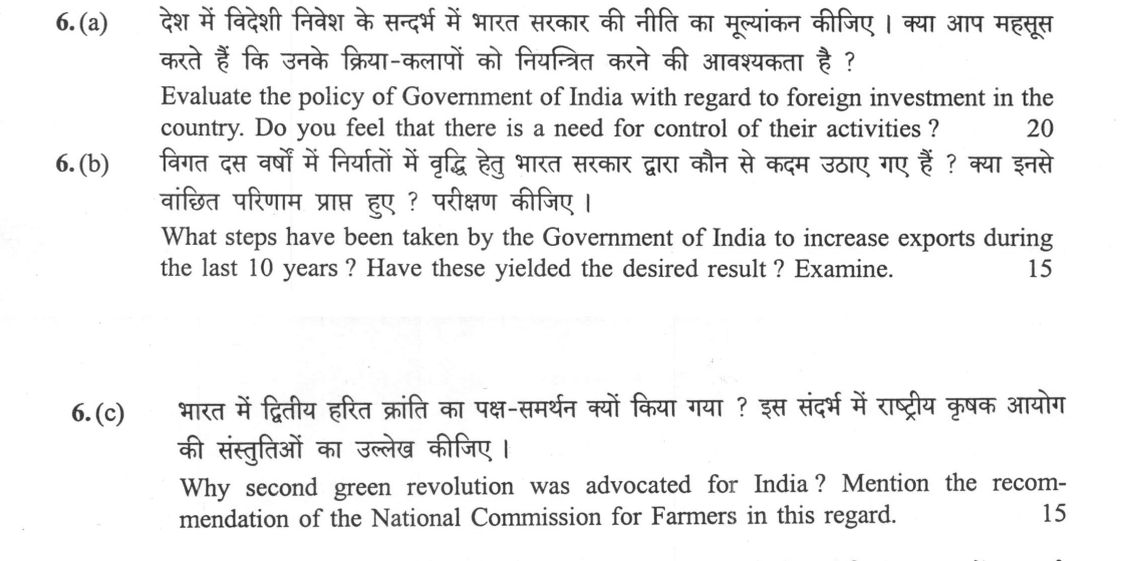
Evaluate the policy of Government of India with regard to foreign investment in the country. Do you feel that there is a need for control of their activities ? 20 marks
What steps have been taken by the Government of India to increase exports during the last 10 years ? Have these yielded the desired result ? Examine. 15 marks
Why second green revolution was advocated for India ? Mention the recommendation of the National Commission for Farmers in this regard. 15 marks
हिंदी में प्रश्न पढ़ें
देश में विदेशी निवेश के सन्दर्भ में भारत सरकार की नीति का मूल्यांकन कीजिए । क्या आप महसूस करते हैं कि उनके क्रिया-कलापों को नियंत्रित करने की आवश्यकता है ? (20 अंक)
विगत दस वर्षों में निर्यातों में वृद्धि हेतु भारत सरकार द्वारा कौन से कदम उठाए गए हैं ? क्या इनसे वांछित परिणाम प्राप्त हुए ? परीक्षण कीजिए । (15 अंक)
भारत में द्वितीय हरित क्रांति का पक्ष-समर्थन क्यों किया गया ? इस संदर्भ में राष्ट्रीय कृषक आयोग की संस्तुतियों का उल्लेख कीजिए । (15 अंक)
Model answer
Written by UPSC Answer Check against this question's marking rubric, to the expected length. UPSC does not publish answers for Mains — this is one way to score well, not an official key.
India’s macroeconomic architecture balances external capital, trade competitiveness, and rural transformation. Foreign investment and export capacity serve as vital engines to finance growth and modernize domestic value chains, particularly in agriculture.
Foreign Investment Policy and the Need for Regulation
India’s foreign direct investment (FDI) regime has evolved from a pre-1991 restrictive, import-substituting framework governed by FERA to an open, post-1991 regime under FEMA. The current framework operates through two channels: the Automatic Route, covering the vast majority of sectors, and the Government Route for sensitive domains. Sectoral caps have been progressively eased, expanding defence to 74% under the automatic route (100% via government approval), insurance to 74%, and single-brand retail to 100%. In multi-brand retail, FDI remains capped at 51% with mandatory domestic sourcing conditions, while the Foreign Investment Promotion Board (FIPB) was abolished to enhance administrative efficiency.
Evaluating this policy reveals that while FDI inflows have provided stable, non-debt capital and integrated Indian industry into global supply chains, calibrated regulatory control remains indispensable. First, national security considerations require targeted oversight, as demonstrated by Press Note 3 (2020), which mandated prior government approval for investments from countries sharing land borders to curb opportunistic takeovers. Second, regulatory checks prevent aggressive transfer pricing and excessive profit repatriation, ensuring genuine domestic technology transfer and value addition. Third, FDI limits in multi-brand retail protect millions of livelihoods in the unorganized retail and small farming sectors from predatory pricing. The appropriate policy stance is not protectionist obstruction, but strategic regulation that safeguards economic sovereignty while maintaining an investor-friendly climate.
Export Promotion Measures (Last 10 Years) and Outcomes
Over the past decade, the Government has implemented structural and fiscal measures to scale exports: The Remission of Duties and Taxes on Exported Products (RoDTEP) replaced earlier non-WTO-compliant schemes; the Export Promotion Capital Goods (EPCG) framework was streamlined; and the Production-Linked Incentive (PLI) scheme was rolled out across 14 manufacturing sectors. Concurrently, India revitalized its trade policy through modern Free Trade Agreements (FTAs), notably the India-UAE CEPA and the India-Australia ECTA, alongside the ‘Districts as Export Hubs’ initiative.
These measures have yielded mixed results. On the positive side, total exports reached a record high exceeding $775 billion in FY23, driven by resilient services exports (information technology and business consulting) and rapid growth in electronics manufacturing and smartphone exports under PLI. However, structural deficits persist. Merchandise exports remain vulnerable to global demand shocks, with the export-to-GDP ratio remaining largely range-bound between 20% and 22%. Market diversification beyond traditional Western destinations remains slow, and the merchandise trade deficit continues to be wide due to heavy import dependencies on crude oil, gold, and critical electronic components.
The Second Green Revolution and NCF Recommendations
The call for a Second Green Revolution emerged because the initial Green Revolution of the 1960s resulted in severe ecological and spatial distortions: acute groundwater depletion, soil salinity and nutrient imbalance, crop monoculture vulnerability, and regional concentration in north-western India. Yields in these green revolution heartlands hit a plateau. The Second Green Revolution is conceived to be ecologically sustainable, nutrition-focused, and regionally balanced, specifically targeting rainfed agro-ecosystems and the eastern states (Bringing Green Revolution to Eastern India).
The National Commission on Farmers (NCF), chaired by Prof. M.S. Swaminathan, provided the blueprint for this transformation:
- Pricing and Returns: Setting the Minimum Support Price (MSP) at a minimum of 50% over the comprehensive cost of production (C2 + 50%).
- Credit and Risk Management: Reducing agricultural credit interest rates to 4%, establishing an Agriculture Risk Fund, and restructuring debt during consecutive natural calamities.
- Resource Conservation: Prioritizing aquifer recharge, participatory watershed management, and soil health testing.
- Value Addition and Markets: Expanding post-harvest infrastructure, setting up state-of-the-art grading and storage facilities, and fostering farmer-centric market access.
Despite significant progress in soil health cards and rural credit expansion, implementation gaps remain regarding statutory MSP guarantees and tenancy security.
Verdict
India's long-term economic resilience depends on the structural synergy of these three pillars: attracting foreign capital into high-technology food processing and industrial manufacturing, converting these investments into export competitiveness, and implementing the Swaminathan Commission’s ecological and pricing reforms to ensure agricultural sustainability. Regulatory controls on foreign capital must serve targeted strategic priorities, while export and farm policies must address domestic structural bottlenecks to deliver balanced growth.
What "Evaluate" is asking you to do
Judge how well something has performed against the standard it set for itself — its stated aim, mandate or promise — and commit to a verdict. Name the yardstick before you judge; an unanchored judgement reads as opinion.
Structure that answers it
Name the yardstick — stated aim, mandate or benchmark → performance against it → shortfall against it → why the gap exists → verdict
Where marks are lost
Presenting both sides and then declining to decide, or delivering a verdict against a standard you never stated, which makes it look arbitrary.
How this answer will be evaluated
Approach
Framework: UPSC General Studies Paper II (Economics). (a) evaluate: criteria > evidence > balanced judgment | (b) examine: intro > how/why with reasoning > evidence > conclusion | (c) explain: definition/context > points in order > small example > short close Full marks: Precise policy analysis with specific data, balanced judgment, and clear linkage between measures and outcomes.
Key points expected
- Define FDI and distinguish FDI from FPI
- Explain the Automatic vs. Approval route mechanism
- Cite specific sectoral caps (e.g., Media, Defence, Insurance)
- Provide a balanced judgment on the need for control
- List key measures (e.g., RoDTEP, EPCG, SEZs)
- Explain the mechanism of at least two measures
- Provide evidence of export growth or stagnation
- Conclude on whether desired results were achieved
Evaluation rubric
Each sub-part is marked on its own, against the marks and word limit printed on the paper.
- (a) Assess India's FDI policy and justify the need for regulatory control. 20 marks
evaluate— criteria → evidence → balanced judgment
Must cover
- Define FDI and distinguish FDI from FPI
- Explain the Automatic vs. Approval route mechanism
- Cite specific sectoral caps (e.g., Media, Defence, Insurance)
- Provide a balanced judgment on the need for control
Loses marks
- Confusing FDI with FPI or Portfolio Investment
- Ignoring the 'National Interest' aspect of control
- Listing sectors without explaining the policy logic
Earns more
- Mention the 2017 FDI Policy Amendment
- Reference the 'National Interest Test' for FDI
- Cite RBI or DPIIT data on FDI inflows
- Discuss the 'Negative List' approach
Extra mark
- Reference the 2020 FDI policy change for China
- Mention the 'Make in India' initiative
- (b) Analyze export promotion measures and assess their effectiveness. 15 marks
examine— intro → how/why with reasoning → evidence → conclusion
Must cover
- List key measures (e.g., RoDTEP, EPCG, SEZs)
- Explain the mechanism of at least two measures
- Provide evidence of export growth or stagnation
- Conclude on whether desired results were achieved
Loses marks
- Listing measures without explaining their mechanism
- Ignoring the 'desired result' part of the question
- Focusing only on imports or trade deficit
Earns more
- Mention the 'Meri Export First' campaign
- Reference the 'Production Linked Incentive' (PLI) scheme
- Cite specific export data (e.g., IT services, pharma)
- Discuss the impact of global supply chain shifts
Extra mark
- Reference the 'Viksit Bharat' export target
- Mention the 'One District One Product' (ODOP) scheme
- (c) Justify the Second Green Revolution and list NCF recommendations. 15 marks
explain— definition/context → points in order → small example → short close
Must cover
- Define the Second Green Revolution (2GR)
- Explain why it is advocated (e.g., climate, food security)
- List specific recommendations of the National Commission for Farmers
- Connect NCF recommendations to the 2GR goals
Loses marks
- Confusing 1GR with 2GR
- Listing NCF recommendations without linking to 2GR
- Ignoring the 'why' part of the question
Earns more
- Mention 'Climate Resilient Agriculture'
- Reference 'Crop Diversification' and 'Millets'
- Cite the 'Swaminathan Commission' (NCF) report
- Discuss 'Sustainable Intensification'
Extra mark
- Reference the 'National Food Security Mission' (NFSM)
- Mention the 'National Mission on Sustainable Agriculture' (NMSA)
Practice this exact question
Write your answer and it is marked point by point against the model answer above — what you covered, what you missed, what you got wrong.
Evaluate my answer →More from Economics 2024 Paper II
- Q3 (a) Highlight the role of MSMEs in Indian Economy. What steps have been taken by the Gove…
- Q4 (a) Discuss the changes made by the Government of India in the fiscal policy since libera…
- Q5 Answer the following questions in about 150 words each: (a) Examine the alternative model…
- Q6 (a) Evaluate the policy of Government of India with regard to foreign investment in the c…
- Q7 (a) Distinguish between fiscal federalism, fiscal consolidation and cooperative federalis…
- Q8 (a) What are the main objectives of monetary policy adopted by the R.B.I. during last 5 y…