Paper II — Q5
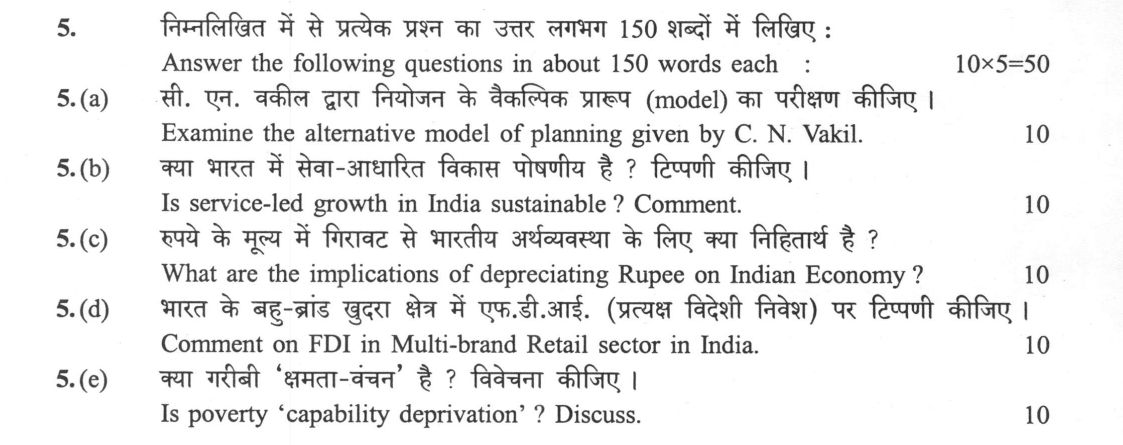
Answer the following questions in about 150 words each: (a) Examine the alternative model of planning given by C. N. Vakil. (10…
Answer the following questions in about 150 words each: Examine the alternative model of planning given by C. N. Vakil. 10 marks
Is service-led growth in India sustainable ? Comment. 10 marks
What are the implications of depreciating Rupee on Indian Economy ? 10 marks
Comment on FDI in Multi-brand Retail sector in India. 10 marks
Is poverty 'capability deprivation' ? Discuss. 10 marks
हिंदी में प्रश्न पढ़ें
निम्नलिखित में से प्रत्येक प्रश्न का उत्तर लगभग 150 शब्दों में लिखिए : सी. एन. वकील द्वारा नियोजन के वैकल्पिक प्रारूप (model) का परीक्षण कीजिए । (10 अंक)
क्या भारत में सेवा-आधारित विकास पोषणीय है ? टिप्पणी कीजिए । (10 अंक)
रुपये के मूल्य में गिरावट से भारतीय अर्थव्यवस्था के लिए क्या निहितार्थ हैं ? (10 अंक)
भारत के बहु-ब्रांड खुदरा क्षेत्र में एफ.डी.आई. (प्रत्यक्ष विदेशी निवेश) पर टिप्पणी कीजिए । (10 अंक)
क्या गरीबी 'क्षमता-वंचन' है ? विवेचना कीजिए । (10 अंक)
Model answer
Written by UPSC Answer Check against this question's marking rubric, to the 150-word length. UPSC does not publish answers for Mains — this is one way to score well, not an official key.
(a) Alternative Model of Planning by C. N. Vakil
C. N. Vakil and P. R. Brahmananda proposed the 'Wage-Goods Model' as an alternative to the heavy-industry-focused Mahalanobis strategy during the Second Five-Year Plan. They identified the principal growth bottleneck not as a deficiency of machines or heavy capital goods, but as a critical shortage of wage-goods—basic consumption essentials such as foodgrains, cloth, and edible oils.
Vakil argued that India possessed vast surplus labour with zero marginal productivity in agriculture. Mobilizing this disguised unemployment for capital creation required an adequate supply of wage-goods to prevent inflationary pressures, operating through the 'wage-goods multiplier'. Since the poor have a high marginal propensity to consume basic necessities and negligible demand for heavy industrial output, prioritizing capital goods restricted employment expansion. The subsequent food shortages of the 1960s, inflationary spikes, and reliance on PL-480 imports vindicated Vakil’s thesis that agricultural development and wage-goods production must precede heavy industrialization.
(b) Sustainability of Service-Led Growth in India
India's post-1991 growth has been uniquely driven by the services sector, led by high-productivity IT-BPM exports (e.g., TCS, Infosys) and financial services, which contribute over 53% to Gross Value Added (GVA). However, the long-term sustainability of this model remains precarious.
High-end modern services are skill-intensive and exhibit low employment elasticity, fostering 'jobless growth' that fails to productively absorb the 45% of the workforce still engaged in low-productivity agriculture. Unlike the East Asian model, which transitioned surplus agrarian labour into low-skilled, export-oriented manufacturing, India skipped this intermediate phase. This pattern aligns with Dani Rodrik’s concept of 'premature deindustrialization', generating deep economic dualism between an enclave of organized service professionals and a massive informal sector. Service-led growth cannot be inclusive or structurally sustainable unless complemented by labour-intensive manufacturing and substantial human capital investments in lower-tier services.
(c) Implications of Depreciating Rupee on the Indian Economy
A depreciating Rupee produces divergent macroeconomic effects across external and domestic sectors. On the positive side, it enhances the price competitiveness of merchandise exports, improves the profit margins of export-oriented software and pharmaceutical firms, and inflates the domestic purchasing value of inward remittances, where India leads globally.
Conversely, the negative implications dominate India's import-dependent structure. Because the country imports over 80% of its crude oil alongside critical fertilizers and electronics, depreciation fuels imported inflation, widening the Current Account Deficit (CAD) and fiscal subsidy burdens. It also inflates the Rupee cost of external debt servicing for corporations holding unhedged External Commercial Borrowings (ECBs). As demonstrated during the 2013 'Taper Tantrum' and the 2022 global monetary tightening episode, the short-run J-curve effect exacerbates balance-of-payments pressures before any export gains materialize, requiring decisive foreign exchange management by the Reserve Bank of India.
(d) FDI in Multi-Brand Retail Sector in India
Foreign Direct Investment (FDI) in Multi-Brand Retail Trading (MBRT) involves balancing modern retail efficiencies against the livelihoods of traditional retailers. Proponents argue that global retail giants introduce modern supply-chain logistics, build farm-gate cold-storage infrastructure, reduce post-harvest agricultural wastage, eliminate intermediaries to improve farmer incomes, and generate formal retail employment.
Opponents highlight the risk of massive displacement of unorganized kirana stores, which lack the scale to withstand predatory pricing, deep discounting, and monopsonistic supply-chain control. Consequently, the 2012 policy permitted up to 51% FDI under the government approval route, subject to stringent riders: mandatory 30% local sourcing from micro, small, and medium enterprises (MSMEs), 50% investment in back-end infrastructure within three years, and implementation left to state-level discretion. The 2018 clarifications on e-commerce foreign investment reinforced these firewalls against inventory-based models. A cautious approach remains essential to modernize supply chains without undermining unorganized retail livelihoods.
(e) Poverty as 'Capability Deprivation'
Amartya Sen reformulated the conceptualization of poverty by defining it as 'capability deprivation' rather than merely low income. In Sen's framework, income is only an instrumental means, whereas real poverty lies in the lack of substantive freedoms and capabilities to achieve basic 'functionings'—the states of being and doing that individuals have reason to value, such as being adequately nourished, educated, healthy, and socially integrated.
This approach critiques traditional unidimensional measures based on Engel's law or minimum caloric intake thresholds, such as those established by the Dandekar-Rath, Alagh, Lakdawala, and Tendulkar committees. Income thresholds overlook non-monetary deprivations, gender inequalities within households, and structural conversion handicaps (e.g., illness or physical disability). Sen's capability perspective underpins the UNDP Human Development Index and the Multidimensional Poverty Index (MPI) utilized by NITI Aayog. Eliminating poverty requires universal public provisioning of quality healthcare, education, and social safety nets.
What "Examine" is asking you to do
Test the proposition the question puts to you and return a finding on how far it holds. Examine stems carry a claim, or ask whether something has happened, and expect evidence weighed both ways before the extent is stated — often with remedial measures attached.
Structure that answers it
Restate the claim as the question frames it → evidence that supports it → evidence that undercuts it → the conditions under which it holds → verdict on how far it stands
Where marks are lost
Stopping at description. An examination has to reach a finding, and “examine with justification” means the extent must be stated, not implied.
How this answer will be evaluated
Approach
Framework: UPSC Economics Paper II. (a) examine: intro > how/why with reasoning > evidence > conclusion | (b) comment: context > arguments both sides > judgment > close | (c) analyse: intro > causes > effects > stakeholders/linkages > way forward | (d) comment: context > arguments both sides > judgment > close | (e) discuss: intro > 3-4 dimensions > example > balanced close Full marks: Comprehensive, well-structured, with data and named references
Key points expected
- Define Vakil's model of planning
- Contrast with standard planning models
- Explain the reasoning behind the model
- Provide evidence or examples
- Define service-led growth
- Present arguments for sustainability
- Present arguments against sustainability
- Provide a balanced judgment
Evaluation rubric
Each sub-part is marked on its own, against the marks and word limit printed on the paper.
- (a) Examine C.N. Vakil's alternative model of planning. 10 marks · 150 words
examine— intro → how/why with reasoning → evidence → conclusion
Must cover
- Define Vakil's model of planning
- Contrast with standard planning models
- Explain the reasoning behind the model
- Provide evidence or examples
Loses marks
- Verbal answer without model
- Unstated assumptions
- Lack of evidence
Earns more
- Mention specific features of Vakil's model
- Reference relevant economic data
- Discuss policy implications
- Compare with other planning models
Extra mark
- Cite a specific Vakil publication
- Include a relevant diagram
- (b) Comment on sustainability of service-led growth in India. 10 marks · 150 words
comment— context → arguments both sides → judgment → close
Must cover
- Define service-led growth
- Present arguments for sustainability
- Present arguments against sustainability
- Provide a balanced judgment
Loses marks
- One-sided argument
- Lack of data
- No clear judgment
Earns more
- Use Indian economic data
- Reference current policy
- Discuss sectoral contributions
- Mention employment implications
Extra mark
- Cite a recent survey or budget figure
- Name a relevant economist
- (c) Analyse implications of depreciating Rupee on Indian Economy. 10 marks · 150 words
analyse— intro → causes → effects → stakeholders/linkages → way forward
Must cover
- Explain causes of Rupee depreciation
- Discuss effects on trade balance
- Analyse impact on inflation
- Consider stakeholder impacts
Loses marks
- Verbal answer without analysis
- Unstated assumptions
- Lack of stakeholder analysis
Earns more
- Reference exchange rate mechanisms
- Use recent economic data
- Discuss RBI policy responses
- Mention sectoral impacts
Extra mark
- Cite a specific RBI policy
- Include a relevant diagram
- (d) Comment on FDI in Multi-brand Retail sector in India. 10 marks · 150 words
comment— context → arguments both sides → judgment → close
Must cover
- Define FDI in Multi-brand Retail
- Present arguments for FDI
- Present arguments against FDI
- Provide a balanced judgment
Loses marks
- One-sided argument
- Lack of policy context
- No clear judgment
Earns more
- Reference Indian retail data
- Discuss policy changes
- Mention impact on local retailers
- Consider consumer benefits
Extra mark
- Cite a specific policy or law
- Name a relevant committee
- (e) Discuss whether poverty is 'capability deprivation'. 10 marks · 150 words
discuss— intro → 3-4 dimensions → example → balanced close
Must cover
- Define capability deprivation
- Explain Amartya Sen's framework
- Provide examples of capability deprivation
- Offer a balanced conclusion
Loses marks
- Verbal answer without framework
- Unstated assumptions
- Lack of examples
Earns more
- Reference Sen's work
- Use Indian poverty data
- Discuss policy implications
- Compare with income-based measures
Extra mark
- Cite a specific Sen publication
- Include a relevant diagram
Practice this exact question
Write your answer and it is marked point by point against the model answer above — what you covered, what you missed, what you got wrong.
Evaluate my answer →More from Economics 2024 Paper II
- Q2 (a) What schemes are launched by the Government to deal with the problem of unemployment…
- Q3 (a) Highlight the role of MSMEs in Indian Economy. What steps have been taken by the Gove…
- Q4 (a) Discuss the changes made by the Government of India in the fiscal policy since libera…
- Q5 Answer the following questions in about 150 words each: (a) Examine the alternative model…
- Q6 (a) Evaluate the policy of Government of India with regard to foreign investment in the c…
- Q7 (a) Distinguish between fiscal federalism, fiscal consolidation and cooperative federalis…
- Q8 (a) What are the main objectives of monetary policy adopted by the R.B.I. during last 5 y…