Paper I — Q1
Answer the following questions in about 150 words each : 10×5=50 (a) Show that when prices and income increase in the same…
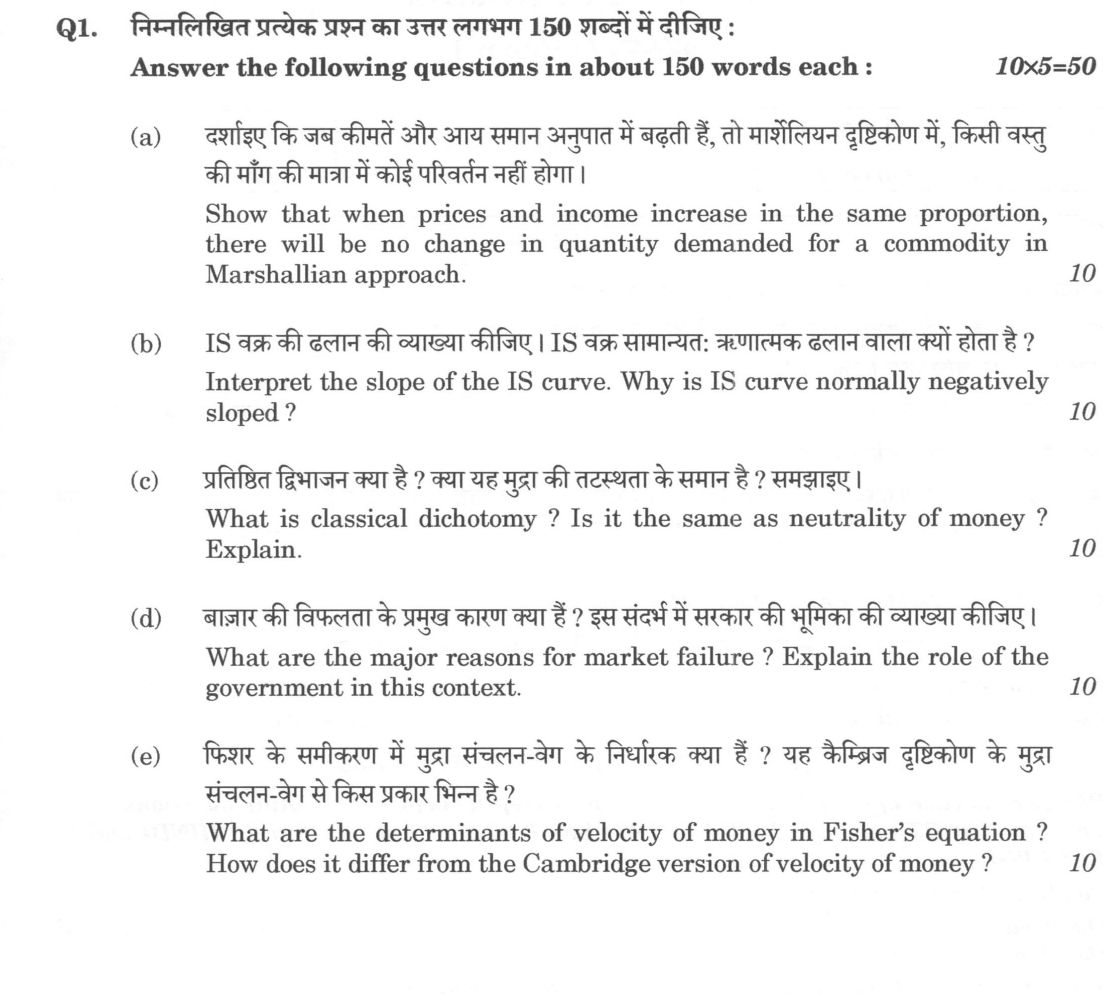
Answer the following questions in about 150 words each : 10×5=50
Show that when prices and income increase in the same proportion, there will be no change in quantity demanded for a commodity in Marshallian approach. 10 marks
Interpret the slope of the IS curve. Why is IS curve normally negatively sloped ? 10 marks
What is classical dichotomy ? Is it the same as neutrality of money ? Explain. 10 marks
What are the major reasons for market failure ? Explain the role of the government in this context. 10 marks
What are the determinants of velocity of money in Fisher's equation ? How does it differ from the Cambridge version of velocity of money ? 10 marks
हिंदी में प्रश्न पढ़ें
निम्नलिखित प्रत्येक प्रश्न का उत्तर लगभग 150 शब्दों में दीजिए :
दर्शाइए कि जब कीमतें और आय समान अनुपात में बढ़ती हैं, तो मार्शलियन दृष्टिकोण में, किसी वस्तु की माँग की मात्रा में कोई परिवर्तन नहीं होगा। 10
IS वक्र की ढलान की व्याख्या कीजिए। IS वक्र सामान्यतः ऋणात्मक ढलान वाला क्यों होता है ? 10 marks
प्रतिष्ठित द्विभाजन क्या है ? क्या यह मुद्रा की तटस्थता के समान है ? समझाइए। 10
बाजार की विफलता के प्रमुख कारण क्या हैं ? इस संदर्भ में सरकार की भूमिका की व्याख्या कीजिए। 10
फिशर के समीकरण में मुद्रा संचलन-वेग के निर्धारक क्या हैं ? यह कैम्ब्रिज दृष्टिकोण के मुद्रा संचलन-वेग से किस प्रकार भिन्न है ? 10 marks
Model answer
Written by UPSC Answer Check against this question's marking rubric, to the 150-word length. UPSC does not publish answers for Mains — this is one way to score well, not an official key.
(a) Let utility be u(x₁, x₂, ..., xₙ), where xᵢ is the quantity of commodity i. Marshallian demand xᵢ(p₁, p₂, ..., pₙ, M) is obtained by maximising u subject to the budget constraint p₁x₁ + p₂x₂ + ... + pₙxₙ = M, with all prices and money income positive. Suppose all prices and money income increase in the same proportion t > 0. The new budget constraint becomes tp₁x₁ + tp₂x₂ + ... + tpₙxₙ = tM. Dividing through by t gives p₁x₁ + p₂x₂ + ... + pₙxₙ = M. Hence the feasible set of commodity bundles is exactly the same as before. Since preferences are unchanged, the utility-maximising bundle is also unchanged.
Formally, the Lagrangian is L = u(x₁, ..., xₙ) + λ(M − p₁x₁ − ... − pₙxₙ). The first-order conditions are ∂u/∂xᵢ = λpᵢ for all i, together with the budget constraint. Eliminating λ between any two goods gives (∂u/∂xᵢ)/(∂u/∂xⱼ) = pᵢ/pⱼ. In the new problem, the same ratio pᵢ/pⱼ is obtained, and after cancelling t the budget constraint is identical. Therefore xᵢ(tp₁, ..., tpₙ, tM) = xᵢ(p₁, ..., pₙ, M). Thus Marshallian demand is homogeneous of degree zero in prices and money income; a proportional rise in all prices and income leaves quantity demanded unchanged. The economic reason is that only relative prices and real income matter. Real income, measured by M/P where P is a suitable price index, remains unchanged, so there is no money illusion.
(b) The IS curve is the locus of combinations of income Y and interest rate r at which the goods market is in equilibrium. In a closed economy with fixed fiscal policy, equilibrium requires Y = C(Y − T) + I(r) + G, where C is consumption, T is taxes, I is investment, and G is government spending. Equivalently, private saving S(Y − T) plus taxes minus government spending equals investment: S(Y − T) + T − G = I(r). To find the slope, differentiate the goods-market equilibrium condition with respect to Y, holding T and G constant: dY = C′(Y − T)dY + I′(r)dr. Hence (1 − C′)dY = I′dr, so dr/dY = (1 − C′)/I′. Since 0 < C′ < 1, the numerator is positive. Since investment is inversely related to the interest rate, I′ < 0. Therefore dr/dY < 0. The IS curve is normally negatively sloped.
The slope measures the change in the interest rate required to restore goods-market equilibrium after a one-unit change in income. Its magnitude is smaller when investment is highly interest-sensitive, i.e. when |I′| is large, and when the marginal propensity to consume C′ is high. It is larger when investment is insensitive to interest and when saving rises strongly with income, i.e. when C′ is low. The negative slope arises because a higher income raises saving and creates an excess of planned saving over planned investment at the initial interest rate. To restore equilibrium, the interest rate must fall so that investment rises. Alternatively, a lower interest rate stimulates investment, which through the multiplier raises equilibrium income. Shifts in G, T, expectations, or autonomous spending shift the IS curve itself.
(c) The classical dichotomy is the analytical separation of the economy into a real sector and a nominal sector. Real variables such as output, employment, real wage, relative prices, and the real interest rate are determined solely by real forces: technology, preferences, endowments, and market clearing. Nominal variables such as money supply, price level, nominal wage, and nominal income are determined by monetary factors. In the classical quantity equation MV = PY, with velocity V and real output Y determined in the real sector, money determines only the price level P. Money is thus treated as a veil.
Neutrality of money means that a change in the nominal money supply leaves all real variables unchanged. Under classical assumptions of flexible prices and wages, absence of money illusion, and stable velocity, a doubling of M doubles P and all nominal magnitudes proportionally. Relative prices and real balances M/P remain unchanged, so output and employment do not change.
The two concepts are related but not identical. The classical dichotomy is the stronger proposition that real variables can be solved independently of nominal variables; nominal variables do not appear in real excess-demand functions. Neutrality is the comparative-static result that changes in money do not affect real variables. Dichotomy generally implies neutrality under classical assumptions, but neutrality can be defined more weakly, for example as a long-run property even when short-run frictions make money non-neutral. Thus the classical dichotomy is not exactly the same as neutrality of money; it is a stronger analytical separation, while neutrality is the absence of real effects of monetary changes.
(d) Market failure occurs when the competitive market fails to achieve a Pareto-efficient allocation. Major reasons include: market power, where monopoly or oligopoly restrict output and set price above marginal cost; externalities, where private costs or benefits differ from social costs or benefits, as in pollution or education; public goods, which are non-rival and non-excludable, leading to free-riding and underprovision; common-pool resources, which are rival but non-excludable and tend to be overused; asymmetric information, causing adverse selection, moral hazard, and missing markets; incomplete markets and coordination failures; and natural monopoly due to increasing returns to scale.
The government can correct these failures through regulation, antitrust policy, Pigouvian taxes and subsidies, cap-and-trade permits, provision or financing of public goods, definition and enforcement of property rights, disclosure requirements, social insurance, and stabilisation policy. However, government intervention may itself fail due to information constraints, rent-seeking, bureaucratic inefficiency, regulatory capture, and political distortions. Thus the role of government is corrective and enabling, but it must be evaluated against the possibility of government failure.
(e) Fisher’s equation of exchange is MV = PT, where M is money supply, V is velocity of money, P is price level, and T is volume of transactions. Velocity is V = PT/M. In Fisher’s approach, V is determined mainly by institutional and technological factors: frequency of wage and salary payments, use of credit and book credit, banking and clearing facilities, availability of money substitutes, transportation and communication, population density, degree of monetisation, and social payment habits. Fisher treated V as broadly stable in the short run.
The Cambridge version is M = kPY, where k is the fraction of nominal income that people choose to hold as cash balances. Here velocity is V = PY/M = 1/k. In the Cambridge approach, k depends on individual and portfolio choices: transactions and precautionary motives, wealth and income, interest rate as the opportunity cost of holding money, price expectations, uncertainty, and financial innovation. It is an income velocity concept, whereas Fisher’s V is a transactions velocity concept.
The key difference is that Fisher emphasises the mechanical and institutional turnover of money as a medium of exchange, often assuming V constant. The Cambridge approach emphasises money as a store of value and derives velocity from the demand for cash balances, making V more variable and sensitive to interest rates and expectations. Hence Fisher treats velocity as largely determined by payment institutions, while Cambridge treats it as the reciprocal of a behavioural cash-balance ratio.
What "Prove" is asking you to do
Establish that the statement holds for every case it claims, not for one representative case. The argument must be closed: each line follows from a definition, a hypothesis, or a named theorem you are entitled to use.
Structure that answers it
Given and to prove, restated → theorem or construction to be used, named → the argument line by line → conclusion stated as proved
Where marks are lost
Testing one example, which illustrates but proves nothing. On an if and only if claim, proving one direction and stopping forfeits that half outright, and degenerate cases — zero, the empty set, the equality case — have to be disposed of rather than assumed away.
How this answer will be evaluated
Approach
Framework: Marshallian Consumer Theory. (a) derive: given > assumptions > stepwise derivation > result > check | (b) explain: definition/context > points in order > small example > short close | (c) explain: definition/context > points in order > small example > short close | (d) explain: definition/context > points in order > small example > short close | (e) compare: paired headings or table > key differences > significance > conclusion Full marks: Rigorous derivation/analysis with clear diagrams and precise terminology.
Key points expected
- State budget constraint P1x1 + P2x2 = M
- Show substitution of kP and kM
- Demonstrate x* remains invariant to k
- Conclude demand is homogeneous of degree zero
- Define IS curve as goods market equilibrium
- Explain interest rate effect on investment
- Link investment to aggregate demand/income
- State the negative slope explicitly
Evaluation rubric
Each sub-part is marked on its own, against the marks and word limit printed on the paper.
- (a) Mathematical proof of homogeneity of degree zero in Marshallian demand. 10 marks · 150 words
derive— given → assumptions → stepwise derivation → result → check
Must cover
- State budget constraint P1x1 + P2x2 = M
- Show substitution of kP and kM
- Demonstrate x* remains invariant to k
- Conclude demand is homogeneous of degree zero
Loses marks
- Verbal explanation without algebraic proof
- Confusing Marshallian with Hicksian demand
Earns more
- Mention of homogeneity property
- Reference to real income vs nominal income
Extra mark
- Graphical illustration of parallel budget line shift
- (b) Interpretation of IS slope and the mechanism of negative relationship. 10 marks · 150 words
explain— definition/context → points in order → small example → short close
Must cover
- Define IS curve as goods market equilibrium
- Explain interest rate effect on investment
- Link investment to aggregate demand/income
- State the negative slope explicitly
Loses marks
- Confusing IS with LM curve
- Failing to link interest rate to income
Earns more
- Mention of marginal propensity to consume
- Reference to investment sensitivity to interest
Extra mark
- Diagram of IS curve with labeled axes
- (c) Definition of classical dichotomy and its relation to money neutrality. 10 marks · 150 words
explain— definition/context → points in order → small example → short close
Must cover
- Define classical dichotomy (real vs nominal)
- Define neutrality of money
- Explain the link between the two concepts
- Mention the assumption of flexible prices
Loses marks
- Treating them as completely unrelated
- Ignoring the price flexibility assumption
Earns more
- Reference to classical economists (Say, Ricardo)
- Mention of long-run vs short-run validity
Extra mark
- Reference to specific classical economist
- (d) Causes of market failure and the role of government intervention. 10 marks · 150 words
explain— definition/context → points in order → small example → short close
Must cover
- List major causes (externalities, public goods, etc.)
- Explain how these lead to inefficiency
- Describe government role (taxes, subsidies, provision)
- Link government action to correcting failure
Loses marks
- Listing causes without explaining the failure
- Ignoring the government's role
Earns more
- Mention of market power/monopoly
- Reference to information asymmetry
Extra mark
- Specific example of government intervention
- (e) Determinants of velocity in Fisher's equation vs Cambridge version. 10 marks · 150 words
compare— paired headings or table → key differences → significance → conclusion
Must cover
- State Fisher's equation (MV=PT)
- List determinants of V in Fisher's view
- State Cambridge equation (M=kPY)
- Contrast the determinants of V (or k) in both
Loses marks
- Confusing the two equations
- Failing to contrast the determinants
Earns more
- Mention of institutional factors in Fisher
- Reference to interest rate in Cambridge
Extra mark
- Reference to specific economist (Fisher vs Keynes)
Practice this exact question
Write your answer and it is marked point by point against the model answer above — what you covered, what you missed, what you got wrong.
Evaluate my answer →More from Economics 2025 Paper I
- Q1 Answer the following questions in about 150 words each : 10×5=50 (a) Show that when price…
- Q2 (a) Derive Marshallian demand curve for an inferior good in a two-commodity framework by…
- Q3 (a) Define liquidity trap. Show that fiscal policy is fully effective in the horizontal p…
- Q4 (a) (i) Explain the effects of public spending on national income, if it is financed thro…