Paper I — Q8
(a) Explain the role of World Trade Organization (WTO) in the present context. Discuss the merits and demerits of TRIMs and…
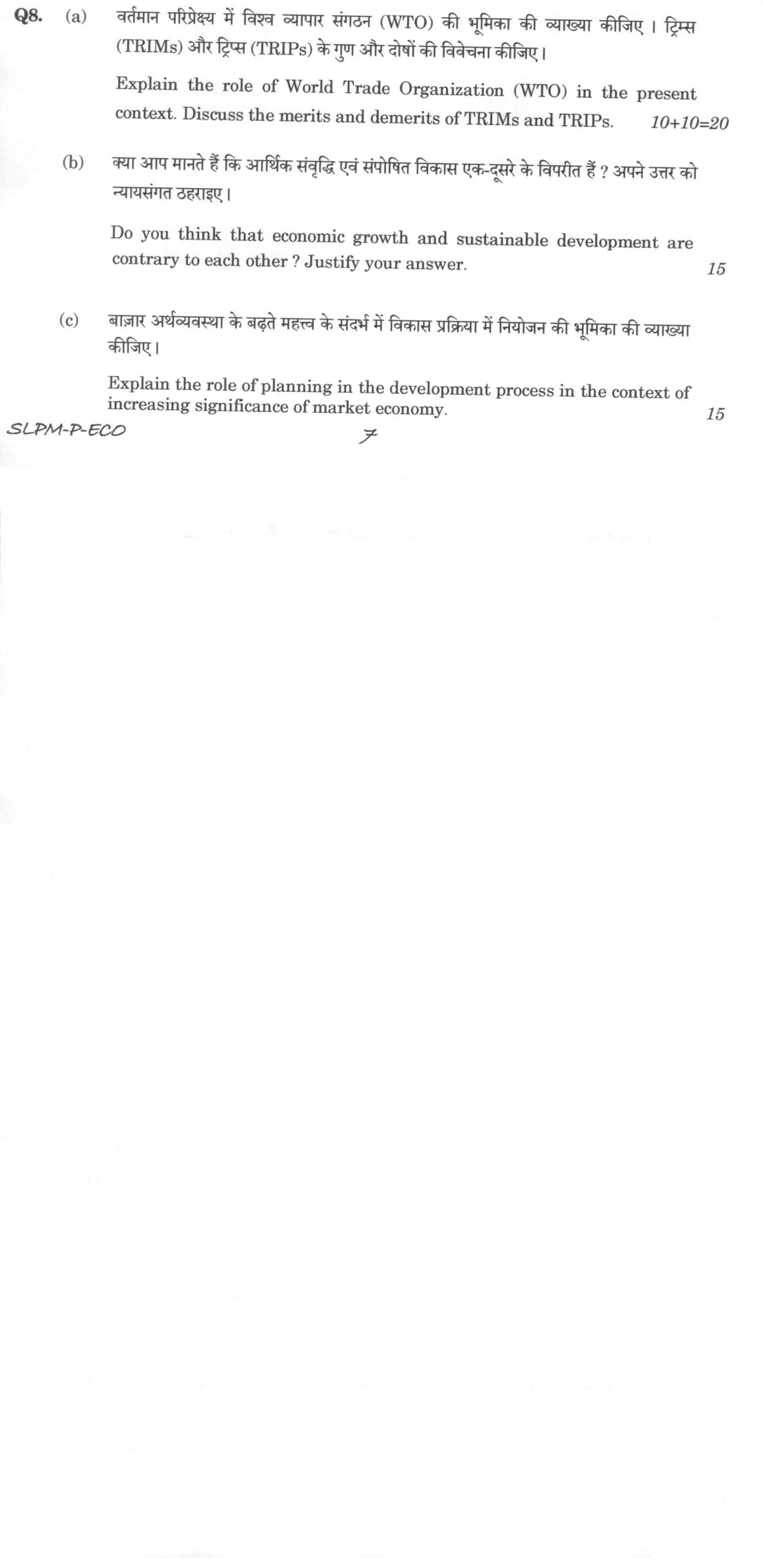
Explain the role of World Trade Organization (WTO) in the present context. Discuss the merits and demerits of TRIMs and TRIPs. 10+10=20
Do you think that economic growth and sustainable development are contrary to each other ? Justify your answer. 15 marks
Explain the role of planning in the development process in the context of increasing significance of market economy. 15 marks
हिंदी में प्रश्न पढ़ें
वर्तमान परिप्रेक्ष्य में विश्व व्यापार संगठन (WTO) की भूमिका की व्याख्या कीजिए । ट्रिम्स (TRIMs) और ट्रिप्स (TRIPs) के गुण और दोषों की विवेचना कीजिए। 10+10=20
क्या आप मानते हैं कि आर्थिक संवृद्धि एवं संपोषित विकास एक-दूसरे के विपरीत हैं ? अपने उत्तर को न्यायसंगत ठहराइए। 15
बाजार अर्थव्यवस्था के बढ़ते महत्व के संदर्भ में विकास प्रक्रिया में नियोजन की भूमिका की व्याख्या कीजिए। 15
Model answer
Written by UPSC Answer Check against this question's marking rubric, to the expected length. UPSC does not publish answers for Mains — this is one way to score well, not an official key.
WTO in the Present Context, TRIMs, and TRIPs
The multilateral trading architecture under the World Trade Organization (WTO) faces systemic friction, marked prominently by the paralysis of its dispute settlement mechanism due to the non-appointment of Appellate Body members. Simultaneously, preserving Special and Differential Treatment (S&DT) remains essential for developing countries to protect food security and rural livelihoods amidst rising global protectionism. Nonetheless, the 12th Ministerial Conference (MC12) demonstrated WTO’s continued relevance through consensus on curbing harmful fisheries subsidies and granting a temporary patent waiver for COVID-19 vaccines.
Trade-Related Investment Measures (TRIMs) eliminate trade-distorting investment policies. Its primary merit is fostering predictable, non-discriminatory foreign direct investment (FDI) inflows and integrating developing nations into global value chains. However, its demerit lies in restricting domestic policy space by prohibiting Local Content Requirements (LCRs). For instance, India had to dismantle its phased indigenisation and export-balancing requirements in the automotive sector following WTO dispute findings.
Trade-Related Aspects of Intellectual Property Rights (TRIPs) establishes uniform intellectual property standards, incentivising global technological research and commercial innovation. Its major demerits include inflated monopoly pricing of life-saving drugs, biopiracy of traditional knowledge, and technological concentration in developed economies. India reconciled TRIPs compliance with public health priorities by enforcing Section 3(d) of the Patents Act, 1970—upheld by the Supreme Court in Novartis v. Union of India (2013) to prevent evergreening—and preserving provisions for Compulsory Licensing.
Economic Growth and Sustainable Development: Contradiction or Compatibility
Economic growth and sustainable development are not inherently contradictory; the tension is contingent on technological adoption, energy intensity, and policy design. The Environmental Kuznets Curve (EKC) hypothesis demonstrates that early stages of industrialisation inevitably degrade natural capital, but post-industrial stages can achieve relative or absolute decoupling between GDP growth and environmental footprint through green technology, circular economy practices, and the UN Sustainable Development Goals (SDG) framework.
Empirical evidence across Indian states illustrates this dynamic. The traditional Gujarat model achieved high per capita output via resource-intensive manufacturing, while the Kerala model prioritised human capital and social safety nets with lower industrial emissions. The NITI Aayog SDG India Index highlights that high-performing states can balance economic dynamism with ecological management. Furthermore, India’s target of 500 GW of non-fossil energy capacity by 2030 proves that clean energy transitions can drive capital formation, energy security, and job creation without retarding economic expansion.
Role of Planning in a Market-Oriented Economy
The expansion of market mechanisms has redefined planning from prescriptive, resource-allocating dirigisme to strategic, indicative, and market-enabling governance. While price mechanisms ensure allocative efficiency in private goods, markets fail to address systemic externalities, spatial regional disparities, long-gestation infrastructure investments, and human capital formation. Planning bridges these critical market failures.
In India, this evolution is institutionalised through NITI Aayog, which replaced Five-Year Plans with a long-term strategic framework comprising a 15-Year Vision, 7-Year Strategy, and 3-Year Action Agenda. Planning now functions through cooperative federalism and the sub-national localization of SDGs. Modern planning instruments—such as the PM Gati Shakti National Master Plan for integrated multimodal infrastructure and the Production Linked Incentive (PLI) schemes—do not supplant markets. Instead, they de-risk private investment, eliminate logistics bottlenecks, and direct market forces toward high-value strategic sectors, establishing a synergy between state direction and market enterprise.
What "Explain" is asking you to do
Make the working of something clear — what sets it off, what follows from what, and what it produces. Explain is the Commission's mechanism word: it dominates the technical papers and the “explain why” stems, where the marks sit in the causal chain and not in the label.
Structure that answers it
State what it is → the initiating condition → the chain of cause, step by step → an instance where it plays out → what the chain produces
Where marks are lost
Describing what something looks like instead of why it works that way. Naming the stages without linking them reads as description too.
How this answer will be evaluated
Approach
Framework: International Trade Theory & Development Economics. (a) explain: definition/context > points in order > small example > short close | (b) discuss: intro > 3-4 dimensions > example > balanced close | (c) explain: definition/context > points in order > small example > short close Full marks: Precise definitions, balanced arguments, specific examples, and clear economic logic.
Key points expected
- WTO Dispute Settlement Mechanism
- TRIMs (Local content requirements)
- TRIPs (Patents, Copyrights)
- Environmental Kuznets Curve
- Market Failures (Externalities)
- Public Goods Provision
Evaluation rubric
Each sub-part is marked on its own, against the marks and word limit printed on the paper.
- (a) WTO's current role and a balanced analysis of TRIMs/TRIPs. 20 marks
explain— definition/context → points in order → small example → short close
Must cover
- WTO's role in dispute settlement and trade liberalization
- Definition of TRIMs (Trade-Related Investment Measures)
- Definition of TRIPs (Trade-Related Aspects of IP)
- Specific merits and demerits of both agreements
Loses marks
- Confusing TRIMs with TRIPs
- Ignoring the 'present context' aspect
- Listing points without specific examples
Earns more
- Mention of Doha Development Agenda
- Reference to 'National Treatment' principle
- Example of a specific WTO dispute case
- Distinction between GATT and WTO
Extra mark
- Reference to 'Special and Differential Treatment' (SDT)
- Mention of the 'Enabling Clause'
- (b) Critical analysis of the relationship between growth and sustainability. 15 marks
discuss— intro → 3-4 dimensions → example → balanced close
Must cover
- Definition of Economic Growth vs Sustainable Development
- Arguments for the contradiction (resource depletion)
- Arguments for compatibility (green growth/tech)
- Concept of Environmental Kuznets Curve (EKC)
Loses marks
- Treating the two as identical
- Ignoring the 'contrary' aspect of the question
- Vague statements without economic logic
Earns more
- Mention of 'Carrying Capacity' limits
- Reference to 'Green GDP' or 'Adjusted Net Savings'
- Example of a country achieving green growth
- Mention of 'Degrowth' theory
Extra mark
- Reference to Brundtland Report definition
- Mention of 'Planetary Boundaries' framework
- (c) The function of planning in a market-driven economy. 15 marks
explain— definition/context → points in order → small example → short close
Must cover
- Definition of 'Development Planning' in market context
- Role in correcting market failures (externalities)
- Role in infrastructure and public goods
- Strategic direction and policy coordination
Loses marks
- Arguing planning is obsolete in markets
- Ignoring the 'increasing significance' of markets
- Confusing planning with central command economy
Earns more
- Mention of 'Mixed Economy' model
- Reference to 'Industrial Policy' (e.g., PLI schemes)
- Role in regional imbalances
- Mention of 'Fiscal Policy' as a planning tool
Extra mark
- Reference to 'NITI Aayog' approach
- Mention of 'Five Year Plans' transition
Practice this exact question
Write your answer and it is marked point by point against the model answer above — what you covered, what you missed, what you got wrong.
Evaluate my answer →More from Economics 2025 Paper I
- Q5 Answer the following questions in about 150 words each : 10×5=50 (a) Define offer curve a…
- Q6 (a) Explain the price effect, protective effect, consumption effect, revenue effect and d…
- Q7 (a) Analyse critically the role of human capital and Research and Development (R&D) expen…
- Q8 (a) Explain the role of World Trade Organization (WTO) in the present context. Discuss th…