Paper I — Q7
(a) Analyse critically the role of human capital and Research and Development (R&D) expenditure on economic growth in the…
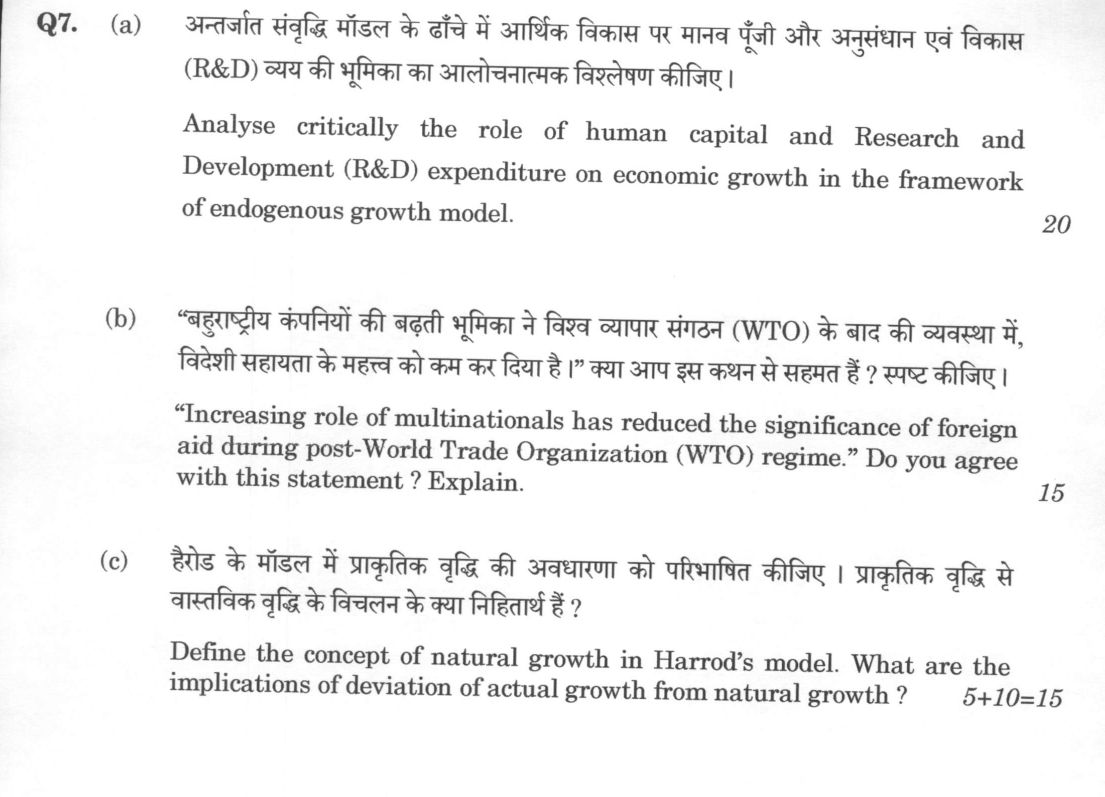
Analyse critically the role of human capital and Research and Development (R&D) expenditure on economic growth in the framework of endogenous growth model. 20 marks
"Increasing role of multinationals has reduced the significance of foreign aid during post-World Trade Organization (WTO) regime." Do you agree with this statement ? Explain. 15 marks
Define the concept of natural growth in Harrod's model. What are the implications of deviation of actual growth from natural growth ? 5+10=15
हिंदी में प्रश्न पढ़ें
अंतर्जात संवृद्धि मॉडल के ढांचे में आर्थिक विकास पर मानव पूंजी और अनुसंधान एवं विकास (R&D) व्यय की भूमिका का आलोचनात्मक विश्लेषण कीजिए। 20
"बहुराष्ट्रीय कंपनियों की बढ़ती भूमिका ने विश्व व्यापार संगठन (WTO) के बाद की व्यवस्था में, विदेशी सहायता के महत्व को कम कर दिया है।" क्या आप इस कथन से सहमत हैं ? स्पष्ट कीजिए। 15
हैरोड के मॉडल में प्राकृतिक वृद्धि की अवधारणा को परिभाषित कीजिए । प्राकृतिक वृद्धि से वास्तविक वृद्धि के विचलन के क्या निहितार्थ हैं ? 5+10=15
Model answer
Written by UPSC Answer Check against this question's marking rubric, to the expected length. UPSC does not publish answers for Mains — this is one way to score well, not an official key.
Endogenous growth theory resolves the neoclassical puzzle of sustained long-run growth by internalising technical progress and human capital formation, offering critical insights into macroeconomic policy and external development finance.
Human Capital, R&D, and Endogenous Growth
Paul Romer’s (1990) horizontal innovation model demonstrates that deliberate R&D expenditure generates a continuous expansion of intermediate input varieties. Because ideas are non-rival and partially excludable, R&D creates positive knowledge spillovers that prevent diminishing returns to capital accumulation. In tandem, Robert Lucas’s (1988) framework formalises human capital accumulation through education and learning-by-doing, generating internal productivity gains as well as positive external spillovers across the wider economy.
Critically, however, these endogenous mechanisms face structural limitations. Non-rivalry induces severe appropriability failures: inadequate intellectual property rights weaken incentives for private innovation, while overly stringent patents foster monopoly distortions. Moreover, R&D-driven growth often induces skill-biased technological change, exacerbating wage dispersion. In developing economies, the empirical link between R&D and growth is frequently inconclusive due to poor absorptive capacity, weak industry-academia linkages, and sub-critical expenditure levels, as observed in India’s stagnant gross R&D outlay of roughly 0.65% of GDP.
MNCs versus Foreign Aid in the Post-WTO Era
The post-1995 WTO regime accelerated trade liberalisation and cross-border investment, significantly altering external capital dynamics. Multinational Corporations (MNCs) emerged as the primary engines of structural transformation by delivering non-debt-creating Foreign Direct Investment (FDI), facilitating frontier technology transfer, and integrating domestic enterprises into Global Value Chains (GVCs). This efficiency-driven capital diminished the relevance of traditional Official Development Assistance (ODA), which had long faced criticism for bureaucratic fungibility, fiscal displacement, and intrusive structural conditionalities.
Nevertheless, MNCs have not rendered foreign aid obsolete. MNC investments remain profit-seeking and pro-cyclical, heavily concentrated in middle-income and resource-rich economies while bypassing non-commercial social sectors. Although emerging economies like India have reduced their reliance on external assistance to become net development partners, bilateral and multilateral aid remains indispensable for Least Developed Countries (LDCs) and for financing global public goods, climate resilience, and foundational infrastructure where private returns are negligible.
Harrod’s Natural Growth and Knife-Edge Instability
In Sir Roy Harrod’s dynamic model, the natural rate of growth (Gₙ) is the maximum long-term growth rate determined exogenously by the rate of labour force expansion (n) and the rate of labour-augmenting technological progress (m), represented as Gₙ = n + m. It represents the full-employment growth ceiling of the macroeconomy.
Because Gₙ is determined independently of the actual growth rate (G = s/v, where s is the propensity to save and v is the actual capital-output ratio), deviations generate profound macroeconomic instability:
- If G > Gₙ, the economy attempts to expand beyond the limits set by labour supply and technological capacity, triggering acute labour shortages, wage-push pressures, and an inflationary gap.
- If G < Gₙ, actual capital accumulation fails to generate sufficient output to fully employ the expanding labour force, resulting in persistent demand deficiency, involuntary unemployment, and secular stagnation.
Conclusion
Navigating modern growth requires synthesising these insights into a cohesive policy framework. For developing economies like India, harnessing MNC integration must be coupled with state-led investments in education and indigenous R&D, thereby elevating the natural growth ceiling and ensuring that actual expansion absorbs the demographic dividend without generating macro-instabilities.
What "Critically analyse" is asking you to do
Break the subject into its working parts and show how they act on each other. The marks are in the interconnections — which factor drives which, and what the resulting structure explains — not in the inventory of factors. “Critically” is not a section added at the end: name the yardstick you are judging by — the evidence, the stated objective, a constitutional principle, a rival explanation — and let a verdict close each part of the body. Where the question quotes a claim, that verdict must land on the claim itself, accepted, qualified or rejected, and not on the theme in general.
Structure that answers it
Define the whole → separate it into its parts → show which part drives which → what that interaction produces → what the structure implies
Where marks are lost
Merits in one paragraph, demerits in the next, and a conclusion calling for a balanced and holistic approach. That is a survey with the judgement left out and it holds the answer in the middle band. The opposite error is reading “critically” as permission to attack — and with the odd pairings, critically describe or critically explain, the exposition still carries most of the marks, the judgement being a layer on it rather than a substitute for it.
How this answer will be evaluated
Approach
Framework: Endogenous Growth Theory (Romer/Lucas) and Harrod-Domar Model. (a) analyse: intro > causes > effects > stakeholders/linkages > way forward | (b) explain: definition/context > points in order > small example > short close | (c) explain: definition/context > points in order > small example > short close Full marks: Comprehensive, critical, and well-structured with models and data.
Key points expected
- Endogenous growth model
- Human capital
- R&D
- MNCs
- Foreign aid
- Post-WTO
- Harrod's model
- Natural growth
- Knife-edge stability
Evaluation rubric
Each sub-part is marked on its own, against the marks and word limit printed on the paper.
- (a) Critical analysis of human capital and R&D in endogenous growth models. 20 marks
analyse— intro → causes → effects → stakeholders/linkages → way forward
Must cover
- Define endogenous growth model
- Role of human capital (Lucas)
- Role of R&D (Romer)
- Critical analysis of limitations
Loses marks
- Verbal answer without model
- Ignoring critical aspect
Earns more
- Production function derivation
- Spillover effects
- Policy implications
- Comparison with Solow model
Extra mark
- Specific equations
- Graphical representation
- (b) Explain the impact of MNCs on foreign aid significance post-WTO. 15 marks
explain— definition/context → points in order → small example → short close
Must cover
- Define MNCs and foreign aid
- Post-WTO regime context
- Arguments for reduced aid significance
- Arguments against (counter-view)
Loses marks
- One-sided argument
- Ignoring the 'agree/disagree' aspect
Earns more
- FDI vs Aid comparison
- Specific examples
- Policy implications
- Balanced conclusion
Extra mark
- Recent data/statistics
- Specific MNC examples
- (c) Define natural growth in Harrod's model and implications of deviation. 15 marks
explain— definition/context → points in order → small example → short close
Must cover
- Define natural growth rate
- Harrod's knife-edge stability
- Implications of actual > natural
- Implications of actual < natural
Loses marks
- Verbal answer without model
- Ignoring the 'implications' aspect
Earns more
- Diagram of Harrod's model
- Wage-price mechanism
- Policy implications
- Comparison with Domar model
Extra mark
- Specific equations
- Graphical representation
Practice this exact question
Write your answer and it is marked point by point against the model answer above — what you covered, what you missed, what you got wrong.
Evaluate my answer →More from Economics 2025 Paper I
- Q4 (a) (i) Explain the effects of public spending on national income, if it is financed thro…
- Q5 Answer the following questions in about 150 words each : 10×5=50 (a) Define offer curve a…
- Q6 (a) Explain the price effect, protective effect, consumption effect, revenue effect and d…
- Q7 (a) Analyse critically the role of human capital and Research and Development (R&D) expen…
- Q8 (a) Explain the role of World Trade Organization (WTO) in the present context. Discuss th…