Paper I — Q3
(a) Define liquidity trap. Show that fiscal policy is fully effective in the horizontal part while the monetary policy is fully…
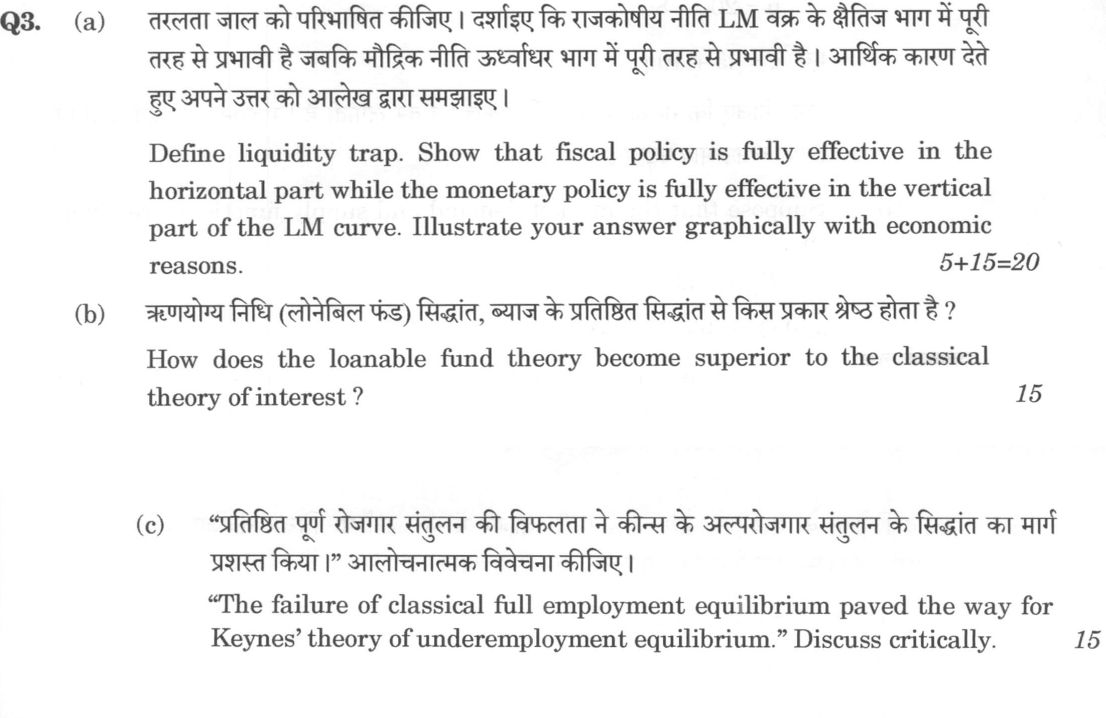
Define liquidity trap. Show that fiscal policy is fully effective in the horizontal part while the monetary policy is fully effective in the vertical part of the LM curve. Illustrate your answer graphically with economic reasons. 5+15=20
How does the loanable fund theory become superior to the classical theory of interest ? 15 marks
"The failure of classical full employment equilibrium paved the way for Keynes' theory of underemployment equilibrium." Discuss critically. 15 marks
हिंदी में प्रश्न पढ़ें
तरलता जाल को परिभाषित कीजिए। दर्शाइए कि राजकोषीय नीति LM वक्र के क्षैतिज भाग में पूरी तरह से प्रभावी है जबकि मौद्रिक नीति उर्ध्वाधर भाग में पूरी तरह से प्रभावी है। आर्थिक कारण देते हुए अपने उत्तर को आलेख द्वारा समझाइए। 5+15=20
ऋणयोग्य निधि (लोनेबिल फंड) सिद्धांत, ब्याज के प्रतिष्ठित सिद्धांत से किस प्रकार श्रेष्ठ होता है ? 15 marks
"प्रतिष्ठित पूर्ण रोजगार संतुलन की विफलता ने कैंस के अल्परोजगार संतुलन के सिद्धांत का मार्ग प्रशस्त किया।" आलोचनात्मक विवेचना कीजिए। 15
Model answer
Written by UPSC Answer Check against this question's marking rubric, to the expected length. UPSC does not publish answers for Mains — this is one way to score well, not an official key.
(a) Liquidity Trap and Policy Effectiveness in Extreme LM Ranges
A liquidity trap represents an extreme macroeconomic state where nominal interest rates drop to a floor (rₘᵢₙ) such that the speculative demand for money becomes infinitely interest-elastic (h → ∞). Economic agents expect interest rates to rise and bond prices to fall, leading them to hold any incremental money balances as cash rather than yield-bearing assets. In the (r, Y) plane, this renders the LM curve perfectly horizontal.
`` r ^ LM (Classical Range: Vertical) | | | IS1 IS2 | | / | r2|--------\-/------| <-- Fiscal shift raises r only (Crowding out) | X | r1|--------/-\------| | / | LM (Liquidity Trap: Horizontal) r0|______/_________|_________________ | IS1 IS2 | +-------------------------------------> Y Y1 Y2 Y_classical ``
In the horizontal part of the LM curve, fiscal policy is fully effective. When the government undertakes expansionary fiscal policy—such as large-scale capital spending under PM Gati Shakti—the IS curve shifts rightward from IS₁ to IS₂. Because money demand is infinitely elastic, the increased transactions demand for money is absorbed entirely from idle speculative balances without driving up the interest rate (r₀). Consequently, private investment suffers zero crowding out, and output expands by the full Keynesian multiplier: Δ Y = [1 / (1 - c(1 - t))] Δ G. Conversely, expansionary monetary policy is completely ineffective; an increase in money supply shifts the LM curve along the horizontal axis, leaving the equilibrium interest rate and output unaltered as injections get trapped in hoards.
In the vertical part of the LM curve (the Classical range), money demand is entirely interest-inelastic (h = 0), serving purely transactions motives. Here, monetary policy is fully effective. An open market purchase by the central bank shifts the vertical LM curve rightward, immediately releasing liquidity, lowering interest rates, and expanding real output in proportion to the Quantity Theory of Money. Fiscal expansion in this range, however, is completely ineffective. An outward shift in the IS curve raises transactions demand, but with a fixed money supply and zero speculative cushion, the interest rate spikes from r₁ to r₂. This induces 100 percent crowding out of private investment, leaving equilibrium output unchanged at Y_classical.
(b) Superiority of the Loanable Funds Theory over Classical Theory
The classical theory of interest, formulated by Ricardo, Marshall, and Pigou, treats the interest rate as an exclusively real phenomenon determined by the intersection of real saving (S) and real investment (I). It suffers from the restrictive assumption of automatic full employment and treats saving solely as a function of the interest rate, ignoring money's role beyond a passive veil.
The Loanable Funds theory (advanced by Wicksell, Ohlin, Robertson, and Myrdal) is superior because it synthesizes real and monetary variables into an integrated market framework. It defines the supply of loanable funds as S + Δ M + DH (where Δ M is commercial bank credit creation and central bank liquidity, and DH is dishoarding), and the demand for loanable funds as I + H (where H represents hoarding for liquidity).
First, the theory explicitly accounts for modern fractional reserve banking, acknowledging that bank credit expansion directly influences market interest rates in the short run. Second, by introducing hoarding and dishoarding, it captures the psychological motives of liquidity preference. Third, it breaks the classical indeterminacy by recognizing that savings depend on both income levels and the interest rate. It thus provides a realistic short-run mechanism of interest rate determination, forming the dynamic bridge between classical static equilibrium and Keynesian monetary economics.
(c) Classical Full Employment Equilibrium and Keynesian Underemployment
Classical macroeconomics rested on two foundational pillars: Say’s Law of Markets ("supply creates its own demand") and price-wage flexibility. Classical theory posited that flexible interest rates ensure all savings are channeled into investment (S = I), while flexible nominal wages guarantee market-clearing equilibrium in the labor market. If involuntary unemployment arose, competitive downward wage flexibility would lower production costs, stimulate hiring, and restore full employment (Y_f).
The Great Depression of 1929 shattered this construct. Persistent mass unemployment proved that market forces do not automatically clear factor markets. John Maynard Keynes demonstrated that the classical adjustment mechanism fails due to three fundamental realities: money wage rigidity downward (enforced by institutional contracts and trade unions), the volatile nature of investment driven by shifting business confidence (Marginal Efficiency of Capital), and the liquidity preference trap where lower interest rates fail to materialize. Furthermore, Keynes showed via the paradox of thrift and macroeconomic aggregation that wage cuts reduce aggregate purchasing power, depressing consumer demand and worsening unemployment rather than resolving it.
Keynes established that the economy settles at an underemployment equilibrium determined by the principle of effective demand—the intersection of Aggregate Demand (C + I + G) and Aggregate Supply. When effective demand is deficient, output and employment stabilize below the full-employment ceiling because firms face an absence of profitable market outlets.
Critically, Keynesian theory did not entirely destroy classical analysis but contextualized it. The Neoclassical Synthesis (Hicks-Hansen IS-LM framework) demonstrated that Keynes' underemployment equilibrium accurately explains short-run demand-constrained economies with sticky prices, whereas classical full-employment equilibrium remains a valid description of long-run potential output when wages and prices fully adjust. Policy thus demands targeted state intervention through counter-cyclical fiscal policy during demand slumps, transitioning toward supply-side efficiency as the economy approaches full employment.
What "Illustrate" is asking you to do
Carry the point with concrete cases rather than assert it, so the examples do the work of proving it. In the technical papers illustrate is often literal — a labelled diagram, a map, a graph — and an answer without the figure has not complied with the instruction.
Structure that answers it
The point stated → example 1 with the feature it demonstrates → example 2 → example 3 or the required diagram → what the set of examples establishes
Where marks are lost
Examples named and then abandoned. A case listed without the sentence showing what it demonstrates is marked as recall of information, not as illustration.
How this answer will be evaluated
Approach
Framework: IS-LM Model. (a) explain: definition/context > points in order > small example > short close | (b) explain: definition/context > points in order > small example > short close | (c) discuss: intro > 3-4 dimensions > example > balanced close Full marks: Precise diagrams, clear derivation, critical analysis, named economists.
Key points expected
- Liquidity trap definition
- IS-LM diagram for fiscal/monetary policy
- Classical vs Loanable Funds theory
- Say's Law vs Effective Demand
- Full employment vs Underemployment
Evaluation rubric
Each sub-part is marked on its own, against the marks and word limit printed on the paper.
- (a) Define liquidity trap and graphically demonstrate policy effectiveness in LM extremes. 20 marks
explain— definition/context → points in order → small example → short close
Must cover
- Define liquidity trap (infinite money demand)
- Diagram: Horizontal LM, vertical IS shift
- Diagram: Vertical LM, horizontal IS shift
- Economic reason: Zero interest rate floor
Loses marks
- Verbal answer without IS-LM diagram
- Confusing horizontal and vertical parts
Earns more
- Mention 'Classical' vs 'Keynesian' ranges
- Label axes (r, Y) clearly
- Explain crowding out in vertical part
- Explain no crowding out in horizontal part
Extra mark
- Reference to 2008 financial crisis
- Mention of 'Zero Lower Bound' (ZLB)
- (b) Explain why loanable funds theory is superior to classical theory of interest. 15 marks
explain— definition/context → points in order → small example → short close
Must cover
- Define Classical Theory (S=I)
- Define Loanable Funds Theory (S+ΔM=I+ΔM)
- Highlight inclusion of money supply
- Highlight inclusion of hoarding
Loses marks
- Confusing 'Classical' with 'Keynesian' theory
- Ignoring the role of money
Earns more
- Mention 'Classical Dichotomy' failure
- Reference to 'Speculative demand for money'
- Mention 'Investment demand' vs 'Saving supply'
- Reference to 'Keynes' critique'
Extra mark
- Reference to 'Fisher' (Classical)
- Reference to 'Hicks' (Loanable Funds)
- (c) Critically discuss how classical failure led to Keynesian underemployment equilibrium. 15 marks
discuss— intro → 3-4 dimensions → example → balanced close
Must cover
- Classical: Say's Law, full employment
- Classical: Flexible wages/prices
- Keynes: Effective demand, underemployment
- Keynes: Sticky wages/prices
Loses marks
- One-sided (only Classical or only Keynes)
- Ignoring the 'critical' aspect of the prompt
Earns more
- Mention 'Paradox of Thrift'
- Mention 'Multiplier effect'
- Reference to 'General Theory' (1936)
- Mention 'Marginal Propensity to Consume'
Extra mark
- Reference to 'Great Depression' (1929)
- Reference to 'Classical Dichotomy' breakdown
Practice this exact question
Write your answer and it is marked point by point against the model answer above — what you covered, what you missed, what you got wrong.
Evaluate my answer →More from Economics 2025 Paper I
- Q1 Answer the following questions in about 150 words each : 10×5=50 (a) Show that when price…
- Q2 (a) Derive Marshallian demand curve for an inferior good in a two-commodity framework by…
- Q3 (a) Define liquidity trap. Show that fiscal policy is fully effective in the horizontal p…
- Q4 (a) (i) Explain the effects of public spending on national income, if it is financed thro…
- Q5 Answer the following questions in about 150 words each : 10×5=50 (a) Define offer curve a…
- Q6 (a) Explain the price effect, protective effect, consumption effect, revenue effect and d…