Paper I — Q5
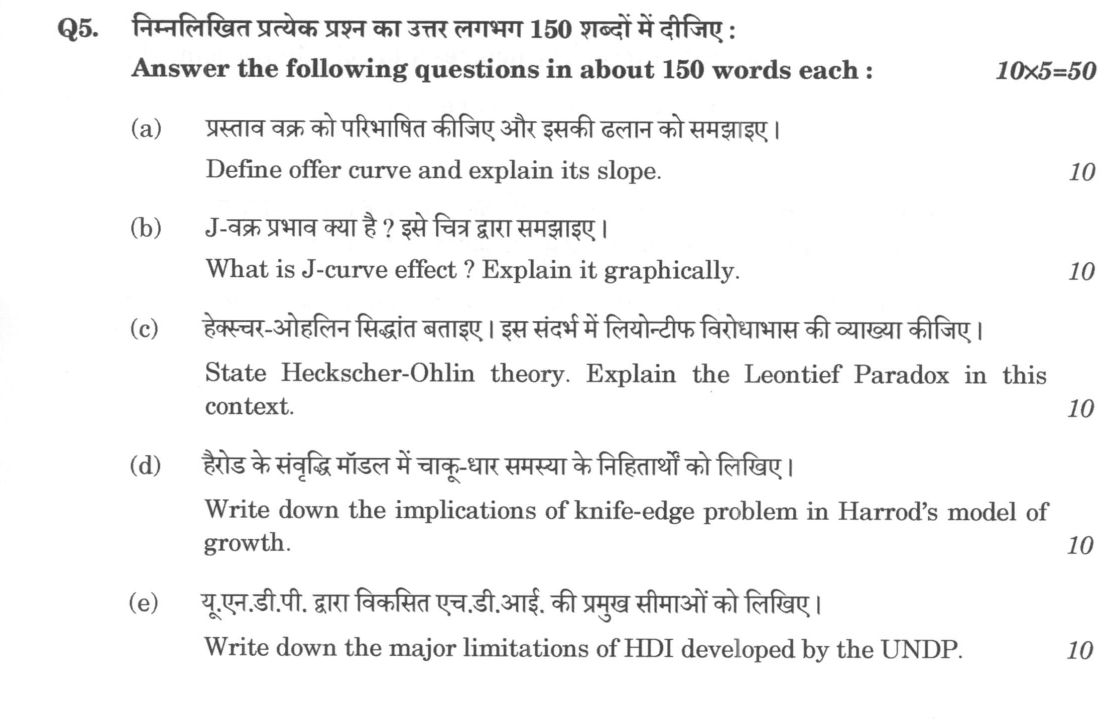
Answer the following questions in about 150 words each : 10×5=50 (a) Define offer curve and explain its slope. 10 (b) What is…
Answer the following questions in about 150 words each : 10×5=50
Define offer curve and explain its slope. 10 marks
What is J-curve effect ? Explain it graphically. 10 marks
State Heckscher-Ohlin theory. Explain the Leontief Paradox in this context. 10 marks
Write down the implications of knife-edge problem in Harrod's model of growth. 10 marks
Write down the major limitations of HDI developed by the UNDP. 10 marks
हिंदी में प्रश्न पढ़ें
निम्नलिखित प्रत्येक प्रश्न का उत्तर लगभग 150 शब्दों में दीजिए :
प्रस्ताव वक्र को परिभाषित कीजिए और इसकी ढलान को समझाइए। 10
J-वक्र प्रभाव क्या है ? इसे चित्र द्वारा समझाइए। 10
हेक्सर-ओहलिन सिद्धांत बताइए। इस संदर्भ में लियोंटीफ विरोधाभास की व्याख्या कीजिए। 10
हेरोड के संवृद्धि मॉडल में चाकू-धार समस्या के निहितार्थों को लिखिए। 10
यू.एन.डी.पी. द्वारा विकसित एच.डी.आई. की प्रमुख सीमाओं को लिखिए। 10
Model answer
Written by UPSC Answer Check against this question's marking rubric, to the 150-word length. UPSC does not publish answers for Mains — this is one way to score well, not an official key.
(a) Offer Curve and its Slope
An offer curve, or reciprocal demand curve devised by Alfred Marshall and Francis Ysidro Edgeworth, illustrates the various quantities of an export commodity a country is willing to offer in exchange for varying quantities of an import commodity at different relative commodity price ratios (terms of trade). It synthesizes both the domestic production possibility curve and consumer indifference maps, effectively capturing domestic supply and demand conditions for trade.
`` Imports (Y) ^ Offer Curve (Nation 1) | / | / (Elastic: e > 1) | / | ( (Inelastic: e < 1) | / +-------------------> Exports (X) ``
The slope of the offer curve (Δ Imports / Δ Exports) is determined by the price elasticity of reciprocal demand (e). Starting from the origin, as the terms of trade improve for the nation (the relative price of its exports rises), the offer curve is positively sloped and bends towards the export axis as long as its import demand is price-elastic (e > 1). Here, a rise in export prices induces the nation to offer more exports to obtain a larger volume of imports. However, if import demand becomes price-inelastic (e < 1), the curve bends backward towards the import axis, because the nation can secure its desired volume of imports by offering fewer exports, reflecting diminishing marginal willingness to trade.
(b) The J-Curve Effect
The J-curve effect describes the temporal path of a nation's trade balance following a nominal currency devaluation or depreciation. In the immediate aftermath, the trade balance deteriorates before eventually recovering and improving, tracing a path that resembles the letter 'J'.
`` Trade Balance ^ Surplus+ | / (Long-run: ML condition holds) | / Zero +-----------------------/---------> Time | / Deficit| _______________/ (Short-run deterioration) | Devaluation (t0) ``
This phenomenon occurs because the Marshall-Lerner condition—which states that devaluation improves the trade balance only if the sum of price elasticities of demand for exports and imports exceeds unity (ηₓ + ηₘ > 1)—is violated in the short run. Due to structural rigidities, informational delays, pre-existing contractual delivery obligations, and habit persistence, short-run price elasticities of demand are highly inelastic (ηₓ + ηₘ < 1). Consequently, the immediate price effect dominates: import prices in domestic currency rise instantly while export prices fall, inflating the total import bill without an immediate volume adjustment. Over the medium-to-long run (typically 6 to 18 months), consumer and producer substitutions materialize, volume elasticities rise, and the Marshall-Lerner condition holds, generating a sustained trade surplus.
(c) Heckscher-Ohlin Theory and the Leontief Paradox
The Heckscher-Ohlin (H-O) factor proportions theory posits that comparative advantage arises from cross-country differences in relative factor endowments and cross-commodity differences in factor intensities. Under standard assumptions (identical technologies and constant returns to scale), a country exports goods intensive in its relatively abundant and cheap factor of production and imports goods intensive in its relatively scarce and expensive factor.
``` Heckscher-Ohlin Prediction: Capital-Abundant Nation (e.g., US) ----> Exports Capital-Intensive Goods
Leontief Paradox (1947 US Data): Capital-Abundant Nation (US) ----------> Exports Labor-Intensive Goods (K/L lower) ```
Wassily Leontief empirically tested the H-O theorem in 1953 using the 1947 input-output table of the United States. Given that the US was unambiguously the most capital-abundant economy in the post-war era, the H-O theorem predicted that US exports would be capital-intensive relative to its competitive import replacements. Leontief discovered the opposite: US exports were approximately 30 percent more labor-intensive than its import-competing production, creating the Leontief Paradox.
This paradox was later reconciled by demonstrating that Leontief treated labor as a homogeneous factor, ignoring human capital. Because US workers possessed superior education, training, and technological skills, effective US labor supply was significantly larger than nominal headcounts, rendering the US abundant in skilled labor and human capital.
(d) Knife-Edge Problem in Harrod's Model
In Sir Roy Harrod’s dynamic growth model, steady-state equilibrium requires the equality of three growth rates: the actual growth rate (G = s/v), the warranted growth rate (G_w = s/vᵣ, where capital is fully utilized), and the natural growth rate (Gₙ = n + λ, determined by labor force growth n and technological progress λ).
``` Harrod's Knife-Edge Instability:
G > Gw ===> v < vr ===> Chronic Shortage ===> Inflationary Boom / G = Gw = Gn (Equilibrium on the Knife-Edge) \ G < Gw ===> v > vr ===> Excess Capacity ===> Deflationary Slump ```
The knife-edge problem represents the inherent, extreme instability of this equilibrium caused by the assumption of fixed-coefficient Leontief production technology, which precludes factor substitution between capital and labor.
If an exogenous shock causes the actual growth rate to deviate from the warranted growth rate (G ≠ G_w), the system does not self-correct via price adjustments; instead, it deviates further through a cumulative destabilizing process. If G > G_w, the actual capital-output ratio v falls below the required ratio vᵣ, causing capital shortages and unintended inventory decumulation. Entrepreneurs respond by expanding investment, widening the divergence into an inflationary spiral. Conversely, if G < G_w, excess capacity triggers investment cuts, causing a cumulative deflationary depression. Sustaining full employment without systemic crises thus requires continuous discretionary state interventions through counter-cyclical fiscal and monetary policies.
(e) Major Limitations of the Human Development Index (HDI)
The Human Development Index (HDI), developed by Mahbub ul Haq and Amartya Sen for the UNDP, shifted the development paradigm from income to capabilities. However, it faces several major analytical and structural limitations.
First, it ignores ecological and environmental sustainability, failing to account for natural capital depletion, carbon emissions, and resource degradation generated during economic growth. Second, by relying on national mean values, the standard HDI masks severe sub-national disparities across gender, race, caste, and geographic regions, a limitation only partially addressed by the later Inequality-adjusted HDI (IHDI). Third, the index assigns arbitrary equal weights (one-third each) to health, education, and standard of living via a geometric mean, presuming uniform policy trade-offs without normative or empirical justification. Fourth, it omits critical non-material dimensions of capability, such as political freedoms, human rights, institutional quality, personal security, and the informal or unpaid care economy. Finally, cross-country comparability is compromised by unequal primary data quality, disparate census cycles, and discrepancies in Purchasing Power Parity (PPP) conversions across developing nations.
What "Explain" is asking you to do
Make the working of something clear — what sets it off, what follows from what, and what it produces. Explain is the Commission's mechanism word: it dominates the technical papers and the “explain why” stems, where the marks sit in the causal chain and not in the label.
Structure that answers it
State what it is → the initiating condition → the chain of cause, step by step → an instance where it plays out → what the chain produces
Where marks are lost
Describing what something looks like instead of why it works that way. Naming the stages without linking them reads as description too.
How this answer will be evaluated
Approach
Framework: International Trade & Growth Theory. (a) define: precise definition > the distinguishing feature > one example | (b) explain: definition/context > points in order > small example > short close | (c) enumerate: list the items in order > one line each > no commentary | (d) explain: definition/context > points in order > small example > short close | (e) explain: definition/context > points in order > small example > short close Full marks: Precise definitions, correct diagrams, named economists, policy implications
Key points expected
- Define as reciprocal demand curve
- Explain slope as MRS of imports/exports
- Link slope to terms of trade
- Mention equilibrium at intersection
- Define J-curve in devaluation context
- Explain initial worsening of BoP
- Explain subsequent improvement
- Graph showing time vs BoP balance
Evaluation rubric
Each sub-part is marked on its own, against the marks and word limit printed on the paper.
- (a) Definition of offer curve and explanation of its slope. 10 marks · 150 words
define— precise definition → the distinguishing feature → one example
Must cover
- Define as reciprocal demand curve
- Explain slope as MRS of imports/exports
- Link slope to terms of trade
- Mention equilibrium at intersection
Loses marks
- Confusing with domestic demand
- Ignoring slope significance
Earns more
- Mention indifference map derivation
- Distinguish from demand curve
Extra mark
- Diagram of offer curve
- (b) Explanation of J-curve effect with graphical representation. 10 marks · 150 words
explain— definition/context → points in order → small example → short close
Must cover
- Define J-curve in devaluation context
- Explain initial worsening of BoP
- Explain subsequent improvement
- Graph showing time vs BoP balance
Loses marks
- No graphical explanation
- Confusing with Laffer curve
Earns more
- Mention Marshall-Lerner condition
- Time lag explanation
Extra mark
- Specific country example
- (c) Statement of H-O theory and explanation of Leontief Paradox. 10 marks · 150 words
enumerate— list the items in order → one line each → no commentary
Must cover
- State H-O theorem (factor abundance)
- Define Leontief Paradox (US data)
- Contradiction with H-O prediction
- Possible explanations for paradox
Loses marks
- Confusing with Ricardian model
- Ignoring the paradox aspect
Earns more
- Mention factor intensity reversal
- Human capital argument
Extra mark
- Specific input-output data
- (d) Implications of knife-edge problem in Harrod's model. 10 marks · 150 words
explain— definition/context → points in order → small example → short close
Must cover
- Define knife-edge problem
- Explain warranted vs actual growth
- Instability of equilibrium
- Policy implications for growth
Loses marks
- Confusing with Solow model
- Ignoring instability aspect
Earns more
- Mention Harrod-Domar model
- Savings-investment balance
Extra mark
- Diagram of growth paths
- (e) Major limitations of HDI developed by UNDP. 10 marks · 150 words
explain— definition/context → points in order → small example → short close
Must cover
- Define HDI components
- Limitation: ignores inequality
- Limitation: ignores environmental factors
- Limitation: data availability issues
Loses marks
- Confusing with GNI per capita
- Ignoring multidimensional aspect
Earns more
- Mention IHDI (Inequality-adjusted)
- Alternative indices (GPI, PPI)
Extra mark
- Specific country ranking example
Practice this exact question
Write your answer and it is marked point by point against the model answer above — what you covered, what you missed, what you got wrong.
Evaluate my answer →More from Economics 2025 Paper I
- Q2 (a) Derive Marshallian demand curve for an inferior good in a two-commodity framework by…
- Q3 (a) Define liquidity trap. Show that fiscal policy is fully effective in the horizontal p…
- Q4 (a) (i) Explain the effects of public spending on national income, if it is financed thro…
- Q5 Answer the following questions in about 150 words each : 10×5=50 (a) Define offer curve a…
- Q6 (a) Explain the price effect, protective effect, consumption effect, revenue effect and d…
- Q7 (a) Analyse critically the role of human capital and Research and Development (R&D) expen…
- Q8 (a) Explain the role of World Trade Organization (WTO) in the present context. Discuss th…