Paper I — Q2
(a) Derive Marshallian demand curve for an inferior good in a two-commodity framework by using income and substitution effects…
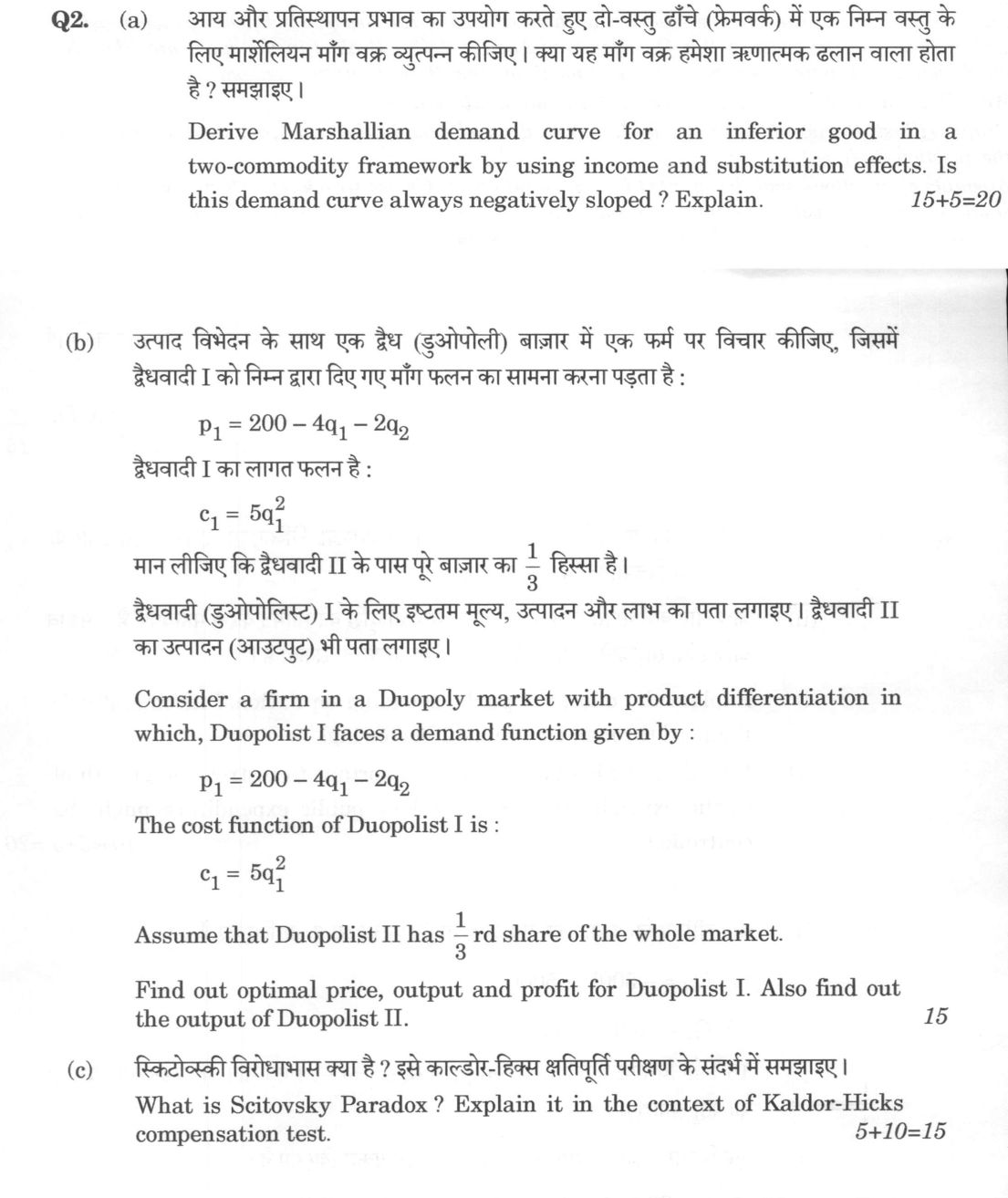
Derive Marshallian demand curve for an inferior good in a two-commodity framework by using income and substitution effects. Is this demand curve always negatively sloped ? Explain. 15+5=20
Consider a firm in a Duopoly market with product differentiation in which, Duopolist I faces a demand function given by :
p₁ = 200 - 4q₁ - 2q₂
The cost function of Duopolist I is :
c₁ = 5q₁²
Assume that Duopolist II has 1/3 rd share of the whole market.
Find out optimal price, output and profit for Duopolist I. Also find out the output of Duopolist II. 15 marks
What is Scitovsky Paradox ? Explain it in the context of Kaldor-Hicks compensation test. 5+10=15
हिंदी में प्रश्न पढ़ें
आय और प्रतिस्थापन प्रभाव का उपयोग करते हुए दो-वस्तु ढाँचे (फ्रेमवर्क) में एक निम्न वस्तु के लिए मार्शलियन माँग वक्र व्युत्पन्न कीजिए। क्या यह माँग वक्र हमेशा ऋणात्मक ढलान वाला होता है ? समझाइए। 15+5=20
उत्पाद विभेदन के साथ एक द्वैध (डुओपोली) बाजार में एक फर्म पर विचार कीजिए, जिसमें द्वैधवादी I को निम्न द्वारा दिए गए मांग फलन का सामना करना पड़ता है :
p₁ = 200 - 4q₁ - 2q₂
द्वैधवादी I का लागत फलन है :
c₁ = 5q₁²
मान लीजिए कि द्वैधवादी II के पास पूरे बाजार का 1/3 हिस्सा है।
द्वैधवादी (डुओपोलिस्ट) I के लिए इष्टतम मूल्य, उत्पादन और लाभ का पता लगाइए। द्वैधवादी II का उत्पादन (आउटपुट) भी पता लगाइए। 15
सिकटोव्स्की विरोधाभास क्या है ? इसे काल्डोर-हिक्स क्षतिपूर्ति परीक्षण के संदर्भ में समझाइए। 5+10=15
Model answer
Written by UPSC Answer Check against this question's marking rubric, to the expected length. UPSC does not publish answers for Mains — this is one way to score well, not an official key.
(a) Let commodities be x and y, prices p_x and p_y, income M. The Marshallian demand for x, x(p_x,p_y,M), is obtained from:
max U(x,y) subject to p_x x + p_y y = M.
The Lagrange function is L = U(x,y) + λ(M − p_x x − p_y y). The first-order conditions are:
U_x = λ p_x, U_y = λ p_y, p_x x + p_y y = M.
Dividing the first two gives the tangency condition U_x/U_y = p_x/p_y, which together with the budget constraint solves for x = x(p_x,p_y,M). This is the Marshallian demand curve.
To decompose a change in p_x, define the Hicksian demand h_x(p_x,p_y,u) from the expenditure minimisation problem:
min p_x x + p_y y subject to U(x,y) = u.
The Slutsky identity, holding p_y and M constant, is:
∂x/∂p_x = ∂h_x/∂p_x − x ∂x/∂M.
Here ∂h_x/∂p_x is the substitution effect. For a convex indifference map, it is always negative. For an inferior good, ∂x/∂M < 0, so the income effect −x ∂x/∂M is positive. Thus:
∂x/∂p_x = (negative substitution effect) + (positive income effect).
If the substitution effect dominates, ∂x/∂p_x < 0, so the Marshallian demand curve slopes downward. If the income effect dominates, ∂x/∂p_x > 0, giving an upward-sloping demand curve. Such a good is a Giffen good. Therefore, an inferior good's demand curve is not always negatively sloped. It is negatively sloped when the substitution effect exceeds the inferior income effect; it becomes positively sloped in the Giffen case when the income effect dominates.
(b) Let total market output be Q = q₁ + q₂. Duopolist II has 1/3 share of the whole market, so:
q₂/Q = 1/3 ⇒ 3q₂ = q₁ + q₂ ⇒ q₂ = q₁/2.
Substitute q₂ = q₁/2 into Duopolist I’s demand:
p₁ = 200 − 4q₁ − 2q₂ = 200 − 4q₁ − 2(q₁/2) = 200 − 5q₁.
Total revenue of I is:
R₁ = p₁ q₁ = 200q₁ − 5q₁².
So marginal revenue is:
MR₁ = dR₁/dq₁ = 200 − 10q₁.
Cost is c₁ = 5q₁², so marginal cost is:
MC₁ = dc₁/dq₁ = 10q₁.
Profit maximisation requires MR₁ = MC₁:
200 − 10q₁ = 10q₁ ⇒ 200 = 20q₁ ⇒ q₁ = 10 units.
Then:
q₂ = q₁/2 = 5 units.
Price:
p₁ = 200 − 5(10) = 150 monetary units per unit.
Profit:
π₁ = p₁ q₁ − c₁ = 150×10 − 5(10²) = 1500 − 500 = 1000 monetary units.
Second-order condition: d²π₁/dq₁² = −20 < 0, so this is a maximum.
Final: q₁ = 10 units, q₂ = 5 units, p₁ = 150 monetary units per unit, π₁ = 1000 monetary units.
(c) The Scitovsky Paradox is the possibility that the Kaldor-Hicks compensation criterion can rank two allocations cyclically: allocation B may be declared superior to A, while A may also be declared superior to B. It shows that potential-compensation tests are not always consistent when income distribution and prices change.
Under the Kaldor test, a move from A to B is desirable if the gainers in B can compensate the losers from A and still be better off. Under the Hicks test, B is desirable if the losers from the move A→B cannot bribe the gainers to forgo the move (equivalently, cannot bribe them to return to A). The Kaldor-Hicks criterion uses such potential compensation, not actual compensation.
The paradox arises because the identity of gainers and losers, and the amount needed for compensation, depends on the prevailing distribution and relative prices. Thus it is possible that:
- gainers at B can compensate losers from A, so B passes the Kaldor test over A;
- gainers at A can compensate losers from B, so A also passes the Kaldor test over B.
Both moves are then potential Pareto improvements, although they are opposite. This makes the compensation test non-transitive and potentially contradictory.
Scitovsky’s double criterion avoids the paradox: B is socially preferable to A only if B is Kaldor-superior to A and A is not Kaldor-superior to B. That is, the reverse compensation test must fail. The Scitovsky Paradox therefore exposes a fundamental weakness of the Kaldor-Hicks test: welfare ranking by potential compensation alone is not always consistent unless checked against the reverse move. It also shows that the Kaldor-Hicks criterion is not a complete social welfare ordering; it requires supplementary distributional judgments or the Scitovsky double test to avoid contradictory rankings.
What "Derive" is asking you to do
Reach the stated expression from a starting relation, justifying every step. The destination is printed in the question, so only the route earns marks, and the assumptions you work under are part of that route.
Structure that answers it
Assumptions and notation defined → starting relation or governing equation → each step with its justification → the required expression → limiting case or boundary check
Where marks are lost
Writing the standard result first and fitting three lines to it, which an examiner reads at a glance. Marks also go on assumptions left unstated — lossless medium, small amplitude, errors independent with zero mean — and on symbols used before they are defined, even when the question says usual notations.
How this answer will be evaluated
Approach
Framework: Consumer Choice Theory (Slutsky Equation) and Oligopoly (Cournot/Bertrand). (a) derive: given > assumptions > stepwise derivation > result > check | (b) derive: given > assumptions > stepwise derivation > result > check | (c) explain: definition/context > points in order > small example > short close Full marks: Complete derivations with all steps shown, correct calculations, clear diagrams where appropriate, and precise definitions with examples.
Key points expected
- Slutsky equation decomposition for part (a)
- Correct market share calculation for part (b)
- Marginal revenue equals marginal cost condition
- Kaldor-Hicks test definition for part (c)
- Scitovsky paradox mechanism explanation
Evaluation rubric
Each sub-part is marked on its own, against the marks and word limit printed on the paper.
- (a) Derive Marshallian demand for inferior good using income/substitution effects and discuss slope. 20 marks
derive— given → assumptions → stepwise derivation → result → check
Must cover
- Decompose price change into substitution and income effects
- Show substitution effect is always negative
- Show income effect is positive for inferior goods
- Explain Giffen good condition (income > substitution)
Loses marks
- Verbal explanation without mathematical derivation
- Confusing inferior good with Giffen good
- Failing to state assumptions
Earns more
- Slutsky equation written explicitly
- Diagram showing budget line shifts
- Distinction between inferior and Giffen goods
- Mention of Hicksian vs Marshallian demand
Extra mark
- Reference to Hicks or Slutsky by name
- Graphical representation of Giffen paradox
- (b) Calculate optimal price, output, and profit for Duopolist I and output for Duopolist II. 15 marks
derive— given → assumptions → stepwise derivation → result → check
Must cover
- Determine q2 from market share assumption (1/3 total)
- Derive total revenue function for firm I
- Set marginal revenue equal to marginal cost
- Solve for q1, p1, and profit
Loses marks
- Incorrect market share calculation
- Algebraic errors in differentiation
- Missing profit calculation
Earns more
- Explicit calculation of q2 = (1/3)(q1+q2)
- Correct differentiation of revenue function
- Verification of second-order condition
- Clear labeling of all variables
Extra mark
- Comparison with monopoly outcome
- Mention of Nash equilibrium concept
- (c) Define Scitovsky Paradox and explain it within Kaldor-Hicks compensation test. 15 marks
explain— definition/context → points in order → small example → short close
Must cover
- Define Kaldor-Hicks compensation test
- Define Scitovsky paradox (inconsistency in compensation)
- Explain how paradox arises from changing reference points
- State implications for welfare economics
Loses marks
- Confusing Kaldor and Hicks tests
- Failing to explain the paradox mechanism
- Vague or imprecise definitions
Earns more
- Example showing inconsistent compensation judgments
- Mention of Scitovsky's 1942 critique
- Distinction between Kaldor and Hicks tests
- Reference to revealed preference theory
Extra mark
- Mention of Scitovsky by name
- Reference to modern welfare economics developments
Practice this exact question
Write your answer and it is marked point by point against the model answer above — what you covered, what you missed, what you got wrong.
Evaluate my answer →More from Economics 2025 Paper I
- Q1 Answer the following questions in about 150 words each : 10×5=50 (a) Show that when price…
- Q2 (a) Derive Marshallian demand curve for an inferior good in a two-commodity framework by…
- Q3 (a) Define liquidity trap. Show that fiscal policy is fully effective in the horizontal p…
- Q4 (a) (i) Explain the effects of public spending on national income, if it is financed thro…
- Q5 Answer the following questions in about 150 words each : 10×5=50 (a) Define offer curve a…