Paper I — Q4
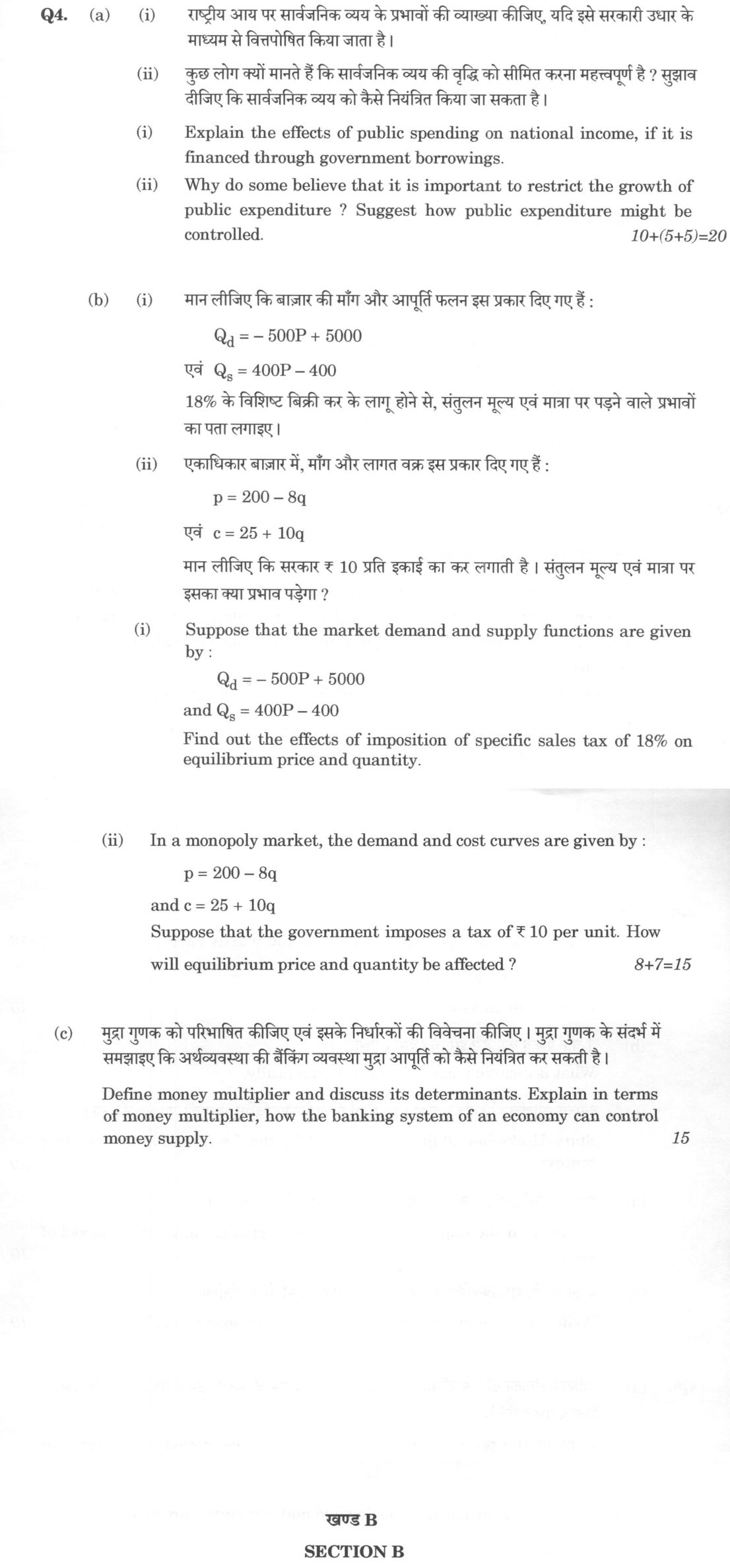
(a) (i) Explain the effects of public spending on national income, if it is financed through government borrowings. (ii) Why do…
Explain the effects of public spending on national income, if it is financed through government borrowings.
Why do some believe that it is important to restrict the growth of public expenditure ? Suggest how public expenditure might be controlled.
10+(5+5)=20
Suppose that the market demand and supply functions are given by :
Qd = – 500P + 5000
and Qs = 400P – 400
Find out the effects of imposition of specific sales tax of 18% on equilibrium price and quantity.
In a monopoly market, the demand and cost curves are given by : p = 200 – 8q and c = 25 + 10q Suppose that the government imposes a tax of ₹ 10 per unit. How will equilibrium price and quantity be affected ? 8+7=15
Define money multiplier and discuss its determinants. Explain in terms of money multiplier, how the banking system of an economy can control money supply. 15 marks
हिंदी में प्रश्न पढ़ें
राष्ट्रीय आय पर सार्वजनिक व्यय के प्रभावों की व्याख्या कीजिए, यदि इसे सरकारी उधार के माध्यम से वित्तपोषित किया जाता है।
कुछ लोग क्यों मानते हैं कि सार्वजनिक व्यय की वृद्धि को सीमित करना महत्वपूर्ण है? सुझाव दीजिए कि सार्वजनिक व्यय को कैसे नियंत्रित किया जा सकता है।
10+(5+5)=20
मान लीजिए कि बाजार की मांग और आपूर्ति फलन इस प्रकार दिए गए हैं :
Qd = – 500P + 5000
एवं Qs = 400P – 400
18% के विशिष्ट बिक्री कर के लागू होने से, संतुलन मूल्य एवं मात्रा पर पड़ने वाले प्रभावों का पता लगाइए।
एकाधिकार बाजार में, मांग और लागत वक्र इस प्रकार दिए गए हैं : p = 200 – 8q एवं c = 25 + 10q मान लीजिए कि सरकार ₹ 10 प्रति इकाई का कर लगाती है। संतुलन मूल्य एवं मात्रा पर इसका क्या प्रभाव पड़ेगा?
8+7=15
मुद्रा गुणक को परिभाषित कीजिए एवं इसके निर्धारकों की विवेचना कीजिए । मुद्रा गुणक के संदर्भ में समझाइए कि अर्थव्यवस्था की बैंकिंग व्यवस्था मुद्रा आपूर्ति को कैसे नियंत्रित कर सकती है । 15
Model answer
Written by UPSC Answer Check against this question's marking rubric, to the expected length. UPSC does not publish answers for Mains — this is one way to score well, not an official key.
Debt-financed public spending raises national income through the Keynesian multiplier: an initial increase in government expenditure raises income, consumption and further demand, so ΔY = ΔG/(1-MPC(1-t)). But if borrowing is from domestic savers, it competes for loanable funds, raises interest rates and crowds out private investment, reducing the multiplier. If the RBI accommodates by monetising debt, crowding out falls but inflation and fiscal dominance risk rise. Under Ricardian equivalence, forward-looking households expect future taxes to repay debt, save more and offset the demand effect, so income may not rise. The net effect depends on slack, expectations and debt sustainability. Productive borrowing for infrastructure can raise potential output; unproductive borrowing increases debt servicing, intergenerational burden and fiscal risk, as seen in India’s market borrowings and the Fiscal Responsibility and Budget Management Act, 2003.
Restricting public expenditure is important because unchecked growth can crowd out private activity, create inflationary pressure, raise debt, distort resource allocation, erode fiscal space and create fiscal dominance. Wagner’s Law and Peacock-Wiseman displacement effect explain why the state tends to expand, especially after crises. Control requires fiscal rules, zero-based and outcome-based budgeting, expenditure ceilings, performance audits by the CAG, user charges, public-private partnerships and disinvestment, and prioritising capital over recurrent spending.
For the competitive market, pre-tax equilibrium is found by equating demand and supply: -500P + 5000 = 400P - 400, so P = 6 and Q = 2000. Interpreting the 18% sales tax as an ad valorem tax on the consumer price, sellers receive 0.82P, so the supply function becomes Qs = 400(0.82P) - 400 = 328P - 400. Equating with demand gives 828P = 5400, so P = 6.52 and Q = 1739. The tax per unit is 0.18 × 6.52 = 1.17. Consumers pay 0.52 more and producers receive 0.65 less; consumer incidence is 0.52/1.17 = 44.4%, and producer incidence is 55.6%.
In monopoly, TR = 200q - 8q², MR = 200 - 16q, MC = 10. Pre-tax: 200 - 16q = 10, q = 11.875, p = 105. With a ₹10 per unit tax, MC becomes 20, so 200 - 16q = 20, q = 11.25, p = 110. Price rises by 5 and output falls by 0.625. The consumer bears 5 of the tax and the producer’s net price falls from 105 to 100, so pass-through is 50%. This is higher than the 44.4% consumer pass-through in the competitive example, but competitive pass-through depends on demand and supply elasticities and can be above or below 50%, so no general ranking exists.
The money multiplier is m = broad money/monetary base. In a simplified Indian banking model, m = 1/(CRR + SLR + ER); if currency drain is explicit, the denominator also includes the currency-to-deposit ratio. Determinants are CRR, SLR, excess reserves, currency drain and the public’s preference for cash. The banking system, guided by the RBI, controls money supply because credit creation is limited by reserve ratios. If the RBI raises CRR or SLR, the multiplier falls and deposit expansion slows; if it raises the repo rate, borrowing cost rises, lending falls and excess reserves may increase, also reducing the multiplier. Open market operations change the monetary base: selling government securities drains base money, while buying injects it. Since money supply equals multiplier times base, the RBI can tighten or ease liquidity by combining base changes with multiplier-affecting instruments.
Thus, debt-financed spending can raise income but must be constrained by fiscal rules; tax incidence and monopoly pricing show that market structure shapes burden; and monetary stability requires managing both the base and the multiplier.
What "Explain" is asking you to do
Make the working of something clear — what sets it off, what follows from what, and what it produces. Explain is the Commission's mechanism word: it dominates the technical papers and the “explain why” stems, where the marks sit in the causal chain and not in the label.
Structure that answers it
State what it is → the initiating condition → the chain of cause, step by step → an instance where it plays out → what the chain produces
Where marks are lost
Describing what something looks like instead of why it works that way. Naming the stages without linking them reads as description too.
How this answer will be evaluated
Approach
Framework: Keynesian Multiplier Model, Comparative Statics, Monopoly Equilibrium, Money Creation Process. (a) explain: definition/context > points in order > small example > short close | (b) derive: given > assumptions > stepwise derivation > result > check | (c) discuss: intro > 3-4 dimensions > example > balanced close Full marks: Rigorous derivation, clear diagrams, policy context, and precise economic terminology.
Key points expected
- Crowding out effect
- IS-LM shift
- Qd = -500P + 5000
- Qs = 400P - 400
- MR = MC
- Money multiplier formula
- Reserve ratio
- Currency ratio
Evaluation rubric
Each sub-part is marked on its own, against the marks and word limit printed on the paper.
- (a) Analyze income effects of debt-financed spending and methods to control expenditure growth. 20 marks
explain— definition/context → points in order → small example → short close
Must cover
- IS-LM diagram showing crowding out
- Mechanism of interest rate rise
- Fiscal dominance vs. crowding out
- Budgetary control mechanisms
Loses marks
- Ignoring the borrowing aspect
- Verbal answer without IS-LM diagram
Earns more
- Ricardian Equivalence reference
- Fiscal Responsibility and Budget Management Act
- Fiscal deficit targets
- Public Expenditure Financial Accountability Act
Extra mark
- Latest Union Budget fiscal deficit data
- Reference to RBI-Fiscal Council
- (b) Calculate equilibrium price/quantity for competitive and monopoly markets with tax. 15 marks
derive— given → assumptions → stepwise derivation → result → check
Must cover
- Initial equilibrium calculation (Qd=Qs)
- Tax-adjusted supply/demand function
- MR=MC condition for monopoly
- Final P and Q values
Loses marks
- Skipping intermediate algebra steps
- Confusing specific vs ad valorem tax
Earns more
- Tax incidence analysis
- Deadweight loss calculation
- Comparison of pre/post tax values
Extra mark
- Graphical representation of tax wedge
- Lerner Index calculation
- (c) Define money multiplier, its determinants, and banking system's role in money supply. 15 marks
discuss— intro → 3-4 dimensions → example → balanced close
Must cover
- Formula: m = 1/(rr + cr)
- Reserve ratio (rr) and currency ratio (cr)
- Banking system credit creation process
- Central bank control mechanisms
Loses marks
- Defining without formula
- Ignoring currency drain
Earns more
- Excess reserves discussion
- Open Market Operations
- Bank Rate policy
- CRR and SLR in India
Extra mark
- Current RBI CRR/SLR rates
- M0 vs M3 distinction
Practice this exact question
Write your answer and it is marked point by point against the model answer above — what you covered, what you missed, what you got wrong.
Evaluate my answer →More from Economics 2025 Paper I
- Q1 Answer the following questions in about 150 words each : 10×5=50 (a) Show that when price…
- Q2 (a) Derive Marshallian demand curve for an inferior good in a two-commodity framework by…
- Q3 (a) Define liquidity trap. Show that fiscal policy is fully effective in the horizontal p…
- Q4 (a) (i) Explain the effects of public spending on national income, if it is financed thro…
- Q5 Answer the following questions in about 150 words each : 10×5=50 (a) Define offer curve a…
- Q6 (a) Explain the price effect, protective effect, consumption effect, revenue effect and d…
- Q7 (a) Analyse critically the role of human capital and Research and Development (R&D) expen…