Paper I — Q6
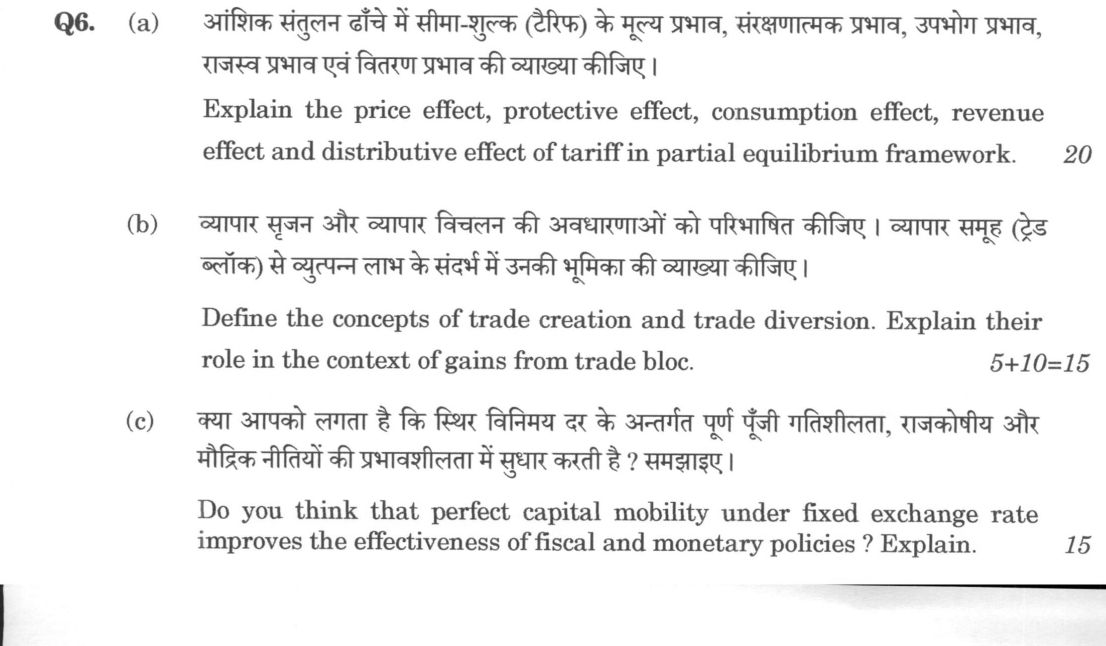
(a) Explain the price effect, protective effect, consumption effect, revenue effect and distributive effect of tariff in partial…
Explain the price effect, protective effect, consumption effect, revenue effect and distributive effect of tariff in partial equilibrium framework. 20 marks
Define the concepts of trade creation and trade diversion. Explain their role in the context of gains from trade bloc. 5+10=15
Do you think that perfect capital mobility under fixed exchange rate improves the effectiveness of fiscal and monetary policies ? Explain. 15 marks
हिंदी में प्रश्न पढ़ें
आंशिक संतुलन ढांचे में सीमा-शुल्क (टैरिफ) के मूल्य प्रभाव, संरक्षणात्मक प्रभाव, उपभोग प्रभाव, राजस्व प्रभाव एवं वितरण प्रभाव की व्याख्या कीजिए। 20
व्यापार सृजन और व्यापार विचलन की अवधारणाओं को परिभाषित कीजिए। व्यापार समूह (ट्रेड ब्लॉक) से व्युत्पन्न लाभ के संदर्भ में उनकी भूमिका की व्याख्या कीजिए। 5+10=15
क्या आपको लगता है कि स्थिर विनिमय दर के अंतर्गत पूर्ण पूंजी गतिशीलता, राजकोषीय और मौद्रिक नीतियों की प्रभावशीलता में सुधार करती है ? समझाइए। 15
Model answer
Written by UPSC Answer Check against this question's marking rubric, to the expected length. UPSC does not publish answers for Mains — this is one way to score well, not an official key.
Trade policy and macroeconomic policy are linked because tariffs redistribute income and affect output, while exchange-rate regimes determine which policy can stabilise the economy.
Price, protective and consumption effects. In partial equilibrium, for a small country facing world price Pw, a specific tariff t raises the domestic price to Pw+t. The price effect is the rise in price paid by consumers. The protective effect follows because domestic producers receive the higher price and expand output from S1 to S2; producer surplus rises. The consumption effect is the fall in quantity demanded from D1 to D2. The revenue effect is tariff receipts equal to t multiplied by post-tariff imports (D2−S2). The distributive effect is seen in welfare areas: consumers lose the area between the old and new prices to the left of demand; producers gain the area between the two prices to the left of supply; the government gains tariff revenue; and two deadweight triangles remain—one from producing more at higher domestic cost and one from consuming less. Thus a tariff transfers part of consumer surplus to producers and the state but creates efficiency loss. If the country is large, the tariff may improve terms of trade; strategic trade policy and optimal tariff theory modify this simple conclusion, though the partial-equilibrium analysis assumes no retaliation.
Trade creation and trade diversion. In a customs union or free trade area, trade creation occurs when imports from a low-cost member replace higher-cost domestic production, moving resources to more efficient use and raising welfare. Trade diversion occurs when imports shift from a low-cost non-member to a higher-cost member because the member’s preferential tariff is lower. The diversion loss is the extra cost of buying from the higher-cost partner, (Pp−Pw)×M0, where Pp is member price, Pw world price and M0 the diverted volume. This loss may be outweighed by trade-creation gains; consumer surplus gains may even exceed the tariff revenue lost on diverted imports. Viner’s analysis therefore makes the net gain from a trade bloc ambiguous: it depends on whether creation exceeds diversion, the size of tariffs removed, and the relative costs of members and outsiders. India’s post-1991 tariff cuts and WTO commitments show that trade liberalisation can raise efficiency, but sectoral exposure and preferential arrangements require careful design.
Fiscal and monetary policy under perfect capital mobility. Under Mundell-Fleming, perfect capital mobility makes the BP curve horizontal at the world interest rate. With a fixed exchange rate, monetary policy is ineffective: an expansionary monetary shift lowers the domestic interest rate, causing capital outflow; the central bank sells foreign reserves to defend the parity, the money supply contracts, and output returns to its initial level. Fiscal policy is highly effective: an expansionary fiscal shift raises output and the interest rate, attracting capital inflows; the central bank buys foreign currency, expanding the money supply and shifting LM right, so there is no crowding out. However, this short-run effectiveness is not necessarily sustainable. Persistent fiscal expansion or external shocks can exhaust reserves, and the impossible trinity implies that a country cannot simultaneously have a fixed exchange rate, free capital mobility and independent monetary policy. India’s RBI-managed float and capital-account management preserve monetary-policy space, illustrating the trade-off.
In conclusion, tariffs create protection and revenue but also efficiency losses; trade blocs are beneficial only when trade creation dominates diversion; and under perfect capital mobility with fixed rates, fiscal policy works while monetary policy does not, unless the exchange-rate commitment is abandoned or capital controls are used.
What "Explain" is asking you to do
Make the working of something clear — what sets it off, what follows from what, and what it produces. Explain is the Commission's mechanism word: it dominates the technical papers and the “explain why” stems, where the marks sit in the causal chain and not in the label.
Structure that answers it
State what it is → the initiating condition → the chain of cause, step by step → an instance where it plays out → what the chain produces
Where marks are lost
Describing what something looks like instead of why it works that way. Naming the stages without linking them reads as description too.
How this answer will be evaluated
Approach
Framework: Partial Equilibrium Analysis. (a) explain: definition/context > points in order > small example > short close | (b) define: precise definition > the distinguishing feature > one example | (c) comment: context > arguments both sides > judgment > close Full marks: Rigorous model application with clear diagrams and precise terminology
Key points expected
- Price effect: domestic price rise equals tariff rate
- Protective effect: domestic output expansion via supply shift
- Consumption effect: domestic demand contraction via demand shift
- Revenue effect: government tariff revenue calculation
- Trade creation: efficient intra-bloc production replaces domestic
- Trade diversion: inefficient intra-bloc replaces efficient extra-bloc
- Net gain condition: creation exceeds diversion
- Viner's framework for customs union analysis
Evaluation rubric
Each sub-part is marked on its own, against the marks and word limit printed on the paper.
- (a) Define and explain five specific tariff effects in partial equilibrium. 20 marks
explain— definition/context → points in order → small example → short close
Must cover
- Price effect: domestic price rise equals tariff rate
- Protective effect: domestic output expansion via supply shift
- Consumption effect: domestic demand contraction via demand shift
- Revenue effect: government tariff revenue calculation
Loses marks
- Verbal description without diagrammatic support
- Confusing revenue effect with protective effect
- Omitting the welfare transfer mechanism
Earns more
- Standard partial equilibrium diagram with labeled areas
- Identification of deadweight loss triangles
- Explicit statement of small country assumption
- Algebraic representation of welfare changes
Extra mark
- Reference to Viner or Balassa
- Quantitative example with specific tariff rates
- (b) Define trade creation/diversion and explain their role in trade bloc gains. 15 marks
define— precise definition → the distinguishing feature → one example
Must cover
- Trade creation: efficient intra-bloc production replaces domestic
- Trade diversion: inefficient intra-bloc replaces efficient extra-bloc
- Net gain condition: creation exceeds diversion
- Viner's framework for customs union analysis
Loses marks
- Defining without explaining the 'gains' context
- Confusing trade creation with trade expansion
- Ignoring the efficiency comparison requirement
Earns more
- Diagram showing cost curves of A, B, C
- Distinction between static and dynamic gains
- Reference to Viner's 1950 work
- Example of EU or ASEAN trade bloc
Extra mark
- Mention of Balassa's empirical work
- Reference to specific trade bloc data
- (c) Assess if perfect capital mobility under fixed rates improves policy effectiveness. 15 marks
comment— context → arguments both sides → judgment → close
Must cover
- Mundell-Fleming model application
- Fiscal policy: effective via interest rate channel
- Monetary policy: ineffective due to exchange rate defense
- Capital mobility assumption: perfect vs. imperfect
Loses marks
- Ignoring the fixed exchange rate constraint
- Treating fiscal and monetary policy identically
- Omitting the capital flow mechanism
Earns more
- IS-LM-BP diagram with labeled shifts
- Explanation of central bank intervention mechanism
- Reference to Mundell's 1963 paper
- Contrast with floating exchange rate regime
Extra mark
- Reference to European Monetary System
- Mention of recent currency crisis examples
Practice this exact question
Write your answer and it is marked point by point against the model answer above — what you covered, what you missed, what you got wrong.
Evaluate my answer →More from Economics 2025 Paper I
- Q3 (a) Define liquidity trap. Show that fiscal policy is fully effective in the horizontal p…
- Q4 (a) (i) Explain the effects of public spending on national income, if it is financed thro…
- Q5 Answer the following questions in about 150 words each : 10×5=50 (a) Define offer curve a…
- Q6 (a) Explain the price effect, protective effect, consumption effect, revenue effect and d…
- Q7 (a) Analyse critically the role of human capital and Research and Development (R&D) expen…
- Q8 (a) Explain the role of World Trade Organization (WTO) in the present context. Discuss th…