Paper II — Q1
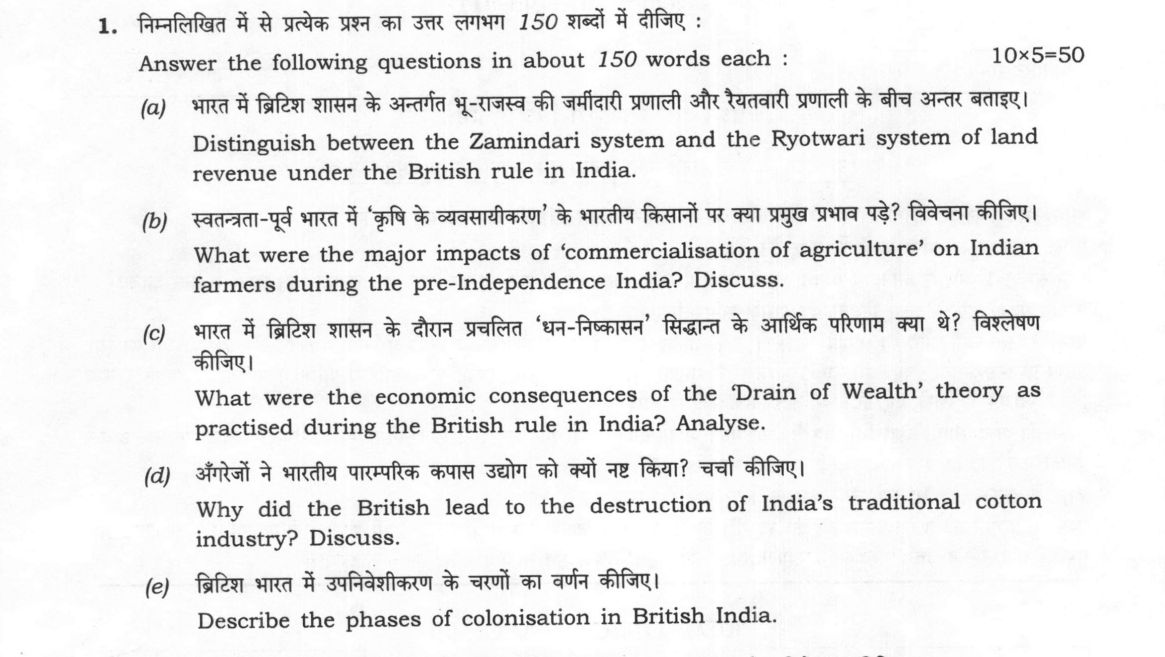
Answer the following questions in about 150 words each: (a) Distinguish between the Zamindari system and the Ryotwari system of…
Answer the following questions in about 150 words each:
Distinguish between the Zamindari system and the Ryotwari system of land revenue under the British rule in India. 10 marks
What were the major impacts of 'commercialisation of agriculture' on Indian farmers during the pre-Independence India? Discuss. 10 marks
What were the economic consequences of the 'Drain of Wealth' theory as practised during the British rule in India? Analyse. 10 marks
Why did the British lead to the destruction of India's traditional cotton industry? Discuss. 10 marks
Describe the phases of colonisation in British India. 10 marks
हिंदी में प्रश्न पढ़ें
निम्नलिखित में से प्रत्येक प्रश्न का उत्तर लगभग 150 शब्दों में दीजिए :
भारत में ब्रिटिश शासन के अन्तर्गत भू-राजस्व की जमींदारी प्रणाली और रैयतवारी प्रणाली के बीच अन्तर बताइए। (10 अंक)
स्वतन्त्रता-पूर्व भारत में 'कृषि के व्यवसायीकरण' के भारतीय किसानों पर क्या प्रमुख प्रभाव पड़े? विवेचना कीजिए। (10 अंक)
भारत में ब्रिटिश शासन के दौरान प्रचलित 'धन-निष्कासन' सिद्धान्त के आर्थिक परिणाम क्या थे? विश्लेषण कीजिए। (10 अंक)
अंग्रेजों ने भारतीय पारम्परिक कपास उद्योग को क्यों नष्ट किया? चर्चा कीजिए। (10 अंक)
ब्रिटिश भारत में उपनिवेशीकरण के चरणों का वर्णन कीजिए। (10 अंक)
Model answer
Written by UPSC Answer Check against this question's marking rubric, to the 150-word length. UPSC does not publish answers for Mains — this is one way to score well, not an official key.
(a) Zamindari vs Ryotwari System
The fundamental distinction between the Zamindari and Ryotwari systems lies in the legal ownership of land and the presence of intermediaries in revenue collection. Introduced by Lord Cornwallis under the Permanent Settlement of 1793 in Bengal, Bihar, and Orissa, the Zamindari system conferred hereditary, proprietary land rights upon zamindars, who acted as state intermediaries. The revenue demand was fixed in perpetuity, leaving cultivators as insecure tenants-at-will subject to rack-renting and eviction.
Conversely, the Ryotwari system, devised by Thomas Munro and Alexander Read in the Madras and Bombay Presidencies, recognized the individual peasant (ryot) as the direct proprietor without any intermediary. Revenue was not fixed permanently but revised periodically (every 20 to 30 years) at high rates. Thus, while revenue risks under Zamindari were nominally borne by the zamindar, under Ryotwari the individual cultivator bore the full burden of production risks and market fluctuations.
(b) Impacts of Commercialisation of Agriculture
The commercialisation of agriculture under colonial rule was an enforced, revenue-driven process rather than an organic, market-led modernization. Driven by British industrial requirements and rigid cash-based revenue demands, farmers shifted cultivation from subsistence food grains to commercial cash crops like indigo, opium, cotton, and jute.
This transition degraded rural economic security. It undermined food grain availability, contributing directly to the severity of late-nineteenth-century famines. Furthermore, commercialisation deepened peasant indebtedness; smallholders relied on advances from moneylenders (mahajans) and European planters under coercive arrangements like the dadni system. Crop specialization disrupted traditional village self-sufficiency and integrated India’s agrarian economy into volatile world markets as a primary commodity supplier, exposing vulnerable cultivators to international price crashes without institutional credit or price support.
(c) Economic Consequences of the 'Drain of Wealth'
Dadabhai Naoroji’s 'Drain of Wealth' thesis, supported by R.C. Dutt, highlighted the unilateral transfer of India’s economic surplus to Britain without equivalent material or commercial returns. This drain materialized through a chronic export surplus offset not by bullion or imports, but by unilateral 'Home Charges'—comprising administrative expenses of the India Office, pensions, guaranteed interest on British railway capital, and military expenditures.
The primary consequence was the systemic depletion of investible domestic capital, arresting indigenous modern industrialization and causing chronic capital flight. The drain necessitated regressive internal taxation to fund external obligations, deepening mass poverty. It subordinated fiscal policy, depreciated the rupee exchange value, and transformed potential domestic capital formation into foreign assets, leaving the Indian economy structurally undercapitalized and perpetually impoverished.
(d) Destruction of Traditional Cotton Industry
The collapse of India’s traditional cotton industry was driven by discriminatory colonial policies tailored to British industrial interests. With the mechanization of British textile manufacturing in Lancashire and Manchester, the colonial administration implemented an asymmetric tariff regime: Indian handloom textiles faced prohibitive import duties in Britain and internal transit duties (chaukis) at home, while British factory-made cotton goods entered India under nominal tariffs.
Unable to compete with cheaper, mass-produced foreign cloth, millions of hereditary weavers, spinners, and artisans lost their livelihoods. India was systematically converted from the world's leading exporter of finished textiles into an exporter of raw cotton to British mills. This structural deindustrialization triggered rapid de-urbanization in historical textile hubs such as Dhaka, Murshidabad, and Surat, forcing displaced artisans back onto agriculture, which intensified agrarian overcrowding and wage depression.
(e) Phases of Colonisation in British India
British colonial exploitation evolved through three distinct, overlapping economic phases:
Phase I: Merchant Capital and Plunder (1757–1813): Following the Battle of Plassey, the East India Company utilized its political monopoly to extract direct territorial revenues (Diwani), which were used to finance the purchase of Indian manufactured goods for export to Europe without importing bullion, draining the state treasury.
Phase II: Industrial Capitalism and Free Trade (1813–1858): Initiated by the Charter Acts of 1813 and 1833, this phase abolished the Company's trade monopoly. India was transformed into a captive consumer market for British machine-made industrial goods and a primary supplier of agricultural raw materials, resulting in widespread domestic deindustrialization.
Phase III: Finance Capitalism (1858–1947): Characterized by British capital investment in guaranteed railways, plantation enclaves, shipping, managing agencies, and public debt. This entrenched a dependent, outward-oriented infrastructure designed to extract primary resources and solidify colonial economic control.
What "Distinguish" is asking you to do
Name the property that separates the items and say which side holds it. Distinguish is marked exactly as differentiate is, with no difference in expectation, but its stems more often line up three terms rather than two — gender equality, gender equity and empowerment — and every pair in the set has to be separated.
Structure that answers it
The category they all sit in → the property dividing the first pair → the second pair → the third → why the boundary matters in practice
Where marks are lost
Separating the two obviously different items and leaving the middle term unplaced. A description of each side from which the line must be inferred is marked as description, not as a distinction.
How this answer will be evaluated
Approach
Framework: UPSC Mains General Studies Paper II (Economic History). (a) compare: paired headings or table > key differences > significance > conclusion | (b) discuss: intro > 3-4 dimensions > example > balanced close | (c) analyse: intro > causes > effects > stakeholders/linkages > way forward | (d) discuss: intro > 3-4 dimensions > example > balanced close | (e) describe: define > structure or process in order > labelled diagram > significance Full marks: Comprehensive, well-structured, and analytically sound answers with specific historical references.
Key points expected
- Identify the region of operation for each system
- Specify the revenue collector (Zamindar vs Ryot)
- Explain the nature of the state's relationship with the land
- Mention the fixed vs variable nature of revenue demand
- Define commercialisation of agriculture in the colonial context
- Explain the shift from food crops to cash crops (indigo, cotton)
- Discuss the impact on food security and famine vulnerability
- Mention the role of moneylenders and the loss of land
Evaluation rubric
Each sub-part is marked on its own, against the marks and word limit printed on the paper.
- (a) Distinguish between Zamindari and Ryotwari systems of land revenue. · 150 words
compare— paired headings or table → key differences → significance → conclusion
Must cover
- Identify the region of operation for each system
- Specify the revenue collector (Zamindar vs Ryot)
- Explain the nature of the state's relationship with the land
- Mention the fixed vs variable nature of revenue demand
Loses marks
- Confusing the roles of the state and the intermediary
- Failing to distinguish the two systems clearly
Earns more
- Reference to Permanent Settlement (1793)
- Mention of the 'intermediary' role of the Zamindar
- Comparison of the risk of revenue collection
Extra mark
- Mention of the 'Ryotwari' system in Madras/Pune
- Reference to the 'Zamindari' system in Bengal/Bihar
- (b) Discuss the major impacts of 'commercialisation of agriculture' on Indian farmers. · 150 words
discuss— intro → 3-4 dimensions → example → balanced close
Must cover
- Define commercialisation of agriculture in the colonial context
- Explain the shift from food crops to cash crops (indigo, cotton)
- Discuss the impact on food security and famine vulnerability
- Mention the role of moneylenders and the loss of land
Loses marks
- Failing to link commercialisation to the loss of food security
- Ignoring the role of the colonial state in promoting cash crops
Earns more
- Reference to the 'indigo' or 'cotton' cultivation
- Mention of the 'deindustrialisation' of the rural economy
- Discussion of the 'marketisation' of the rural economy
Extra mark
- Reference to the 'Ryotwari' or 'Zamindari' system's role
- Mention of specific cash crops like 'jute' or 'sugarcane'
- (c) Analyse the economic consequences of the 'Drain of Wealth' theory. · 150 words
analyse— intro → causes → effects → stakeholders/linkages → way forward
Must cover
- Define the 'Drain of Wealth' theory (Dadabhai Naoroji)
- Explain the mechanism of the drain (home charges, profits)
- Discuss the impact on India's capital formation
- Mention the impact on India's industrial development
Loses marks
- Failing to explain the mechanism of the drain
- Ignoring the impact on India's industrial development
Earns more
- Reference to 'home charges' (interest on debt, pensions)
- Mention of the 'sterling balance' and its impact
- Discussion of the 'deindustrialisation' of India
Extra mark
- Reference to Dadabhai Naoroji's 'Poverty and Un-British Rule in India'
- Mention of the 'drain' as a 'one-way flow' of wealth
- (d) Discuss why the British led to the destruction of India's traditional cotton industry. · 150 words
discuss— intro → 3-4 dimensions → example → balanced close
Must cover
- Explain the 'deindustrialisation' of the Indian cotton industry
- Mention the impact of British tariffs and duties
- Discuss the role of machine-made cloth in India
- Explain the 'raw material' role of India in the British economy
Loses marks
- Failing to explain the role of British tariffs
- Ignoring the impact of machine-made cloth on Indian weavers
Earns more
- Reference to the 'cotton' industry in 'Surat' or 'Dhaka'
- Mention of the 'tariff' on Indian cotton cloth
- Discussion of the 'machine-made' cloth from 'Manchester'
Extra mark
- Reference to the 'cotton' industry's 'decline' in the 19th century
- Mention of the 'raw cotton' export from India to Britain
- (e) Describe the phases of colonisation in British India. · 150 words
describe— define → structure or process in order → labelled diagram → significance
Must cover
- Identify the 'commercial' phase (East India Company)
- Explain the 'political' phase (Crown rule)
- Discuss the 'industrial' phase (post-1857)
- Mention the 'agricultural' phase (commercialisation of agriculture)
Loses marks
- Failing to identify the distinct phases of colonisation
- Ignoring the 'industrial' phase and its impact on India
Earns more
- Reference to the 'East India Company' and its 'charter'
- Mention of the 'Crown rule' and the 'Government of India Act'
- Discussion of the 'industrial' phase and the 'deindustrialisation' of India
Extra mark
- Reference to the 'commercial' phase and the 'trade' with India
- Mention of the 'political' phase and the 'annexation' of Indian states
Practice this exact question
Write your answer and it is marked point by point against the model answer above — what you covered, what you missed, what you got wrong.
Evaluate my answer →More from Economics 2025 Paper II
- Q1 Answer the following questions in about 150 words each: (a) Distinguish between the Zamin…
- Q2 (a) Is land reform necessary to improve agricultural productivity in India? Discuss. (20…
- Q3 (a) Examine the objectives and components of the Green Revolution in India. (20 marks) (b…
- Q4 (a) What are the methods used in measuring poverty and inequality in India? Analyse. (20…