Paper II — Q5
Answer the following questions in about 150 words each: (a) Discuss the components of food processing schemes introduced by the…
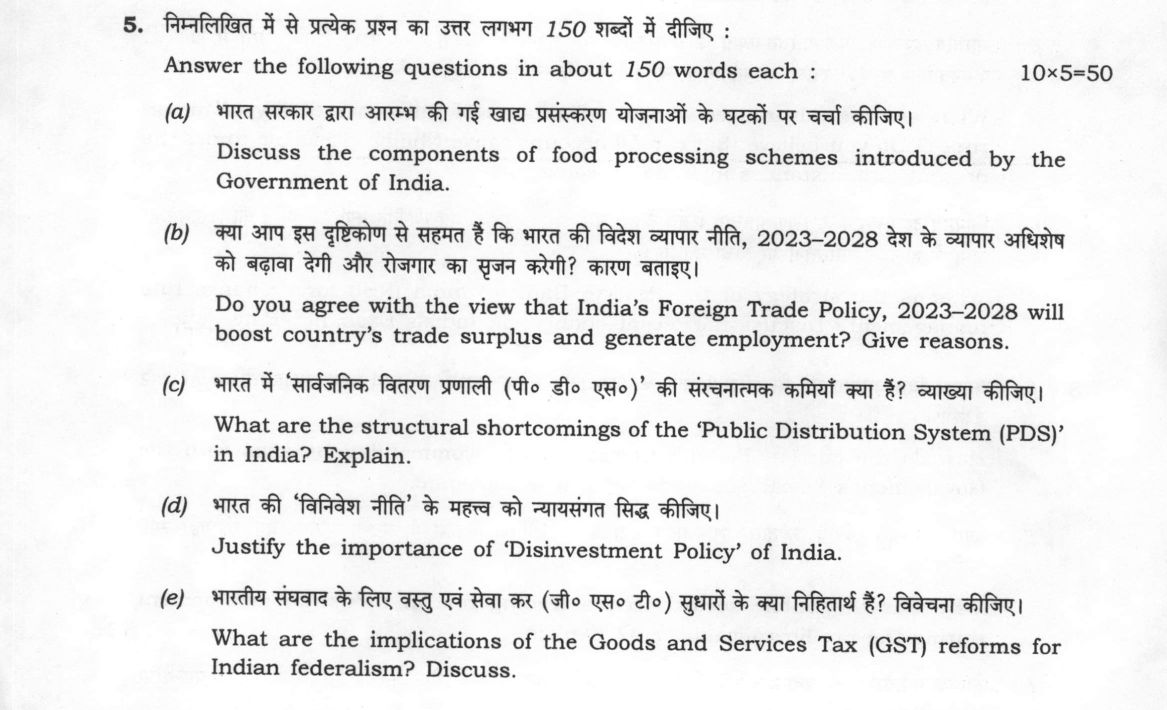
Answer the following questions in about 150 words each:
Discuss the components of food processing schemes introduced by the Government of India. 10 marks
Do you agree with the view that India's Foreign Trade Policy, 2023-2028 will boost country's trade surplus and generate employment? Give reasons. 10 marks
What are the structural shortcomings of the 'Public Distribution System (PDS)' in India? Explain. 10 marks
Justify the importance of 'Disinvestment Policy' of India. 10 marks
What are the implications of the Goods and Services Tax (GST) reforms for Indian federalism? Discuss. 10 marks
हिंदी में प्रश्न पढ़ें
निम्नलिखित में से प्रत्येक प्रश्न का उत्तर लगभग 150 शब्दों में दीजिए :
भारत सरकार द्वारा आरम्भ की गई खाद्य प्रसंस्करण योजनाओं के घटकों पर चर्चा कीजिए। (10 अंक)
क्या आप इस दृष्टिकोण से सहमत हैं कि भारत की विदेश व्यापार नीति, 2023-2028 देश के व्यापार अधिशेष को बढ़ावा देगी और रोजगार का सृजन करेगी? कारण बताइए। (10 अंक)
भारत में 'सार्वजनिक वितरण प्रणाली (पी० डी० एस०)' की संरचनात्मक कमियाँ क्या हैं? व्याख्या कीजिए। (10 अंक)
भारत की 'विनिवेश नीति' के महत्व को न्यायसंगत सिद्ध कीजिए। (10 अंक)
भारतीय संघवाद के लिए वस्तु एवं सेवा कर (जी० एस० टी०) सुधारों के क्या निहितार्थ हैं? विवेचना कीजिए। (10 अंक)
Model answer
Written by UPSC Answer Check against this question's marking rubric, to the 150-word length. UPSC does not publish answers for Mains — this is one way to score well, not an official key.
(a) Food processing schemes. India’s food processing schemes aim to reduce post-harvest losses, add value, and connect agriculture with organised industry. PM Kisan SAMPADA Yojana is the flagship, comprising Mega Food Parks for cluster-based processing, Integrated Cold Chain Development for storage, packaging and logistics, Food Safety and Quality Infrastructure for testing, certification and standards, and Operation Greens, expanded from tomato to all fruits and vegetables (TOTAL), to stabilise prices and reduce wastage. Pradhan Mantri Formalisation of Micro Food Processing Enterprises (PMFME) supports micro enterprises and self-help groups through cluster promotion and individual projects, bringing informal units into the formal economy. The Production Linked Incentive for food processing rewards incremental output, encourages modern technology and helps Indian products compete globally. Together, these components create backward and forward linkages, improve farm incomes, strengthen food security, support export competitiveness, reduce regional imbalances in perishable markets, and promote rural non-farm employment in processing clusters.
(b) Foreign Trade Policy 2023-28. I partially agree that FTP 2023-28 can boost trade and employment, but a sustained surplus is uncertain. The policy’s Districts as Export Hubs and E-Commerce Export Hubs can decentralise exports, reduce logistics costs and help MSMEs enter global value chains. SCOMET liberalisation may widen technology exports, while Rupee trade mechanisms can lower currency risk and deepen trade with friendly countries. These measures may generate employment through MSME linkages, services exports and value addition. However, India’s trade surplus depends on import intensity: capital goods, energy and intermediate imports remain high, and export growth may not automatically offset them. Employment gains will depend on skill development, compliance ease and MSME access to credit. Thus, the policy can improve trade competitiveness and jobs, but surplus outcomes require import substitution, energy security, stronger export diversification, better port connectivity, single-window clearance and export credit to support MSMEs and exporters abroad.
(c) PDS structural shortcomings. The PDS remains India’s largest food security programme, but its structure has persistent weaknesses. Inclusion and exclusion errors persist because Aadhaar seeding, biometric authentication and database updates are uneven, causing eligible poor to be denied or ineligible persons to receive benefits. Leakages and diversion remain a concern; FCI data on physical stock losses, theft and ghost beneficiaries show that physical supply chains can be inefficient. The system is cereal-centric, focusing mainly on rice and wheat, while protein and micronutrient needs remain unaddressed, limiting nutritional outcomes. Inter-state disparity in Targeted PDS implementation creates unequal access, as states differ in ration network capacity, pricing and monitoring. Digitisation gaps, including poor connectivity, weak last-mile delivery and limited data integration, weaken accountability. These shortcomings require stronger nutrition baskets, better data governance, state-specific delivery reforms and transparent grievance redressal to ensure the PDS reaches the intended poor efficiently, fairly and equitably.
(d) Disinvestment policy. India’s disinvestment policy is important because it helps the government raise resources for infrastructure and social sectors while reducing fiscal pressure. Strategic disinvestment in Central Public Sector Enterprises can improve efficiency, as CPSE performance data often show that private participation brings better governance, technology and market discipline. It also supports Atmanirbhar Bharat by encouraging private investment in strategic sectors such as defence, energy, telecom and manufacturing, where public capacity may be limited. By reducing the government’s equity burden, disinvestment can help contain the fiscal deficit and create space for capital expenditure. It may also improve corporate governance, investor confidence and capital market development. However, the process must balance revenue needs with national interest, worker welfare and strategic autonomy. A transparent, outcome-linked disinvestment framework can make the policy a tool for growth, industrial competitiveness and public interest while avoiding fire sales that undermine strategic assets and public trust.
(e) GST and federalism. GST reforms have restructured Indian federalism by introducing concurrent taxation under Article 246A, where Centre and states levy tax on goods and services. This has strengthened cooperative federalism through the GST Council, where states have a 33% voting weight, but it has also eroded states’ independent indirect taxation powers and fiscal autonomy. The 15th Finance Commission has highlighted vertical and horizontal fiscal imbalances, as states bear expenditure responsibilities while revenue sharing depends on GST rates and compensation. The discontinuation of revenue compensation has exposed states to shortfalls, especially those with lower consumption or higher fiscal needs. IGST settlement delays further strain state finances and weaken trust in the shared tax system. Thus, GST has improved tax administration and a common market, but it requires timely settlements, adequate compensation or equalisation, greater state fiscal space, a constitutional settlement on GST compensation to preserve federal balance and trust.
What "Discuss" is asking you to do
Lay the issue out from more than one side — how it arose, what is claimed for it, what is held against it, and where it now stands. UPSC attaches discuss to broad topics with several live dimensions, so coverage of the dimensions earns more than the strength of your opinion.
Structure that answers it
Set the issue up → the case as it is made → the case against → the dimension both sides leave out → where the balance now lies
Where marks are lost
Listing facts with no thread between them, or arguing one side throughout and calling it a discussion.
How this answer will be evaluated
Approach
Framework: UPSC Economics Paper II. (a) discuss: intro > 3-4 dimensions > example > balanced close | (b) comment: context > arguments both sides > judgment > close | (c) explain: definition/context > points in order > small example > short close | (d) justify: claim > 3-4 reasons > evidence > conclusion | (e) discuss: intro > 3-4 dimensions > example > balanced close Full marks: Precise, specific, well-structured with named schemes/data
Key points expected
- Name PMFME and its sub-components
- Identify infrastructure support schemes
- Mention quality certification initiatives
- Reference specific scheme names
- State specific FTA policy measures
- Link measures to trade surplus
- Link measures to employment generation
- Provide reasoned judgment
Evaluation rubric
Each sub-part is marked on its own, against the marks and word limit printed on the paper.
- (a) Intro > 3-4 dimensions > example > balanced close · 150 words
discuss— intro → 3-4 dimensions → example → balanced close
Must cover
- Name PMFME and its sub-components
- Identify infrastructure support schemes
- Mention quality certification initiatives
- Reference specific scheme names
Loses marks
- Generic description without scheme names
- Confusing food processing with food security
- Listing schemes without explaining components
Earns more
- Mention PMKSY linkage
- Reference specific budget allocations
- Mention state-wise implementation
- Reference specific targets
Extra mark
- Mention specific recent scheme launch
- Reference specific committee report
- (b) Context > arguments both sides > judgment > close · 150 words
comment— context → arguments both sides → judgment → close
Must cover
- State specific FTA policy measures
- Link measures to trade surplus
- Link measures to employment generation
- Provide reasoned judgment
Loses marks
- Generic trade policy discussion
- No link to employment generation
- No reasoned judgment provided
Earns more
- Mention specific export targets
- Reference specific import substitution
- Mention specific sectoral focus
- Reference specific trade data
Extra mark
- Mention specific trade agreement
- Reference specific economic forecast
- (c) Definition/context > points in order > small example > short close · 150 words
explain— definition/context → points in order → small example → short close
Must cover
- Identify supply chain inefficiencies
- Mention exclusion and inclusion errors
- Reference infrastructure limitations
- Mention administrative challenges
Loses marks
- Generic PDS description
- No specific structural issues
- Confusing PDS with other welfare schemes
Earns more
- Mention specific leakages
- Reference specific state issues
- Mention digitalization challenges
- Reference specific reform attempts
Extra mark
- Mention specific committee report
- Reference specific data on leakages
- (d) Claim > 3-4 reasons > evidence > conclusion · 150 words
justify— claim → 3-4 reasons → evidence → conclusion
Must cover
- Mention fiscal deficit reduction
- Reference efficiency improvements
- Mention private sector participation
- Reference global best practices
Loses marks
- Generic privatization discussion
- No specific reasons provided
- No evidence or examples
Earns more
- Mention specific disinvestment targets
- Reference specific PSU performance
- Mention specific revenue figures
- Reference specific policy documents
Extra mark
- Mention specific committee report
- Reference specific international example
- (e) Intro > 3-4 dimensions > example > balanced close · 150 words
discuss— intro → 3-4 dimensions → example → balanced close
Must cover
- Mention tax power transfer
- Reference GST Council structure
- Mention compensation mechanism
- Reference federalism implications
Loses marks
- Generic GST description
- No federalism implications
- No specific examples or evidence
Earns more
- Mention specific state concerns
- Reference specific compensation formula
- Mention specific GST Council decisions
- Reference specific legal challenges
Extra mark
- Mention specific committee report
- Reference specific Supreme Court judgment
Practice this exact question
Write your answer and it is marked point by point against the model answer above — what you covered, what you missed, what you got wrong.
Evaluate my answer →More from Economics 2025 Paper II
- Q2 (a) Is land reform necessary to improve agricultural productivity in India? Discuss. (20…
- Q3 (a) Examine the objectives and components of the Green Revolution in India. (20 marks) (b…
- Q4 (a) What are the methods used in measuring poverty and inequality in India? Analyse. (20…
- Q5 Answer the following questions in about 150 words each: (a) Discuss the components of foo…
- Q6 (a) What are the causes of industrial backwardness in India? Critically evaluate the role…
- Q7 (a) What is the sectoral composition of India's national income? Mention the most importa…
- Q8 (a) How do the current Finance Commission's recommendations align with the Government's F…