Paper II — Q3
(a) Examine the objectives and components of the Green Revolution in India. (20 marks) (b) Why does inter-State disparity in…
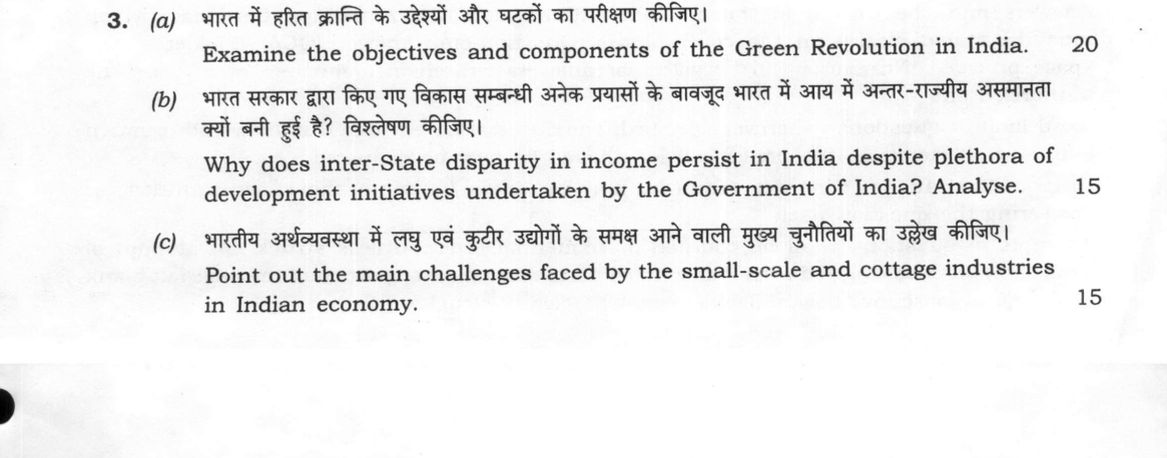
Examine the objectives and components of the Green Revolution in India. 20 marks
Why does inter-State disparity in income persist in India despite plethora of development initiatives undertaken by the Government of India? Analyse. 15 marks
Point out the main challenges faced by the small-scale and cottage industries in Indian economy. 15 marks
हिंदी में प्रश्न पढ़ें
भारत में हरित क्रान्ति के उद्देश्यों और घटकों का परीक्षण कीजिए। (20 अंक)
भारत सरकार द्वारा किए गए विकास सम्बन्धी अनेक प्रयासों के बावजूद भारत में आय में अन्तर-राज्यीय असमानता क्यों बनी हुई है? विश्लेषण कीजिए। (15 अंक)
भारतीय अर्थव्यवस्था में लघु एवं कुटीर उद्योगों के समक्ष आने वाली मुख्य चुनौतियों का उल्लेख कीजिए। (15 अंक)
Model answer
Written by UPSC Answer Check against this question's marking rubric, to the expected length. UPSC does not publish answers for Mains — this is one way to score well, not an official key.
Post-independence Indian economic development reflects a structural triad: transforming agricultural productivity, redressing spatial growth divergence, and promoting labour-intensive micro-enterprises to generate inclusive employment.
Objectives and Components of the Green Revolution
Initiated in the mid-1960s to break the "ship-to-mouth" vulnerability under US PL-480, the Green Revolution aimed at attaining national food self-sufficiency, stabilising macro-level foodgrain prices to insulate real wages, and augmenting farm incomes to stimulate rural demand.
Its core rested on a coordinated technological package:
- High-Yielding Varieties (HYV) responsive to intensive inputs, notably dwarf wheat strains such as Kalyan Sona and Sonalika, followed by IR-8 rice.
- Controlled irrigation through tube wells and canals, which was essential for HYV biological responsiveness.
- High doses of chemical inputs (NPK fertilizers, pesticides).
- Expansion of institutional credit through Primary Agricultural Credit Societies and nationalised commercial banks.
- Price-risk mitigation and public procurement via the Agricultural Prices Commission (now CACP) through Minimum Support Prices (MSP) and the Food Corporation of India.
Critically examined, the first phase remained a localised "Wheat Revolution" concentrated in Punjab, Haryana, and Western Uttar Pradesh due to their established canal infrastructure and larger landholdings. The subsequent "Rice Revolution" spread to eastern and southern tracts with varied success. While it eliminated aggregate food deficits, this input-intensive regime generated severe regional concentration, monocropping distortions, groundwater depletion, soil toxicity, and secondary salinity, leaving dryland and rainfed tracts historically underdeveloped.
Persistence of Inter-State Income Disparities
Despite planned interventions and equalization grants, regional income divergence persists due to structural, policy, and market mechanisms:
Structural and Historical Legacies: Favourable agro-climatic endowments and colonial-era spatial preferences toward port presidencies created deep historical advantages in physical infrastructure and market access, disadvantaging the hinterlands.
Policy and Fiscal Distortions: Centrally Sponsored Schemes (CSS) with uniform co-financing requirements place disproportionate burdens on fiscally constrained poorer States. Furthermore, historical policies like the Freight Equalisation Scheme stripped eastern States of location-specific resource advantages without fostering indigenous manufacturing capacity.
New Economic Geography Perspective: Regional divergence can be explained through Paul Krugman’s core-periphery model of cumulative circular causation. Fiscally sound, advanced States (e.g., Gujarat, Maharashtra, Tamil Nadu) leverage superior human capital, established industrial ecosystems, and agglomeration economies to attract the bulk of private investment and Foreign Direct Investment (FDI). Conversely, poorer States suffer human capital out-migration and low internal revenue generation. Consequently, per capita income Gini coefficients and NITI Aayog’s SDG India Index demonstrate widening spatial divergence rather than neoclassical income convergence.
Challenges Facing Small-Scale and Cottage Industries
Small-scale and cottage industries remain vulnerable across multiple dimensions:
Credit and Financial Constraints: Inadequate access to formal institutional credit forces reliance on high-cost informal channels. Strict collateral requirements, delayed credit disbursements, and systemic delays in receiving receivables from large buyers erode their working capital base.
Technological and Market Disadvantages: Low investment in R&D and primitive production methods depress total factor productivity. Cottage units suffer from weak forward linkages, inadequate standardization, and poor integration into digital e-commerce supply chains and public procurement platforms.
Regulatory Burdens: Multi-layered compliance requirements—including intricate GST return mechanisms, complex local labour laws, and procedural delays in securing environmental clearances—disproportionately increase transaction costs for micro-enterprises.
Scale and Trade Pressures: Micro-enterprises face severe competition from the domestic organised corporate sector and cheap imports following Free Trade Agreements (FTAs). Flagship interventions such as the Prime Minister’s Employment Generation Programme (PMEGP) and the Scheme of Fund for Regeneration of Traditional Industries (SFURTI) remain constrained by sub-scale fund allocations, procedural friction, and insufficient common facility infrastructure.
Sustaining long-term inclusive growth requires transitioning from input-heavy cereal farming to climate-resilient agriculture, adopting asymmetric fiscal transfers to break regional circular causation, and modernising cottage clusters through accessible credit and technology networks.
What "Examine" is asking you to do
Test the proposition the question puts to you and return a finding on how far it holds. Examine stems carry a claim, or ask whether something has happened, and expect evidence weighed both ways before the extent is stated — often with remedial measures attached.
Structure that answers it
Restate the claim as the question frames it → evidence that supports it → evidence that undercuts it → the conditions under which it holds → verdict on how far it stands
Where marks are lost
Stopping at description. An examination has to reach a finding, and “examine with justification” means the extent must be stated, not implied.
How this answer will be evaluated
Approach
Framework: UPSC Economics Paper II. (a) examine: intro > how/why with reasoning > evidence > conclusion | (b) analyse: intro > causes > effects > stakeholders/linkages > way forward | (c) challenges: 3-4 challenges > solutions mapped to them > conclusion Full marks: Comprehensive, data-driven, specific policy references, clear structure
Key points expected
- State primary objective: food security
- List components: HYV seeds, irrigation, fertilizer
- Mention institutional support: credit, MSP
- Provide evidence of success (production data)
- Identify structural causes (geography, infrastructure)
- Discuss policy failures (implementation gaps)
- Link to economic indicators (GSDP, per capita income)
- Suggest specific remedial measures
Evaluation rubric
Each sub-part is marked on its own, against the marks and word limit printed on the paper.
- (a) Intro > Objectives > Components > Evidence > Conclusion 20 marks
examine— intro → how/why with reasoning → evidence → conclusion
Must cover
- State primary objective: food security
- List components: HYV seeds, irrigation, fertilizer
- Mention institutional support: credit, MSP
- Provide evidence of success (production data)
Loses marks
- Confusing Green with White Revolution
- Ignoring regional disparities
- Vague listing without analysis
Earns more
- Mention regional concentration (Punjab/Haryana)
- Discuss social consequences (inequality)
- Reference specific Five Year Plans
- Mention environmental impact
Extra mark
- Cite specific production statistics
- Name specific policy documents
- (b) Intro > Causes > Effects > Linkages > Way Forward 15 marks
analyse— intro → causes → effects → stakeholders/linkages → way forward
Must cover
- Identify structural causes (geography, infrastructure)
- Discuss policy failures (implementation gaps)
- Link to economic indicators (GSDP, per capita income)
- Suggest specific remedial measures
Loses marks
- Generalizing without state examples
- Ignoring the 'despite initiatives' aspect
- Listing causes without analysis
Earns more
- Mention specific disparity indices
- Discuss role of FDI distribution
- Reference specific central schemes
- Mention human capital differences
Extra mark
- Cite specific state data
- Name specific committees on regional disparity
- (c) 3-4 Challenges > Solutions > Conclusion 15 marks
challenges— 3-4 challenges → solutions mapped to them → conclusion
Must cover
- Identify financing constraints
- Discuss technology and skill gaps
- Mention market access issues
- Map solutions to specific challenges
Loses marks
- Listing challenges without solutions
- Confusing small-scale with large-scale issues
- Ignoring the 'cottage' aspect
Earns more
- Reference specific government schemes (MUDRA, etc.)
- Discuss role of cooperatives
- Mention digitalization challenges
- Discuss raw material supply issues
Extra mark
- Cite specific employment data
- Name specific industry associations
Practice this exact question
Write your answer and it is marked point by point against the model answer above — what you covered, what you missed, what you got wrong.
Evaluate my answer →More from Economics 2025 Paper II
- Q1 Answer the following questions in about 150 words each: (a) Distinguish between the Zamin…
- Q2 (a) Is land reform necessary to improve agricultural productivity in India? Discuss. (20…
- Q3 (a) Examine the objectives and components of the Green Revolution in India. (20 marks) (b…
- Q4 (a) What are the methods used in measuring poverty and inequality in India? Analyse. (20…
- Q5 Answer the following questions in about 150 words each: (a) Discuss the components of foo…
- Q6 (a) What are the causes of industrial backwardness in India? Critically evaluate the role…