Paper II — Q2
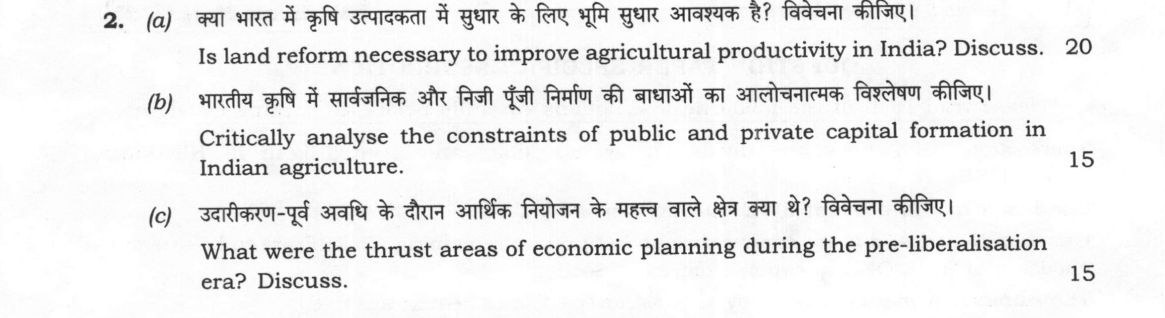
(a) Is land reform necessary to improve agricultural productivity in India? Discuss. (20 marks) (b) Critically analyse the…
Is land reform necessary to improve agricultural productivity in India? Discuss. 20 marks
Critically analyse the constraints of public and private capital formation in Indian agriculture. 15 marks
What were the thrust areas of economic planning during the pre-liberalisation era? Discuss. 15 marks
हिंदी में प्रश्न पढ़ें
क्या भारत में कृषि उत्पादकता में सुधार के लिए भूमि सुधार आवश्यक है? विवेचना कीजिए। (20 अंक)
भारतीय कृषि में सार्वजनिक और निजी पूँजी निर्माण की बाधाओं का आलोचनात्मक विश्लेषण कीजिए। (15 अंक)
उदारीकरण-पूर्व अवधि के दौरान आर्थिक नियोजन के महत्व वाले क्षेत्र क्या थे? विवेचना कीजिए। (15 अंक)
Model answer
Written by UPSC Answer Check against this question's marking rubric, to the expected length. UPSC does not publish answers for Mains — this is one way to score well, not an official key.
(a) Land reform and productivity Land reform is necessary for improving agricultural productivity in India, but it is not sufficient by itself. The inverse relationship between farm size and productivity—small and marginal farms often yield more per acre because of intensive labour use—means that secure tenure, tenancy abolition, tenancy regulation, ceiling laws and consolidation can raise efficiency by giving cultivators incentives to invest. The case is strongest where tenancy was insecure: without legal recognition, tenants cannot invest in soil, water or high-value crops. Ownership reforms such as zamindari abolition removed absentee landlords, but operational reforms—tenancy regulation, land-to-the-tiller, consolidation—matter more for productivity because they determine who actually works the land and can retain returns. Kerala and West Bengal show that secure tenancy and better implementation can improve incentives and rural stability, whereas Bihar and Uttar Pradesh illustrate failures due to benami transfers, weak records and incomplete abolition. Against this, critics note that land reform alone did not transform productivity: implementation was uneven, ceilings often fragmented holdings, and the Green Revolution, contract farming, market linkages and technology diffusion could raise output even where ownership remained imperfect. Alternative pathways can work, but they may fail smallholders if they lack access to inputs and markets. Thus, land reform is a necessary institutional base, especially for smallholders, but it must be paired with credit, irrigation and technology.
(b) Capital formation constraints Public capital formation is constrained by the post-FRBM fiscal squeeze, declining plan outlays, an irrigation maintenance deficit and poorly targeted subsidies. Irrigation, research, rural roads and power are largely public goods, yet underinvestment and poor maintenance reduce returns. Private capital faces land fragmentation, risk aversion, credit market imperfections and low returns relative to non-farm investment. Fixed capital such as tubewells and tractors requires large upfront outlays, while working capital for fertilizers, seeds and hired labour is recurrent and sensitive to price and weather shocks. Fixed assets are often more visible, while working capital is underprovided because it is small-ticket and time-bound. Institutional credit through banks, cooperatives, NABARD and KCC has expanded, but it is limited by collateral requirements, delays, weak enforcement, over-indebtedness and uneven reach; KCC’s collateral-free intent is often diluted by documentation and risk concerns. Institutional credit may also favour larger farmers because of lower transaction costs, while smallholders depend on non-institutional lenders, which remain important but costly. The result is that many farmers invest in visible fixed assets while under-investing in soil health, water conservation and quality inputs.
(c) Pre-liberalisation planning Pre-liberalisation planning placed agriculture within a broader development strategy. The First Plan emphasised land reforms and launched community development. The Second Plan’s core thrust was rapid industrialisation under the Mahalanobis strategy, while retaining community development and cooperatives as institutional supports. The Third Plan began the shift to foodgrain production; the HYV/Green Revolution strategy became central from the Fourth Plan, while price support and procurement were used across the Third to Fifth Plans, and the Fifth Plan stressed poverty removal and self-reliance. The Sixth Plan introduced poverty alleviation through IRDP, and the Seventh Plan adopted a technology mission approach. The planning approach assumed that state direction could coordinate investment, but it often treated agriculture as a source of surplus for industry. Price support and procurement helped some regions but did not fully correct the input-output price scissors. Yet planning had limits: an urban-industrial bias, inadequate attention to rainfed agriculture, and regional disparities, with Punjab and Haryana benefiting more than eastern India.
In sum, land reform, capital availability and planning priorities jointly shaped Indian agriculture. A way forward is to combine secure operational land rights, better public investment in irrigation and research, targeted credit, and balanced regional planning.
What "Discuss" is asking you to do
Lay the issue out from more than one side — how it arose, what is claimed for it, what is held against it, and where it now stands. UPSC attaches discuss to broad topics with several live dimensions, so coverage of the dimensions earns more than the strength of your opinion.
Structure that answers it
Set the issue up → the case as it is made → the case against → the dimension both sides leave out → where the balance now lies
Where marks are lost
Listing facts with no thread between them, or arguing one side throughout and calling it a discussion.
How this answer will be evaluated
Approach
Framework: UPSC Economics Paper II. (a) discuss: intro > 3-4 dimensions > example > balanced close | (b) analyse: intro > causes > effects > stakeholders/linkages > way forward | (c) discuss: intro > 3-4 dimensions > example > balanced close Full marks: Precise definitions, specific data/statutes, clear logical flow, balanced arguments.
Key points expected
- Define land reform (ceiling, tenancy, consolidation)
- Link fragmentation to low productivity
- Mention tenancy laws (e.g., Zamindari Abolition)
- Balanced conclusion on necessity vs. other factors
- Define capital formation in agriculture
- Public constraints (fiscal deficit, subsidy crowding out)
- Private constraints (credit access, risk)
- Linkage between public and private investment
Evaluation rubric
Each sub-part is marked on its own, against the marks and word limit printed on the paper.
- (a) Argument on the necessity of land reform for productivity improvement. 20 marks
discuss— intro → 3-4 dimensions → example → balanced close
Must cover
- Define land reform (ceiling, tenancy, consolidation)
- Link fragmentation to low productivity
- Mention tenancy laws (e.g., Zamindari Abolition)
- Balanced conclusion on necessity vs. other factors
Loses marks
- Ignoring tenancy issues in favor of only ceilings
- No link between reform and productivity
Earns more
- Cite NITI Aayog or ICAR data on fragmentation
- Reference specific state land acts
- Mention 'Right to Fair Compensation' Act
Extra mark
- Reference to 'Land to the Tiller' policy
- Specific data on average landholding size
- (b) Critical analysis of constraints on public and private capital formation. 15 marks
analyse— intro → causes → effects → stakeholders/linkages → way forward
Must cover
- Define capital formation in agriculture
- Public constraints (fiscal deficit, subsidy crowding out)
- Private constraints (credit access, risk)
- Linkage between public and private investment
Loses marks
- Treating public and private as isolated silos
- Vague statements without specific constraints
Earns more
- Mention Kisan Credit Cards (KCC) as a mechanism
- Reference to 'Capital Formation' in 5th Plan
- Data on public investment in agriculture (PIA)
Extra mark
- Reference to 'Capital Formation' in 5th Plan
- Specific data on public investment in agriculture (PIA)
- (c) Discussion of thrust areas of economic planning pre-liberalisation. 15 marks
discuss— intro → 3-4 dimensions → example → balanced close
Must cover
- Define pre-liberalisation era (1950-1991)
- Identify key thrust areas (e.g., industrialization, self-reliance)
- Mention specific plans (e.g., 1st, 2nd, 5th Plan)
- Context of 'License Raj' or 'Import Substitution'
Loses marks
- Confusing pre-liberalisation with post-1991 policies
- Listing areas without explaining their 'thrust' nature
Earns more
- Reference to 'Green Revolution' as a thrust
- Mention 'Self-Reliance' (Swadeshi) policy
- Reference to 'License Raj' or 'Import Substitution'
Extra mark
- Reference to 'Green Revolution' as a thrust
- Mention 'Self-Reliance' (Swadeshi) policy
Practice this exact question
Write your answer and it is marked point by point against the model answer above — what you covered, what you missed, what you got wrong.
Evaluate my answer →More from Economics 2025 Paper II
- Q1 Answer the following questions in about 150 words each: (a) Distinguish between the Zamin…
- Q2 (a) Is land reform necessary to improve agricultural productivity in India? Discuss. (20…
- Q3 (a) Examine the objectives and components of the Green Revolution in India. (20 marks) (b…
- Q4 (a) What are the methods used in measuring poverty and inequality in India? Analyse. (20…
- Q5 Answer the following questions in about 150 words each: (a) Discuss the components of foo…