Paper II — Q7
(a) What is the sectoral composition of India's national income? Mention the most important source of national income in India…
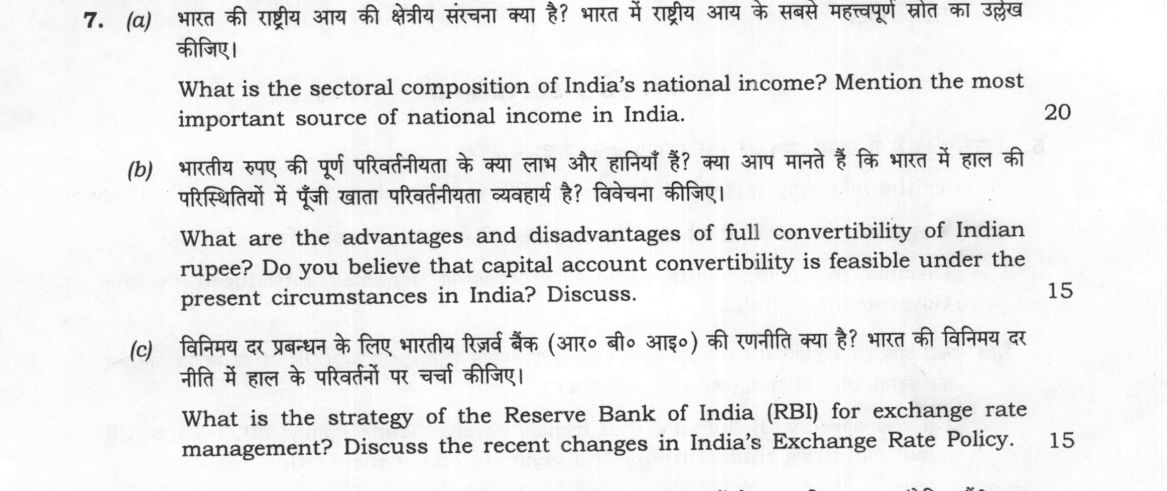
What is the sectoral composition of India's national income? Mention the most important source of national income in India. 20 marks
What are the advantages and disadvantages of full convertibility of Indian rupee? Do you believe that capital account convertibility is feasible under the present circumstances in India? Discuss. 15 marks
What is the strategy of the Reserve Bank of India (RBI) for exchange rate management? Discuss the recent changes in India's Exchange Rate Policy. 15 marks
हिंदी में प्रश्न पढ़ें
भारत की राष्ट्रीय आय की क्षेत्रीय संरचना क्या है? भारत में राष्ट्रीय आय के सबसे महत्त्वपूर्ण स्रोत का उल्लेख कीजिए। (20 अंक)
भारतीय रुपए की पूर्ण परिवर्तनीयता के क्या लाभ और हानियाँ हैं? क्या आप मानते हैं कि भारत में हाल की परिस्थितियों में पूँजी खाता परिवर्तनीयता व्यवहार्य है? विवेचना कीजिए। (15 अंक)
विनिमय दर प्रबंधन के लिए भारतीय रिज़र्व बैंक (आर. बी. आई.) की रणनीति क्या है? भारत की विनिमय दर नीति में हाल के परिवर्तनों पर चर्चा कीजिए। (15 अंक)
Model answer
Written by UPSC Answer Check against this question's marking rubric, to the expected length. UPSC does not publish answers for Mains — this is one way to score well, not an official key.
India's national income is best read through gross value added (GVA), which excludes net indirect taxes, whereas GDP adds them; both show a services-led economy. On a GVA basis, agriculture and allied activities—farming, forestry and fishing—contribute a declining share of about 17–18%, industry, including manufacturing and construction, about 25–28%, and services, the largest sector, about 54–55%. In GDP terms, agriculture is somewhat lower, around 15–16%, because of taxes on goods and services. The most important source of national income is therefore the services sector, especially IT-BPM, financial services, trade and logistics, professional and business services, and transport. This matches the Fisher-Clark and Kuznets pattern of labour and value added moving from primary to secondary and then tertiary activities as income rises. Yet India shows a structural transformation paradox: services have a high income share but low employment elasticity, while agriculture still absorbs a large share of labour. Manufacturing has not expanded enough to provide mass employment, so the economy is income-rich in services but employment-weak in the sectors that could absorb surplus rural labour.
Convertibility. Full rupee convertibility means removing restrictions on both current and capital account transactions; India already has current-account convertibility for legitimate current transactions, but the capital account remains selective. Its advantages are efficient cross-border capital allocation, lower transaction costs, deeper integration with global markets, and reduced black-market premia. It can also improve credibility and lower borrowing costs by reducing risk premia. The disadvantages are greater exchange-rate volatility, vulnerability to speculative attacks and sudden stops, and possible pressure on monetary policy. The impossible-trinity argument must be stated carefully: loss of monetary autonomy is strongest under a fixed or heavily pegged rate; under a managed float, some autonomy remains, though capital flows can still constrain policy, especially when domestic rates differ sharply from global rates. Feasibility of capital account convertibility should be judged against the Tarapore Committee I (1997) and II (2006) preconditions: fiscal consolidation, an inflation rate range, such as 3–5%, rather than formal inflation targeting, lower NPAs (Tarapore I suggested around 3% gross NPAs; Tarapore II around 1%), and adequate forex reserves. India has made progress on fiscal deficits, reserves and financial stability, but banking asset quality, external vulnerabilities and domestic rate differentials remain. Hence full convertibility is not yet appropriate; a calibrated approach—FPI and FDI access, ECB relaxations with safeguards, and selective liberalisation—is more feasible.
Exchange-rate management. The RBI manages the rupee under a managed float, intervening to curb excessive volatility rather than to target a specific level. This reflects a move from more active management of the level to volatility management. It builds forex reserves as a precautionary buffer and treats financial stability as the overriding objective, while allowing market forces to determine the rate. Recent changes reflect greater flexibility after the 2013 taper tantrum, when the rupee was allowed to adjust more freely and the RBI focused on volatility rather than defending a level. The adoption of the inflation-targeting framework in 2016 anchored expectations and helped separate exchange-rate management from price stability. India's inclusion in global bond indices in 2024 increased foreign portfolio flows and made the rupee more sensitive to global liquidity. At the same time, the RBI has supported rupee internationalisation through trade settlement, currency swaps and deeper market development, while retaining controls to manage volatility.
Conclusion. The three issues are linked: a services-led income structure raises external income and capital flows, making convertibility and exchange-rate management more consequential. Full convertibility can strengthen efficiency but should be phased only when preconditions are met. A flexible, market-based exchange-rate regime with RBI intervention for stability is the appropriate present strategy.
What "Discuss" is asking you to do
Lay the issue out from more than one side — how it arose, what is claimed for it, what is held against it, and where it now stands. UPSC attaches discuss to broad topics with several live dimensions, so coverage of the dimensions earns more than the strength of your opinion.
Structure that answers it
Set the issue up → the case as it is made → the case against → the dimension both sides leave out → where the balance now lies
Where marks are lost
Listing facts with no thread between them, or arguing one side throughout and calling it a discussion.
How this answer will be evaluated
Approach
Framework: UPSC Economics Paper II. (a) explain: definition/context > points in order > small example > short close | (b) discuss: intro > 3-4 dimensions > example > balanced close | (c) discuss: intro > 3-4 dimensions > example > balanced close Full marks: Comprehensive, data-driven, and well-structured answers with clear definitions and specific examples.
Key points expected
- Define national income and sectoral composition
- Breakdown of Primary, Secondary, Tertiary sectors
- Identify the most important source of income
- Provide current data or trends for the sectors
- Define full convertibility (current and capital account)
- List advantages of full convertibility
- List disadvantages/risks of full convertibility
- Assess feasibility of capital account convertibility in India
Evaluation rubric
Each sub-part is marked on its own, against the marks and word limit printed on the paper.
- (a) Sectoral composition of national income and identification of the primary source. 20 marks
explain— definition/context → points in order → small example → short close
Must cover
- Define national income and sectoral composition
- Breakdown of Primary, Secondary, Tertiary sectors
- Identify the most important source of income
- Provide current data or trends for the sectors
Loses marks
- Verbal description without data or structure
- Confusing national income with GDP
- Failing to identify the 'most important' source
Earns more
- Reference to NSO or RBI data
- Mention of specific sub-sectors (e.g., IT, Agriculture)
- Comparison of sectoral growth rates
Extra mark
- Cite specific percentage contribution of a sector
- Mention a specific economist's view on sectoral shift
- (b) Pros/cons of full convertibility and feasibility of capital account convertibility. 15 marks
discuss— intro → 3-4 dimensions → example → balanced close
Must cover
- Define full convertibility (current and capital account)
- List advantages of full convertibility
- List disadvantages/risks of full convertibility
- Assess feasibility of capital account convertibility in India
Loses marks
- Confusing current account with capital account convertibility
- Failing to provide a balanced view (pros and cons)
- Ignoring the 'feasibility' aspect of the question
Earns more
- Mention of RBI's stance on convertibility
- Reference to specific economic conditions (e.g., inflation, debt)
- Comparison with other emerging economies
Extra mark
- Cite a specific RBI policy paper or committee report
- Mention a specific historical event related to convertibility
- (c) RBI's exchange rate management strategy and recent policy changes. 15 marks
discuss— intro → 3-4 dimensions → example → balanced close
Must cover
- Define RBI's exchange rate management strategy
- Explain the mechanism of exchange rate management
- Discuss recent changes in India's exchange rate policy
- Provide examples of recent policy shifts
Loses marks
- Failing to distinguish between strategy and policy
- Ignoring the 'recent changes' aspect of the question
- Providing a generic answer without specific RBI context
Earns more
- Mention of specific RBI tools (e.g., forex reserves, interest rates)
- Reference to recent economic events (e.g., global crises)
- Comparison of past and current exchange rate regimes
Extra mark
- Cite a specific RBI circular or policy document
- Mention a specific economist's analysis of RBI's strategy
Practice this exact question
Write your answer and it is marked point by point against the model answer above — what you covered, what you missed, what you got wrong.
Evaluate my answer →More from Economics 2025 Paper II
- Q4 (a) What are the methods used in measuring poverty and inequality in India? Analyse. (20…
- Q5 Answer the following questions in about 150 words each: (a) Discuss the components of foo…
- Q6 (a) What are the causes of industrial backwardness in India? Critically evaluate the role…
- Q7 (a) What is the sectoral composition of India's national income? Mention the most importa…
- Q8 (a) How do the current Finance Commission's recommendations align with the Government's F…