Paper II — Q8
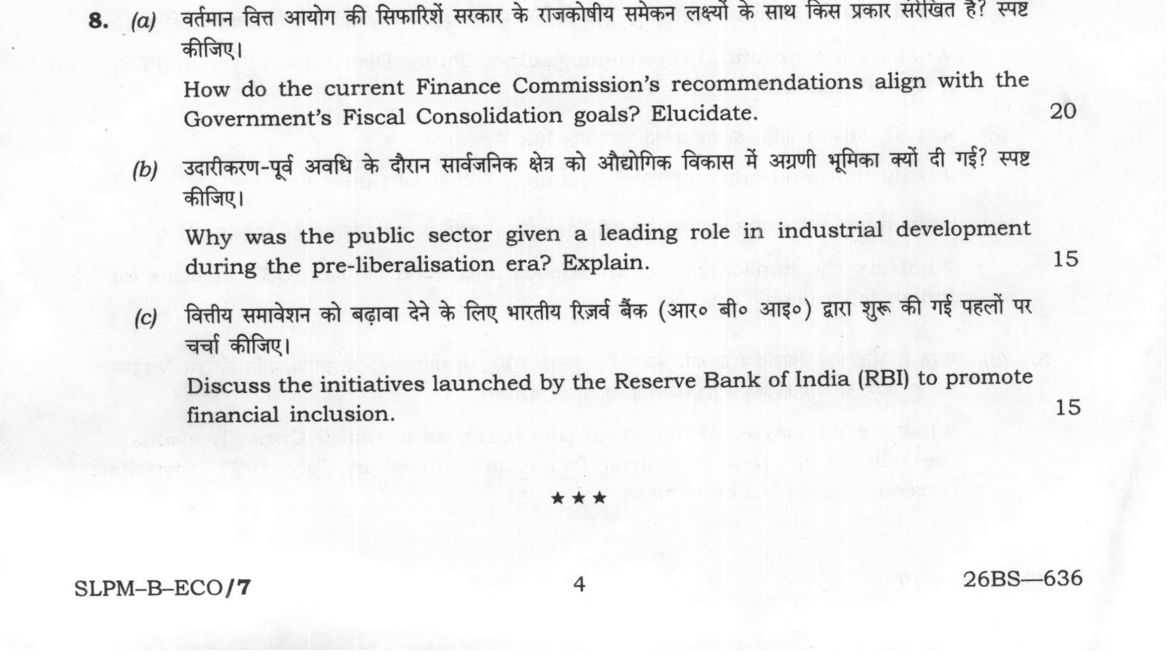
(a) How do the current Finance Commission's recommendations align with the Government's Fiscal Consolidation goals? Elucidate…
How do the current Finance Commission's recommendations align with the Government's Fiscal Consolidation goals? Elucidate. 20 marks
Why was the public sector given a leading role in industrial development during the pre-liberalisation era? Explain. 15 marks
Discuss the initiatives launched by the Reserve Bank of India (RBI) to promote financial inclusion. 15 marks
हिंदी में प्रश्न पढ़ें
वर्तमान वित्त आयोग की सिफारिशें सरकार के राजकोषीय समेकन लक्ष्यों के साथ किस प्रकार संरेखित हैं? स्पष्ट कीजिए। (20 अंक)
उदारीकरण-पूर्व अवधि के दौरान सार्वजनिक क्षेत्र को औद्योगिक विकास में अग्रणी भूमिका क्यों दी गई? स्पष्ट कीजिए। (15 अंक)
वित्तीय समावेशन को बढ़ावा देने के लिए भारतीय रिज़र्व बैंक (आर. बी. आई.) द्वारा शुरू की गई पहलों पर चर्चा कीजिए। (15 अंक)
Model answer
Written by UPSC Answer Check against this question's marking rubric, to the expected length. UPSC does not publish answers for Mains — this is one way to score well, not an official key.
Fiscal consolidation and the 15th Finance Commission The 15th Finance Commission’s recommendations reinforce the Government’s fiscal consolidation agenda by making state finances predictable, measurable and outcome-linked. Its core vertical devolution of 41 per cent of net GST proceeds to states gives states a stable revenue base, reducing dependence on ad hoc central assistance and encouraging them to own expenditure discipline. The Commission’s revenue deficit grants are tied to states’ reduction of revenue deficits, which supports the FRBM objective of lowering the debt-to-GSDP ratio and curbing interest burden. The grants also reduce borrowing and interest outlays. Performance-linked incentives for power sector reforms and disaster management align fiscal transfers with efficiency: states that improve power distribution, reduce losses or build disaster resilience receive additional grants, making consolidation not merely austerity but capacity-building. This aligns with the Centre’s FRBM targets, including the 4 per cent fiscal deficit target for the Union and the 15th FC’s recommendation that states reduce fiscal deficit to 3 per cent of GSDP by 2025-26. Yet a tension remains. Article 280 requires the Commission to recommend principles for grants-in-aid, and it can recommend both conditional and unconditional transfers; cooperative federalism favours flexibility, while fiscal consolidation favours conditionality. The pandemic-era invocation of FRBM escape clauses accommodated higher deficits, but shows that consolidation must be credible and time-bound.
Public sector before liberalisation Before 1991, the public sector was given a leading role because the State was seen as the principal agent of industrialisation. The Mahalanobis strategy, adopted in the Second Five Year Plan, prioritised heavy capital goods—steel, machinery, power and fertilisers—because these sectors were considered the engine of long-term growth and were too capital-intensive, risky and long-gestation for private enterprise in a capital-scarce economy. Import substitution required the State to build domestic capacity where private investment was weak, while the Industrial Policy Resolution of 1956 reserved key industries for the public sector to control the commanding heights of the economy. Market failure arguments also mattered: heavy industry generated externalities, required coordination across sectors, and private profit motives were feared to deepen regional and income inequality. In a low-income economy with thin capital markets, the State could mobilise savings, direct credit, and absorb social costs that private firms would avoid. Planning was thus a political-economy choice: the State would allocate scarce resources, ensure employment, and prevent concentration of economic power.
RBI and financial inclusion The RBI has promoted financial inclusion through a regulatory and institutional architecture that extends banking to unbanked and underbanked populations. It formalised the Business Correspondent model, enabling banks to use local agents for account opening, deposits and micro-credit. The Self-Help Group-Bank Linkage Programme, launched by NABARD in 1992, was supported by RBI through guidelines that made group lending a channel for women’s self-employment. The PMJDY, a Government initiative, was strengthened by RBI regulations on zero-balance accounts, simplified KYC and account portability, helping it reach more than 50 crore accounts. Differentiated licensing of payment banks and small finance banks expanded competition in low-income segments, while the regulatory sandbox allowed testing of digital financial products. RBI’s payments framework supported the UPI developed and operated by NPCI, which RBI regulates, and the JAM trinity, a Government initiative, by ensuring interoperability and safety in digital payments. Financial literacy initiatives, including bank-led outreach and Financial Literacy Week, aim to convert accounts into safe usage. This makes inclusion not merely account creation but access to credit, payments and insurance.
Together, these shifts show India’s evolving state-market balance: the State no longer directly owns the commanding heights, but it uses fiscal rules, federal transfers and regulatory design to correct market failures, deepen inclusion and sustain consolidation.
What "Elucidate" is asking you to do
Make a stated proposition plain and then prove it with instances. Elucidate stems almost always carry a claim or a named concept, and very often the words “with examples” or “with suitable diagrams” — the illustration is part of the directive, not decoration.
Structure that answers it
Plain-language statement of what the proposition means → the part that is obscure, resolved → first illustration → second illustration → why the proposition holds
Where marks are lost
Adding terminology; elucidate rewards removing it. The commoner loss is a clean explanation with no example, when the stem asked for examples.
How this answer will be evaluated
Approach
Framework: UPSC Economics Paper II (SLPM-B-ECO/7). (a) examine: intro > how/why with reasoning > evidence > conclusion | (b) explain: definition/context > points in order > small example > short close | (c) discuss: intro > 3-4 dimensions > example > balanced close Full marks: Precise, data-driven, and directly addresses the specific command words with clear linkages.
Key points expected
- Define Fiscal Consolidation (deficit reduction targets)
- Identify specific FC recommendations (e.g., GST compensation, state debt)
- Explain the mechanism of alignment (e.g., FRBM Act compliance)
- Discuss the impact on state fiscal autonomy
- Contextualize with the License Raj / Nehruvian model
- Explain the 'Commanding Heights' rationale (heavy industry)
- Mention the role of PSUs in infrastructure and employment
- Discuss the logic of import substitution
Evaluation rubric
Each sub-part is marked on its own, against the marks and word limit printed on the paper.
- (a) Link Finance Commission (FC) recommendations to Fiscal Consolidation (FC) goals. 20 marks
examine— intro → how/why with reasoning → evidence → conclusion
Must cover
- Define Fiscal Consolidation (deficit reduction targets)
- Identify specific FC recommendations (e.g., GST compensation, state debt)
- Explain the mechanism of alignment (e.g., FRBM Act compliance)
- Discuss the impact on state fiscal autonomy
Loses marks
- Generic discussion of fiscal policy without FC context
- Confusing central and state fiscal responsibilities
- Ignoring the 'alignment' aspect (just listing recommendations)
Earns more
- Reference to 15th Finance Commission
- Mention of GST compensation cess
- Discussion of state debt-to-GSDP ratio
- Reference to FRBM Act 2003
Extra mark
- Specific data on state fiscal deficit targets
- Reference to NITI Aayog's role in fiscal monitoring
- (b) Justify the leading role of the public sector in pre-liberalisation industrial development. 15 marks
explain— definition/context → points in order → small example → short close
Must cover
- Contextualize with the License Raj / Nehruvian model
- Explain the 'Commanding Heights' rationale (heavy industry)
- Mention the role of PSUs in infrastructure and employment
- Discuss the logic of import substitution
Loses marks
- Discussing post-1991 reforms (out of scope)
- Failing to link public sector to specific industrial goals
- Vague generalities about 'government control'
Earns more
- Reference to Industrial Policy Resolution 1956
- Mention of specific PSUs (e.g., SAIL, BHEL)
- Discussion of the 'Socialist Pattern of Society'
- Reference to the 'License Raj' mechanism
Extra mark
- Mention of the 'Hindu Rate of Growth' context
- Reference to the B.C. Roy Committee
- (c) Detail RBI initiatives for financial inclusion. 15 marks
discuss— intro → 3-4 dimensions → example → balanced close
Must cover
- Define financial inclusion (access, usage, quality)
- Mention specific RBI initiatives (e.g., PMJDY, UPI, Digital India)
- Discuss the role of technology (fintech, mobile banking)
- Explain the 'last mile' connectivity strategy
Loses marks
- Listing initiatives without explaining their impact
- Ignoring the 'RBI' specific role (focusing only on government)
- Vague generalities about 'banking for all'
Earns more
- Reference to the 'Financial Inclusion' framework
- Mention of the 'Jan Dhan' account
- Discussion of the 'Unified Payments Interface' (UPI)
- Reference to the 'Digital India' initiative
Extra mark
- Specific data on bank account penetration
- Reference to the 'RBI's Financial Inclusion' report
Practice this exact question
Write your answer and it is marked point by point against the model answer above — what you covered, what you missed, what you got wrong.
Evaluate my answer →More from Economics 2025 Paper II
- Q5 Answer the following questions in about 150 words each: (a) Discuss the components of foo…
- Q6 (a) What are the causes of industrial backwardness in India? Critically evaluate the role…
- Q7 (a) What is the sectoral composition of India's national income? Mention the most importa…
- Q8 (a) How do the current Finance Commission's recommendations align with the Government's F…