Paper II — Q6
(a) What are the causes of industrial backwardness in India? Critically evaluate the role of the New Industrial Policy, announced…
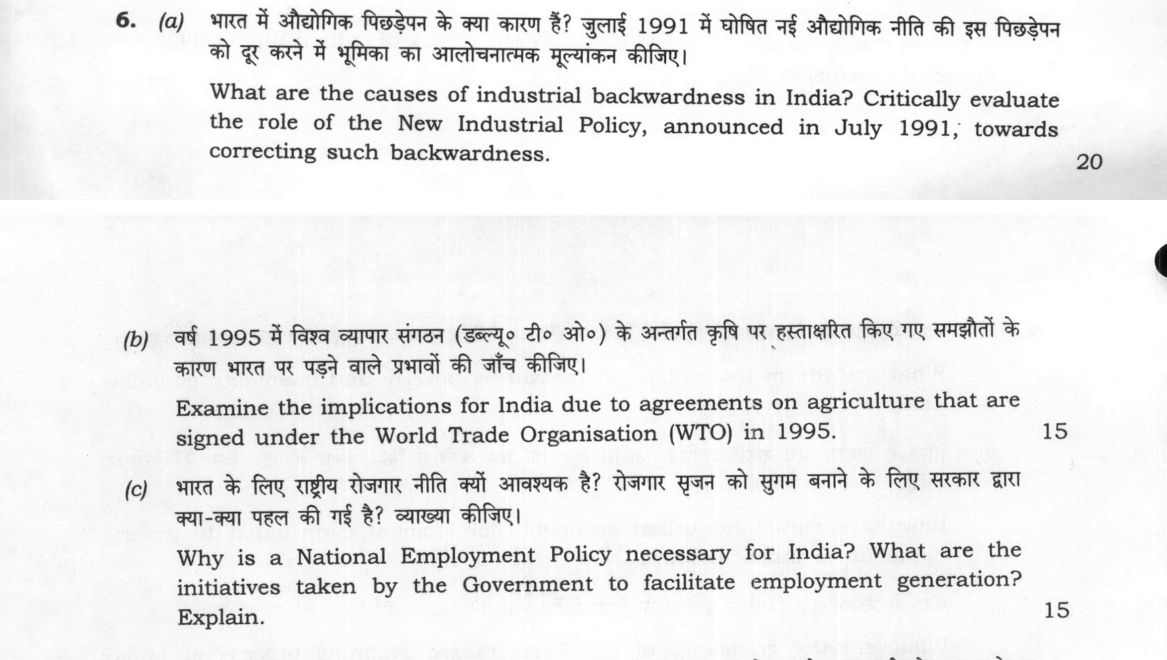
What are the causes of industrial backwardness in India? Critically evaluate the role of the New Industrial Policy, announced in July 1991, towards correcting such backwardness. 20 marks
Examine the implications for India due to agreements on agriculture that are signed under the World Trade Organisation (WTO) in 1995. 15 marks
Why is a National Employment Policy necessary for India? What are the initiatives taken by the Government to facilitate employment generation? Explain. 15 marks
हिंदी में प्रश्न पढ़ें
भारत में औद्योगिक पिछड़ेपन के क्या कारण हैं? जुलाई 1991 में घोषित नई औद्योगिक नीति की इस पिछड़ेपन को दूर करने में भूमिका का आलोचनात्मक मूल्यांकन कीजिए। (20 अंक)
वर्ष 1995 में विश्व व्यापार संगठन (डब्ल्यू. टी. ओ.) के अन्तर्गत कृषि पर हस्ताक्षरित किए गए समझौतों के कारण भारत पर पड़ने वाले प्रभावों की जाँच कीजिए। (15 अंक)
भारत के लिए राष्ट्रीय रोजगार नीति क्यों आवश्यक है? रोजगार सृजन को सुगम बनाने के लिए सरकार द्वारा क्या-क्या पहल की गई है? व्याख्या कीजिए। (15 अंक)
Model answer
Written by UPSC Answer Check against this question's marking rubric, to the expected length. UPSC does not publish answers for Mains — this is one way to score well, not an official key.
India’s developmental trajectory reflects an incomplete structural transformation, where industrial, agricultural trade, and employment policies have often operated in silos, hindering equitable growth.
Industrial Backwardness and Critical Evaluation of NIP 1991
Industrial backwardness in pre-1991 India was rooted in the colonial legacy of deindustrialization, low gross domestic capital formation, chronic technology gaps, and acute logistical deficits. This was aggravated by regulatory failures under the License-Permit Raj, output curbs under the Monopolies and Restrictive Trade Practices (MRTP) Act 1969, rigid foreign exchange controls under FERA 1973, extensive Small Scale Industry (SSI) reservations that prevented economies of scale, and severe technical skill shortages.
The New Industrial Policy (NIP) of July 1991 sought to dismantle these constraints by abolishing industrial licensing for most sectors, removing MRTP asset thresholds, liberalizing Foreign Direct Investment (FDI) via automatic routes, diluting FERA into FEMA, and shrinking the public sector's reserved domain through disinvestment.
Critical Evaluation and Verdict: NIP 1991 successfully dismantled state-enforced entry barriers, curbed rent-seeking, enhanced industrial efficiency, and spurred globally competitive capital- and knowledge-intensive sectors like automobiles and pharmaceuticals. However, on the metric of structural transformation, the policy fell short. Manufacturing’s share of GDP has remained virtually stagnant at 15–17%, producing a trajectory of "jobless growth". By liberalizing product markets while leaving factor markets (land, labour) unreformed and physical infrastructure deficient, NIP 1991 exposed domestic MSMEs to premature global competition without fostering the mass labour-intensive manufacturing base necessary to absorb rural surplus labour.
Implications of the WTO Agreement on Agriculture (1995)
The WTO Agreement on Agriculture (AoA) introduced rules across three core pillars: market access (tariffication of non-tariff barriers), domestic support reduction (disciplining Aggregate Measurement of Support or AMS), and the phase-out of export subsidies (formalized at the Nairobi Ministerial, 2015).
For India, the implications are two-fold:
- Market Access and Vulnerability: Tariffication allowed India to expand exports in commodities like rice and marine products. However, high non-tariff barriers (sanitary and phytosanitary measures) in developed markets, combined with heavily subsidized Western farm imports under Green Box exemptions, continually threaten domestic smallholders.
- Domestic Policy Constraints: India’s Minimum Support Price (MSP) and Public Distribution System (PDS) operations face constraints under the 10% de minimis product-specific AMS ceiling, which relies on an outdated 1986–88 external reference price that ignores inflation. Although the Bali Ministerial (2013) secured an interim "Peace Clause" protecting India's public stockholding for food security from legal challenges, a permanent negotiated solution remains unresolved.
Rationale for a National Employment Policy and Government Initiatives
A National Employment Policy (NEP) is essential to harness India’s fleeting demographic window, address the structural stagnation where over 45% of the workforce remains in low-productivity agriculture, formalize the overwhelming 85%+ informal sector, mitigate technology- and AI-led labour displacement, and institutionalize international labour standards (ILO Convention C122).
To generate employment, the Government has implemented key multi-pronged interventions:
- Rural Safety Net: MGNREGA provides guaranteed wage employment, mitigating seasonal distress.
- Skill Development: Skill India, anchored by the National Skills Qualifications Framework (NSQF), aims to bridge the industry-academia skill mismatch.
- Manufacturing and Enterprise: Make in India, Startup India, PM MUDRA Yojana, and Production Linked Incentive (PLI) schemes across 14 key sectors incentivize labour-absorbing domestic manufacturing.
- Labour Reforms and Social Security: Rationalization of 29 central labour laws into four Labour Codes to improve ease of doing business while extending statutory minimum wages, and the e-Shram portal to provide targeted social security architecture for unorganized and gig economy workers.
Conclusion
A fragmented approach cannot resolve India's economic challenges. Overcoming structural backwardness requires an integrated strategy where trade policy safeguards agricultural livelihoods, industrial policy targets labour-intensive manufacturing, and a dedicated National Employment Policy transforms demographic potential into formal, high-productivity jobs.
What "Critically evaluate" is asking you to do
Judge how well something has performed against the standard it set for itself — its stated aim, mandate or promise — and commit to a verdict. Name the yardstick before you judge; an unanchored judgement reads as opinion. “Critically” is not a section added at the end: name the yardstick you are judging by — the evidence, the stated objective, a constitutional principle, a rival explanation — and let a verdict close each part of the body. Where the question quotes a claim, that verdict must land on the claim itself, accepted, qualified or rejected, and not on the theme in general.
Structure that answers it
Name the yardstick — stated aim, mandate or benchmark → performance against it → shortfall against it → why the gap exists → verdict
Where marks are lost
Merits in one paragraph, demerits in the next, and a conclusion calling for a balanced and holistic approach. That is a survey with the judgement left out and it holds the answer in the middle band. The opposite error is reading “critically” as permission to attack — and with the odd pairings, critically describe or critically explain, the exposition still carries most of the marks, the judgement being a layer on it rather than a substitute for it.
How this answer will be evaluated
Approach
Framework: UPSC Economics Paper II (Indian Economy). (a) critically evaluate: positives > negatives/limits > conditions/safeguards > conclusion | (b) examine: intro > how/why with reasoning > evidence > conclusion | (c) explain: definition/context > points in order > small example > short close Full marks: Comprehensive, critical, and well-structured answers with specific data and policy references.
Key points expected
- Identify structural causes of industrial backwardness (e.g., licensing, low FDI, infrastructure)
- Detail key 1991 reforms (liberalization, deregulation, FDI liberalization)
- Critically evaluate the policy's success in correcting backwardness
- Highlight limitations or negative impacts of the 1991 policy
- Identify key WTO agricultural agreements (e.g., AoA, TRIPS)
- Explain the impact on Indian agricultural exports
- Discuss the impact on domestic agricultural policy (e.g., MSP, subsidies)
- Analyze the challenges faced by Indian farmers due to WTO rules
Evaluation rubric
Each sub-part is marked on its own, against the marks and word limit printed on the paper.
- (a) Causes of industrial backwardness and a critical assessment of the 1991 New Industrial Policy's role in correcting them. 20 marks
critically evaluate— positives → negatives/limits → conditions/safeguards → conclusion
Must cover
- Identify structural causes of industrial backwardness (e.g., licensing, low FDI, infrastructure)
- Detail key 1991 reforms (liberalization, deregulation, FDI liberalization)
- Critically evaluate the policy's success in correcting backwardness
- Highlight limitations or negative impacts of the 1991 policy
Loses marks
- Listing causes without linking them to the 1991 policy
- Describing the 1991 policy without critical evaluation
- Ignoring the 'backwardness' aspect and focusing only on growth
Earns more
- Mention specific sectors that benefited or lagged
- Reference specific policy instruments (e.g., DRDA, FDI limits)
- Compare pre-1991 and post-1991 industrial growth rates
- Discuss the role of global integration
Extra mark
- Cite specific data on industrial growth or FDI inflows
- Reference a specific economist or committee report on industrial policy
- (b) Implications for India of the 1995 WTO agreements on agriculture. 15 marks
examine— intro → how/why with reasoning → evidence → conclusion
Must cover
- Identify key WTO agricultural agreements (e.g., AoA, TRIPS)
- Explain the impact on Indian agricultural exports
- Discuss the impact on domestic agricultural policy (e.g., MSP, subsidies)
- Analyze the challenges faced by Indian farmers due to WTO rules
Loses marks
- General discussion of WTO without specific focus on agriculture
- Ignoring the 1995 context and discussing current issues
- Failing to link WTO rules to Indian domestic policy
Earns more
- Mention specific crops affected (e.g., rice, wheat, sugar)
- Discuss the 'Special Safeguard Mechanism' (SSM)
- Reference the 'Peace Clause' for domestic support
- Analyze the impact on food security
Extra mark
- Cite specific data on agricultural trade or subsidies
- Reference a specific WTO dispute or negotiation round
- (c) Necessity of a National Employment Policy and government initiatives for employment generation. 15 marks
explain— definition/context → points in order → small example → short close
Must cover
- Explain why a National Employment Policy is necessary for India
- List and explain key government initiatives for employment generation
- Discuss the impact of these initiatives on employment
- Provide a balanced view of the effectiveness of these initiatives
Loses marks
- Listing initiatives without explaining their impact
- Ignoring the 'necessity' aspect and focusing only on initiatives
- General discussion without specific reference to Indian context
Earns more
- Mention specific schemes (e.g., MGNREGA, PMEGP, Skill India)
- Discuss the role of the private sector in employment
- Analyze the impact of demographic dividend
- Reference specific data on unemployment or employment rates
Extra mark
- Cite specific data on employment generation by schemes
- Reference a specific committee report on employment
Practice this exact question
Write your answer and it is marked point by point against the model answer above — what you covered, what you missed, what you got wrong.
Evaluate my answer →More from Economics 2025 Paper II
- Q3 (a) Examine the objectives and components of the Green Revolution in India. (20 marks) (b…
- Q4 (a) What are the methods used in measuring poverty and inequality in India? Analyse. (20…
- Q5 Answer the following questions in about 150 words each: (a) Discuss the components of foo…
- Q6 (a) What are the causes of industrial backwardness in India? Critically evaluate the role…
- Q7 (a) What is the sectoral composition of India's national income? Mention the most importa…
- Q8 (a) How do the current Finance Commission's recommendations align with the Government's F…