Paper II — Q1
(a) Critically examine the ‘drain theory’ as propounded by Dadabhai Naoroji. How did it explain the root cause of poverty in…
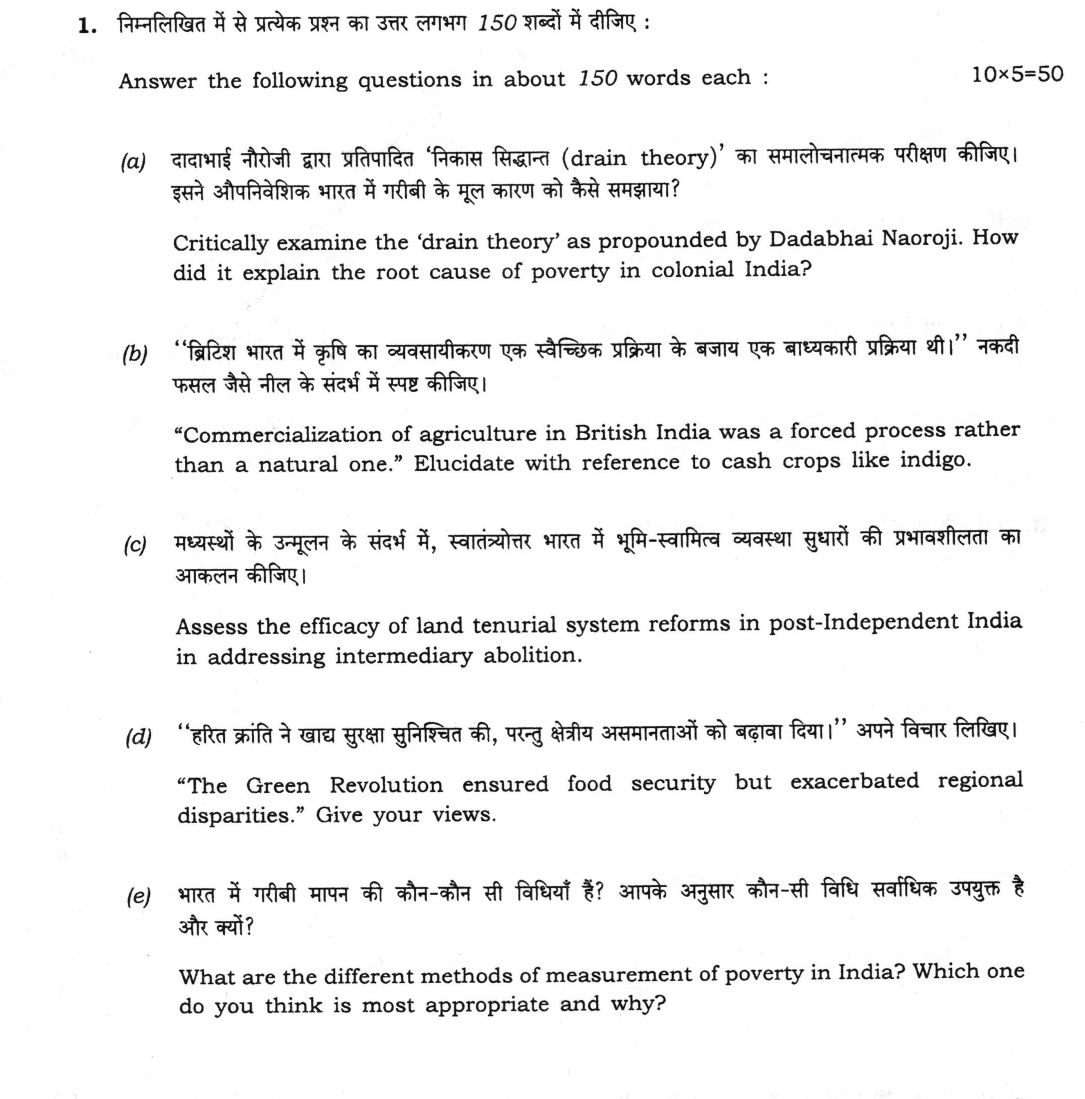
Answer the following questions in about 150 words each :
Critically examine the ‘drain theory’ as propounded by Dadabhai Naoroji. How did it explain the root cause of poverty in colonial India? 10 marks
“Commercialization of agriculture in British India was a forced process rather than a natural one.” Elucidate with reference to cash crops like indigo. 10 marks
Assess the efficacy of land tenurial system reforms in post-Independent India in addressing intermediary abolition. 10 marks
“The Green Revolution ensured food security but exacerbated regional disparities.” Give your views. 10 marks
What are the different methods of measurement of poverty in India? Which one do you think is most appropriate and why? 10 marks
हिंदी में प्रश्न पढ़ें
निम्नलिखित में से प्रत्येक प्रश्न का उत्तर लगभग 150 शब्दों में दीजिए :
दादाभाई नौरोजी द्वारा प्रतिपादित ‘निकास सिद्धान्त (drain theory)’ का समालोचनात्मक परीक्षण कीजिए। इसने औपनिवेशिक भारत में गरीबी के मूल कारण को कैसे समझाया? (10 अंक)
‘‘ब्रिटिश भारत में कृषि का व्यवसायीकरण एक स्वैच्छिक प्रक्रिया के बजाय एक बाध्यकारी प्रक्रिया थी।’’ नकदी फसल जैसे नील के संदर्भ में स्पष्ट कीजिए। (10 अंक)
मध्यस्थों के उन्मूलन के संदर्भ में, स्वातंत्र्योत्तर भारत में भूमि-स्वामित्व व्यवस्था सुधारों की प्रभावशीलता का आकलन कीजिए। (10 अंक)
‘‘हरित क्रांति ने खाद्य सुरक्षा सुनिश्चित की, परन्तु क्षेत्रीय असमानताओं को बढ़ावा दिया।’’ अपने विचार लिखिए। (10 अंक)
भारत में गरीबी मापन की कौन-कौन सी विधियाँ हैं? आपके अनुसार कौन-सी विधि सर्वाधिक उपयुक्त है और क्यों? (10 अंक)
Model answer
Drafted with AI by UPSC Answer Check against this question's marking rubric, to the 150-word length. UPSC does not publish answers for Mains — this is one way to score well, not an official key. How we build rubrics and answers.
(a) Naoroji's drain theory (10 marks)
Dadabhai Naoroji’s Poverty and Un-British Rule in India (1901) formalized the drain theory, arguing that colonialism caused a unilateral transfer of wealth from India to Britain. This drain took the form of India’s continuous excess of merchandise exports over imports, where the surplus was absorbed by "Home Charges" (India Office establishment, pensions, interest on public debt), guaranteed interest on railway capital, and remittances by British capitalists. Naoroji argued this unrequited export surplus, which left per capita income at only about Rs 20 a year on his estimate, was the root cause of poverty, refuting the "overpopulation" theory.
Critically, while official rebuttals like Theodore Morison’s claimed these were payments for services and returns on capital, and the theory ignores internal exploitation by landlords and moneylenders, it remains the core of economic nationalism. It was further developed by R. C. Dutt and M. G. Ranade, and Bipan Chandra’s The Rise and Growth of Economic Nationalism in India (1966) remains the standard assessment. Although the precise magnitude of the drain is debated, the theory successfully identified the structural exploitation of the colonial relationship.
(b) Forced commercialisation: indigo (10 marks)
Commercialization in British India was a coerced process driven by the structural compulsion of the Permanent Settlement (1793), which fixed land revenue in cash. In the indigo trade, the dadni system of advances and the tinkathia system in Champaran forced peasants to grow indigo on a fixed portion of their land. This coercion led to the Indigo Revolt (1859–60) and the Indigo Commission (1860); the tinkathia grievance culminated in the Champaran Satyagraha (1917), and German synthetic indigo from 1897 collapsed the trade. Similarly, the state opium monopoly and the Deccan cotton boom (1861–65) led to a post-1865 crash and the Deccan Riots of 1875.
This was not a natural process because there was no accompanying technological change or capital formation; instead, the terms of trade moved against the primary producer, leading to recurrent famines (1876–78, 1896–97). While some tracts like Gujarat and Punjab responded voluntarily to price signals, the majority of the agrarian economy was trapped in a cycle of debt and distress sales, illustrating that commercialization was a product of imperial extraction rather than organic growth.
(c) Intermediary abolition (10 marks)
The primary objective of post-Independence land reforms was the abolition of intermediaries (zamindars, jagirdars, and inamdars). The Madras Estates (Abolition) Act, 1948, was the first such law, followed by the UP Zamindari Abolition Act (1950) and the West Bengal Estates Acquisition Act (1953). These reforms were constitutionally protected by Articles 31A and 31B and the Ninth Schedule.
The efficacy of these reforms is mixed. On one hand, approximately 2 crore tenants were brought into direct relation with the State, making it a relative success compared to the near-failure of land ceilings. However, the reforms were undermined by the "personal cultivation" (sir/khudkasht) loophole, which allowed intermediaries to retain land by evicting tenants before the appointed dates. Furthermore, benami transfers and heavy compensation grants meant many ex-zamindars remained the largest landowners. Experts like Daniel Thorner and the 2009 Committee on State Agrarian Relations conclude that while the legal abolition was achieved, the social and economic transformation remained "unfinished" in many regions.
(d) Green Revolution and regional disparity (10 marks)
The Green Revolution, launched under the New Agricultural Strategy (1965–66) and the High-Yielding Varieties Programme (1966–67), with C. Subramaniam, M. S. Swaminathan and Norman Borlaug, was a success in ensuring food security. India’s food grain production rose from 50.8 million tonnes (1950–51) to 108.4 million tonnes by 1970–71 and a record of about 358 million tonnes in 2024–25, ending the "ship-to-mouth" era and reducing dependence on PL-480 imports.
However, the revolution exacerbated regional disparities. It was concentrated in the irrigated plains of Punjab, Haryana, and Western Uttar Pradesh, while the rainfed east and Deccan regions were largely excluded. The scale-neutral but not resource-neutral nature of the technology (as noted by Hanumantha Rao) favored large landowners, increasing income inequality. The focus on wheat and rice also led to the neglect of pulses and coarse grains. While the government later attempted to address these gaps through the Bringing Green Revolution to Eastern India (BGREI) in 2010, in my view the initial success of the Green Revolution was inherently geographically and socially uneven.
(e) Measuring poverty in India (10 marks)
India has used several methods to measure poverty. The Alagh Task Force (1979) used a calorie norm (2400 kcal rural, 2100 kcal urban), while the Lakdawala Committee (1993) introduced state-specific poverty lines for urban and rural areas using CPI-AL and CPI-IW. The Tendulkar method (2009) gave 21.9% for 2011–12, and the Rangarajan Committee (2014) 29.5%, a report the Government did not formally adopt. Additionally, the FGT index and the multidimensional NITI Aayog MPI (3 dimensions, 12 indicators) are used. The Household Consumption Expenditure Surveys (2022–23, 2023–24) have reopened the debate; on them the World Bank puts extreme poverty at 5.3% in 2022–23 at $3.00 a day (2021 PPP).
The most appropriate method is a combination of the official consumption line and the MPI. The consumption line is essential for the administrative targeting of welfare schemes such as rural employment guarantee (MGNREGA, now succeeded by the VB-G RAM G Act, 2025) and food subsidies. However, it fails to capture the "capability gaps" in health and education. The MPI provides a more holistic view of deprivation. A dual approach treats poverty as both income shortfall and capability deprivation.
How this answer will be evaluated
Evaluation rubric
Each sub-part is marked on its own, against the marks and word limit printed on the paper.
- (a) Two directives: (i) 'critically examine' the drain theory of Dadabhai Naoroji, i.e. state its content and components and then weigh the criticisms against it; (ii) explain how the theory located the root cause of Indian poverty in the colonial relationship itself. Both halves must be answered in about 150 words. 10 marks · 150 words
Must cover
- Dadabhai Naoroji, Poverty and Un-British Rule in India (1901)
- Home Charges
- unrequited exports / export surplus as the form of the drain
- guaranteed interest on railway capital
- Naoroji's per capita income estimate of about Rs 20 per annum
- Theodore Morison / official rebuttal that the transfers were payments for services and returns on capital
Loses marks
- Writing a general essay on colonial exploitation without defining the drain as a unilateral transfer with no quid pro quo.
- Missing the mechanism - failing to connect the drain to India's export surplus, which is the analytical core of Naoroji's argument.
- Answering only the first half (describing the theory) and not explaining how the drain explained poverty, or vice versa.
- Asserting a precise magnitude (a rupee or pound figure, or a percentage of national income) as established fact when the estimates are disputed.
- Confusing Naoroji's drain theory with R. C. Dutt's deindustrialisation thesis or with the 1930s Marxist critique, and attributing the wrong book to the wrong author.
Earns more
- Names at least three components: Home Charges (India Office establishment, pensions and furlough allowances of British officials, interest on public debt), guaranteed interest on railway and irrigation capital, civil and military charges including the cost of imperial wars, remittances and profits of British capitalists and planters, payments for shipping, banking and insurance, and stores purchased in England.
- Explains the mechanism: the drain took the form of India's continuous excess of merchandise exports over imports - exports were 'unrequited' because the surplus was absorbed in financing these unilateral transfers rather than returning as imports or bullion.
Extra mark
- Earlier writings: England's Debt to India (1867); The Poverty of India (1876)
- R. C. Dutt, Economic History of India (1901, 1903); M. G. Ranade; G. V. Joshi; G. Subramania Iyer as the wider economic-nationalist school
- Bipan Chandra, The Rise and Growth of Economic Nationalism in India (1966) as the standard modern assessment
- (b) 'Elucidate' the given statement - explain and substantiate why commercialisation of agriculture in British India was a coerced rather than a voluntary/natural process, using indigo and other cash crops as the illustrative evidence. The indigo reference is compulsory. 10 marks · 150 words
Must cover
- Permanent Settlement, 1793 and cash land revenue as the structural compulsion
- dadni (system of advances) and the indigo contract
- tinkathia system in Champaran (indigo on 3 kathas of every bigha)
- Indigo Revolt / Blue Mutiny, 1859-60; Indigo Commission, 1860
- Deccan cotton boom (1861-65), crash and Deccan Riots, 1875
- recurrent famines of 1876-78, 1896-97 and 1899-1900
Loses marks
- Describing commercialisation in general terms without any indigo-specific detail, when the question expressly asks for reference to cash crops like indigo.
- Confusing the Bengal Indigo Revolt (1859-60) with the Bihar Champaran movement (1917), or dating tinkathia to Bengal.
- Treating commercialisation as unambiguously exploitative with no acknowledgement of price-responsive tracts - loses the 'elucidate with evidence' quality.
- Omitting the structural coercion of cash land revenue and assuming force meant only physical coercion by planters.
- Writing a political-history narrative of Gandhi's satyagraha instead of an economic analysis of compulsion, prices, debt and terms of trade.
Earns more
- Extends the argument to other crops and structures: the state opium monopoly with compulsory advances in Bihar and Bengal; the Deccan and Berar cotton boom during the American Civil War (1861-65) and the post-1865 crash leading to the Deccan Riots of 1875 and the Deccan Agriculturists' Relief Act of 1879; jute in Bengal; tea in Assam worked by indentured labour under penal contract laws; and the underlying compulsions of a land revenue fixed and collected in cash (Permanent Settlement of 1793, high ryotwari assessments), railway-borne integration with world prices, and mahajan advances that forced distress sales.
- Establishes why it was not a natural commercialisation: there was no accompanying technological change or capital formation, no reinvestment of the surplus in agriculture, terms of trade moved against the primary producer, per capita food availability fell and famines recurred (1876-78, 1896-97, 1899-1900); a balanced answer concedes that some tracts and richer peasants (Gujarat cotton, Madras groundnut, Punjab wheat) did respond voluntarily to price signals.
Extra mark
- Nadia; Digambar Biswas and Bishnucharan Biswas
- Champaran Satyagraha, 1917; Champaran Agrarian Act, 1918
- synthetic (German) indigo from 1897 destroying the market
- opium monopoly; Deccan Agriculturists' Relief Act, 1879
- (c) 'Assess the efficacy' - deliver a reasoned verdict, with evidence, on how well post-Independence land tenurial reforms achieved one specific objective: the abolition of intermediaries (zamindari, jagirdari, inamdari, mahalwari tenures). The answer must be confined to intermediary abolition, not to ceilings or tenancy reform except by way of comparison. 10 marks · 150 words
Must cover
- Madras Estates (Abolition and Conversion into Ryotwari) Act, 1948 as the first such law
- UP Zamindari Abolition and Land Reforms Act, 1950
- Constitution (First Amendment) Act, 1951 - Articles 31A, 31B, Ninth Schedule
- about 2 crore (20 million) tenants brought into direct relation with the State
- resumption for 'personal cultivation' (sir/khudkasht) as the principal loophole
- Committee on State Agrarian Relations and the Unfinished Task in Land Reforms, 2009
Loses marks
- Answering on land reforms in general - ceilings, consolidation, Operation Barga - instead of assessing intermediary abolition specifically.
- Getting the pioneering statute wrong (crediting UP 1950 rather than Madras 1948) or misdating the First Amendment and the Ninth Schedule.
- Claiming abolition was a total failure; the examiner expects recognition that it was the most successful of the four components.
- Ignoring the constitutional and judicial dimension, which is what actually determined the pace of abolition.
- Quoting large distribution figures for ceiling-surplus land as evidence of intermediary abolition's success - they are different components.
Earns more
- The limits: statutes permitted intermediaries to retain land under 'personal cultivation' (sir, khudkasht, home farms, orchards), which triggered large-scale pre-emptive eviction of tenants before the appointed dates; benami and intra-family partition transfers preserved holdings; heavy compensation and rehabilitation grants transferred resources back to ex-zamindars, many of whom emerged as the largest landowners; concealed oral tenancy and share-cropping survived below the recorded tenure.
- Comparative and expert verdict: Kerala's Land Reforms (Amendment) Act, 1969 (in force from 1 January 1970) and West Bengal's Operation Barga from 1978 show what political mobilisation could achieve where abolition alone did not suffice; critiques by Daniel Thorner, Wolf Ladejinsky and P. S. Appu, and the 2009 Committee on State Agrarian Relations and the Unfinished Task in Land Reforms, all treat intermediary abolition as the one relative success against the near-failure of ceilings, under which cumulative distribution of surplus land amounted to less than about 2 per cent of the operated area.
Extra mark
- Bihar Land Reforms Act, 1950; West Bengal Estates Acquisition Act, 1953; J&K Big Landed Estates Abolition Act, 1950
- State of Bihar v. Kameshwar Singh (1952)
- Constitution (Fourth Amendment) Act, 1955; Forty-fourth Amendment, 1978 / Article 300A
- abwab and begar
- (d) 'Give your views' on a two-part proposition - that the Green Revolution delivered food security and that it simultaneously widened regional disparities. The answer must substantiate both halves with evidence and end in a clear personal judgement. 10 marks · 150 words
Must cover
- New Agricultural Strategy 1965-66; High Yielding Varieties Programme 1966-67
- Norman Borlaug; M. S. Swaminathan; C. Subramaniam
- foodgrain output 50.8 mt (1950-51) to 108.4 mt (1970-71), about 358 mt in 2024-25
- PL-480 imports and the end of ship-to-mouth existence
- Punjab, Haryana, western Uttar Pradesh versus eastern India and the rainfed Deccan
- scale-neutral but not resource-neutral (C. H. Hanumantha Rao)
- Bringing Green Revolution to Eastern India, 2010-11
Loses marks
- Listing achievements of the Green Revolution without explaining the irrigation precondition that caused the regional selectivity - the causal mechanism is what earns marks.
- Substituting inter-class inequality for the inter-regional inequality the question asks about, or vice versa; both should appear but the regional argument must dominate.
- Dating the Green Revolution to 1951 or to the First Plan, or confusing the IADP (1960-61) with the HYVP (1966-67).
- Attributing HYV wheat to M. S. Swaminathan alone and omitting Borlaug, or naming rice varieties as wheat varieties.
- Giving no quantitative evidence at all, or quoting current foodgrain output figures as though they were 1970s figures.
Earns more
- Price and procurement policy reinforced the gap: assured minimum support prices with effective FCI procurement operated mainly in the north-western wheat-rice belt, so public expenditure on food management itself became regionally regressive, while unprocured crops and unprocured regions received no equivalent support.
- Crop and class dimensions of the disparity: wheat gained first and rice much later, while pulses, coarse cereals and oilseeds stagnated (necessitating the Technology Mission on Oilseeds in 1986); the technology was scale-neutral but not resource-neutral (C. H. Hanumantha Rao), so large and irrigated farms captured a disproportionate share, tenants were resumed and evicted, and rural inequality rose - the 'economic gains and political costs' of Francine Frankel's study.
- Ecological cost within the success regions and the policy correction: falling water tables and over-exploited blocks in central Punjab, soil salinity and micronutrient depletion, paddy-wheat monoculture, stubble burning and decelerating total factor productivity; corrective measures include the Rashtriya Krishi Vikas Yojana (2007-08), the National Food Security Mission (2007-08), the Bringing Green Revolution to Eastern India programme (2010-11) which made Odisha, Bihar, Chhattisgarh, Jharkhand, Assam, eastern UP and West Bengal significant rice contributors, and the National Food Security Act, 2013.
Extra mark
- IADP from 1960-61; Sonora 64 / Lerma Rojo 64A, Kalyan Sona, Sonalika; IR-8 and Jaya
- Food Corporation of India (1965); Agricultural Prices Commission (1965, now CACP)
- Technology Mission on Oilseeds, 1986
- (e) Two sub-parts: (i) set out the different methods of measuring poverty in India - the successive official expert-group methodologies and the non-monetary/multidimensional alternatives; (ii) choose one as most appropriate and defend the choice with reasons. The second part is compulsory and must be argued, not merely asserted. 10 marks · 150 words
Must cover
- Task Force under Y. K. Alagh, 1979; 2400 kcal rural and 2100 kcal urban norms
- Lakdawala Expert Group, 1993; State-specific lines; CPI-AL and CPI-IW updating
- Tendulkar Committee, 2009; 21.9 per cent for 2011-12
- Rangarajan Committee, 2014; 29.5 per cent for 2011-12 (not formally accepted)
- Alkire-Foster methodology; NITI Aayog National MPI (3 dimensions, 12 indicators)
- a reasoned choice of the most appropriate method
Loses marks
- Listing only the committees without stating what methodological change each one made - the examiner is testing method, not chronology.
- Mixing up the committees' numbers (attributing Rs 816/1000 to Rangarajan or 29.5 per cent to Tendulkar).
- Omitting the second sub-part - no reasoned choice means the answer cannot exceed 7 marks.
- Treating the Rangarajan estimates as the official poverty line; the Government did not accept the report and the Tendulkar line remains the last accepted one.
- Ignoring multidimensional measurement entirely, or conversely describing the MPI only and skipping the official consumption-based lines.
Earns more
- Lakdawala Expert Group (1993): retained the original calorie-anchored basket but disaggregated to State-specific poverty lines and updated them over time by price indices - CPI for Agricultural Labourers for rural and CPI for Industrial Workers for urban areas - rather than by recomputing calorie costs.
- Rangarajan Committee (2014): constructed independent rural and urban baskets with normative requirements for calories (about 2155 kcal rural and 2090 kcal urban), protein and fat, plus normative non-food spending on clothing, rent, conveyance and education and observed expenditure on other items; its 2011-12 lines were about Rs 972 rural and Rs 1407 urban per capita per month, giving 29.5 per cent poverty - a report the Government did not formally accept.
- Non-monetary and alternative methods: head count ratio versus the depth and severity measures of the Foster-Greer-Thorbecke family (poverty gap and squared poverty gap indices) and the Sen index; the World Bank's international PPP-based lines; deprivation- and exclusion-based BPL identification (score-based BPL censuses, the N. C. Saxena Committee 2009 for rural and the S. R. Hashim Committee 2012 for urban, and the Socio-Economic and Caste Census 2011); and multidimensional measurement using the Alkire-Foster method, which underlies the UNDP-OPHI global MPI and NITI Aayog's National MPI built on three dimensions and twelve indicators from NFHS data.
Extra mark
- Rupee lines: Tendulkar Rs 816 rural / Rs 1000 urban; Rangarajan Rs 972 / Rs 1407 per capita per month
- head count ratio; poverty gap and squared poverty gap (Foster-Greer-Thorbecke); Sen index
- Saxena Committee (2009) and Hashim Committee (2012) for BPL identification; SECC 2011
- Household Consumption Expenditure Surveys 2022-23 and 2023-24; World Bank $3.00 a day (2021 PPP) estimate of 5.3 per cent for 2022-23
What "Critically examine" is asking you to do
Test the proposition the question puts to you and return a finding on how far it holds. Examine stems carry a claim, or ask whether something has happened, and expect evidence weighed both ways before the extent is stated — often with remedial measures attached. “Critically” is not a section added at the end: name the yardstick you are judging by — the evidence, the stated objective, a constitutional principle, a rival explanation — and let a verdict close each part of the body. Where the question quotes a claim, that verdict must land on the claim itself, accepted, qualified or rejected, and not on the theme in general.
Structure that answers it
Restate the claim as the question frames it → evidence that supports it → evidence that undercuts it → the conditions under which it holds → verdict on how far it stands
Where marks are lost
Merits in one paragraph, demerits in the next, and a conclusion calling for a balanced and holistic approach. That is a survey with the judgement left out and it holds the answer in the middle band. The opposite error is reading “critically” as permission to attack — and with the odd pairings, critically describe or critically explain, the exposition still carries most of the marks, the judgement being a layer on it rather than a substitute for it.
Practice this exact question
Write your answer and it is marked point by point against the model answer above — what you covered, what you missed, what you got wrong.
Evaluate my answer →More from Economics 2026 Paper II
- Q1 Answer the following questions in about 150 words each : (a) Critically examine the ‘drai…
- Q2 (a) Evaluate the success of land reforms in post-Independent India. Why was the success l…
- Q3 (a) Trace the trajectory of India’s industrial policy from the Nehruvian model of ‘Mahala…
- Q4 (a) Trace the evolution of the debate between the public and private sectors in India's i…