Paper II — Q4
(a) Trace the evolution of the debate between the public and private sectors in India's industrial development from the…
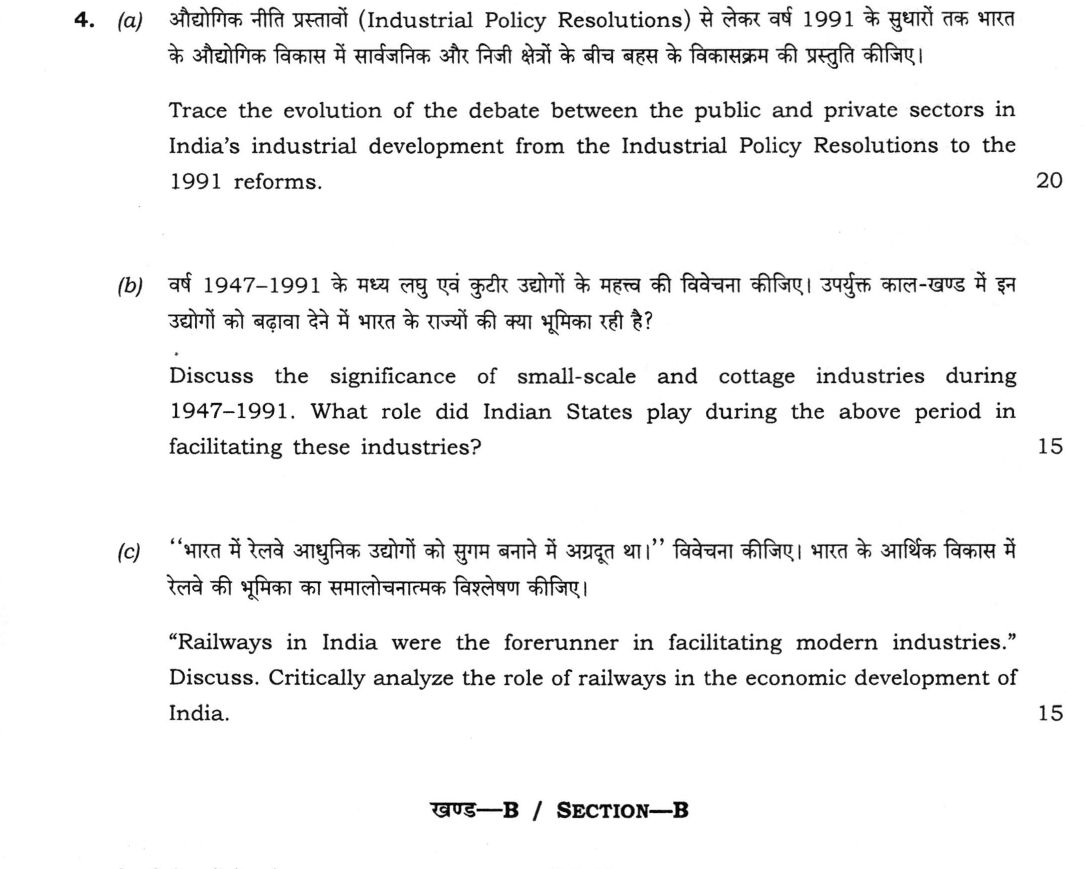
Trace the evolution of the debate between the public and private sectors in India's industrial development from the Industrial Policy Resolutions to the 1991 reforms. 20 marks
Discuss the significance of small-scale and cottage industries during 1947–1991. What role did Indian States play during the above period in facilitating these industries? 15 marks
“Railways in India were the forerunner in facilitating modern industries.” Discuss. Critically analyze the role of railways in the economic development of India. 15 marks
हिंदी में प्रश्न पढ़ें
औद्योगिक नीति प्रस्तावों (Industrial Policy Resolutions) से लेकर वर्ष 1991 के सुधारों तक भारत के औद्योगिक विकास में सार्वजनिक और निजी क्षेत्रों के बीच बहस के विकासक्रम की प्रस्तुति कीजिए। (20 अंक)
वर्ष 1947–1991 के मध्य लघु एवं कुटीर उद्योगों के महत्व की विवेचना कीजिए। उपर्युक्त काल-खण्ड में इन उद्योगों को बढ़ावा देने में भारत के राज्यों की क्या भूमिका रही है? (15 अंक)
‘‘भारत में रेलवे आधुनिक उद्योगों को सुगम बनाने में अग्रदूत था।’’ विवेचना कीजिए। भारत के आर्थिक विकास में रेलवे की भूमिका का समालोचनात्मक विश्लेषण कीजिए। (15 अंक)
Model answer
Drafted with AI by UPSC Answer Check against this question's marking rubric, to the expected length. UPSC does not publish answers for Mains — this is one way to score well, not an official key. How we build rubrics and answers.
(a) Public versus private sector debate, 1948-1991 (20 marks)
The debate over the relative roles of the public and private sectors in India’s industrial development was not a post-Independence invention; it was settled in principle before 1947. The Bombay Plan of 1944, drafted by leading industrialists such as J. R. D. Tata and G. D. Birla, already conceded a leading state role in basic industries, while the People’s Plan (M. N. Roy) and Gandhian Plan (S. N. Agarwal) argued for more radical or village-based alternatives. The Industrial Policy Resolution (IPR) of 1948 reflected this compromise, dividing industries into four categories and reserving key sectors for the state. The IPR of 1956 deepened this, creating the "commanding heights" of the economy: Schedule A (17 industries) reserved exclusively for the public sector, and Schedule B (12 industries) where the state would take the lead. Licensing under the Industries (Development and Regulation) Act, 1951 gave the state control over private capacity.
B. R. Shenoy dissented on the Second Plan, A. D. Shroff founded the Forum of Free Enterprise (1956), and C. Rajagopalachari’s Swatantra Party (1959) attacked the "licence-permit-quota raj". The Hazari (1967) and Dutt (1969) committees confirmed that licensing had merely concentrated capacity in large business houses. The state responded by deepening its dominance: the MRTP Act (1969), bank nationalisation (19 July 1969), and FERA (1973). The 1977 statement favoured small industry and the 1980 statement returned to efficiency. By the 1980s, the "performance critique" of public enterprises—characterized by low returns and overmanning—led to the Arjun Sengupta Committee (1984) and the MoU system, alongside broad-banding and selective delicensing. The New Industrial Policy of 24 July 1991 finally shifted the state’s role to that of a regulator, delicensing all but 18 industries, cutting the public sector list from 17 to 8 and opening the economy to FDI and disinvestment.
(b) Small-scale and cottage industries, 1947-1991 (15 marks)
(i) Significance of Small-Scale and Cottage Industries Between 1947 and 1991, small-scale and cottage industries were central to India’s industrial strategy. The Karve Committee (1955) and the Second Five Year Plan paired heavy industry with the development of small and cottage sectors to ensure employment generation and geographic dispersion. The sector became the largest source of non-agricultural employment and a significant contributor to exports. Policy support was extensive: the Small Scale Industries Board (1954), the Small Industries Development Organisation (SIDO, 1954), and the National Small Industries Corporation (NSIC, 1955) provided institutional backing, later capped by SIDBI (1989-90). The Khadi and Village Industries Commission (KVIC, 1956) specifically targeted the cottage sector. A major policy instrument was the "reservation" of items for exclusive manufacture by the small-scale sector, which began in 1967. The "tiny" sector was further formalized in the 1977 Industrial Policy Statement. However, by 1991, the sector faced a "dwarf" problem; the fear of losing concessions upon crossing investment thresholds created a disincentive to grow, leading to technological obsolescence and the "missing middle."
(ii) Role of Indian States While the Centre provided the regulatory framework, Indian States were the primary facilitators on the ground. Under the State Financial Corporations Act of 1951, states established financial corporations to provide credit. They set up State Small Industries Development Corporations and industrial development corporations such as MIDC (1962), and created industrial estates to provide infrastructure. A landmark development was the establishment of District Industries Centres (DICs) from 1978 following the 1977 policy statement, which were run by the States to provide localised support, consultancy, and marketing assistance to entrepreneurs.
(c) Railways and economic development (15 marks)
Karl Marx (1853) predicted that railways would become "the forerunner of modern industry" in India, and the proposition is supported by the linkages they created. The first line, from Bombay to Thane, opened on 16 April 1853, following Lord Dalhousie’s vision for a unified transport network. The railways acted as a catalyst for industrialisation by creating a demand for heavy inputs: they required massive quantities of coal, iron, and steel, which directly facilitated the growth of the Tata Iron and Steel Company (TISCO) in 1907 and the development of engineering works like the Jamalpur shops.
However, a critical analysis reveals that the benefits of this industrialisation were largely diverted abroad. The guarantee system, which assured British investors a 5% return on railway capital with deficits met from Indian revenues, was a significant drain on public finances. Furthermore, the "stores system" meant that most of the rolling stock, engines, and even the technical expertise were imported from England, leaving little for the domestic industrial base; locomotives were built at scale only after Independence, at Chittaranjan (1950). The freight structure was also "port-oriented," designed to move raw materials from the interior to ports for export rather than to facilitate domestic industrial integration. While scholars like Donaldson argue that railways improved agricultural income and helped mitigate famines, the nationalist critique, as seen in Thorner’s Investment in Empire, suggests that the railways primarily served imperial interests. Thus, while railways modernised the transport sector, their role in facilitating domestic industrial development was limited by the colonial structure of the economy.
How this answer will be evaluated
Evaluation rubric
Each sub-part is marked on its own, against the marks and word limit printed on the paper.
- (a) 'Trace the evolution of the debate' - give a dated, argumentative account of how the relative roles of the public and the private sector in Indian industrial development were contested and settled at successive stages, from the pre-Independence plans and the Industrial Policy Resolutions of 1948 and 1956 through the statements of the 1970s and 1980s to the reforms of 1991. Both sides of the debate and their protagonists must appear. 20 marks
Must cover
- Bombay Plan (1944) conceding a large state role; People's Plan and Gandhian Plan as alternatives
- Industrial Policy Resolution, 1948 (four categories) and IPR 1956 - Schedule A (17), Schedule B (12), Schedule C; 'commanding heights'
- Industries (Development and Regulation) Act, 1951 and licensing
- liberal critique: B. R. Shenoy; Forum of Free Enterprise (A. D. Shroff); Swatantra Party (Rajagopalachari) and the 'licence-permit-quota raj'
- Hazari (1967) and Dutt (1969) Committees; MRTP Act, 1969; bank nationalisation, 19 July 1969; FERA, 1973
- 1977 and 1980 statements and 1980s partial liberalisation; Arjun Sengupta Committee (1984) MoU system
- New Industrial Policy, 24 July 1991 - delicensing except 18 industries, public sector list cut from 17 to 8, FDI opening, disinvestment
Loses marks
- Narrating industrial policy chronologically without presenting it as a debate - the protagonists on both sides and their arguments are what distinguish a good answer here.
- Claiming the Bombay Plan was a private-sector manifesto against state intervention; it in fact called for a large state role, which is the point worth making.
- Confusing the four categories of IPR 1948 with the three Schedules of IPR 1956, or misstating the Schedule A and B counts.
- Omitting the liberal critics (Shenoy, Shroff, Rajagopalachari) and the licensing committees, leaving the 'debate' one-sided.
- Treating 1991 as a sudden rupture and ignoring the 1980s partial liberalisation that preceded it.
- Misdating bank nationalisation, the MRTP Act or the New Industrial Policy.
Earns more
- Pre-Independence origins of the debate: M. Visvesvaraya's 'Planned Economy for India' (1934) and the Congress National Planning Committee of 1938 under Jawaharlal Nehru; the Bombay Plan of 1944, drawn up by leading industrialists including J. R. D. Tata, G. D. Birla, Purshotamdas Thakurdas, Lala Shri Ram, Kasturbhai Lalbhai, A. D. Shroff, Ardeshir Dalal and John Mathai, which itself demanded a large state role in basic industries and public investment; the People's Plan of 1945 associated with M. N. Roy, and the Gandhian Plan of S. N. Agarwal (1944) favouring village and cottage industry - so Indian business had itself conceded a leading state role before Independence.
- The deepening of state dominance and its critics: the late 1960s and 1970s saw the MRTP Act, 1969, the nationalisation of 14 major banks on 19 July 1969, of general insurance in 1972 and of coal between 1971 and 1973, FERA 1973 and the takeover of sick private units, while the number of central public sector enterprises expanded from a handful in 1951 to well over two hundred by 1990-91; against this stood a continuous liberal critique - B. R. Shenoy's lone memorandum of dissent on the draft Second Plan (1955), A. D. Shroff's Forum of Free Enterprise (1956), and C. Rajagopalachari's Swatantra Party (1959) which coined the phrase 'licence-permit-quota raj' - reinforced by the Hazari (1967) and Dutt (1969) committee findings that licensing had concentrated capacity in large business houses rather than dispersing it.
- The turn: the Janata Government's Industrial Policy Statement of 1977 shifted emphasis to cottage, tiny and small-scale industry and District Industries Centres rather than to the private corporate sector, while the Statement of 1980 restored an efficiency and competition orientation with nucleus plants, economic federalism and regulatory relaxation; the performance critique of public enterprises - low returns on capital, chronic sickness, overmanning and soft budget constraints - produced the memorandum-of-understanding system on the recommendation of the Arjun Sengupta Committee (1984), and the 1980s brought within-system liberalisation through delicensing of selected industries, broad-banding, capacity re-endorsement and the raising of the MRTP asset threshold in 1985.
Extra mark
- National Planning Committee (1938); M. Visvesvaraya, Planned Economy for India (1934)
- Avadi session, 1955 - socialistic pattern of society
- 51 per cent automatic FDI approval in 34 industries (1991)
- New Public Sector Enterprise Policy, 2021 - four strategic sectors
- (b) Two sub-parts, both compulsory: (i) discuss why small-scale and cottage industries mattered in India between 1947 and 1991 - their ideological rationale, their economic functions and the policy support they received; (ii) specify the role played by the Indian States, as distinct from the Centre, in facilitating these industries in that period. 15 marks
Must cover
- Karve Committee (Village and Small Scale Industries Committee, 1955)
- Second Five Year Plan pairing heavy industry with small and cottage industry; employment and dispersal rationale
- Small Scale Industries Board (1954), SIDO (1954), NSIC (1955), KVIC (1956)
- reservation of items for the small-scale sector from 1967; the 'tiny' sector in the 1977 statement
- State role: State Financial Corporations (SFC Act, 1951), State Small Industries Development Corporations, industrial estates
- District Industries Centres (from 1978, after the 1977 statement), run by the States
- 'dwarf' problem - the growth disincentive of threshold-linked concessions
Loses marks
- Answering only the first sub-part and ignoring the role of the State governments, which carries the largest single block of marks.
- Writing about the present MSME framework - the MSMED Act, 2006, Udyam registration, the revised turnover-based definition - when the question is confined to 1947-1991; such material can be a brief closing remark only.
- Confusing the Karve Committee (1955) with the Abid Hussain Committee (1997), or dating reservation to the Second Plan rather than 1967.
- Presenting the sector as an unqualified success, with no mention of the growth disincentive created by threshold-linked concessions.
- Treating khadi and village industries and modern small-scale industry as identical; the policy instruments for the two differed.
Earns more
- The central institutional architecture: the Small Scale Industries Board (1954) as the apex advisory body, the Small Industries Development Organisation (1954) with its network of Small Industries Service Institutes, the National Small Industries Corporation (1955) for machinery on hire-purchase and government marketing support, the Khadi and Village Industries Commission under the KVIC Act of 1956, the All India Handloom Board and the All India Handicrafts Board, the Coir Board and the Central Silk Board, and finally the Small Industries Development Bank of India, established under the SIDBI Act of 1989 and commencing operations in 1990 as the apex refinancing institution.
- Critical assessment by 1991: the sector became the largest source of non-agricultural employment after agriculture and contributed a substantial share of industrial output and of manufactured exports, and it did disperse industry geographically; but reservation and threshold-linked concessions created a disincentive to grow, producing the 'dwarf' problem and the missing middle, alongside technological obsolescence, low productivity, dependence on protection, sickness and the capture of concessions by units that artificially stayed below the ceiling - which is why the Abid Hussain Committee on small scale enterprises (1997) recommended dismantling reservation, and de-reservation proceeded from 1997 until the last items were released in 2015.
Extra mark
- SIDBI (SIDBI Act, 1989; operations from 1990)
- All India Handloom Board and All India Handicrafts Board
- MIDC (1962) and other State industrial development corporations
- Abid Hussain Committee (1997) and subsequent de-reservation
- (c) Two directives: (i) 'discuss' the proposition that railways were the forerunner of modern industry in India, setting out the linkages through which they could have industrialised the economy; (ii) 'critically analyse' the railways' actual role in India's economic development, weighing the gains against the ways in which the linkages were diverted abroad. 15 marks
Must cover
- railways as 'forerunner of modern industry' (Karl Marx, 1853)
- Bombay-Thane line, 16 April 1853; Dalhousie's Railway Minute, 1853
- guarantee system - 5 per cent guaranteed return on British railway capital, deficits met from Indian revenues
- stores purchase in England; imported locomotives, rails and rolling stock
- backward linkages: coal (Raniganj, Jharia), TISCO (1907), railway workshops such as Jamalpur (1862)
- port-oriented discriminatory freight-rate structure
- balanced verdict: Daniel Thorner (Investment in Empire, 1950) versus Dave Donaldson (Railroads of the Raj)
Loses marks
- Listing the benefits of railways without the critical half, when the question explicitly asks for a critical analysis.
- Omitting the stores purchase and imported rolling stock argument, which is the single most important reason the forerunner prediction failed.
- Misdating the first passenger railway (16 April 1853, Bombay to Thane) or attributing the network's creation to Lord Curzon rather than Dalhousie.
- Describing the guarantee system as private risk-taking; it was a risk-free return guaranteed at the Indian taxpayer's expense, which is the nationalist objection.
- Presenting the railways as wholly without benefit; market integration and famine mitigation are documented and a one-sided condemnation is not a critical analysis.
Earns more
- The guarantee system and the freight-rate structure as fiscal and commercial biases: under the contracts from 1849 British companies were assured a guaranteed return of 5 per cent on capital, the deficit being met from Indian revenues, which removed the incentive to economise and made railway interest part of the Home Charges and thus of the drain; freight rates were structured to favour the movement of raw materials from the interior to the ports and of imported manufactures inland, while discriminating against the internal movement of Indian manufactures - so the network accelerated the penetration of machine-made imports and the decline of handicrafts, and in famine years moved grain out of deficit areas towards paying demand.
- A balanced verdict with the historiography: the nationalist critique runs from Naoroji and R. C. Dutt to Daniel Thorner's 'Investment in Empire' (1950) and Bipan Chandra, and Indian scholarship generally holds that railways modernised transport without industrialising the economy; against this, recent econometric work by Dave Donaldson ('Railroads of the Raj') finds that the railways raised real agricultural income substantially, narrowed inter-regional price gaps and reduced the sensitivity of famine mortality to local rainfall shocks, so a strong answer concedes real welfare gains while maintaining that the industrialising linkage was captured abroad.
Extra mark
- Chittaranjan Locomotive Works, 1950 - domestic locomotive manufacture at scale only after Independence
- Great Indian Peninsula Railway; workshops at Perambur, Ajmer, Kanchrapara
- TISCO's first steel in 1912
What "Trace" is asking you to do
Follow a development through in sequence, showing what carried each stage into the next. The sequence may be historical, or in the science papers an anatomical or physiological pathway followed from origin to destination.
Structure that answers it
Point of origin → stage, with what moved it on → next stage → the turning point → where it ends and what it had become
Where marks are lost
Dates or stations listed in order with nothing joining them; the marks are on the connecting steps, not on the sequence itself.
Practice this exact question
Write your answer and it is marked point by point against the model answer above — what you covered, what you missed, what you got wrong.
Evaluate my answer →More from Economics 2026 Paper II
- Q1 Answer the following questions in about 150 words each : (a) Critically examine the ‘drai…
- Q2 (a) Evaluate the success of land reforms in post-Independent India. Why was the success l…
- Q3 (a) Trace the trajectory of India’s industrial policy from the Nehruvian model of ‘Mahala…
- Q4 (a) Trace the evolution of the debate between the public and private sectors in India's i…
- Q5 Answer the following questions in about 150 words each : (a) Analyze the impact of the TR…
- Q6 (a) Critically examine the impact of the New Economic Policy on the Indian corporate sect…
- Q7 (a) “Economic development without employment generation is meaningless.” Give your views.…