Paper II — Q3
(a) Trace the trajectory of India’s industrial policy from the Nehruvian model of ‘Mahalanobis Strategy’ to the liberalization…
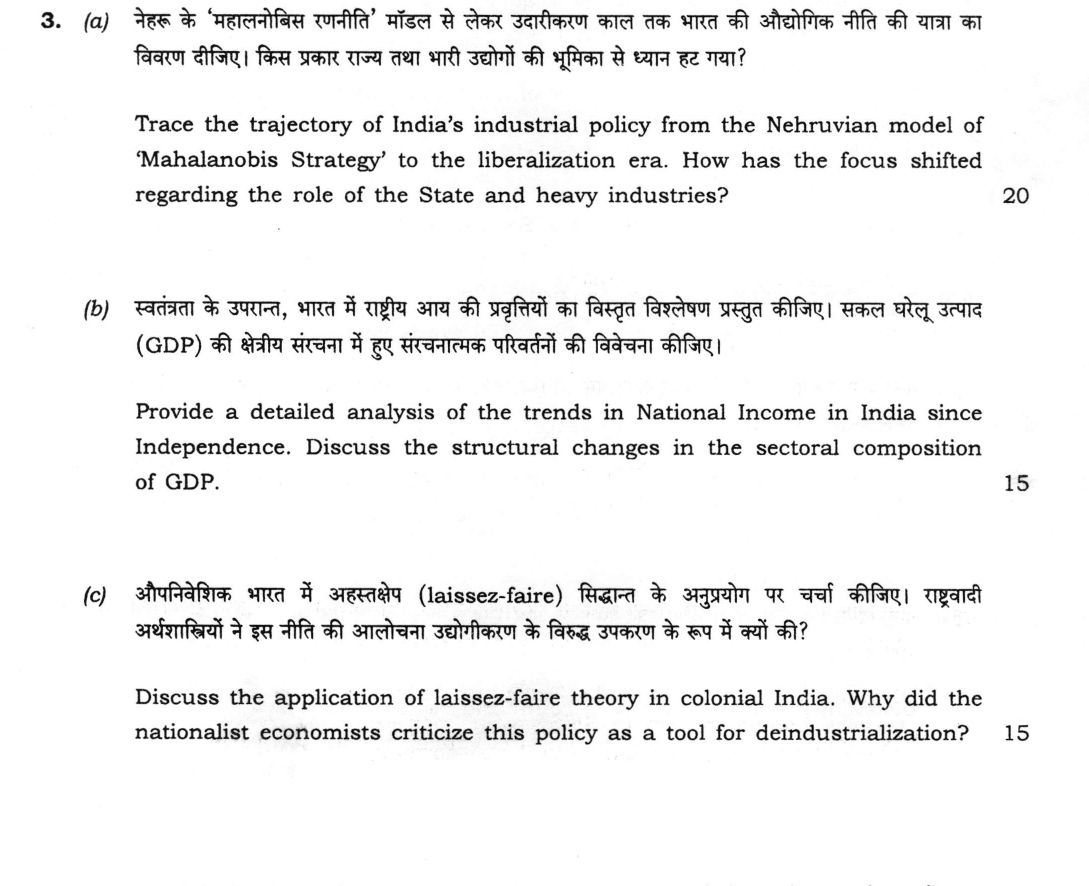
Trace the trajectory of India’s industrial policy from the Nehruvian model of ‘Mahalanobis Strategy’ to the liberalization era. How has the focus shifted regarding the role of the State and heavy industries? 20 marks
Provide a detailed analysis of the trends in National Income in India since Independence. Discuss the structural changes in the sectoral composition of GDP. 15 marks
Discuss the application of laissez-faire theory in colonial India. Why did the nationalist economists criticize this policy as a tool for deindustrialization? 15 marks
हिंदी में प्रश्न पढ़ें
नेहरू के ‘महालनोबिस रणनीति’ मॉडल से लेकर उदारीकरण काल तक भारत की औद्योगिक नीति की यात्रा का विवरण दीजिए। राज्य तथा भारी उद्योगों की भूमिका के संबंध में ध्यान किस प्रकार परिवर्तित हुआ है? (20 अंक)
स्वतंत्रता के उपरान्त, भारत में राष्ट्रीय आय की प्रवृत्तियों का विस्तृत विश्लेषण प्रस्तुत कीजिए। सकल घरेलू उत्पाद (GDP) की क्षेत्रीय संरचना में हुए संरचनात्मक परिवर्तनों की विवेचना कीजिए। (15 अंक)
औपनिवेशिक भारत में अहस्तक्षेप (laissez-faire) सिद्धांत के अनुप्रयोग पर चर्चा कीजिए। राष्ट्रवादी अर्थशास्त्रियों ने इस नीति की आलोचना उद्योगीकरण के विरुद्ध उपकरण के रूप में क्यों की? (15 अंक)
Model answer
Drafted with AI by UPSC Answer Check against this question's marking rubric, to the expected length. UPSC does not publish answers for Mains — this is one way to score well, not an official key. How we build rubrics and answers.
(a) Industrial Policy Trajectory
India’s industrial policy trajectory reflects a fundamental transition from a state-directed, heavy-industry-centric model to a liberalized, market-oriented framework. The Nehruvian era was anchored in the Mahalanobis model, which posited that long-run economic growth is determined by the share of investment allocated to the capital-goods sector. This logic was institutionalized through the Industrial Policy Resolution (IPR) of 1956, which reserved 17 Schedule A industries for the State, placed 12 in Schedule B for progressive state ownership and left Schedule C to the private sector, and the Industries (Development and Regulation) Act (IDRA) of 1951.
By the late 1960s, internal critiques from the Hazari and Dutt Committees revealed that licensing had concentrated capacity in large business houses. The state responded by deepening controls through the MRTP Act (1969), FERA (1973), and the Industrial Policy Statements of 1970, 1973, 1977, and 1980. The 1980s saw partial liberalization, including broad-banding of capacity and the Arjun Sengupta Committee’s memorandum-of-understanding system for public enterprises.
The decisive shift occurred with the New Industrial Policy of 24 July 1991, which delicensed all but 18 industries and reduced the public sector list from 17 to 8. Consequently, the role of the State shifted from owner and producer to regulator and facilitator, evidenced by the replacement of MRTP with the Competition Act (2002) and FERA with FEMA (1999). The New Public Sector Enterprise Policy (2021) further limits the state to four strategic sectors. Heavy industry is now private-led and supported by initiatives like Make in India and production-linked incentive (PLI) schemes, though manufacturing’s share of GVA has stayed around 15-17 per cent, short of the 25 per cent target of the National Manufacturing Policy, 2011.
(b) National Income and Structural Change
The measurement of India’s national income began with the National Income Committee (NIC) in 1949, under P. C. Mahalanobis, with D. R. Gadgil and V. K. R. V. Rao. The current series, managed by the National Statistical Office (NSO) under MoSPI, uses a 2022-23 base year (the new series released by MoSPI in February 2026, replacing the 2011-12 base) and reports Gross Value Added (GVA) at basic prices.
Since 1947, growth has been characterized by distinct phases. From 1950-51 to 1980-81, India experienced the "Hindu rate of growth" (a term coined by Raj Krishna) of approximately 3.5 per cent. This was followed by an acceleration in the 1980s and a significant post-1991 boom, peaking between 2003-04 and 2007-08, followed by the COVID-19 contraction of 2020-21, a sharp rebound and growth of about 7.6 per cent in 2025-26 (second advance estimate). The gross domestic savings rate rose from under 10 per cent of GDP in 1950-51 to over 30 per cent today, peaking at 36-37 per cent in 2007-08.
Structurally, India has undergone a transformation that deviates from the classical Kuznets pattern. While agriculture’s share has fallen from over half of national income in 1950-51 to under a fifth of GVA, and services now contribute roughly half or more, manufacturing has stayed around 15-17 per cent; the new 2022-23 series shows a somewhat larger agriculture share and a smaller services share than the old one. This represents a "services-led" transition without a corresponding manufacturing peak. This output shift is not mirrored by employment; according to the Periodic Labour Force Survey (PLFS), agriculture still employs around 45 per cent of the workforce, illustrating the Lewis surplus-labour model where labor remains trapped in the primary sector despite its declining contribution to national income.
(c) Colonial Laissez-Faire and Deindustrialization
The application of laissez-faire theory in colonial India was a primary instrument of economic exploitation. The British government dismantled the Company’s trade monopoly through the Charter Acts of 1813 and 1833, opening Indian markets to British goods. A critical moment was the abolition of cotton import duties in 1882. Although import duties were reimposed in 1894, they were offset by a countervailing excise duty on Indian mill-made cotton goods, which was abolished only in 1926. Even these were "revenue tariffs": the countervailing excise denied Indian mills any protection against Lancashire.
Nationalist economists, including R. C. Dutt, Dadabhai Naoroji, and M. G. Ranade, criticized this policy as a tool for deindustrialization. They argued that "free trade" was a double standard: Britain had built its own textile industry behind high duties on Indian calicoes before turning to free trade, yet denied India the same protection. Together with the drain of wealth, this hastened the decline of indigenous textiles and handicrafts. The critique rested on the "infant industry" argument (Ranade, drawing on Friedrich List), which suggested that protection was necessary for nascent industries to compete. The belated adoption of discriminating protection in 1923, after the Fiscal Commission of 1921-22, first extended to steel (TISCO) in 1924, underlined the earlier bias against industrialisation. While the magnitude of deindustrialization is debated by scholars like Morris and Bagchi, the direction of the policy’s impact on Indian industry is undisputed.
How this answer will be evaluated
Evaluation rubric
Each sub-part is marked on its own, against the marks and word limit printed on the paper.
- (a) Two directives: (i) 'trace the trajectory' - give a dated, phase-wise account of Indian industrial policy from the Nehru-Mahalanobis heavy-industry strategy of the Second Plan to the liberalisation of 1991 and after; (ii) explain specifically how the focus shifted with respect to the role of the State and the priority given to heavy industry. 20 marks
Must cover
- Mahalanobis model logic: long-run growth depends on the share of investment in the capital-goods sector; Second Five Year Plan (1956-61)
- Industrial Policy Resolution, 1956 (Schedules A, B and C; 17 and 12 industries); Industries (Development and Regulation) Act, 1951
- Hazari Committee (1967) and Dutt Committee (1969); MRTP Act, 1969; FERA, 1973
- 1980s partial liberalisation: broad-banding of capacity; Arjun Sengupta Committee MoU system
- New Industrial Policy, 24 July 1991 - delicensing except 18 industries; public sector list cut from 17 to 8
- Competition Act, 2002; FEMA, 1999; New Public Sector Enterprise Policy, 2021 - four strategic sectors
- Make in India (2014); production-linked incentive schemes (from 2020); manufacturing share still around 15-17 per cent of GVA
Loses marks
- Describing the Mahalanobis model loosely as 'heavy industry first' without stating its actual logic - that the long-run growth rate depends on the share of investment allocated to the capital-goods sector.
- Confusing the Industrial Policy Resolution of 1956 with the Resolution of 1948, or misstating the Schedule A and Schedule B counts.
- Jumping straight from 1956 to 1991 and ignoring the 1970, 1973, 1977 and 1980 statements and the 1980s partial liberalisation, which is exactly the 'trajectory' being asked for.
- Answering only the first directive and never addressing how the role of the State and the place of heavy industry changed.
- Claiming 1991 abolished licensing entirely; a short negative list remains, and reserved public sector industries were reduced, not eliminated.
- Misdating the New Industrial Policy (it is 24 July 1991) or attributing the Competition Act to 1991.
Earns more
- Internal critique and the mid-course statements: the Hazari Committee report on industrial planning and licensing policy (1967) and the Dutt Committee on industrial licensing (1969) showed that licensing had concentrated capacity in large business houses and produced pre-emptive licensing rather than capacity creation; the response deepened controls - the MRTP Act, 1969, the Industrial Policy Statements of 1970 and 1973 (core industries, the joint sector, Appendix I industries) and the Foreign Exchange Regulation Act, 1973 that led to the exit of IBM and Coca-Cola; the Janata Government's 1977 statement shifted emphasis to cottage, tiny and small-scale industry and District Industries Centres, while the 1980 statement returned to efficiency, economic federalism, nucleus plants and regulatory relaxation.
- The 1980s partial liberalisation within the system: delicensing of selected industries and broad-banding of licensed capacity, re-endorsement and automatic expansion of capacity, raising the MRTP asset threshold (from Rs 20 crore to Rs 100 crore in 1985), import liberalisation of capital goods and components under OGL, and the influential reports of the Abid Hussain Committee on trade policy (1984), the L. K. Jha Economic Administration Reforms Commission and the Arjun Sengupta Committee (1984) which introduced the memorandum-of-understanding system for public enterprises.
- The shift in the role of the State and of heavy industry, with the current framework: the State moved from owner and producer to regulator, competition authority and facilitator - the MRTP Act was replaced by the Competition Act, 2002 with the Competition Commission of India, FERA by FEMA, 1999, and the New Public Sector Enterprise Policy of 2021 limits the public sector to a bare minimum presence in four strategic sectors with privatisation elsewhere (Air India's transfer to the Tatas in January 2022); heavy industry is no longer state-built but private-led and incentive-supported through Make in India (2014), the production-linked incentive schemes from 2020, the National Infrastructure Pipeline, PM Gati Shakti (2021) and the National Logistics Policy (2022) - yet manufacturing's share in gross value added has remained around 17 per cent against the 25 per cent target of the National Manufacturing Policy, 2011.
Extra mark
- Industrial Policy Resolution, 1948
- Avadi session, 1955 - socialistic pattern of society
- Industrial Policy Statements of 1970, 1973, 1977 and 1980
- 51 per cent automatic FDI approval in 34 industries (1991)
- (b) Two linked tasks: (i) a detailed analysis of the trends in India's national income since 1947 - the growth phases, their rates and their turning points; (ii) a discussion of the structural change in the sectoral composition of GDP, including the contrast between the output shift and the employment shift. 15 marks
Must cover
- National Income Committee, 1949 (P. C. Mahalanobis, with D. R. Gadgil and V. K. R. V. Rao); NSO, MoSPI
- new series with base year 2022-23 (released February 2026, replacing 2011-12); GVA at basic prices
- 'Hindu rate of growth' (Raj Krishna) of about 3.5 per cent, 1950-51 to 1980-81
- acceleration in the 1980s; post-1991 growth; the 2003-04 to 2007-08 boom; the COVID-19 contraction of 2020-21 and the rebound
- agriculture's share falling from over half of national income in 1950-51 to under a fifth of GVA; services about half or more
- manufacturing stuck around 15-17 per cent of GVA - a services-led transition deviating from the Kuznets pattern
- agriculture still employing around 45 per cent of the workforce (PLFS); the Lewis surplus-labour model
Loses marks
- Describing only growth rates and omitting the structural composition question, or vice versa - both halves carry marks.
- Treating the output shift and the employment shift as the same thing; the divergence between them is the analytical heart of the answer.
- Quoting sectoral shares without saying whether they are of GDP at market prices or of GVA at basic prices, and mixing constant-price and current-price shares.
- Claiming Indian structural change follows the classical Kuznets pattern; it is precisely the deviation - services without manufacturing - that the examiner wants named.
- Using outdated base-year figures or attributing the 'Hindu rate of growth' phrase to someone other than Raj Krishna.
Earns more
- The measurement framework: official estimation begins with the National Income Committee constituted in 1949 under P. C. Mahalanobis (with D. R. Gadgil and V. K. R. V. Rao), whose reports of 1951 and 1954 established the conventional series, continued by the Central Statistical Organisation, now the National Statistical Office under MoSPI; base years have been revised successively, the current series (released in February 2026) having 2022-23 as base year in place of 2011-12, with gross value added at basic prices as the headline production-side aggregate.
- Supporting evidence on savings, investment and welfare: the gross domestic savings rate rose from under 10 per cent of GDP in 1950-51 to over 30 per cent today, having peaked at around 36-37 per cent in 2007-08, with gross fixed capital formation of a similar order; per capita net national income at constant prices has risen many times over, and India is now among the largest economies in the world in nominal terms - though per capita income remains at lower-middle-income levels.
Extra mark
- Fisher-Clark sequence of structural change
- gross domestic savings rate above 30 per cent of GDP, peaking around 36-37 per cent in 2007-08
- the 2022-23 series shows a higher agriculture share and a lower services share than the 2011-12 series
- (c) Two tasks: (i) discuss how the doctrine of laissez-faire was applied in colonial India - in trade, tariff, industrial and famine policy; (ii) explain why the nationalist economists attacked that policy as an instrument of deindustrialisation. The Hindi rendering asks why they saw it as a tool against industrialisation, which is the same demand. 15 marks
Must cover
- Charter Acts of 1813 and 1833
- abolition of cotton import duties in 1882; reimposition in 1894 with the countervailing cotton excise duty; excise abolished in 1926
- revenue tariff versus protective tariff
- R. C. Dutt, The Economic History of India (1901, 1903); Dadabhai Naoroji
- M. G. Ranade, Essays on Indian Economics (1898); Friedrich List and the infant-industry argument
- Indian Fiscal Commission, 1921-22; discriminating protection from 1923; protection to steel (TISCO)
- the deindustrialisation debate: Morris D. Morris versus Amiya Kumar Bagchi - direction agreed, magnitude disputed
Loses marks
- Describing laissez-faire in the abstract without the concrete tariff history - the 1882 abolition and the 1894 cotton excise are the decisive evidence and must appear.
- Asserting deindustrialisation as an undisputed quantified fact; the direction is agreed but the magnitude is genuinely contested and should be flagged.
- Confusing the fiscal autonomy convention of 1919 and discriminating protection of 1923 with the Swadeshi movement or with post-Independence protection.
- Attributing 'Essays on Indian Economics' or the infant-industry argument to Naoroji or Dutt rather than to Ranade.
- Missing the second directive - the nationalist critique - and writing only a descriptive account of British trade policy.
Earns more
- The contradictions the nationalists exposed: the colonial state abandoned laissez-faire whenever British interests demanded it - it guaranteed a fixed return (5 per cent) on British railway capital and charged the burden to Indian revenues, mandated the purchase of stores in England, ran a state opium monopoly and salt monopoly, fixed freight rates that favoured the movement of raw materials to ports and of imports inland, and manipulated the exchange rate and currency policy; conversely it invoked non-intervention to justify inaction during the famines of the later nineteenth century and to refuse protection, technical education and state finance to Indian industry.
- The retreat from laissez-faire and the historiographical qualification: the fiscal autonomy convention of 1919 and the Indian Fiscal Commission of 1921-22 under Sir Ibrahim Rahimtoola led to the policy of discriminating protection from 1923 and the establishment of the Tariff Board, under which steel (Tata Iron and Steel Company), sugar, paper, cement and textiles received protection in the interwar decades; the deindustrialisation thesis itself is debated, with Morris D. Morris and Daniel Thorner questioning its extent for the census period after 1881, while Amiya Kumar Bagchi's study of Gangetic Bihar found the share of industrial employment roughly halving between the early nineteenth century and 1901 - so the answer should present the extent as disputed even while the direction is agreed.
Extra mark
- William Digby; Bipan Chandra, The Rise and Growth of Economic Nationalism in India (1966)
- guaranteed 5 per cent return on railway capital; stores purchase in England; the salt and opium monopolies
- Sir Ibrahim Rahimtoola; the Tariff Board; Daniel Thorner
What "State" is asking you to do
Give the formulation itself — the theorem, rule, statutory provision or position — worded accurately. Precision of wording is the whole of the mark; no background or justification is being asked for.
Structure that answers it
The statement in full, complete in itself → the conditions under which it holds → an illustration only where the stem asks for one
Where marks are lost
Approximating the wording. A theorem or a provision stated loosely forfeits the mark that exact statement would have carried.
Practice this exact question
Write your answer and it is marked point by point against the model answer above — what you covered, what you missed, what you got wrong.
Evaluate my answer →More from Economics 2026 Paper II
- Q1 Answer the following questions in about 150 words each : (a) Critically examine the ‘drai…
- Q2 (a) Evaluate the success of land reforms in post-Independent India. Why was the success l…
- Q3 (a) Trace the trajectory of India’s industrial policy from the Nehruvian model of ‘Mahala…
- Q4 (a) Trace the evolution of the debate between the public and private sectors in India's i…
- Q5 Answer the following questions in about 150 words each : (a) Analyze the impact of the TR…
- Q6 (a) Critically examine the impact of the New Economic Policy on the Indian corporate sect…