Paper II — Q6
(a) Critically examine the impact of the New Economic Policy on the Indian corporate sector. Discuss its effects on…
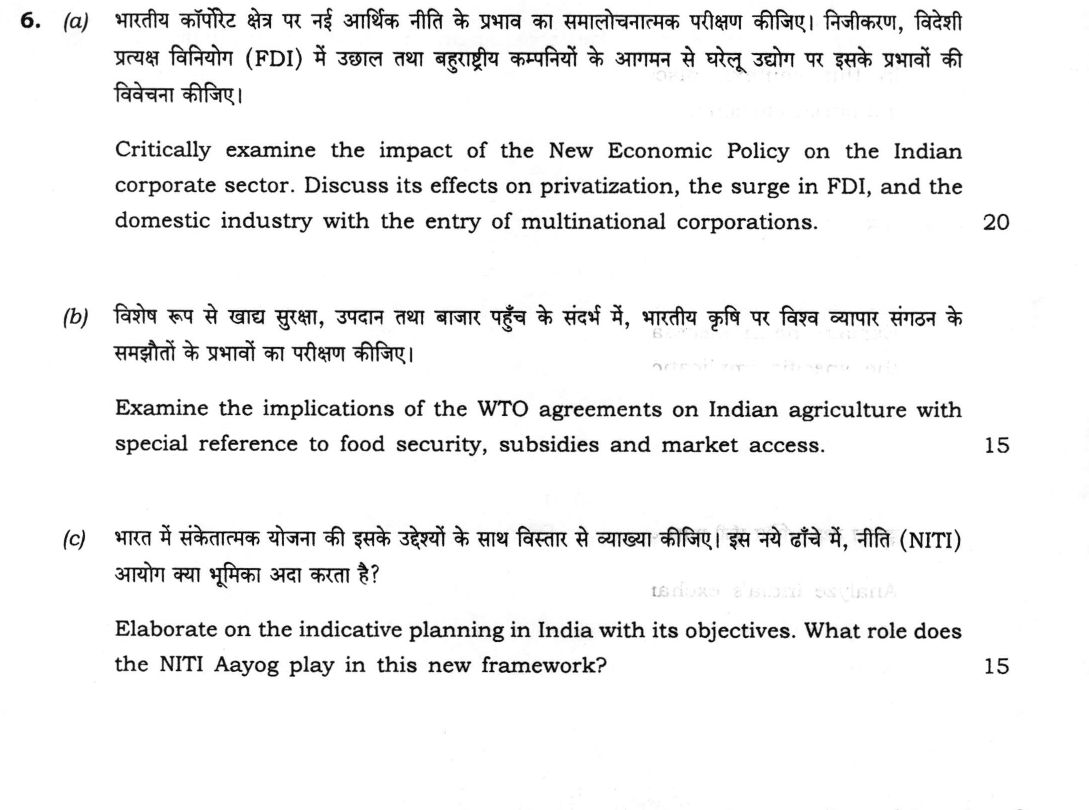
Critically examine the impact of the New Economic Policy on the Indian corporate sector. Discuss its effects on privatization, the surge in FDI, and the domestic industry with the entry of multinational corporations. 20 marks
Examine the implications of the WTO agreements on Indian agriculture with special reference to food security, subsidies and market access. 15 marks
Elaborate on the indicative planning in India with its objectives. What role does the NITI Aayog play in this new framework? 15 marks
हिंदी में प्रश्न पढ़ें
भारतीय कॉर्पोरेट क्षेत्र पर नई आर्थिक नीति के प्रभाव का समालोचनात्मक परीक्षण कीजिए। निजीकरण, विदेशी प्रत्यक्ष विनियोग (FDI) में उछाल तथा बहुराष्ट्रीय कम्पनियों के आगमन से घरेलू उद्योग पर इसके प्रभावों की विवेचना कीजिए। (20 अंक)
विशेष रूप से खाद्य सुरक्षा, उपदान तथा बाजार पहुँच के संदर्भ में, भारतीय कृषि पर विश्व व्यापार संगठन के समझौतों के प्रभावों का परीक्षण कीजिए। (15 अंक)
भारत में संकेतात्मक योजना की इसके उद्देश्यों के साथ विस्तार से व्याख्या कीजिए। इस नये ढाँचे में, नीति (NITI) आयोग क्या भूमिका अदा करता है? (15 अंक)
Model answer
Drafted with AI by UPSC Answer Check against this question's marking rubric, to the expected length. UPSC does not publish answers for Mains — this is one way to score well, not an official key. How we build rubrics and answers.
(a) NEP 1991 and the corporate sector (20 marks)
The New Economic Policy of 1991 restructured the Indian corporate sector by dismantling the "Licence Raj" and integrating it with global markets. The New Industrial Policy of 24 July 1991 delicensed all but 18 industries and removed the MRTP Act's pre-entry scrutiny; the Controller of Capital Issues was abolished in 1992 and SEBI, under the SEBI Act, 1992, professionalised capital-market regulation.
Privatisation has been cautious. Disinvestment from 1991-92 mostly sold minority stakes without transferring control. Strategic sales in 1999-2004 (BALCO, VSNL, Hindustan Zinc, Maruti, Modern Foods) marked real privatisation, and the transfer of Air India to the Tata group in January 2022 reflects the New Public Sector Enterprise Policy, 2021, which confines the public sector to four strategic sectors.
The surge in FDI was triggered by automatic approval up to 51 per cent in 34 industries in 1991, later raised to 100 per cent in most sectors, while FEMA (1999) replaced FERA. Foreign capital brought technology and deepened capital markets.
The entry of MNCs had a differentiated impact on domestic industry. Consumers gained in price, quality and variety in cars, consumer durables and telecommunications. The "Bombay Club" (1993) demanded a "level playing field", citing higher capital costs and infrastructure deficits; some domestic firms were acquired or became junior partners, while others became globally competitive in IT, pharmaceuticals and steel. The Competition Act, 2002 replaced the MRTP Act to police the new market structure.
Critically, the 2003-08 investment boom ended in the "twin balance sheet problem" of over-leveraged firms and bad bank loans, requiring the Insolvency and Bankruptcy Code, 2016; corporate growth has been weakly employment-generating, and manufacturing's share of GVA has stayed around 15-17 per cent.
(b) WTO and Indian agriculture (15 marks)
The Agreement on Agriculture (AoA), in force since 1 January 1995, shapes Indian farm policy through three pillars: market access, domestic support and export competition.
Food security is India's main concern. Market price support is measured against an external reference price fixed at 1986-88 levels without inflation adjustment, so MSP procurement appears as a large subsidy in the Aggregate Measurement of Support. The Bali Ministerial Decision (December 2013) gave an interim "Peace Clause" for public stockholding, made open-ended by the General Council in November 2014, but a permanent solution is still pending; this matters for the National Food Security Act, 2013.
Subsidies are classified into Amber, Blue and Green Boxes. India relies on the 10 per cent de minimis for developing countries and on Article 6.2, which exempts investment subsidies generally available to agriculture and input subsidies to low-income or resource-poor farmers. Rice support has exceeded the de minimis, and India has invoked the Peace Clause for rice since 2020. Through the G-33, India seeks "Special Products" and a "Special Safeguard Mechanism" (SSM) against import surges.
Market access required non-tariff barriers to be converted into bound tariffs. India, which kept quantitative restrictions on balance of payments grounds, bound farm tariffs at high ceilings (about 100-300 per cent) but had to remove the restrictions by April 2001 after a dispute with the United States. The gap between bound and applied rates gives headroom against import surges, while Indian exports face tariff peaks and SPS and TBT barriers abroad. The Nairobi decision (2015) to eliminate export subsidies also constrains support such as India's sugar export aid.
(c) Indicative planning and NITI Aayog (15 marks)
Indicative planning replaces the directive, command-and-control approach of the early Five Year Plans with guidance through information, incentives and coordination. Inspired by French planification, it was first explicitly adopted in India in the Eighth Five Year Plan (1992-97), after the 1991 reforms; the Twelfth Plan (2012-17) was the last.
Its objectives are to give the economy a strategic direction, coordinate the Centre, States and private sector, signal priority sectors for investment, and create an enabling environment for growth. Targets are indicative signals rather than binding production quotas, and the state steers rather than allocates.
NITI Aayog (National Institution for Transforming India), set up by a Cabinet resolution on 1 January 2015 in place of the Planning Commission (Cabinet resolution of 15 March 1950), is the institutional core of this framework. Chaired by the Prime Minister, with a Governing Council of Chief Ministers, it acts as a think-tank and a platform for cooperative federalism. Crucially, it allocates no funds; with the plan and non-plan distinction ended, allocation rests with the Finance Ministry. It sets direction through its three-year Action Agenda, seven-year Strategy and fifteen-year Vision, and promotes competitive federalism through indices such as the SDG India Index and the National Multidimensional Poverty Index. It runs the Aspirational Districts Programme (2018) and the Atal Innovation Mission. Its leverage is therefore advisory and reputational, which suits indicative planning but leaves long-horizon investment planning without a single owner.
How this answer will be evaluated
Evaluation rubric
Each sub-part is marked on its own, against the marks and word limit printed on the paper.
- (a) 'Critically examine' the effect of the New Economic Policy of 1991 on the Indian corporate sector, and then discuss three named consequences separately: privatisation, the surge in foreign direct investment, and the impact on domestic industry of the entry of multinational corporations. All three must be covered and the treatment must weigh gains against costs. 20 marks
Must cover
- New Industrial Policy, 24 July 1991; delicensing except 18 industries; removal of MRTP pre-entry scrutiny
- abolition of the Controller of Capital Issues (1992); SEBI Act, 1992
- disinvestment versus privatisation: minority stake sales from 1991-92; strategic sales 1999-2004 (BALCO, VSNL, Hindustan Zinc, Maruti, Modern Foods)
- Air India to the Tata group (January 2022); New Public Sector Enterprise Policy, 2021
- 51 per cent automatic FDI approval in 34 industries (1991), later 100 per cent in most sectors; FEMA, 1999
- MNC entry: consumer gains versus the Bombay Club's 'level playing field' (1993); differentiated outcome
- critical balance: twin balance sheet problem and IBC, 2016; weak employment growth; manufacturing stuck around 15-17 per cent of GVA
Loses marks
- Writing a general essay on liberalisation and never addressing the corporate sector, which is the stated subject.
- Omitting one of the three named sub-parts - privatisation, FDI, or MNC entry and domestic industry; each carries marks and all three are compulsory.
- Treating disinvestment and privatisation as synonymous; most Indian disinvestment has been minority stake sale without transfer of control, and noting the distinction is a mark of a strong answer.
- Presenting MNC entry as either pure benefit or pure destruction; the examiner expects the differentiated outcome and the Bombay Club debate.
- Quoting FDI figures without stating the year or the measure (gross inflows, total inflows including reinvested earnings, or net FDI).
- Ignoring the critical dimension altogether - jobless growth, the twin balance sheet problem and stagnant manufacturing are the standard criticisms expected.
Earns more
- Multinational entry and its impact on domestic industry, argued both ways: entry and competition produced large consumer gains in price, quality, variety and technology - conspicuously in passenger cars, consumer durables, telecommunications and fast-moving consumer goods - and forced domestic firms to raise productivity, invest in brands and technology and specialise; the contrary case was pressed at the time by the group of leading Indian industrialists known as the Bombay Club, which in 1993 demanded a level playing field before full opening, arguing that domestic firms faced higher capital costs, infrastructure deficits and legacy obligations; in the event the outcome was differentiated - some domestic firms were acquired or reduced to junior joint-venture partners and segments such as consumer electronics were largely lost, while others became globally competitive, in information technology, pharmaceuticals, automotive components, steel and telecommunications, and several Indian groups themselves became multinationals through large overseas acquisitions in the 2000s.
- Corporate restructuring, capital markets and governance: the end of licensing triggered a wave of mergers, demergers and divestment of non-core businesses as diversified family houses refocused on core competencies, and the composition of India's largest business groups changed substantially; capital markets deepened with the National Stock Exchange from 1994, dematerialisation and depositories, rolling settlement and the growth of private equity and venture capital; and corporate governance was rebuilt through the Kumar Mangalam Birla Committee (1999) and the resulting listing-agreement code, the Narayana Murthy Committee (2003), the Companies Act, 2013 with mandatory corporate social responsibility, and the SEBI listing obligations regulations of 2015; competition regulation moved from the MRTP Act to the Competition Act, 2002 and the Competition Commission of India.
- The critical balance: against the gains must be set the evidence that corporate growth has been weakly employment-generating, that the investment boom of 2003-08 ended in the twin balance sheet problem of over-leveraged firms and non-performing bank assets requiring the Insolvency and Bankruptcy Code, 2016, that the corporate tax reduction of 2019 was not matched by a commensurate rise in private investment, that manufacturing's share of value added has stayed around 15-17 per cent despite Make in India and the production-linked incentive schemes, and that concerns about market concentration and the closeness of business and government remain live.
Extra mark
- Narasimham Committee (1991); Chelliah Committee (1991)
- Rangarajan Committee (1993); Disinvestment Commission (1996); LIC listing (2022)
- Competition Act, 2002 and the Competition Commission of India replacing the MRTP Act
- Kumar Mangalam Birla Committee (1999) and Narayana Murthy Committee (2003); Companies Act, 2013
- (b) 'Examine the implications' of the WTO agreements for Indian agriculture under three specified heads - food security, subsidies and market access. The Agreement on Agriculture must be the analytical frame, and each of the three heads must be addressed with the relevant provisions and India's negotiating position. 15 marks
Must cover
- Agreement on Agriculture (1 January 1995): market access, domestic support, export competition
- Amber, Blue and Green Boxes; AMS; 10 per cent de minimis for developing countries; Article 6.2
- MSP procurement counted as market price support against a fixed 1986-88 external reference price
- Bali Peace Clause (December 2013), made open-ended in November 2014; permanent solution on public stockholding pending
- removal of quantitative restrictions by April 2001; high bound versus low applied tariffs
- Nairobi decision (2015) eliminating export subsidies; SPS and TBT barriers to Indian exports
- G-33: special products and the special safeguard mechanism
Loses marks
- Writing a general critique of globalisation and Indian agriculture without using the Agreement on Agriculture's actual categories - the boxes, the de minimis and the external reference price.
- Omitting the public stockholding issue, which is the single most important implication for India and the core of its negotiating position.
- Claiming India's agricultural subsidies violate WTO rules outright; most are notified under the Green Box or Article 6.2, and only market price support for rice has breached the de minimis.
- Confusing the Bali Peace Clause with a permanent solution, or dating it to Doha or Nairobi.
- Getting the de minimis wrong - it is 10 per cent of the value of production for developing countries, against 5 per cent for developed members.
- Ignoring market access barriers faced by Indian exports (SPS, TBT, tariff escalation) and treating market access as only an import question.
Earns more
- Market access: non-tariff barriers had to be converted into tariffs and bound; India, having no tariffication obligation because it maintained quantitative restrictions on balance of payments grounds, bound its agricultural tariffs at high ceiling levels - broadly 100 per cent for primary products, 150 per cent for processed products and 300 per cent for edible oils, later renegotiating the bindings on a few items - but had to remove the quantitative restrictions themselves by April 2001 after losing the dispute brought by the United States; since applied duties are usually far below the bound rates, India retains headroom to raise duties against import surges, which it has used for edible oils, pulses and sugar, but Indian exports in turn face high tariff peaks, tariff escalation and sanitary and phytosanitary and technical barriers in developed markets.
- Export competition and the other agreements: the Nairobi Ministerial Decision of December 2015 required the elimination of agricultural export subsidies, developed members immediately and developing members over a transition, with limited flexibility for marketing and internal transport subsidies - a discipline under which India's sugar export support was successfully challenged; the SPS and TBT Agreements shape non-tariff access for Indian exports through pesticide residue, aflatoxin and contaminant standards; and the TRIPS Agreement bears on seeds, to which India responded with its own sui generis Protection of Plant Varieties and Farmers' Rights Act, 2001 preserving the farmer's right to save, use, exchange and sell farm-saved seed rather than joining UPOV; India pursues its demands through the G-33 coalition on special products and a special safeguard mechanism, the collapse of the 2008 mini-ministerial over the safeguard trigger being the key precedent.
Extra mark
- National Food Security Act, 2013
- Protection of Plant Varieties and Farmers' Rights Act, 2001 as the sui generis response to TRIPS
- India's invocation of the Peace Clause for rice (since 2020)
- (c) Two linked tasks: (i) elaborate on indicative planning in India - what it means, how and when India adopted it, and what its objectives are; (ii) explain the role NITI Aayog plays within this new framework. Both must be covered in about 250 words. 15 marks
Must cover
- indicative versus imperative planning; French planification as the model
- Eighth Five Year Plan (1992-97) as India's first explicitly indicative plan
- objectives: strategic direction, coordination, targets as signals, an enabling environment
- Planning Commission (Cabinet Resolution, 15 March 1950) replaced by NITI Aayog (1 January 2015); Twelfth Plan (2012-17) the last
- NITI Aayog: Prime Minister as Chairperson, Governing Council of Chief Ministers; no fund allocation
- cooperative and competitive federalism; indices such as the SDG India Index; Aspirational Districts Programme (2018)
Loses marks
- Defining indicative planning only as 'flexible planning' without contrasting it with imperative planning and without identifying the mechanism - information, targets and incentives rather than directives.
- Failing to name the Eighth Plan as the point of adoption, which is the standard examinable fact.
- Describing NITI Aayog as a renamed Planning Commission; the decisive difference is that it has no fund-allocating power.
- Attributing the Planning Commission or NITI Aayog to a constitutional or statutory provision; both were created by Cabinet Resolutions.
- Listing NITI Aayog's schemes without connecting them to the indicative framework - coordination, benchmarking and knowledge rather than allocation.
Earns more
- NITI Aayog's functions within the framework: it acts as the Government's think-tank and knowledge and innovation hub, formulating strategy documents and model laws (such as the model agricultural land leasing and agricultural marketing laws); it is the platform of cooperative federalism through the Governing Council and of competitive federalism through published rankings and indices - the SDG India Index, the Composite Water Management Index, the Health Index, the School Education Quality Index, the Export Preparedness Index and the India Innovation Index; it runs targeted convergence programmes, notably the Aspirational Districts Programme launched in January 2018 and its later extension to blocks; it publishes the National Multidimensional Poverty Index using the Alkire-Foster method; it houses the Atal Innovation Mission; and it monitors and evaluates programmes through the Development Monitoring and Evaluation Office.
- Critical appraisal: because NITI Aayog has no financial powers, its leverage over States is reputational and analytical rather than fiscal, which some see as the essence of genuine cooperative federalism and others as a loss of the Planning Commission's ability to steer long-term public investment and to negotiate with States; the National Development Council has become dormant; and the framework leaves open who now performs the long-horizon investment planning that infrastructure and energy transition require.
Extra mark
- Eleventh Plan 'faster and more inclusive growth'; Twelfth Plan 'faster, more inclusive and sustainable growth'
- three-year Action Agenda, seven-year Strategy, fifteen-year Vision
- Atal Innovation Mission; Development Monitoring and Evaluation Office; National Multidimensional Poverty Index
- end of the plan / non-plan distinction
What "Critically examine" is asking you to do
Test the proposition the question puts to you and return a finding on how far it holds. Examine stems carry a claim, or ask whether something has happened, and expect evidence weighed both ways before the extent is stated — often with remedial measures attached. “Critically” is not a section added at the end: name the yardstick you are judging by — the evidence, the stated objective, a constitutional principle, a rival explanation — and let a verdict close each part of the body. Where the question quotes a claim, that verdict must land on the claim itself, accepted, qualified or rejected, and not on the theme in general.
Structure that answers it
Restate the claim as the question frames it → evidence that supports it → evidence that undercuts it → the conditions under which it holds → verdict on how far it stands
Where marks are lost
Merits in one paragraph, demerits in the next, and a conclusion calling for a balanced and holistic approach. That is a survey with the judgement left out and it holds the answer in the middle band. The opposite error is reading “critically” as permission to attack — and with the odd pairings, critically describe or critically explain, the exposition still carries most of the marks, the judgement being a layer on it rather than a substitute for it.
Practice this exact question
Write your answer and it is marked point by point against the model answer above — what you covered, what you missed, what you got wrong.
Evaluate my answer →More from Economics 2026 Paper II
- Q3 (a) Trace the trajectory of India’s industrial policy from the Nehruvian model of ‘Mahala…
- Q4 (a) Trace the evolution of the debate between the public and private sectors in India's i…
- Q5 Answer the following questions in about 150 words each : (a) Analyze the impact of the TR…
- Q6 (a) Critically examine the impact of the New Economic Policy on the Indian corporate sect…
- Q7 (a) “Economic development without employment generation is meaningless.” Give your views.…
- Q8 (a) Explain the Intellectual Property Rights (IPR) regime under the WTO. Discuss the spec…