Paper II — Q8
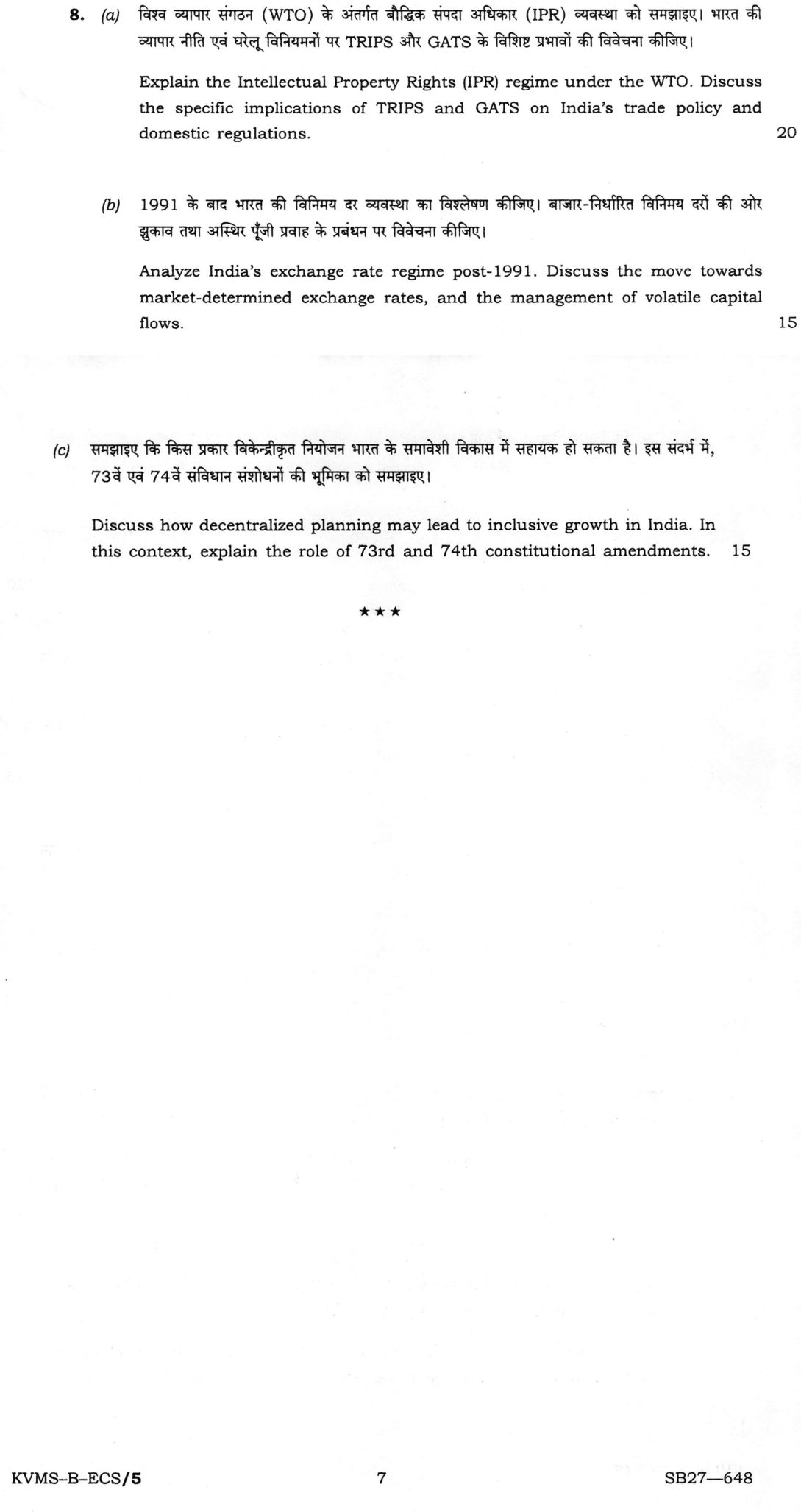
(a) Explain the Intellectual Property Rights (IPR) regime under the WTO. Discuss the specific implications of TRIPS and GATS on…
Explain the Intellectual Property Rights (IPR) regime under the WTO. Discuss the specific implications of TRIPS and GATS on India’s trade policy and domestic regulations. 20 marks
Analyze India’s exchange rate regime post-1991. Discuss the move towards market-determined exchange rates, and the management of volatile capital flows. 15 marks
Discuss how decentralized planning may lead to inclusive growth in India. In this context, explain the role of 73rd and 74th constitutional amendments. 15 marks
हिंदी में प्रश्न पढ़ें
विश्व व्यापार संगठन (WTO) के अंतर्गत बौद्धिक संपदा अधिकार (IPR) व्यवस्था को समझाइए। भारत की व्यापार नीति एवं घरेलू विनियमनों पर TRIPS और GATS के विशिष्ट प्रभावों की विवेचना कीजिए। (20 अंक)
1991 के बाद भारत की विनिमय दर व्यवस्था का विश्लेषण कीजिए। बाजार-निर्धारित विनिमय दरों की ओर झुकाव तथा अस्थिर पूँजी प्रवाह के प्रबंधन पर विवेचना कीजिए। (15 अंक)
समझाइए कि किस प्रकार विकेन्द्रीकृत नियोजन भारत के समावेशी विकास में सहायक हो सकता है। इस संदर्भ में, 73वें एवं 74वें संविधान संशोधनों की भूमिका को समझाइए। (15 अंक)
Model answer
Drafted with AI by UPSC Answer Check against this question's marking rubric, to the expected length. UPSC does not publish answers for Mains — this is one way to score well, not an official key. How we build rubrics and answers.
(a) TRIPS and GATS (20 marks)
The WTO's intellectual property regime is the TRIPS Agreement (Annex 1C of the Marrakesh Agreement, in force 1 January 1995). It sets minimum standards for seven categories - copyright, trademarks, geographical indications, industrial designs, patents, layout-designs of integrated circuits and undisclosed information - on the basis of national treatment and most-favoured-nation treatment. It incorporates the Paris and Berne Conventions, requires domestic enforcement (Part III) and is backed by the dispute settlement system. Article 27 requires patents in all fields of technology, Article 33 fixes a 20-year term, Article 27.3(b) allows an effective sui generis system for plant varieties, and Articles 31 and 31bis and the Doha Declaration (2001) preserve compulsory licensing for public health.
For India, TRIPS turned patent law from an instrument of industrial policy into a binding international obligation. The process-patent regime that built the generic industry gave way to product patents through the Patents (Amendment) Acts of 1999, 2002 and 2005, effective for pharmaceuticals from 1 January 2005. India used the flexibilities: Section 3(d) against evergreening (upheld in Novartis v. Union of India, 2013), compulsory licensing under Section 84, the Protection of Plant Varieties and Farmers' Rights Act, 2001, and the Geographical Indications Act, 1999. The turmeric, neem and basmati cases led to the Traditional Knowledge Digital Library and the Biological Diversity Act, 2002, and the National IPR Policy followed in 2016. India resists "TRIPS-plus" demands such as data exclusivity and patent linkage, in bilateral talks and under the US Special 301 process, and co-sponsored with South Africa the October 2020 proposal to waive TRIPS for COVID-19 products.
GATS covers services through four modes of supply and positive-list scheduling; market access (Article XVI) and national treatment (Article XVII) bind only in scheduled sectors. India's offensive interest lies in Mode 1 (IT-enabled services) and Mode 4 (temporary movement of professionals). Defensively, it has kept Mode 3 commitments in sensitive sectors such as retail, legal services and education well below its autonomous FDI liberalisation, preserving room to reverse policy. Article VI requires transparent, objective licensing and qualification rules. India's stance is compliance with maximum use of policy space, and opposition to plurilateral rule-making outside the multilateral framework.
(b) India's exchange rate regime since 1991 (15 marks)
Until 1991 the rupee was administered under FERA, pegged first to sterling and then to a basket. The balance of payments crisis brought the two-step devaluation of 1 and 3 July 1991, the dual-rate Liberalised Exchange Rate Management System (March 1992), unification of the rate (March 1993) and acceptance of IMF Article VIII, that is current account convertibility (August 1994). The market-oriented FEMA replaced FERA in 1999. The present regime is a managed float: the RBI announces no target or band and intervenes in the spot and forward markets only to curb excessive volatility, watching the NEER and REER as indicators of competitiveness.
Volatile capital flows are managed by calibration, not free convertibility; the Tarapore committees (1997, 2006) set a cautious roadmap. The RBI sterilises inflows through open market operations and the Market Stabilisation Scheme (2004), builds reserves (about $6 billion in March 1991 to several hundred billion dollars), and adjusts FPI debt limits, the ECB framework and the Liberalised Remittance Scheme. In stress it has used special windows: Resurgent India Bonds (1998), India Millennium Deposits (2000) and the FCNR(B) swap window (2013). The regime absorbed the 1997 Asian crisis, the 2008 global crisis and the 2013 taper tantrum with depreciation but without a payments crisis. Since 2022 policy has added rupee internationalisation, with trade settlement in rupees through special vostro accounts. The constraint is the impossible trinity: with open capital flows and an independent monetary policy, the rate cannot also be fixed.
(c) Decentralised planning and inclusive growth (15 marks)
Decentralised planning makes plans reflect local needs, uses local information to target water, roads and welfare schemes such as MGNREGA (now succeeded by the VB-G RAM G Act, 2025), and gives the poor a voice through the gram sabha, which brings growth closer to excluded groups.
The 73rd Amendment (in force 24 April 1993) inserted Part IX (Articles 243-243O) and the Eleventh Schedule of 29 subjects: three-tier panchayats (the intermediate tier optional below 20 lakh population), reservation for SCs, STs and at least one-third for women, State Election Commissions, State Finance Commissions every five years and the gram sabha; PESA (1996) extended it to Scheduled Areas. The 74th Amendment (1 June 1993) inserted Part IXA (Articles 243P-243ZG) and the Twelfth Schedule of 18 subjects for municipalities. Article 243ZD requires a District Planning Committee, with at least four-fifths elected members, to consolidate panchayat and municipal plans into a district plan, and Article 243ZE a Metropolitan Planning Committee. Kerala's People's Plan Campaign (1996) showed the model by devolving a large part of the State plan to local bodies.
However, Articles 243G and 243W are only enabling provisions, so the three Fs - functions, funds and functionaries - remain incompletely devolved, District Planning Committees are dysfunctional in several States and own revenues are thin. Inclusive growth needs devolution that is effective, not merely constitutional.
How this answer will be evaluated
Evaluation rubric
Each sub-part is marked on its own, against the marks and word limit printed on the paper.
- (a) Two tasks: (i) explain the intellectual property regime of the WTO, i.e. the TRIPS Agreement - scope, principles and minimum standards; (ii) discuss the specific implications of TRIPS and of GATS for India's trade policy and domestic regulation. Both agreements must be treated, with concrete Indian implications. 20 marks
Must cover
- TRIPS as Annex 1C of the Marrakesh Agreement (in force 1 January 1995): seven categories of intellectual property, minimum standards, national treatment and MFN, enforcement under Part III and dispute settlement; Article 27 (patents in all fields), Article 33 (20-year term), Article 27.3(b) (sui generis protection for plant varieties)
- Flexibilities: compulsory licensing (Articles 31 and 31bis) and the Doha Declaration on TRIPS and Public Health (2001)
- Indian implications of TRIPS: process to product patents (Patents Amendment Acts 1999, 2002, 2005; pharmaceuticals from 1 January 2005); Section 3(d); Section 84; Protection of Plant Varieties and Farmers' Rights Act 2001; Geographical Indications Act 1999; TKDL and Biological Diversity Act 2002; National IPR Policy 2016
- Resistance to TRIPS-plus demands (data exclusivity, patent linkage) and to the US Special 301 process; the India-South Africa waiver proposal of October 2020
- GATS: four modes of supply, positive-list scheduling, Articles XVI, XVII and VI; India's offensive interest in Modes 1 and 4 and defensive stance in Mode 3
Loses marks
- Treating TRIPS as being only about pharmaceutical patents; it covers seven categories.
- Omitting GATS, or describing it without the four modes and the positive-list nature of commitments.
- Claiming GATS obliges India to open all services; market access and national treatment bind only in scheduled sectors and modes.
- Dating pharmaceutical product patents in India to 1995 rather than to 1 January 2005, or claiming Article 27.3(b) requires India to join UPOV.
Earns more
- TRIPS for India: patent law became a bound international obligation, ending the process-patent regime that built the generic industry; the flexibilities (Section 3(d), compulsory licensing) were used to protect access to medicines; biopiracy defences (TKDL, Biological Diversity Act) and geographical indications (Darjeeling tea) were created.
- GATS for India: bound commitments in sensitive Mode 3 sectors - retail, legal services, education, health - are deliberately kept below autonomous FDI liberalisation so that policy remains reversible; India presses for disciplines on visas, economic needs tests and recognition of qualifications in Mode 4; the agreement interacts with sectoral FDI caps and regulators.
- Overall stance: full compliance combined with maximum defence of policy space - use of every permitted flexibility, resistance to TRIPS-plus and to plurilateral rule-making outside the multilateral framework.
Extra mark
- Novartis v. Union of India (2013) upholding Section 3(d)
- The narrow ministerial decision of June 2022 on COVID-19 vaccines that resulted from the waiver proposal
- (b) Three linked tasks: (i) analyse India's exchange rate regime since 1991; (ii) discuss the move towards market-determined exchange rates and how it was sequenced; (iii) discuss how volatile capital flows have been managed under that regime. 15 marks
Must cover
- Administered rate under FERA (sterling peg, then a basket); two-step devaluation of 1 and 3 July 1991
- LERMS (March 1992, dual rate), unification (March 1993), IMF Article VIII acceptance (August 1994), FEMA 1999 replacing FERA
- Present regime a managed float: no target rate or band, intervention only against excessive volatility; NEER and REER as indicators
- Capital flow management: sterilisation through OMOs and the Market Stabilisation Scheme (2004), reserve accumulation, calibration of FPI debt limits, ECB framework and LRS
- Special windows - Resurgent India Bonds (1998), India Millennium Deposits (2000), FCNR(B) swap (2013) - and the impossible trinity
Loses marks
- Calling the present regime a free float or a peg; it is a managed float without a declared band.
- Confusing current account convertibility (August 1994) with capital account convertibility (still partial).
- Describing the 1991 devaluation as a single event rather than a two-step adjustment.
- Discussing intervention without sterilisation or the capital account calibration that does most of the work; quoting reserve or rupee levels without a date.
Earns more
- The regime absorbed the 1997 Asian crisis, the 2008 global financial crisis and the 2013 taper tantrum with depreciation but without a balance of payments crisis; defenders credit calibrated capital account opening plus reserves.
- The debate: critics argue that heavy and asymmetric intervention amounts to an implicit target, imposes a sterilisation cost and blunts the exchange rate's role as a shock absorber.
- Current direction: not full capital account convertibility but internationalisation of the rupee, including trade settlement in rupees through special vostro accounts (2022).
Extra mark
- Tarapore committees (1997, 2006) on capital account convertibility
- Reserves rising from about six billion dollars (March 1991) to several hundred billion dollars
- (c) Two tasks: (i) explain how decentralised planning can lead to inclusive growth in India, with mechanisms and evidence; (ii) explain the role of the 73rd and 74th Constitutional Amendments in creating its institutional basis. Both must be answered. 15 marks
Must cover
- 73rd Amendment (in force 24 April 1993): Part IX, Articles 243-243O, Eleventh Schedule with 29 subjects; 74th Amendment (in force 1 June 1993): Part IXA, Articles 243P-243ZG, Twelfth Schedule with 18 subjects
- Three-tier panchayats; reservation for SCs and STs and at least one-third for women; State Election Commission; State Finance Commission every five years; gram sabha; PESA 1996
- District Planning Committee under Article 243ZD (at least four-fifths elected members) and Metropolitan Planning Committee under Article 243ZE
- Kerala People's Plan Campaign (1996) and MGNREGA's gram sabha-based planning as evidence
- Articles 243G and 243W are enabling provisions, so the three Fs - functions, funds, functionaries - are incompletely devolved
Loses marks
- Listing the Amendments' provisions without linking them to planning or inclusion.
- Omitting the District Planning Committee (Article 243ZD), the constitutional instrument of decentralised planning.
- Swapping the two Amendments - the 73rd is rural (Part IX, 29 subjects), the 74th urban (Part IXA, 18 subjects) - or misquoting dates and Schedule counts.
- Claiming devolution of functions and funds is mandatory; Articles 243G and 243W are enabling provisions.
Earns more
- Mechanisms of inclusion: plans reflect local needs and information; the gram sabha gives the poor voice and accountability; reservation brings women and SC/ST representatives into planning; local bodies target water, roads, sanitation and welfare delivery.
- Evidence and institutions: Kerala's campaign, gram sabha selection of works and social audit under MGNREGA (now succeeded by the VB-G RAM G Act, 2025), Finance Commission grants to local bodies and Gram Panchayat Development Plans.
- Constraints: District Planning Committees are non-functional in several States, State Finance Commissions are irregular, own revenues are minimal, capacity is weak, and parastatal agencies bypass urban local bodies.
Extra mark
- Metropolitan Planning Committee and urban local bodies as the weaker tier
- Evidence that women pradhans shift spending towards drinking water and roads
What "Discuss" is asking you to do
Lay the issue out from more than one side — how it arose, what is claimed for it, what is held against it, and where it now stands. UPSC attaches discuss to broad topics with several live dimensions, so coverage of the dimensions earns more than the strength of your opinion.
Structure that answers it
Set the issue up → the case as it is made → the case against → the dimension both sides leave out → where the balance now lies
Where marks are lost
Listing facts with no thread between them, or arguing one side throughout and calling it a discussion.
Practice this exact question
Write your answer and it is marked point by point against the model answer above — what you covered, what you missed, what you got wrong.
Evaluate my answer →More from Economics 2026 Paper II
- Q5 Answer the following questions in about 150 words each : (a) Analyze the impact of the TR…
- Q6 (a) Critically examine the impact of the New Economic Policy on the Indian corporate sect…
- Q7 (a) “Economic development without employment generation is meaningless.” Give your views.…
- Q8 (a) Explain the Intellectual Property Rights (IPR) regime under the WTO. Discuss the spec…