Paper II — Q5
(a) Analyze the impact of the TRIPS Agreement on the pricing and availability of generic drugs in the Indian pharmaceutical…
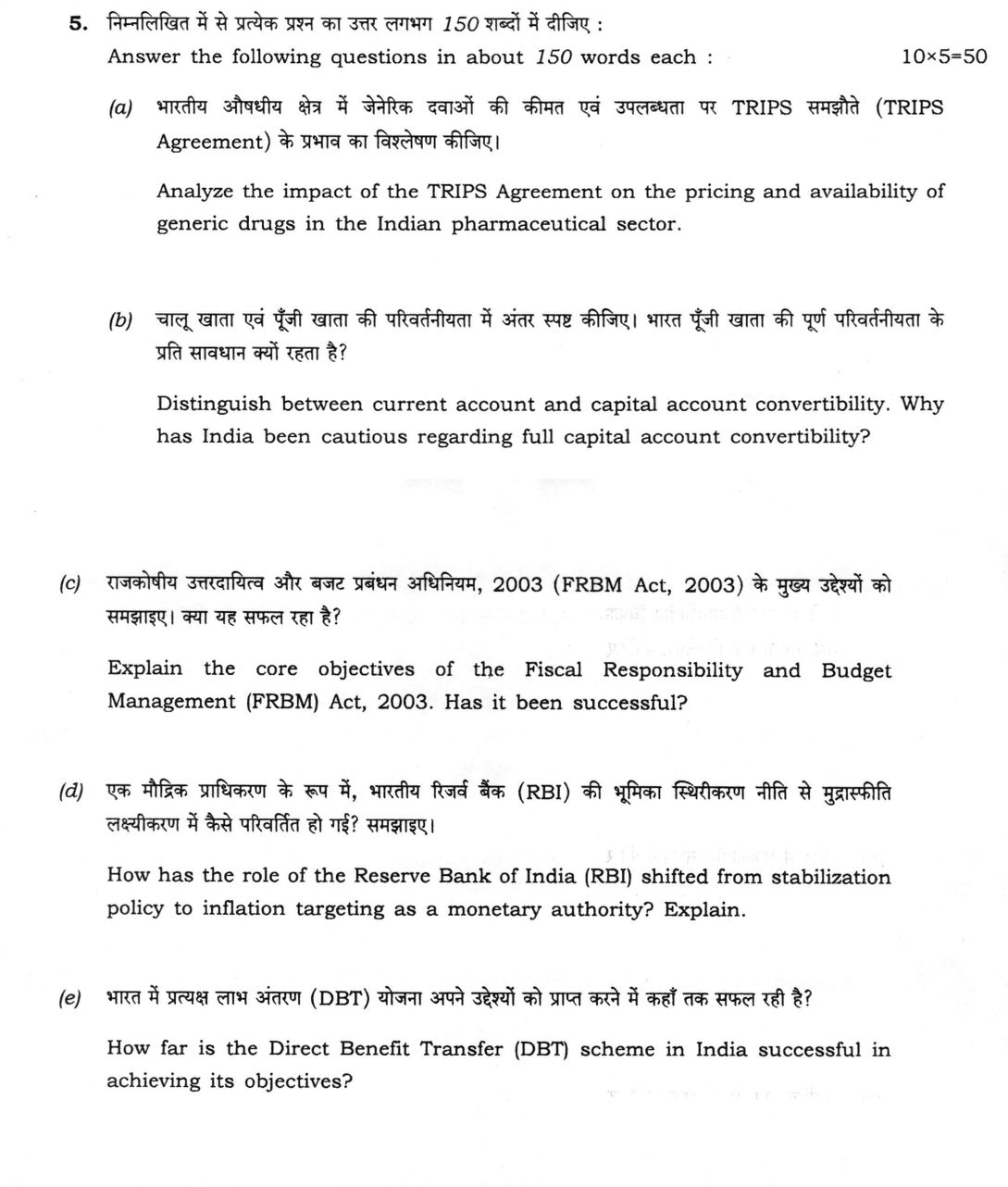
Answer the following questions in about 150 words each :
Analyze the impact of the TRIPS Agreement on the pricing and availability of generic drugs in the Indian pharmaceutical sector. 10 marks
Distinguish between current account and capital account convertibility. Why has India been cautious regarding full capital account convertibility? 10 marks
Explain the core objectives of the Fiscal Responsibility and Budget Management (FRBM) Act, 2003. Has it been successful? 10 marks
How has the role of the Reserve Bank of India (RBI) shifted from stabilization policy to inflation targeting as a monetary authority? Explain. 10 marks
How far is the Direct Benefit Transfer (DBT) scheme in India successful in achieving its objectives? 10 marks
हिंदी में प्रश्न पढ़ें
निम्नलिखित में से प्रत्येक प्रश्न का उत्तर लगभग 150 शब्दों में दीजिए :
भारतीय औषधीय क्षेत्र में जेनेरिक दवाओं की कीमत एवं उपलब्धता पर TRIPS समझौते (TRIPS Agreement) के प्रभाव का विश्लेषण कीजिए। (10 अंक)
चालू खाता एवं पूँजी खाता की परिवर्तनीयता में अंतर स्पष्ट कीजिए। भारत पूँजी खाता की पूर्ण परिवर्तनीयता के प्रति सावधान क्यों रहता है? (10 अंक)
राजकोषीय उत्तरदायित्व और बजट प्रबंधन अधिनियम, 2003 (FRBM Act, 2003) के मुख्य उद्देश्यों को समझाइए। क्या यह सफल रहा है? (10 अंक)
एक मौद्रिक प्राधिकरण के रूप में, भारतीय रिजर्व बैंक (RBI) की भूमिका स्थिरीकरण नीति से मुद्रास्फीति लक्ष्यीकरण में कैसे परिवर्तित हो गई? समझाइए। (10 अंक)
भारत में प्रत्यक्ष लाभ अंतरण (DBT) योजना अपने उद्देश्यों को प्राप्त करने में कहाँ तक सफल रही है? (10 अंक)
Model answer
Drafted with AI by UPSC Answer Check against this question's marking rubric, to the 150-word length. UPSC does not publish answers for Mains — this is one way to score well, not an official key. How we build rubrics and answers.
(a) TRIPS and Generics (10 marks)
The TRIPS Agreement, in force from 1 January 1995, required product patents for pharmaceuticals, which India introduced from 1 January 2005 through the Patents (Amendment) Acts of 1999, 2002 and 2005, ending the process-patent regime of the Patents Act, 1970.
On pricing, product patents gave patent holders exclusive rights over newer molecules, raising their prices. India's use of the flexibilities affirmed by the Doha Declaration (2001) limited this impact. Section 3(d), upheld in Novartis AG v. Union of India (2013), blocks evergreening, and Section 84 allows compulsory licensing, as in Natco Pharma v. Bayer (2012) for sorafenib, which cut its price drastically. The Drugs (Prices Control) Order, 2013, administered by the NPPA, caps prices of essential medicines.
On availability, India remains the largest supplier of generic medicines by volume, the "pharmacy of the developing world". The Bolar exemption (Section 107A(a)) lets generic makers test products before patent expiry. "TRIPS-plus" demands in FTAs, such as data exclusivity, remain a risk, but the present framework balances patent rights with public health.
(b) Convertibility (10 marks)
(i) Distinction: Current account convertibility is the freedom to convert currency for trade in goods and services and for primary and secondary income; India achieved it by accepting IMF Article VIII obligations in August 1994. Capital account convertibility is the freedom to move funds for capital transactions such as FDI, portfolio investment, external commercial borrowings, deposits and property. Under FEMA, 1999, current account transactions are free unless restricted, while capital account transactions are allowed only as specified; residents may remit abroad under the Liberalised Remittance Scheme.
(ii) Reasons for Caution: The "impossible trinity" (Mundell-Fleming trilemma) means a country cannot combine a managed exchange rate, free capital movement and independent monetary policy. The 1991 balance of payments crisis, the 1997-98 East Asian crisis and the 2013 "taper tantrum" showed how sudden stops hit open capital accounts. The Tarapore Committees (1997, 2006) set preconditions: fiscal consolidation, low inflation and a sound financial system with low NPAs. As these are only partly met, India keeps calibrated controls and uses foreign exchange reserves as a buffer.
(c) FRBM (10 marks)
(i) Core Objectives: The FRBM Act, 2003 (Rules, 2004) seeks inter-generational equity, long-term macroeconomic stability and the removal of fiscal impediments to monetary policy. It aimed to eliminate the revenue deficit and cut the fiscal deficit to 3% of GDP by 31 March 2008, barred the RBI from subscribing to primary issues of Central Government securities from 1 April 2006, ending automatic monetisation, and required transparency through the Medium-Term Fiscal Policy and Fiscal Policy Strategy Statements.
(ii) Success Assessment: The record is mixed. The Act ended automatic monetisation and built a norm of fiscal discipline, but its numerical targets were repeatedly missed: they were set aside in 2008-10 after the global financial crisis, and off-budget borrowing circumvented its intent. The N. K. Singh Review Committee (2017) recommended a debt anchor (60% of GDP for general government), adopted in the 2018 amendment. After COVID, the Centre met its glide path of a deficit below 4.5% of GDP in 2025-26 (about 4.4%) and, from 2026-27, has moved to a debt anchor of 50 ± 1% of GDP by 2030-31.
(d) RBI to FIT (10 marks)
The RBI has evolved from a "development central bank" into a monetary authority focused on price stability. Earlier, monetary policy served stabilisation and plan financing, with deficits automatically monetised through ad hoc Treasury Bills. From 1985 the RBI followed monetary targeting (Chakravarty Committee), and from 1998 a "multiple indicator approach" covering money, credit, rates and liquidity.
The move to inflation targeting was driven by the need for predictability and an end to fiscal dominance: ad hoc Treasury Bills ended on 1 April 1997, and the FRBM Act barred primary subscription from 2006. The Urjit Patel Committee (2014) led to the Monetary Policy Framework Agreement (2015) and the Finance Act, 2016, which amended the RBI Act.
A six-member Monetary Policy Committee, with the Governor's casting vote, now targets CPI inflation of 4% within a 2-6% band, a target retained for 2026-31. The regime is "flexible" because price stability is pursued "keeping in mind the objective of growth", and missing the band for three consecutive quarters requires a report to the Government.
(e) DBT (10 marks)
Direct Benefit Transfer (DBT), launched on 1 January 2013, transfers subsidies and benefits directly to beneficiaries' bank accounts to cut leakage and improve transparency. Its success is best summed up as strong as plumbing, partial as welfare.
Successes: Built on the JAM trinity (Jan Dhan, Aadhaar, mobile), DBT has improved speed and de-duplication. PAHAL for LPG subsidies (nationwide from 1 January 2015) removed many ghost and duplicate connections, and PM-KISAN (from 2019) shows how quickly income support can be delivered. Removing intermediaries has produced substantial reported savings.
Shortfalls: "Savings" are not always leakage plugged, since some come from excluding genuine beneficiaries. Biometric authentication failures and weak last-mile banking have caused exclusion errors, and low digital and financial literacy limits use.
Verdict: DBT is a successful administrative reform, not a cure for poverty. It needs robust exception handling, grievance redress and continued investment in JAM so that the plumbing serves the welfare objective.
How this answer will be evaluated
Evaluation rubric
Each sub-part is marked on its own, against the marks and word limit printed on the paper.
- (a) Analyse two specific outcomes of the TRIPS Agreement for the Indian pharmaceutical sector - the pricing of generic drugs and their availability. The answer must connect India's TRIPS-compliant patent regime to what happened to generic prices and supply, not merely describe TRIPS. 10 marks · 150 words
Must cover
- TRIPS in force 1 January 1995; India's product-patent regime from 1 January 2005 (Patents (Amendment) Acts 1999, 2002, 2005)
- Patents Act, 1970 process-patent regime as the pre-TRIPS base
- Section 3(d) and Novartis AG v. Union of India (2013)
- Section 84 compulsory licence; Natco Pharma v. Bayer (2012), sorafenib
- Doha Declaration on the TRIPS Agreement and Public Health (2001)
- Drugs (Prices Control) Order, 2013 / NPPA; India as the largest supplier of generics by volume
Loses marks
- Describing TRIPS in general terms without linking it to generic prices and availability, which is the actual demand.
- Claiming TRIPS made all Indian medicines costly; only post-2005 patented molecules are affected, and the distinction between the patented and the off-patent segment is the key analytical point.
- Omitting Section 3(d) and the compulsory licence provision, which are precisely the mechanisms that limited the price impact.
- Misdating the transition (India's product patent regime began on 1 January 2005, not 1995) or attributing the Novartis judgement to the Natco compulsory licence case.
- Confusing compulsory licensing under Section 84 with price control under the DPCO - they are different instruments with different legal bases.
Earns more
- The pre-TRIPS foundation and the compliance amendments: the Patents Act, 1970, following the Rajagopala Ayyangar Committee report of 1959, abolished product patents for food, drugs and chemicals and allowed only short-term process patents, which enabled Indian firms to reverse-engineer molecules cheaply and made India the 'pharmacy of the developing world'; compliance came through the Patents (Amendment) Acts of 1999 (mailbox and exclusive marketing rights), 2002 (twenty-year term, wider compulsory licensing) and 2005 (product patents for pharmaceuticals from 1 January 2005).
- Impact on availability, with the policy cushions: India remains the largest supplier of generic medicines by volume and a major source of affordable antiretrovirals and vaccines for developing countries; availability of newer patented drugs is managed through compulsory and voluntary licensing (as with the licensing of sofosbuvir to Indian manufacturers) and through domestic price regulation under the Drugs (Prices Control) Order, 2013 administered by the National Pharmaceutical Pricing Authority on the National List of Essential Medicines, alongside the Pradhan Mantri Bhartiya Janaushadhi Pariyojana; the continuing risks are 'TRIPS-plus' demands for data exclusivity and patent linkage in free trade agreements, which India has so far resisted.
Extra mark
- mailbox applications and exclusive marketing rights
- pre-grant and post-grant opposition; Bolar exemption, Section 107A(a)
- Article 31bis
- 'TRIPS-plus' demands - data exclusivity and patent linkage - in FTAs
- National List of Essential Medicines
- (b) Two sub-parts: (i) distinguish current account convertibility from capital account convertibility, defining both precisely; (ii) explain why India has been cautious about moving to full capital account convertibility. Both must be answered within about 150 words. 10 marks · 150 words
Must cover
- current account transactions - goods, services, primary and secondary income
- capital account transactions - FDI, portfolio investment, ECB, deposits, loans, immovable property
- FEMA, 1999 - current account free unless restricted; capital account only as specified
- IMF Article VIII obligations accepted in August 1994
- Tarapore Committees (1997, 2006) and their preconditions
- impossible trinity; sudden-stop episodes (1991, 1997-98, 2013)
Loses marks
- Defining convertibility only as 'freedom to convert currency' without specifying which class of transactions each account covers.
- Stating that India has full capital account convertibility for foreign investors and none for residents; the regime is calibrated on both sides, with equity more open than debt.
- Omitting the Tarapore committees, which are the standard reference for the preconditions and are expected by the examiner.
- Misdating current account convertibility - India accepted IMF Article VIII obligations in 1994, not in 1991 or 1993.
- Giving crisis anecdotes without the analytical reason - the impossible trinity and the sudden-stop risk are what explain the caution.
Earns more
- The official roadmaps and their preconditions: the Committee on Capital Account Convertibility chaired by S. S. Tarapore (1997) proposed a three-year phased move conditional on fiscal consolidation, a low and stable inflation rate, and a strengthened financial system with sharply lower non-performing assets and cash reserve ratio; the Committee on Fuller Capital Account Convertibility, again under Tarapore (2006), proposed a further phased roadmap with monitorable indicators covering the fiscal deficit, the current account deficit, external debt, reserve adequacy and bank capital - and successive governments have judged the preconditions incompletely met.
Extra mark
- LERMS (March 1992); exchange-rate unification (March 1993)
- Liberalised Remittance Scheme
- foreign exchange reserves and macroprudential controls as the alternative buffer
- (c) Two sub-parts: (i) explain the core objectives of the Fiscal Responsibility and Budget Management Act, 2003 as stated in the Act itself; (ii) deliver a reasoned verdict on whether it has succeeded, supported by the record of compliance, suspension and amendment. 10 marks · 150 words
Must cover
- FRBM Act, 2003; FRBM Rules, 2004
- objectives: inter-generational equity, macroeconomic stability, removing fiscal impediments to monetary policy, transparency
- elimination of the revenue deficit and a 3 per cent fiscal deficit target by 31 March 2008
- ban on RBI primary subscription from 1 April 2006 - end of automatic monetisation
- suspension in 2008-10; off-budget borrowing as circumvention
- N. K. Singh Committee (2017) debt anchor; 2018 amendment
- explicit, differentiated verdict on success
Loses marks
- Listing deficit targets as though they were the objectives; the Act's stated objectives are broader and include inter-generational equity, monetary policy effectiveness and transparency.
- Omitting the prohibition on RBI primary subscription, which is the Act's single most durable achievement.
- Answering only 'it failed' or only 'it succeeded'; the question asks whether it has been successful and expects a differentiated verdict.
- Confusing the N. K. Singh Committee with the Fourteenth or Fifteenth Finance Commission, or misdating its report.
- Ignoring off-budget liabilities and the absence of any enforcement mechanism, which are the core reasons the numerical rule failed.
Earns more
- Review and redesign, and the balanced verdict: the FRBM Review Committee chaired by N. K. Singh, which reported in January 2017, recommended that general government debt replace the fiscal deficit as the primary anchor - 60 per cent of GDP for the general government with 40 per cent for the Centre and 20 per cent for the States - together with an operational fiscal deficit target, a narrow escape clause and an independent fiscal council; the Act was amended in 2018 to adopt the debt anchor and a deviation clause. The honest verdict is mixed: the Act succeeded in ending automatic monetisation, in enabling the later shift to inflation targeting, in institutionalising medium-term fiscal statements and in creating a norm against which governments are held publicly accountable, and it prompted parallel State-level fiscal responsibility legislation; but it failed as a binding rule because it contains no sanction for breach, no independent fiscal council was ever created, off-budget liabilities circumvented it, and the targets have been deferred more often than met.
Extra mark
- Medium-Term Fiscal Policy, Fiscal Policy Strategy and Macro-Economic Framework Statements
- the escape clause
- post-COVID glide path (below 4.5 per cent in 2025-26) and the debt anchor of 50 ± 1 per cent of GDP by 2030-31
- State fiscal responsibility laws from 2005
- (d) Explain the evolution of the RBI's role as monetary authority - from a development central bank using monetary policy for stabilisation and plan financing, through monetary targeting and the multiple indicator approach, to statutory flexible inflation targeting - and identify what actually changed institutionally. 10 marks · 150 words
Must cover
- ad hoc Treasury Bills and automatic monetisation, ended 1 April 1997
- Chakravarty Committee, 1985 - monetary targeting
- multiple indicator approach, 1998
- Urjit Patel Committee (2014); Monetary Policy Framework Agreement (2015); Finance Act, 2016
- 4 per cent CPI target with a 2-6 per cent band (retained for 2026-31)
- six-member MPC; Governor's casting vote; flexible targeting with growth in the preamble
Loses marks
- Treating the shift as a single event in 2016 and ignoring the earlier phases - monetary targeting after Chakravarty and the multiple indicator approach after 1998 - which is precisely the evolution asked for.
- Saying the RBI adopted inflation targeting in 2015; the 2015 agreement was administrative and the statutory framework came with the Finance Act, 2016 and the target notification.
- Getting the target wrong - it is 4 per cent CPI (Combined) with a 2 to 6 per cent band, not a 4 to 6 per cent target.
- Misdescribing the MPC's composition or claiming the Governor has a veto; the Governor chairs, votes and has only a casting vote in a tie.
- Claiming the RBI abandoned stabilisation altogether; the framework is explicitly flexible inflation targeting and the growth objective is written into the preamble.
Earns more
- The transition of the 1990s and 2000s: the Narasimham Committee reforms cut the cash reserve and statutory liquidity ratios and deregulated interest rates; the supplemental agreements between the Government and the RBI phased out ad hoc Treasury Bills, ending automatic monetisation from 1 April 1997 and replacing it with Ways and Means Advances, a change locked in by the FRBM Act's bar on RBI subscription to primary issues from 1 April 2006; monetary targeting was abandoned in April 1998 for the multiple indicator approach, and operating procedure shifted to the Liquidity Adjustment Facility introduced in 2000, with the repo rate emerging as the policy rate and the Market Stabilisation Scheme (2004) used for sterilisation.
Extra mark
- financial repression - high CRR/SLR, administered rates, selective credit control
- Liquidity Adjustment Facility (2000); repo rate as the policy rate
- FRBM bar on RBI primary subscription (2006)
- failure defined as three consecutive quarters outside the band
- (e) 'How far' requires a graded verdict: state what DBT was meant to achieve, assess the evidence that it has achieved those objectives, set out where it has fallen short, and conclude with a qualified judgement rather than a yes or no. 10 marks · 150 words
Must cover
- DBT launched 1 January 2013
- JAM trinity - Jan Dhan, Aadhaar, mobile
- PAHAL for LPG, nationwide from 1 January 2015; PM-KISAN (February 2019)
- de-duplication and reported savings
- exclusion errors from biometric and Aadhaar-seeding failure and last-mile banking
- savings are not the same as leakage plugged; graded verdict
Loses marks
- Listing DBT schemes without assessing performance against the stated objectives, which is what 'how far successful' requires.
- Accepting the Government's savings figures uncritically; the examiner expects awareness that deletion of beneficiaries is not identical to leakage eliminated.
- Ignoring exclusion errors entirely, or conversely condemning DBT wholesale and ignoring the documented gains in LPG and in payment timeliness.
- Confusing DBT with financial inclusion or with Aadhaar itself; JAM is the enabling architecture, not the programme.
- Misdating the launch (1 January 2013) or attributing PAHAL's nationwide rollout to 2013 rather than January 2015.
Earns more
- Scale and coverage: DBT now spans several hundred central schemes across dozens of ministries besides State schemes, and the flagship applications are PAHAL for LPG subsidy, relaunched nationwide on 1 January 2015 and among the largest cash transfer programmes in the world by number of beneficiaries, PM-KISAN income support of Rs 6,000 a year in three instalments since February 2019, MGNREGS wage payments, National Social Assistance Programme pensions and scholarships; cumulative transfers and reported savings run into lakhs of crores of rupees on the Government's own accounting.
- The qualified verdict: DBT has been largely successful as delivery plumbing - targeting, deduplication, timeliness and fiscal saving - and only partially successful as welfare policy, because the design transfers the burden of proving identity to the poorest claimant; making success complete requires grievance redress with statutory timelines, exception-handling that does not rely on biometrics alone, universal rather than exclusionary verification, and strengthened last-mile banking.
Extra mark
- Aadhaar Payment Bridge; NPCI mapper; PFMS
- 'Give It Up' campaign
- the contested proposal to replace the PDS with cash transfers
What "Analyse" is asking you to do
Break the subject into its working parts and show how they act on each other. The marks are in the interconnections — which factor drives which, and what the resulting structure explains — not in the inventory of factors.
Structure that answers it
Define the whole → separate it into its parts → show which part drives which → what that interaction produces → what the structure implies
Where marks are lost
A flat list of causes with no account of which drives which. An answer of neatly separated headings, each self-contained, scores as description.
Practice this exact question
Write your answer and it is marked point by point against the model answer above — what you covered, what you missed, what you got wrong.
Evaluate my answer →More from Economics 2026 Paper II
- Q2 (a) Evaluate the success of land reforms in post-Independent India. Why was the success l…
- Q3 (a) Trace the trajectory of India’s industrial policy from the Nehruvian model of ‘Mahala…
- Q4 (a) Trace the evolution of the debate between the public and private sectors in India's i…
- Q5 Answer the following questions in about 150 words each : (a) Analyze the impact of the TR…
- Q6 (a) Critically examine the impact of the New Economic Policy on the Indian corporate sect…
- Q7 (a) “Economic development without employment generation is meaningless.” Give your views.…
- Q8 (a) Explain the Intellectual Property Rights (IPR) regime under the WTO. Discuss the spec…