Paper II — Q2
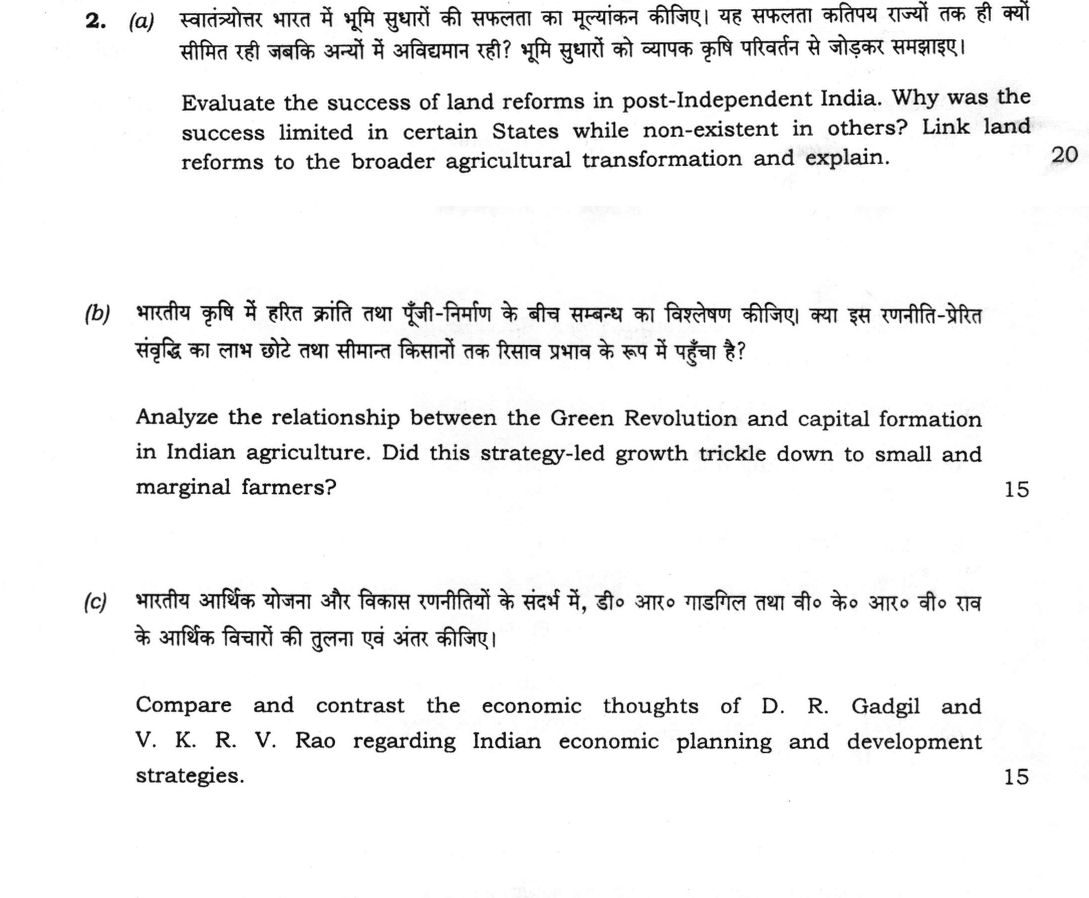
(a) Evaluate the success of land reforms in post-Independent India. Why was the success limited in certain States while…
Evaluate the success of land reforms in post-Independent India. Why was the success limited in certain States while non-existent in others? Link land reforms to the broader agricultural transformation and explain. 20 marks
Analyze the relationship between the Green Revolution and capital formation in Indian agriculture. Did this strategy-led growth trickle down to small and marginal farmers? 15 marks
Compare and contrast the economic thoughts of D. R. Gadgil and V. K. R. V. Rao regarding Indian economic planning and development strategies. 15 marks
हिंदी में प्रश्न पढ़ें
स्वातंत्र्योत्तर भारत में भूमि सुधारों की सफलता का मूल्यांकन कीजिए। यह सफलता कतिपय राज्यों तक ही क्यों सीमित रही जबकि अन्यों में अविद्यमान रही? भूमि सुधारों को व्यापक कृषि परिवर्तन से जोड़कर समझाइए। (20 अंक)
भारतीय कृषि में हरित क्रांति तथा पूँजी-निर्माण के बीच सम्बन्ध का विश्लेषण कीजिए। क्या इस रणनीति-प्रेरित संवृद्धि का लाभ छोटे तथा सीमांत किसानों तक रिसाव प्रभाव के रूप में पहुँचा है? (15 अंक)
भारतीय आर्थिक योजना और विकास रणनीतियों के संदर्भ में, डी० आर० गाडगिल तथा वी० के० आर० वी० राव के आर्थिक विचारों की तुलना एवं अंतर कीजिए। (15 अंक)
Model answer
Drafted with AI by UPSC Answer Check against this question's marking rubric, to the expected length. UPSC does not publish answers for Mains — this is one way to score well, not an official key. How we build rubrics and answers.
(a) Land reforms: success, variation and transformation (20 marks)
Post-Independent land reforms delivered a partial and uneven success: the abolition of intermediaries was largely achieved, while tenancy reform, ceilings and consolidation stayed incomplete. Abolition of intermediaries was the clearest gain; statutes such as the Madras Estates Abolition Act 1948 and the UP Zamindari Abolition and Land Reforms Act 1950 dismantled the intermediary layer, shielded from litigation by the First Amendment (1951), Articles 31A-31B and the Ninth Schedule. Tenancy reform was mixed: the Kerala Land Reforms Act 1963 (amended 1969, in force from 1 January 1970) and Operation Barga in West Bengal from 1978 gave security to tenants, yet tenancy remained largely oral and concealed. Ceilings on holdings were a near-failure, redistributing only about 2 per cent of total area, and consolidation remained incomplete.
Because land is a State subject (Entry 18 of the State List), reform depended on State legislatures and a local bureaucracy. In Bihar and eastern Uttar Pradesh the dominant landowning castes captured both, and the "personal cultivation" resumption loophole let them retain land, so the most unequal structures reformed least. In Kerala and West Bengal, by contrast, strong political mobilisation of the peasantry forced genuine implementation.
This connects directly to the wider agricultural transformation. Secure ownership created the incentive and the collateral for private capital formation—tubewells and pumpsets—which, together with institutional credit after the bank nationalisation of 1969, underwrote the Green Revolution in the north-west. Amit Bhaduri's semi-feudalism thesis (1973) holds that unreformed tenurial relations in the east were precisely why it stagnated there. The unfinished agenda—86 per cent of holdings small or marginal, averaging 1.08 hectares (Agriculture Census 2015-16)—is now addressed through the Model Agricultural Land Leasing Act 2016, DILRMP and SVAMITVA, which legalise leasing and modernise records.
(b) Green Revolution and capital formation (15 marks)
The Green Revolution was, at its core, a process of capital formation in Indian agriculture, and its strategy-led growth trickled down to small and marginal farmers only partially and conditionally. The sequencing of investment was decisive. Public investment came first—irrigation, rural electrification and State agricultural universities—laying the groundwork and "crowding in" private investment, as farmers responded by purchasing tubewells, pumpsets and tractors. This was financed by a credit architecture built around the bank nationalisation of 1969, priority-sector lending, the Regional Rural Banks from 1975 and NABARD from 1982. After the mid-1980s the relationship inverted: public gross capital formation in agriculture declined, and the state shifted to a subsidy-investment trade-off, subsidising inputs rather than infrastructure; agricultural gross capital formation has since recovered to about 20% of agricultural GVA (2022-23).
Whether this reached the small farmer is genuinely contested. On one side the technology was scale-neutral: small farmers could adopt high-yielding varieties, and an inverse farm-size-productivity relationship, documented by G. S. Bhalla and G. K. Chadha, meant small Punjab farms were often more productive per hectare. On the other side the technology was not resource-neutral, as C. H. Hanumantha Rao stressed: unequal access to credit, power and extension gave larger farmers first-mover gains, while small and marginal farmers faced credit rationing, higher unit costs and greater risk-bearing. As cultivation turned profitable, landlords resumed land for "personal cultivation" and evicted tenants, and eastern, rainfed India was excluded altogether. In Francine Frankel's phrase, the Revolution delivered "economic gains and political costs"; the trickle-down was real but partial and regionally bounded, and it sowed the seeds of later agrarian distress.
(c) Gadgil and V. K. R. V. Rao (15 marks)
D. R. Gadgil and V. K. R. V. Rao shared a commitment to planning, the mixed economy and a strong state, but differed as institutional pragmatist and aggregate theorist. They converged in origin and in fundamentals: both were colleagues on the National Income Committee (1949), and both accepted that planning and a strong public sector were indispensable to development; their disagreement was over method and emphasis rather than over the basic framework.
Gadgil (The Industrial Evolution of India in Recent Times, 1924), associated with the Gokhale Institute of Politics and Economics and serving as Deputy Chairman of the Planning Commission (1967-71), was an institutionalist and a field economist concerned with the "how" of development. He championed area planning, the cooperative sector and the integration of the informal economy. His signature contribution was the Gadgil Formula (1969) for distributing central plan assistance among States, weighting population and backwardness to reduce inter-State inequality.
Rao, who worked at the Delhi School of Economics, the Institute of Economic Growth and the Institute for Social and Economic Change, was a theorist of aggregates concerned with the "why" and the "what" of planning. His decisive contribution was a critique of the Keynesian multiplier in the Indian context: because the supply of wage-goods is inelastic, unemployment is disguised and a large non-monetised sector persists, an increase in investment does not automatically raise income and employment in proportion.
Thus Gadgil supplied the institutional and allocative instruments of development, while Rao supplied the theoretical corrections that exposed the limits of those instruments; their perspectives are complementary rather than opposed, and both remain relevant to current questions such as food inflation and the devolved local governance of the 73rd and 74th Amendments.
How this answer will be evaluated
Evaluation rubric
Each sub-part is marked on its own, against the marks and word limit printed on the paper.
- (a) Three linked tasks: (i) evaluate the overall success of post-Independence land reforms component by component; (ii) explain the inter-State variation - why success was limited in some States and absent in others; (iii) connect land reforms to the wider transformation of Indian agriculture. All three must be addressed in about 300 words. 20 marks
Must cover
- the four components: intermediary abolition, tenancy reform, ceilings on holdings, consolidation and land records
- Madras Estates Abolition Act 1948; UP Zamindari Abolition and Land Reforms Act 1950
- Kerala Land Reforms Act 1963 and the 1969 amendment (in force 1 January 1970); Operation Barga, West Bengal, from 1978
- land as a State subject - Entry 18 of the State List
- resumption for 'personal cultivation' and benami transfers as the principal loopholes
- link to private capital formation, institutional credit and the Green Revolution; Amit Bhaduri's semi-feudalism (1973)
- unfinished agenda: about 86 per cent small and marginal holdings (average about 1.08 ha); Model Agricultural Land Leasing Act, 2016
Loses marks
- Treating land reform as one undifferentiated programme and returning a single verdict instead of evaluating each of the four components separately.
- Answering the 'why some States and not others' part with a list of States rather than a political-economy explanation of mobilisation, class base and legislative capture.
- Ignoring the third directive altogether - not linking land reform to capital formation, credit, the Green Revolution or the mode-of-production debate.
- Attributing Operation Barga to Kerala or the 1969 tenancy abolition to West Bengal, or dating Kerala's reform to 1957 as an enacted law rather than a Bill.
- Quoting ceiling-surplus distribution figures as large successes, or claiming tenancy has disappeared because recorded leasing is low - the concealed-tenancy caveat is expected.
- Writing only about the constitutional litigation and spending the whole answer on Articles 31A/31B.
Earns more
- Explains the failures: land is a State subject (Entry 18 of the State List), so implementation depended on State legislatures captured by dominant landowning castes and a local bureaucracy drawn from them; statutes built in loopholes for resumption for 'personal cultivation', benami and intra-family transfers and 'voluntary surrender'; land records were absent, outdated or silent on oral tenancy; litigation delayed implementation despite Ninth Schedule protection; tenants and landless labourers were unorganised; and the result was that Bihar and eastern Uttar Pradesh, with the most unequal structures, reformed least.
- Links land reform to agricultural transformation: secure ownership created the incentive and the collateral for private capital formation - tubewells, pumpsets, tractors - complemented by public investment and by institutional credit after bank nationalisation in 1969, the Regional Rural Banks from 1975 and NABARD in 1982, which together underwrote the Green Revolution; the mode-of-production debate (Amit Bhaduri's semi-feudalism thesis of 1973, Ashok Rudra, Utsa Patnaik, Daniel Thorner, Wolf Ladejinsky) argued that unreformed tenurial relations were precisely why eastern India stagnated while the reformed or ryotwari north-west grew; the contrast with Japan, South Korea and Taiwan, where thorough land reform preceded rapid agricultural growth, reinforces the point.
- The unfinished agenda and forward link: fragmentation has reduced the average operational holding to about 1.08 hectares with roughly 86 per cent of holdings small or marginal (Agriculture Census 2015-16); current instruments are NITI Aayog's Model Agricultural Land Leasing Act, 2016 (drafted by the expert committee chaired by T. Haque) to legalise and record leasing, the Digital India Land Records Modernisation Programme and the SVAMITVA scheme for titling, alongside the recommendations of the 2009 Committee on State Agrarian Relations and the Unfinished Task in Land Reforms.
Extra mark
- West Bengal Estates Acquisition Act 1953; J&K Big Landed Estates Abolition Act, 1950
- Constitution (First Amendment) Act 1951 - Articles 31A, 31B and the Ninth Schedule
- Daniel Thorner; Wolf Ladejinsky; P. S. Appu
- bank nationalisation 1969; RRBs from 1975; NABARD 1982
- DILRMP; SVAMITVA; T. Haque committee
- (b) Two tasks: (i) analyse the relationship between the Green Revolution and capital formation in Indian agriculture, distinguishing public from private investment and their sequencing; (ii) answer directly whether this strategy-led growth trickled down to small and marginal farmers, arguing both sides before concluding. 15 marks
Must cover
- gross capital formation in agriculture; private tubewells, pumpsets, tractors as the induced investment
- public investment in irrigation, rural electrification, ICAR and State agricultural universities
- crowding-in followed by the post-mid-1980s decline in public investment; the subsidy-investment trade-off
- bank nationalisation 1969; RRBs (1975); NABARD (1982)
- scale-neutral but not resource-neutral (C. H. Hanumantha Rao)
- inverse farm-size-productivity relationship (G. S. Bhalla and G. K. Chadha)
- explicit verdict: partial and conditional trickle-down
Loses marks
- Writing a general account of the Green Revolution and never analysing capital formation - the question is specifically about investment, its public-private composition and its sequencing.
- Failing to distinguish public from private capital formation, or missing the post-mid-1980s decline in public investment and the subsidy trade-off.
- Answering the trickle-down question one-sidedly; the examiner expects both the scale-neutrality evidence and the resource-neutrality critique before a verdict.
- Confusing scale-neutrality with resource-neutrality, or asserting that small farmers could not adopt HYVs at all.
- Getting institutional dates wrong - dating NABARD to 1975 or the RRBs to 1982, or crediting NABARD's creation to the Narasimham Committee.
Earns more
- The credit architecture that financed it: social control and the nationalisation of major banks in 1969, the Lead Bank Scheme of 1969, priority-sector lending with an 18 per cent sub-target for agriculture, the All India Rural Credit Review Committee of 1969 under B. Venkatappiah, Regional Rural Banks from 2 October 1975 under the Regional Rural Banks Act, 1976, NABARD established on 12 July 1982 on the recommendation of the CRAFICARD (Sivaraman) Committee, and the Kisan Credit Card from 1998-99.
- Trickle-down - the negative case and the verdict: the technology was scale-neutral but not resource-neutral, as C. H. Hanumantha Rao emphasised, so unequal access to credit, power connections, tubewells and extension gave larger farmers first-mover gains; small and marginal farmers faced credit rationing and dependence on informal lenders, higher unit costs, greater risk-bearing and weaker marketing power; landlords resumed land for 'personal cultivation' and evicted tenants as cultivation became profitable; eastern and rainfed India was excluded altogether; and inequality, indebtedness and later agrarian distress in Punjab - the 'economic gains and political costs' identified by Francine Frankel - qualify any claim of trickle-down to a partial and regionally conditional one.
Extra mark
- Lead Bank Scheme 1969; 18 per cent agriculture sub-target in priority-sector lending; All India Rural Credit Review Committee 1969 (B. Venkatappiah); CRAFICARD (Sivaraman) Committee
- Ashok Gulati and S. Mahendra Dev on the subsidy-investment trade-off
- custom hiring and groundwater markets
- Francine Frankel, India's Green Revolution: Economic Gains and Political Costs
- (c) 'Compare and contrast' requires both similarities and differences: set out the economic thought of D. R. Gadgil and of V. K. R. V. Rao on Indian economic planning and on development strategy, show where they converged, and then sharpen where they diverged. A one-sided biography of either economist does not answer the question. 15 marks
Must cover
- D. R. Gadgil - Gokhale Institute; Deputy Chairman, Planning Commission, 1967-71
- Gadgil Formula, 1969, for Central plan assistance to States
- Gadgil on cooperatives and decentralised / area planning
- V. K. R. V. Rao - Delhi School of Economics, Institute of Economic Growth, Institute for Social and Economic Change
- Rao's critique of the Keynesian multiplier in an underdeveloped economy: disguised unemployment, inelastic wage-goods supply, non-monetised sector
- shared ground: both on the National Income Committee (1949), both backing planning and the mixed economy
Loses marks
- Writing two separate biographies with no explicit comparison or contrast - the question demands both.
- Attributing the wage-goods model of development to V. K. R. V. Rao; that is the Vakil-Brahmananda model, though Rao's multiplier critique points in a similar direction.
- Crediting the Gadgil Formula to the Finance Commission, or confusing the original 1969 formula with its later modifications.
- Omitting Rao's multiplier critique, which is his single most examinable contribution.
- Assuming the two were opposed on planning itself; both supported planning and the mixed economy, and saying otherwise is a factual error.
Earns more
- The contrasts sharpened: in method, Gadgil worked from field-based, institutional and historical evidence while Rao worked from macroeconomic aggregates and theory; in the unit of analysis, Gadgil's was the region, district and cooperative while Rao's was the national economy; in the principal instrument, Gadgil relied on institutional reform (cooperatives, land reform, decentralised planning, a transparent formula for Centre-State resource transfer) while Rao relied on macro-policy levers (savings mobilisation, wage-goods supply, price stability, education); and on the central plan, Gadgil pressed for federal devolution and the States' share, whereas Rao's concern was with the aggregate consistency and financeability of the plan.
- Assessment and contemporary relevance: Rao's wage-goods and inelastic-supply argument anticipates present debates on food inflation and supply-side constraints on stimulus, while Gadgil's formula survives in modified form in the logic of formula-based Centre-State transfers and his decentralisation argument is embodied in the 73rd and 74th Amendments and in district planning; their disagreement is one of emphasis within a shared planning framework rather than a conflict of paradigms.
Extra mark
- The Industrial Evolution of India in Recent Times (1924)
- The National Income of British India, 1931-32 (1940)
- Fourth Five Year Plan (1969-74) as the first plan under the Gadgil Formula
What "Evaluate" is asking you to do
Judge how well something has performed against the standard it set for itself — its stated aim, mandate or promise — and commit to a verdict. Name the yardstick before you judge; an unanchored judgement reads as opinion.
Structure that answers it
Name the yardstick — stated aim, mandate or benchmark → performance against it → shortfall against it → why the gap exists → verdict
Where marks are lost
Presenting both sides and then declining to decide, or delivering a verdict against a standard you never stated, which makes it look arbitrary.
Practice this exact question
Write your answer and it is marked point by point against the model answer above — what you covered, what you missed, what you got wrong.
Evaluate my answer →More from Economics 2026 Paper II
- Q1 Answer the following questions in about 150 words each : (a) Critically examine the ‘drai…
- Q2 (a) Evaluate the success of land reforms in post-Independent India. Why was the success l…
- Q3 (a) Trace the trajectory of India’s industrial policy from the Nehruvian model of ‘Mahala…
- Q4 (a) Trace the evolution of the debate between the public and private sectors in India's i…
- Q5 Answer the following questions in about 150 words each : (a) Analyze the impact of the TR…