Paper I — Q1
(a) In Figure 1(a) shown below, the two-port network is characterized in terms of y-parameters with y₁₁ = 3·3 × 10⁻³ S, y₂₂ = 5 ×…
In Figure 1(a) shown below, the two-port network is characterized in terms of y-parameters with y₁₁ = 3·3 × 10⁻³ S, y₂₂ = 5 × 10⁻³ S and y₁₂ = y₂₁ = 0. Find the voltage across 200 Ω load. 10 marks
For the signal shown in Figure 1(b), calculate the total energy of the signal X(t). Also sketch y(t) = X(10t – 5). 10 marks
A 220 V dc shunt motor has armature resistance Rₐ = 0·13 Ω, field resistance Rf = 250 Ω and rotational loss 230 W. On full-load, the line current is 9·5 A with the motor running at 1440 rpm. Determine the following: The mechanical power developed
The power output
The load torque
The full-load efficiency 10 marks
For the transistor circuit shown in Figure 1(d), determine the value of reverse saturation current, I_S, that would give a collector current of 1 mA, if β = 80, V_A = ∞ and V_T = 26 mV at T = 300 K. 10 marks
Consider the four variables logic function defined as follows: F (A, B, C, D) = ĀC + ĀD + B̄C + B̄D + ABC̄ D̄ Assuming input variables as A, B, C and D, propose a logic circuit using only three logic gates to implement the function. 10 marks
हिंदी में प्रश्न पढ़ें
चित्र 1(a) में प्रदर्शित द्वि-प्रद्वार जालक्रम के, y-प्राचलों y₁₁ = 3·3 × 10⁻³ S, y₂₂ = 5 × 10⁻³ S तथा y₁₂ = y₂₁ = 0 के रूप में लक्षण बताए गए हैं । 200 Ω भार के आर-पार वोल्टता का मान ज्ञात कीजिए । (10 अंक)
चित्र 1(b) में प्रदर्शित संकेत के लिए, संकेत X(t) की संपूर्ण ऊर्जा की गणना कीजिए । y(t) = X(10t – 5) का आरेखण भी कीजिए । (10 अंक)
एक 220 V dc समानान्तर क्रम मोटर का, आर्मेचर प्रतिरोध Rₐ = 0·13 Ω, क्षेत्र प्रतिरोध Rf = 250 Ω तथा घूर्णन हान 230 W है । मोटर के 1440 rpm पर पूर्ण भार पर चलते समय लाइन धारा का मान 9·5 A है । निम्नलिखित का मान ज्ञात कीजिए : विकसित (उत्पन्न) यांत्रिक शक्ति
निर्गत शक्ति
भार (लोड) बल-आघूर्ण
पूर्ण भार दक्षता (10 अंक)
चित्र 1(d) में प्रदर्शित ट्रांजिस्टर परिपथ के लिए, व्युत्क्रम संतृप्त धारा I_S का वह मान ज्ञात कीजिए जो संग्राहक धारा का मान 1 mA कर दे, यदि T = 300 K पर β = 80, V_A = ∞ तथा V_T = 26 mV हो । (10 अंक)
निम्नानुसार परिभाषित चतुर्वर तार्किक फलन पर विचार कीजिए : F (A, B, C, D) = ĀC + ĀD + B̄C + B̄D + ABC̄ D̄ A, B, C और D को निवेश चर मानकर केवल तीन तार्किक द्वारों का प्रयोग करते हुए इस फलन के कार्यान्वयन के लिए तार्किक परिपथ प्रस्तावित कीजिए । (10 अंक)
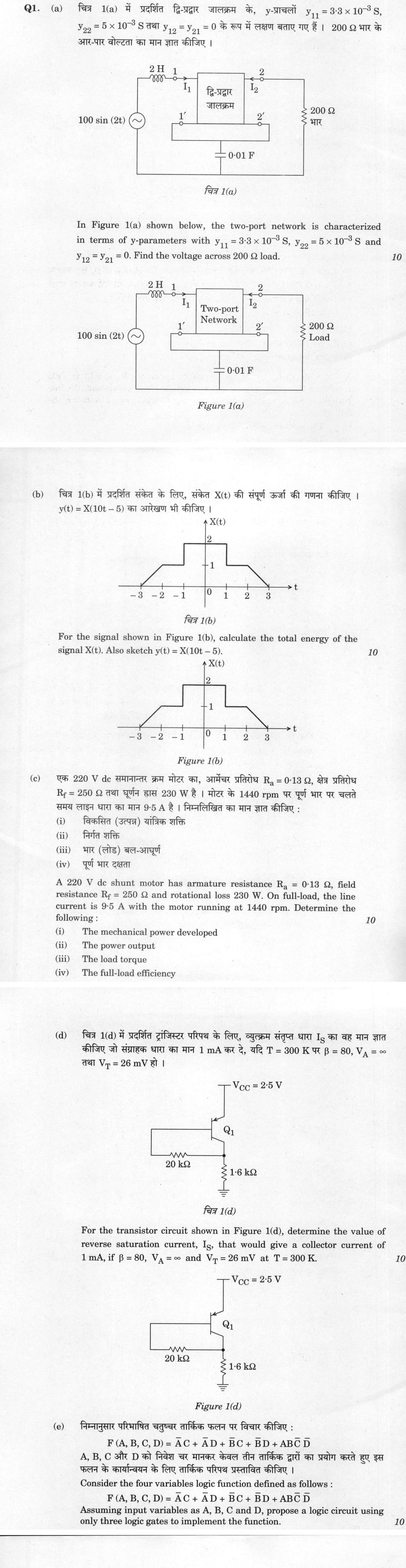
The figure this question refers to, in words
The question paper is a scan and the diagram did not survive as text. This is the figure as read from the original page — every component, value and label — so the question can be worked from the text below.
(a) A two-port network circuit. An AC voltage source labelled 100 sin (2t) is connected in series with a 2 H inductor. The inductor connects to terminal 1 (top left) of a rectangular 'Two-port Network' block. Terminal 1' (bottom left) of the block connects to the return path of the source. A 200 ohm Load resistor is connected between terminal 2 (top right) and terminal 2' (bottom right) of the two-port network. A 0.01 F capacitor is connected across the bottom terminals 1' and 2'. Current I1 enters terminal 1 and current I2 enters terminal 2. The voltage across the 200 ohm load is to be found.
(b) A graph of X(t) versus t. The horizontal axis is labelled t with tick marks at -3, -2, -1, 0, 1, 2, 3. The vertical axis is labelled X(t) with tick marks at 1 and 2. The waveform is a symmetric trapezoid: it is zero for t < -3, rises linearly from 0 at t = -3 to 2 at t = -2, stays constant at 2 from t = -2 to t = -1, drops linearly from 2 at t = -1 to 1 at t = 0, rises linearly from 1 at t = 0 to 2 at t = 1, stays constant at 2 from t = 1 to t = 2, falls linearly from 2 at t = 2 to 0 at t = 3, and is zero for t > 3.
(d) A bipolar junction transistor circuit. A DC supply Vcc = 2.5 V connects to the collector of an NPN transistor Q1. The base of Q1 connects to one end of a 20 kOhm resistor; the other end of this resistor connects to the collector node. The emitter of Q1 connects to one end of a 1.6 kOhm resistor; the other end of this resistor connects to ground. The quantity asked for is the reverse saturation current IS.
Model answer
Written by UPSC Answer Check against this question's marking rubric, to the expected length. UPSC does not publish answers for Mains — this is one way to score well, not an official key.
(a) Using the y-parameter port equations: I₁ = y₁₁V₁ + y₁₂V₂ I₂ = y₂₁V₁ + y₂₂V₂ Given y₁₂ = y₂₁ = 0, the two ports are decoupled: I₁ = 3.3×10⁻³ V₁ I₂ = 5×10⁻³ V₂
For the 200 Ω load at port 2, with I₂ entering the two-port, the load equation is: I₂ = −V₂/200
Substitute I₂ = 5×10⁻³ V₂: 5×10⁻³ V₂ = −V₂/200 5×10⁻³ V₂ + 5×10⁻³ V₂ = 0 10×10⁻³ V₂ = 0 V₂ = 0 V
The capacitor between the lower terminals does not create a transfer because y₁₂ = y₂₁ = 0; the input loop current returns through port 1 and no common-mode signal reaches port 2. Final answer: V_load = 0 V.
(b) The total energy is: E = ∫₋∞^∞ X²(t) dt
Break the integral into the six intervals of the waveform: E = ∫₋₃^−2 [2(t+3)]² dt + ∫₋₂^−1 2² dt + ∫₋₁^0 (1−t)² dt + ∫₀^1 (1+t)² dt + ∫₁^2 2² dt + ∫₂^3 [2(3−t)]² dt
Evaluate:
- ∫₋₃^−2 4(t+3)² dt = 4/3
- ∫₋₂^−1 4 dt = 4
- ∫₋₁^0 (1−t)² dt = 7/3
- ∫₀^1 (1+t)² dt = 7/3
- ∫₁^2 4 dt = 4
- ∫₂^3 4(3−t)² dt = 4/3
Therefore: E = 4/3 + 4 + 7/3 + 7/3 + 4 + 4/3 = 46/3
Final answer: E = 46/3 units²·s (if X is in volts, V²·s; if in amperes, A²·s).
For y(t) = X(10t − 5), let τ = 10t − 5. The nonzero interval is −3 ≤ τ ≤ 3, so: −3 ≤ 10t − 5 ≤ 3 2 ≤ 10t ≤ 8 0.2 ≤ t ≤ 0.8
The piecewise sketch is:
- 0.2 ≤ t ≤ 0.3: y = 20t − 4
- 0.3 ≤ t ≤ 0.4: y = 2
- 0.4 ≤ t ≤ 0.5: y = 6 − 10t
- 0.5 ≤ t ≤ 0.6: y = 10t − 4
- 0.6 ≤ t ≤ 0.7: y = 2
- 0.7 ≤ t ≤ 0.8: y = 16 − 20t
- Outside [0.2, 0.8]: y = 0
At t = 0.2 and 0.8, y = 0; at t = 0.3, 0.4, 0.6, 0.7, y = 2; at t = 0.5, y = 1.
(c) Using DC shunt-motor power balance:
Field current: I_f = V/R_f = 220/250 = 0.88 A
Armature current: I_a = I_L − I_f = 9.5 − 0.88 = 8.62 A
Input power: P_in = V I_L = 220 × 9.5 = 2090 W
Field copper loss: P_f = V I_f = 220 × 0.88 = 193.6 W
Armature copper loss: P_cu = I_a²R_a = (8.62)² × 0.13 = 9.659572 W
(i) Mechanical power developed: P_dev = P_in − P_f − P_cu P_dev = 2090 − 193.6 − 9.659572 = 1886.740428 W P_dev ≈ 1886.74 W
(ii) Power output: P_out = P_dev − rotational loss P_out = 1886.740428 − 230 = 1656.740428 W P_out ≈ 1656.74 W
(iii) Load torque: ω = 2πN/60 = 2π × 1440/60 = 48π rad/s T = P_out/ω = 1656.740428/(48π) T ≈ 10.9866 N·m T ≈ 10.99 N·m
(iv) Full-load efficiency: η = P_out/P_in = 1656.740428/2090 = 0.792698 η ≈ 79.27% η ≈ 79.27%
(d) For the BJT in active region, use: I_C = I_S exp(V_BE/V_T)
Given: I_C = 1 mA = 1×10⁻³ A β = 80 I_B = I_C/β = 1×10⁻³/80 = 12.5×10⁻⁶ A = 12.5 μA I_E = I_C + I_B = 1×10⁻³ + 12.5×10⁻⁶ = 1.0125×10⁻³ A
The emitter voltage is: V_E = I_E × 1.6 kΩ = 1.0125×10⁻³ × 1600 = 1.62 V
The collector is at V_CC = 2.5 V, so the base voltage is: V_B = V_C − I_B × 20 kΩ = 2.5 − 12.5×10⁻⁶ × 20000 V_B = 2.5 − 0.25 = 2.25 V
Thus: V_BE = V_B − V_E = 2.25 − 1.62 = 0.63 V
Now: I_S = I_C exp(−V_BE/V_T) I_S = 1×10⁻³ exp(−0.63/0.026) 0.63/0.026 = 24.230769 exp(24.230769) ≈ 3.34×10¹⁰
Therefore: I_S ≈ 1×10⁻³/(3.34×10¹⁰) ≈ 2.99×10⁻¹⁴ A
Final answer: I_S ≈ 3.0×10⁻¹⁴ A.
(e) Simplify the Boolean function using Boolean algebra.
F = ¬A C + ¬A D + ¬B C + ¬B D + A B ¬C ¬D F = ¬A(C + D) + ¬B(C + D) + A B ¬C ¬D F = (¬A + ¬B)(C + D) + A B ¬(C + D) F = ¬(AB)(C + D) + AB ¬(C + D)
This is the XOR form: F = AB ⊕ (C + D)
So the three-gate implementation is:
- Gate 1: AND gate with inputs A and B, output X = AB.
- Gate 2: OR gate with inputs C and D, output S = C + D.
- Gate 3: XOR gate with inputs X and S, output F = X ⊕ S.
Final answer: F = (A·B) ⊕ (C + D), using one AND gate, one OR gate and one XOR gate only.
What "Solve" is asking you to do
Choose the method, then carry it through to a final answer. Identifying what kind of problem this is and why that method applies is the first thing marked; a correct figure arrived at invisibly earns almost nothing.
Structure that answers it
Given data and what is required → method chosen, with the reason it applies → set-up (equation, circuit, free body, trial balance) → working, step by step → answer with units and any condition of validity
Where marks are lost
Doing the middle steps mentally and writing only the result. In mathematics papers, a further loss comes from giving a decimal where the exact value in surds or fractions was wanted, or from skipping the justification a part explicitly asks for.
How this answer will be evaluated
Approach
(a) calculate: given > formula > substitution > result with units > interpretation | (b) calculate: given > formula > substitution > result with units > interpretation | (c) calculate: given > formula > substitution > result with units > interpretation | (d) calculate: given > formula > substitution > result with units > interpretation | (e) justify: claim > 3-4 reasons > evidence > conclusion Full marks: Correct method, clear steps, and accurate final values for all parts.
Key points expected
- Convert source and 2H inductor to phasor domain (ω=2).
- Apply y-parameter equations I1=y11V1, I2=y22V2.
- Formulate KVL for input and output loops.
- Solve for V2 and state final voltage with units.
- Calculate energy E = ∫|X(t)|²dt over the signal duration.
- Identify time scaling (1/10) and shift (1/2) for y(t).
- Sketch y(t) with correct amplitude and time axis.
- Label key points on the sketch (0.2, 0.5, 0.8).
Evaluation rubric
Each sub-part is marked on its own, against the marks and word limit printed on the paper.
- (a) Voltage across the 200 Ω load using y-parameter equations. 10 marks
calculate— given → formula → substitution → result with units → interpretation
Must cover
- Convert source and 2H inductor to phasor domain (ω=2).
- Apply y-parameter equations I1=y11V1, I2=y22V2.
- Formulate KVL for input and output loops.
- Solve for V2 and state final voltage with units.
Loses marks
- Using time-domain values in phasor equations.
- Ignoring the 2H inductor in the input loop.
Earns more
- Correctly identifies y12=y21=0 as decoupled ports.
- Calculates inductive impedance j4Ω explicitly.
Extra mark
- Draws the equivalent circuit with phasor values.
- (b) Total energy of X(t) and sketch of y(t)=X(10t-5). 10 marks
calculate— given → formula → substitution → result with units → interpretation
Must cover
- Calculate energy E = ∫|X(t)|²dt over the signal duration.
- Identify time scaling (1/10) and shift (1/2) for y(t).
- Sketch y(t) with correct amplitude and time axis.
- Label key points on the sketch (0.2, 0.5, 0.8).
Loses marks
- Sketching y(t) with the original time scale.
- Forgetting the time shift of 0.5s.
Earns more
- Shows the integration limits clearly.
- Notes that energy is invariant under time scaling.
Extra mark
- Calculates the energy of y(t) to show it equals E.
- (c) Mechanical power, output power, torque, and efficiency of the DC motor. 10 marks
calculate— given → formula → substitution → result with units → interpretation
Must cover
- Calculate field current If = V/Rf.
- Calculate armature current Ia = Il - If.
- Calculate back EMF Eb = V - IaRa.
- Calculate developed power Pm = EbIa and output power.
Loses marks
- Using line current instead of armature current for IaRa.
- Ignoring rotational losses in efficiency calculation.
Earns more
- Calculates torque using T = P_out / ω.
- Calculates efficiency as P_out / P_in.
Extra mark
- Lists all losses (copper, rotational) in a table.
- (d) Value of reverse saturation current IS for the given transistor circuit. 10 marks
calculate— given → formula → substitution → result with units → interpretation
Must cover
- Write KVL for the base-emitter loop.
- Express base current IB in terms of IS and VBE.
- Use the diode equation IC = IS * exp(VBE/VT).
- Solve for IS using the given IC = 1mA.
Loses marks
- Assuming VBE = 0.7V without deriving it.
- Using the wrong sign in the diode equation.
Earns more
- Calculates VBE from the KVL equation.
- Substitutes VT = 26mV correctly.
Extra mark
- Checks if the transistor is in active region.
- (e) Logic circuit implementation using only three gates. 10 marks
justify— claim → 3-4 reasons → evidence → conclusion
Must cover
- Simplify the Boolean expression F(A,B,C,D).
- Identify the common factor (C+D).
- Show the simplified form F = (C+D) + AB(C'+D').
- Draw the circuit with exactly three gates.
Loses marks
- Using more than three logic gates.
- Failing to simplify the expression before drawing.
Earns more
- Uses a K-map to show the simplification.
- Labels the gates (AND, OR, NOT) clearly.
Extra mark
- Provides a truth table for verification.
Practice this exact question
Write your answer and it is marked point by point against the model answer above — what you covered, what you missed, what you got wrong.
Evaluate my answer →More from Electrical Engineering 2021 Paper I
- Q1 (a) In Figure 1(a) shown below, the two-port network is characterized in terms of y-param…
- Q2 (a) Find the Thevenin's equivalent of the circuit shown in Figure 2(a) below as seen from…
- Q3 (a) (i) Explain what happens when a circuit shown in Figure 3(a)(i) below is constructed…
- Q4 (a) Consider a discrete time system with transfer function given by H(z) = Y(z)/R(z) = (z…