Paper I — Q7
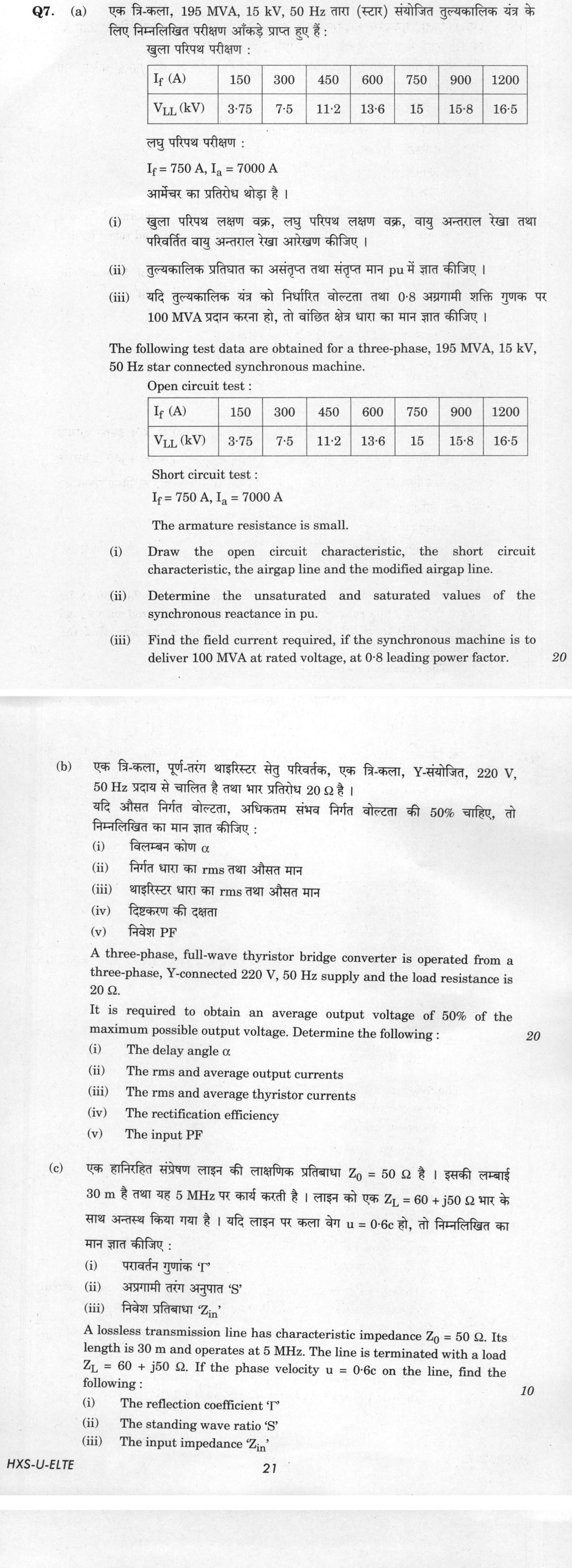
The following test data are obtained for a three-phase, 195 MVA, 15 kV, 50 Hz star connected synchronous machine. Open circuit…
The following test data are obtained for a three-phase, 195 MVA, 15 kV, 50 Hz star connected synchronous machine.
Open circuit test :
| I_f (A) | 150 | 300 | 450 | 600 | 750 | 900 | 1200 |
|---|---|---|---|---|---|---|---|
| V_LL (kV) | 3·75 | 7·5 | 11·2 | 13·6 | 15 | 15·8 | 16·5 |
Short circuit test : I_f = 750 A, I_a = 7000 A
The armature resistance is small.
Draw the open circuit characteristic, the short circuit characteristic, the airgap line and the modified airgap line.
Determine the unsaturated and saturated values of the synchronous reactance in pu.
Find the field current required, if the synchronous machine is to deliver 100 MVA at rated voltage, at 0·8 leading power factor. 20 marks
A three-phase, full-wave thyristor bridge converter is operated from a three-phase, Y-connected 220 V, 50 Hz supply and the load resistance is 20 Ω.
It is required to obtain an average output voltage of 50% of the maximum possible output voltage. Determine the following :
The delay angle α
The rms and average output currents
The rms and average thyristor currents
The rectification efficiency
The input PF 20 marks
A lossless transmission line has characteristic impedance Z₀ = 50 Ω. Its length is 30 m and operates at 5 MHz. The line is terminated with a load Zₗ = 60 + j50 Ω. If the phase velocity u = 0.6c on the line, find the following :
The reflection coefficient 'Γ'
The standing wave ratio 'S'
The input impedance 'Zᵢₙ' 10 marks
हिंदी में प्रश्न पढ़ें
एक त्रि-कला, 195 MVA, 15 kV, 50 Hz तारा (स्टार) संयोजित तुल्यकालिक यंत्र के लिए निम्नलिखित परीक्षण आँकड़े प्राप्त हुए हैं :
खुला परिपथ परीक्षण :
| I_f (A) | 150 | 300 | 450 | 600 | 750 | 900 | 1200 |
|---|---|---|---|---|---|---|---|
| V_LL (kV) | 3·75 | 7·5 | 11·2 | 13·6 | 15 | 15·8 | 16·5 |
लघु परिपथ परीक्षण : I_f = 750 A, I_a = 7000 A
आर्मेचर का प्रतिरोध थोड़ा है ।
खुला परिपथ लक्षण वक्र, लघु परिपथ लक्षण वक्र, वायु अंतराल रेखा तथा परिवर्तित वायु अंतराल रेखा आरेखण कीजिए ।
तुल्यकालिक प्रतिघात का असंतृप्त तथा संतृप्त मान pu में ज्ञात कीजिए ।
यदि तुल्यकालिक यंत्र को निर्धारित वोल्टता तथा 0·8 अग्रगामी शक्ति गुणक पर 100 MVA प्रदान करना हो, तो वांछित क्षेत्र धारा का मान ज्ञात कीजिए । (20 अंक)
एक त्रि-कला, पूर्ण-तरंग थाइरिस्टर सेतु परिवर्तक, एक त्रि-कला, Y-संयोजित, 220 V, 50 Hz प्रदाय से चालित है तथा भार प्रतिरोध 20 Ω है।
यदि औसत निर्गत वोल्टता, अधिकतम संभव निर्गत वोल्टता की 50% चाहिए, तो निम्नलिखित का मान ज्ञात कीजिए :
विलम्बन कोण α
निर्गत धारा का rms तथा औसत मान
थाइरिस्टर धारा का rms तथा औसत मान
दिष्टकरण की दक्षता
निवेश PF (20 अंक)
एक हानिरहित संप्रेषण लाइन की लाक्षणिक प्रतिबाधा Z₀ = 50 Ω है। इसकी लम्बाई 30 m है तथा यह 5 MHz पर कार्य करती है। लाइन को एक Zₗ = 60 + j50 Ω भार के साथ अन्तस्थ किया गया है। यदि लाइन पर कला वेग u = 0.6c हो, तो निम्नलिखित का मान ज्ञात कीजिए :
परावर्तन गुणांक 'Γ'
अप्रगामी तरंग अनुपात 'S'
निवेश प्रतिबाधा 'Zᵢₙ' (10 अंक)
The figure this question refers to, in words
The question paper is a scan and the diagram did not survive as text. This is the figure as read from the original page — every component, value and label — so the question can be worked from the text below.
(a) Table titled 'Open circuit test' with two rows and eight columns. The first row header is 'I_f (A)' followed by values: 150, 300, 450, 600, 750, 900, 1200. The second row header is 'V_LL (kV)' followed by values: 3.75, 7.5, 11.2, 13.6, 15, 15.8, 16.5.
(c) Table: Open circuit test data for a three-phase, 195 MVA, 15 kV, 50 Hz star connected synchronous machine. Columns: I_f (A), V_LL (kV). Rows: 150, 3.75; 300, 7.5; 450, 11.2; 600, 13.6; 750, 15; 900, 15.8; 1200, 16.5. Short circuit test data: I_f = 750 A, I_a = 7000 A. Note: The armature resistance is small.
Table 1: Open circuit test data. Columns: I_f (A), V_LL (kV). Rows: (150, 3.75), (300, 7.5), (450, 11.2), (600, 13.6), (750, 15), (900, 15.8), (1200, 16.5). Table 2: Short circuit test data. Row: I_f = 750 A, I_a = 7000 A.
What "Solve" is asking you to do
Choose the method, then carry it through to a final answer. Identifying what kind of problem this is and why that method applies is the first thing marked; a correct figure arrived at invisibly earns almost nothing.
Structure that answers it
Given data and what is required → method chosen, with the reason it applies → set-up (equation, circuit, free body, trial balance) → working, step by step → answer with units and any condition of validity
Where marks are lost
Doing the middle steps mentally and writing only the result. In mathematics papers, a further loss comes from giving a decimal where the exact value in surds or fractions was wanted, or from skipping the justification a part explicitly asks for.
How this answer will be evaluated
Approach
Framework: null. (a) calculate: given > formula > substitution > result with units > interpretation | (b) calculate: given > formula > substitution > result with units > interpretation | (c) calculate: given > formula > substitution > result with units > interpretation Full marks: Correct method, clear diagrams, accurate calculations with units.
Key points expected
- Plot O.C.C., S.C.C., and air-gap lines
- Calculate unsaturated and saturated Xs in pu
- Determine field current for 100 MVA, 0.8 pf
- Calculate delay angle alpha
- Determine rms and average output currents
- Calculate thyristor currents and efficiency
- Calculate reflection coefficient Gamma
- Determine standing wave ratio S
Evaluation rubric
Each sub-part is marked on its own, against the marks and word limit printed on the paper.
- (a) Determine machine parameters and required field current from test data. 20 marks
calculate— given → formula → substitution → result with units → interpretation
Must cover
- Plot O.C.C., S.C.C., and air-gap lines
- Calculate unsaturated and saturated Xs in pu
- Determine field current for 100 MVA, 0.8 pf
Loses marks
- Missing per-unit base calculations
- Incorrect phase angle for leading pf
Earns more
- Draw modified air-gap line
- Use phasor diagram for field current
Extra mark
- Label saturation knee point
- (b) Compute converter parameters for 50% average output voltage. 20 marks
calculate— given → formula → substitution → result with units → interpretation
Must cover
- Calculate delay angle alpha
- Determine rms and average output currents
- Calculate thyristor currents and efficiency
Loses marks
- Confusing line and phase voltages
- Incorrect efficiency formula
Earns more
- Calculate input power factor
- Show waveform sketches
Extra mark
- State assumptions for continuous conduction
- (c) Find transmission line reflection, SWR, and input impedance. 10 marks
calculate— given → formula → substitution → result with units → interpretation
Must cover
- Calculate reflection coefficient Gamma
- Determine standing wave ratio S
- Compute input impedance Zin
Loses marks
- Ignoring phase velocity in length calc
- Sign error in impedance formula
Earns more
- Calculate electrical length in degrees
- Use Smith chart or formula
Extra mark
- Verify with Smith chart
Model answer coming soon
Every evaluation on this site is marked against a verified model answer. This question's answer is still being written; evaluation opens the moment it lands.
More from Electrical Engineering 2021 Paper I
- Q4 (a) Consider a discrete time system with transfer function given by H(z) = Y(z)/R(z) = (z…
- Q5 (a) A step down dc chopper is feeding a load of R = 10 Ω and L = 20 mH. The dc supply vol…
- Q6 (a) The magnetic field intensity of a linearly polarized uniform plane wave propagating i…
- Q7 The following test data are obtained for a three-phase, 195 MVA, 15 kV, 50 Hz star connec…
- Q8 For an FM communication system with β = 2 and white channel noise with PSD Sₙ(ω) = 10⁻¹⁰,…