Paper I — Q8
For an FM communication system with β = 2 and white channel noise with PSD Sₙ(ω) = 10⁻¹⁰, the output SNR is found to be 28 dB…
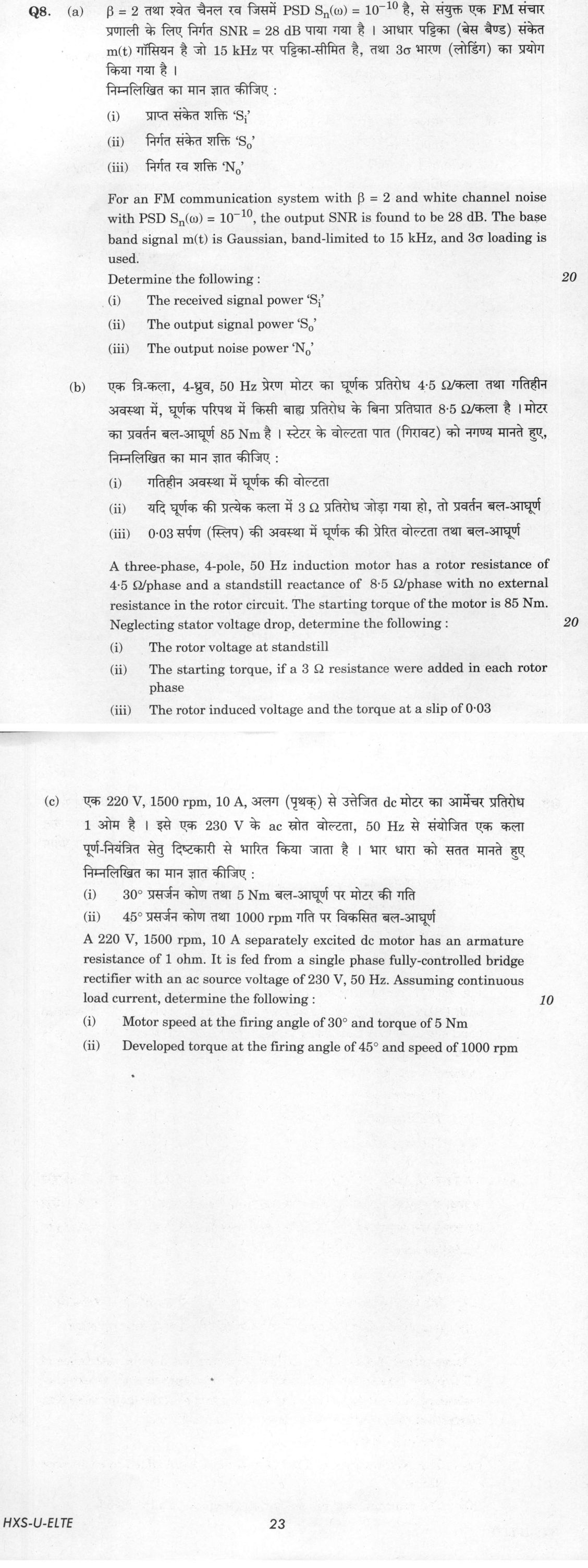
For an FM communication system with β = 2 and white channel noise with PSD Sₙ(ω) = 10⁻¹⁰, the output SNR is found to be 28 dB. The base band signal m(t) is Gaussian, band-limited to 15 kHz, and 3σ loading is used.
Determine the following :
The received signal power 'Sᵢ'
The output signal power 'S₀'
The output noise power 'N₀' 20 marks
A three-phase, 4-pole, 50 Hz induction motor has a rotor resistance of 4·5 Ω/phase and a standstill reactance of 8·5 Ω/phase with no external resistance in the rotor circuit. The starting torque of the motor is 85 Nm. Neglecting stator voltage drop, determine the following :
The rotor voltage at standstill
The starting torque, if a 3 Ω resistance were added in each rotor phase
The rotor induced voltage and the torque at a slip of 0·03 20 marks
A 220 V, 1500 rpm, 10 A separately excited dc motor has an armature resistance of 1 ohm. It is fed from a single phase fully-controlled bridge rectifier with an ac source voltage of 230 V, 50 Hz. Assuming continuous load current, determine the following :
Motor speed at the firing angle of 30° and torque of 5 Nm
Developed torque at the firing angle of 45° and speed of 1000 rpm 10 marks
हिंदी में प्रश्न पढ़ें
β = 2 तथा श्वेत चैनल रव जिसमें PSD Sₙ(ω) = 10⁻¹⁰ है, से संयुक्त एक FM संचार प्रणाली के लिए निर्गत SNR = 28 dB पाया गया है । आधार पटिका (बेस बैंड) संकेत m(t) गॉसियन है जो 15 kHz पर पटिका-सीमित है, तथा 3σ भारण (लोडिंग) का प्रयोग किया गया है ।
निम्नलिखित का मान ज्ञात कीजिए :
प्राप्त संकेत शक्ति 'Sᵢ'
निर्गत संकेत शक्ति 'S₀'
निर्गत रव शक्ति 'N₀' (20 अंक)
एक त्रि-कला, 4-ध्रुव, 50 Hz प्रेरण मोटर का घूर्णक प्रतिरोध 4·5 Ω/कला तथा गतिहीन अवस्था में, घूर्णक परिपथ में किसी बाह्य प्रतिरोध के बिना प्रतिघात 8·5 Ω/कला है । मोटर का प्रवर्तन बल-आघूर्ण 85 Nm है । स्टेटर के वोल्टता पात (गिरावट) को नगण्य मानते हुए, निम्नलिखित का मान ज्ञात कीजिए :
गतिहीन अवस्था में घूर्णक की वोल्टता
यदि घूर्णक की प्रत्येक कला में 3 Ω प्रतिरोध जोड़ा गया हो, तो प्रवर्तन बल-आघूर्ण
0·03 सर्पण (स्लिप) की अवस्था में घूर्णक की प्रेरित वोल्टता तथा बल-आघूर्ण (20 अंक)
एक 220 V, 1500 rpm, 10 A, अलग (पृथक) से उत्तेजित dc मोटर का आर्मेचर प्रतिरोध 1 ओम है । इसे एक 230 V के ac स्रोत वोल्टता, 50 Hz से संयोजित एक कला पूर्ण-नियंत्रित सेतु दिष्टकारी से भारित किया जाता है । भार धारा को सतत मानते हुए निम्नलिखित का मान ज्ञात कीजिए :
30° प्रसर्जन कोण तथा 5 Nm बल-आघूर्ण पर मोटर की गति
45° प्रसर्जन कोण तथा 1000 rpm गति पर विकसित बल-आघूर्ण (10 अंक)
The figure this question refers to, in words
The question paper is a scan and the diagram did not survive as text. This is the figure as read from the original page — every component, value and label — so the question can be worked from the text below.
(b) A logic circuit diagram labeled 'Figure 4(b)' at the bottom. The circuit consists of four 2-to-1 multiplexers on the left and one 4-to-1 multiplexer on the right. The four 2-to-1 multiplexers are arranged vertically. The top 2-to-1 MUX has inputs D0 (connected to input 0) and D1 (connected to input 1). The second 2-to-1 MUX has inputs D2 (connected to input 0) and D3 (connected to input 1). The third 2-to-1 MUX has inputs D4 (connected to input 0) and D5 (connected to input 1). The bottom 2-to-1 MUX has inputs D6 (connected to input 0) and D7 (connected to input 1). The select line for all four 2-to-1 multiplexers is connected to a common input labeled S0. The output of the top 2-to-1 MUX connects to input 00 of the 4-to-1 MUX. The output of the second 2-to-1 MUX connects to input 01 of the 4-to-1 MUX. The output of the third 2-to-1 MUX connects to input 10 of the 4-to-1 MUX. The output of the bottom 2-to-1 MUX connects to input 11 of the 4-to-1 MUX. The 4-to-1 MUX has two select lines labeled S2 and S1. The output of the 4-to-1 MUX is labeled Y.
(c) Circuit diagram of a three-phase bridge inverter (labeled Figure 6(b)). A DC voltage source Vs is connected to the inverter bridge. The bridge consists of six switching devices (transistors Q1 to Q6) arranged in three legs. Each leg has an upper switch (Q1, Q3, Q5) and a lower switch (Q4, Q6, Q2). Each switch has an anti-parallel diode (D1 to D6). The midpoints of the legs are labeled 'a', 'b', and 'c'. These three points connect to a star-connected (Y-connected) resistive load. Each phase of the load has a resistance labeled 'R'. The neutral point of the load is labeled 'n'. The text below the figure states: 'A three-phase bridge inverter shown in Figure 6(b) is used to feed a Y-connected resistive load with R = 10 ohm per phase. The dc input to the inverter Vs = 400 V and the output frequency is 50 Hz. If the inverter is operating with 180 degree conduction mode,' followed by four sub-questions: (i) compute the rms value of the load current, (ii) compute the rms value of the current in each switching device, (iii) calculate the output power, and (iv) draw the waveforms of phase and line voltages.
What "Calculate" is asking you to do
Apply the standard formula or schedule to data the question has already supplied — a table of readings, cost records, a balance sheet — and produce the number. The method is rarely in doubt; the marks sit in the named intermediate quantities, each of which has to appear as a labelled line.
Structure that answers it
Data as given → formula or standard treatment, named → substitution → each intermediate, labelled → result with units
Where marks are lost
Omitting an intermediate the marking scheme pays for separately, or rounding at an intermediate line so the final figure drifts. In commerce and accountancy, any figure in a statement that no numbered working note supports is treated as unearned.
How this answer will be evaluated
Approach
(a) calculate: given > formula > substitution > result with units > interpretation | (b) calculate: given > formula > substitution > result with units > interpretation | (c) calculate: given > formula > substitution > result with units > interpretation Full marks: All three parts solved with correct formulas, clear steps, and proper units; equivalent circuits or models shown where appropriate.
Key points expected
- State FM output SNR formula (3β²Sᵢ/N₀)
- Calculate output noise power N₀ from PSD and bandwidth
- Calculate received signal power Sᵢ from SNR and N₀
- Calculate output signal power S₀ from Sᵢ and SNR
- Use torque ratio formula T ∝ R₂ / (R₂² + (sX₂)²)
- Calculate rotor voltage from standstill impedance and current
- Recalculate torque with added 3Ω resistance
- Calculate torque at slip 0.03 using slip-dependent impedance
Evaluation rubric
Each sub-part is marked on its own, against the marks and word limit printed on the paper.
- (a) Determine received signal power, output signal power, and output noise power for the FM system. 20 marks
calculate— given → formula → substitution → result with units → interpretation
Must cover
- State FM output SNR formula (3β²Sᵢ/N₀)
- Calculate output noise power N₀ from PSD and bandwidth
- Calculate received signal power Sᵢ from SNR and N₀
- Calculate output signal power S₀ from Sᵢ and SNR
Loses marks
- Confusing PSD Sₙ(ω) with Sₙ(f) without factor of 2
- Using linear SNR directly without dB conversion
Earns more
- Explicitly convert 28 dB SNR to linear ratio
- State bandwidth calculation (2 × 15 kHz)
Extra mark
- Mention Carson's rule for bandwidth context
- (b) Determine rotor voltage, modified starting torque, and torque at slip 0.03 for the induction motor. 20 marks
calculate— given → formula → substitution → result with units → interpretation
Must cover
- Use torque ratio formula T ∝ R₂ / (R₂² + (sX₂)²)
- Calculate rotor voltage from standstill impedance and current
- Recalculate torque with added 3Ω resistance
- Calculate torque at slip 0.03 using slip-dependent impedance
Loses marks
- Forgetting to square terms in torque formula
- Using stator voltage instead of rotor induced voltage
Earns more
- Draw equivalent circuit for rotor at standstill
- State assumption of constant air-gap flux
Extra mark
- Calculate rotor current at standstill explicitly
- (c) Determine motor speed and developed torque for the DC motor with rectifier drive. 10 marks
calculate— given → formula → substitution → result with units → interpretation
Must cover
- Calculate rectifier output voltage V₀ = (2Vₘ/π)cosα
- Use motor equation V₀ = E + IₐRₐ
- Relate back-EMF E to speed and flux
- Calculate torque from armature current
Loses marks
- Using peak voltage instead of average output voltage
- Ignoring armature resistance drop
Earns more
- State assumption of continuous conduction mode
- Calculate back-EMF constant from rated values
Extra mark
- Draw rectifier circuit with motor load
Model answer coming soon
Every evaluation on this site is marked against a verified model answer. This question's answer is still being written; evaluation opens the moment it lands.
More from Electrical Engineering 2021 Paper I
- Q5 (a) A step down dc chopper is feeding a load of R = 10 Ω and L = 20 mH. The dc supply vol…
- Q6 (a) The magnetic field intensity of a linearly polarized uniform plane wave propagating i…
- Q7 The following test data are obtained for a three-phase, 195 MVA, 15 kV, 50 Hz star connec…
- Q8 For an FM communication system with β = 2 and white channel noise with PSD Sₙ(ω) = 10⁻¹⁰,…