Paper I — Q5
(a) A step down dc chopper is feeding a load of R = 10 Ω and L = 20 mH. The dc supply voltage is 100 V. The chopper is switching…
A step down dc chopper is feeding a load of R = 10 Ω and L = 20 mH. The dc supply voltage is 100 V. The chopper is switching at a frequency of 2 kHz with a duty cycle of 50%. Determine the load current and the peak-to-peak ripple current as an absolute value and as percentage of dc value. 10 marks
In a certain material with σ = 0, ε = ε₀ εᵣ and μ = μ₀ μᵣ, the magnetic field intensity component is given by H = 10 sin (10⁸ t – 2x) aᵤ A/m. Find the following: (i) Displacement current density (ii) Electric field intensity 10 marks
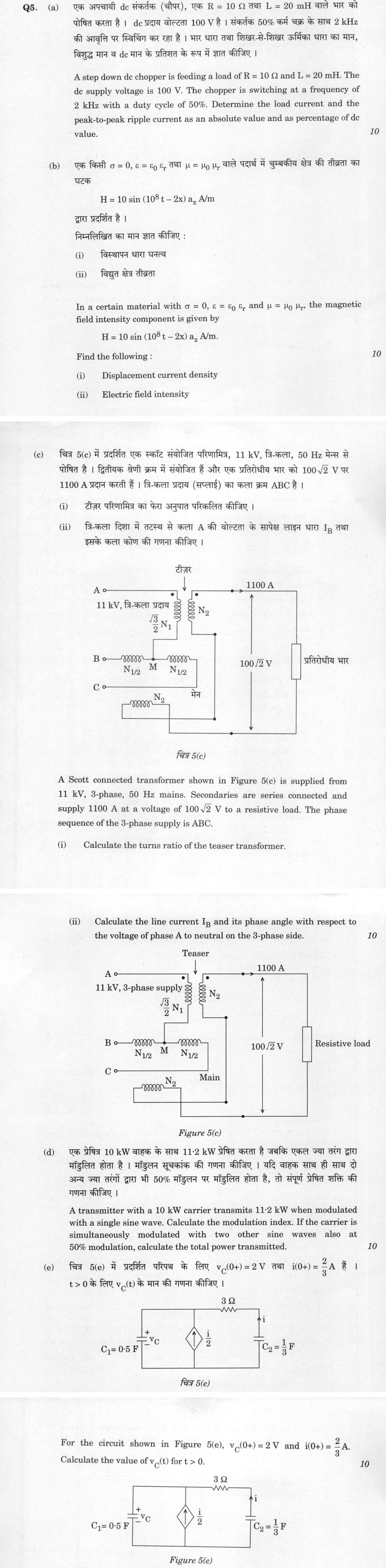
A Scott connected transformer shown in Figure 5(c) is supplied from 11 kV, 3-phase, 50 Hz mains. Secondaries are series connected and supply 1100 A at a voltage of 100√2 V to a resistive load. The phase sequence of the 3-phase supply is ABC. (i) Calculate the turns ratio of the teaser transformer. (ii) Calculate the line current I_B and its phase angle with respect to the voltage of phase A to neutral on the 3-phase side. 10 marks
A transmitter with a 10 kW carrier transmits 11·2 kW when modulated with a single sine wave. Calculate the modulation index. If the carrier is simultaneously modulated with two other sine waves also at 50% modulation, calculate the total power transmitted. 10 marks
For the circuit shown in Figure 5(e), v_C(0+) = 2 V and i(0+) = 2/3 A. Calculate the value of v_C(t) for t > 0. 10 marks
हिंदी में प्रश्न पढ़ें
एक अपचायी dc संकटक (चॉपर), एक R = 10 Ω तथा L = 20 mH वाले भार को पोषित करता है । dc प्रदाय वोल्टता 100 V है । संकटक 50% कर्म चक्र के साथ 2 kHz की आवृत्ति पर स्विचिंग कर रहा है । भार धारा तथा शिखर-से-शिखर ऊर्मिका धारा का मान, विशुद्ध मान व dc मान के प्रतिशत के रूप में ज्ञात कीजिए । (10 अंक)
एक किसी σ = 0, ε = ε₀ εᵣ तथा μ = μ₀ μᵣ वाले पदार्थ में चुंबकीय क्षेत्र की तीव्रता का घटक H = 10 sin (10⁸ t – 2x) aᵤ A/m द्वारा प्रदर्शित है । निम्नलिखित का मान ज्ञात कीजिए : (i) विस्थापन धारा घनत्व (ii) विद्युत क्षेत्र तीव्रता (10 अंक)
चित्र 5(c) में प्रदर्शित एक स्कॉट संयोजित परिणामित्र, 11 kV, त्रि-कला, 50 Hz मैंस से पोषित है । द्वितीयक श्रेणी क्रम में संयोजित हैं और एक प्रतिरोधीय भार को 100√2 V पर 1100 A प्रदान करती है । त्रि-कला प्रदाय (सप्लाई) का कला क्रम ABC है । (i) टीज़र परिणामित्र का फेरा अनुपात परिकलित कीजिए । (ii) त्रि-कला दिशा में तत्क्ष से कला A की बोल्टता के सापेक्ष लाइन धारा I_B तथा इसके कला कोण की गणना कीजिए । (10 अंक)
एक प्रेषित्र 10 kW वाहक के साथ 11·2 kW प्रेषित करता है जबकि एकल ज्या तरंग द्वारा मॉडुलित होता है । मॉडुलन सूचकांक की गणना कीजिए । यदि वाहक साथ ही साथ दो अन्य ज्या तरंगों द्वारा भी 50% मॉडुलन पर मॉडुलित होता है, तो संपूर्ण प्रेषित शक्ति की गणना कीजिए । (10 अंक)
चित्र 5(e) में प्रदर्शित परिपथ के लिए v_C(0+) = 2 V तथा i(0+) = 2/3 A हैं । t > 0 के लिए v_C(t) के मान की गणना कीजिए । (10 अंक)
The figure this question refers to, in words
The question paper is a scan and the diagram did not survive as text. This is the figure as read from the original page — every component, value and label — so the question can be worked from the text below.
(c) Figure 5(c) shows a Scott connected transformer circuit. On the left, a 3-phase supply labeled '11 kV, 3-phase supply' has three terminals: A, B, and C. Terminal A connects to the top of a vertical inductor labeled 'Teaser' with a turns ratio of (sqrt(3)/2)N1. Terminal B connects to a horizontal inductor labeled N1/2, which connects to a central node M. From node M, another horizontal inductor labeled N1/2 connects to terminal C. This arrangement is labeled 'Main'. On the right side, there is a vertical inductor labeled N2 connected in series with the top of the Teaser inductor. The bottom of the Teaser inductor connects to node M. The bottom of the Main transformer section (from the N1/2 inductor connected to C) connects to the bottom of a second vertical inductor labeled N2. The top of the right-side N2 inductor and the bottom of the left-side N2 inductor form the secondary output terminals. These terminals are connected to a 'Resistive load'. The secondary voltage is indicated as 100/sqrt(2) V (with a vertical double-headed arrow) and the current is indicated as 1100 A (with a horizontal arrow pointing right).
(e) Circuit diagram labeled Figure 5(e). The circuit consists of a capacitor C1 (0.5 F) on the left, a dependent current source in the middle, a resistor (3 Ohm) in series with a capacitor C2 (1/3 F) on the right. The components are connected in a parallel configuration between a top and bottom rail. The voltage across C1 is labeled vC with the positive terminal at the top. The dependent current source is a diamond shape with an arrow pointing upwards, labeled with the value i/2. The current flowing through the right branch (through the 3 Ohm resistor and C2) is labeled i, with an arrow pointing upwards. The bottom rail is a common ground line.
What "Calculate" is asking you to do
Apply the standard formula or schedule to data the question has already supplied — a table of readings, cost records, a balance sheet — and produce the number. The method is rarely in doubt; the marks sit in the named intermediate quantities, each of which has to appear as a labelled line.
Structure that answers it
Data as given → formula or standard treatment, named → substitution → each intermediate, labelled → result with units
Where marks are lost
Omitting an intermediate the marking scheme pays for separately, or rounding at an intermediate line so the final figure drifts. In commerce and accountancy, any figure in a statement that no numbered working note supports is treated as unearned.
How this answer will be evaluated
Approach
Framework: null. (a) calculate: given > formula > substitution > result with units > interpretation | (b) calculate: given > formula > substitution > result with units > interpretation | (c) calculate: given > formula > substitution > result with units > interpretation | (d) calculate: given > formula > substitution > result with units > interpretation | (e) calculate: given > formula > substitution > result with units > interpretation Full marks: Complete method with correct formulas, units, and interpretation for all parts
Key points expected
- State average load current formula (V_s * D / R)
- Calculate ripple current using L, R, f, and D
- Express ripple as percentage of DC value
- Show equivalent circuit or time-domain analysis
- Apply Maxwell's curl equation for H to find E
- Calculate displacement current density (J_d = ∂D/∂t)
- Determine phase relationship between E and H
- State units for both quantities
Evaluation rubric
Each sub-part is marked on its own, against the marks and word limit printed on the paper.
- (a) Determine load current and peak-to-peak ripple current (absolute and %). 10 marks
calculate— given → formula → substitution → result with units → interpretation
Must cover
- State average load current formula (V_s * D / R)
- Calculate ripple current using L, R, f, and D
- Express ripple as percentage of DC value
- Show equivalent circuit or time-domain analysis
Loses marks
- Using wrong frequency (switching vs ripple)
- Ignoring inductance in ripple calculation
Earns more
- Sketch of current waveform showing ripple
- Explicit calculation of time constant (L/R)
Extra mark
- Discussion of continuous vs discontinuous conduction mode
- (b) Find displacement current density and electric field intensity. 10 marks
calculate— given → formula → substitution → result with units → interpretation
Must cover
- Apply Maxwell's curl equation for H to find E
- Calculate displacement current density (J_d = ∂D/∂t)
- Determine phase relationship between E and H
- State units for both quantities
Loses marks
- Sign error in phase term (10^8 t - 2x)
- Confusing displacement current with conduction current
Earns more
- Explicit calculation of wave impedance (η)
- Verification of wave propagation direction
Extra mark
- Mention of intrinsic impedance of the medium
- (c) Calculate teaser turns ratio and line current I_B with phase angle. 10 marks
calculate— given → formula → substitution → result with units → interpretation
Must cover
- Identify Scott connection components (Teaser, Main, Booster)
- Calculate teaser transformer turns ratio
- Determine magnitude of line current I_B
- Calculate phase angle of I_B relative to V_AN
Loses marks
- Incorrect identification of teaser vs main transformer
- Phase angle error in Scott connection analysis
Earns more
- Phasor diagram showing current relationships
- Explicit calculation of teaser secondary voltage
Extra mark
- Discussion of power balance in Scott connection
- (d) Calculate modulation index and total transmitted power. 10 marks
calculate— given → formula → substitution → result with units → interpretation
Must cover
- Use power formula P_t = P_c(1 + m²/2) for single tone
- Solve for modulation index m from given power
- Calculate total power for multiple modulation
- Apply root-sum-square for multiple modulating signals
Loses marks
- Using wrong power formula for AM
- Adding modulation indices instead of powers
Earns more
- Explicit calculation of sideband power
- Verification of modulation index range
Extra mark
- Mention of over-modulation effects
- (e) Calculate v_C(t) for t > 0 given initial conditions. 10 marks
calculate— given → formula → substitution → result with units → interpretation
Must cover
- Set up differential equation for the circuit
- Apply initial conditions v_C(0+) and i(0+)
- Solve for natural and forced response
- Determine time constant of the circuit
Loses marks
- Incorrect initial condition application
- Sign error in differential equation
Earns more
- Explicit calculation of equivalent capacitance
- Verification of initial current direction
Extra mark
- Sketch of v_C(t) waveform
Model answer coming soon
Every evaluation on this site is marked against a verified model answer. This question's answer is still being written; evaluation opens the moment it lands.
More from Electrical Engineering 2021 Paper I
- Q2 (a) Find the Thevenin's equivalent of the circuit shown in Figure 2(a) below as seen from…
- Q3 (a) (i) Explain what happens when a circuit shown in Figure 3(a)(i) below is constructed…
- Q4 (a) Consider a discrete time system with transfer function given by H(z) = Y(z)/R(z) = (z…
- Q5 (a) A step down dc chopper is feeding a load of R = 10 Ω and L = 20 mH. The dc supply vol…
- Q6 (a) The magnetic field intensity of a linearly polarized uniform plane wave propagating i…
- Q7 The following test data are obtained for a three-phase, 195 MVA, 15 kV, 50 Hz star connec…
- Q8 For an FM communication system with β = 2 and white channel noise with PSD Sₙ(ω) = 10⁻¹⁰,…