Paper I — Q3
(a) (i) Explain what happens when a circuit shown in Figure 3(a)(i) below is constructed using logarithmic amplifier. 10 Figure…
Explain what happens when a circuit shown in Figure 3(a)(i) below is constructed using logarithmic amplifier. 10 marks
Figure 3(a)(i)
Explain what happens if the topology is modified as shown in Figure 3(a)(ii) below. 10 marks
Figure 3(a)(ii)
For the circuit shown in Figure 3(b), calculate the voltage V₀(t) as function of time,
Figure 3(b)
where V(t) = 10 sin (6t + 60°) V and I(t) = 5 cos (4t + 30°) A. 20 marks
A mixer (analog multiplier) is used as a process in some analog communication systems. Two signals X₁(t) and X₂(t) are mixed to produce the output y(t) = X₁(t) X₂(t).
If X₁(t) = 10 sin c (10t) and X₂(t) = 2 cos (1000 πt), then calculate and plot the magnitude of the Fourier transform of output signal. Further, specify and prove the property of Fourier transform used in calculations. 10 marks
हिंदी में प्रश्न पढ़ें
समझाइए कि जब चित्र 3(a)(i) में प्रदर्शित परिपथ को लघुगणकीय प्रवर्धक का प्रयोग करते हुए निर्मित किया जाएगा, तो क्या होगा ।
चित्र 3(a)(i)
समझाइए कि यदि संस्थितिकी को चित्र 3(a)(ii) में दर्शाए अनुसार परिवर्तित कर दिया जाए, तो क्या होगा ।
चित्र 3(a)(ii)
चित्र 3(b) में प्रदर्शित परिपथ के लिए वोल्टता V₀(t) की गणना समय के फलन के रूप में कीजिए,
चित्र 3(b)
जहाँ V(t) = 10 sin (6t + 60°) V और I(t) = 5 cos (4t + 30°) A हैं।
एक मिश्रक (अनुकृप गुणक) को किसी अनुकृप संचार प्रणाली के एक प्रक्रम के रूप में प्रयुक्त किया गया है । निर्गत y(t) = X₁(t) X₂(t) निर्मित करने के लिए दो संकेतों X₁(t) तथा X₂(t) को मिश्रित किया गया है ।
यदि X₁(t) = 10 sin c (10t) तथा X₂(t) = 2 cos (1000 πt) हो, तो निर्गत संकेत के फुरिये रूपांतर के परिमाण की गणना कीजिए तथा उसका आरेखण कीजिए । गणना में प्रयुक्त फुरिये रूपांतर के गुणों का उल्लेख कीजिए तथा उन्हें सिद्ध कीजिए ।
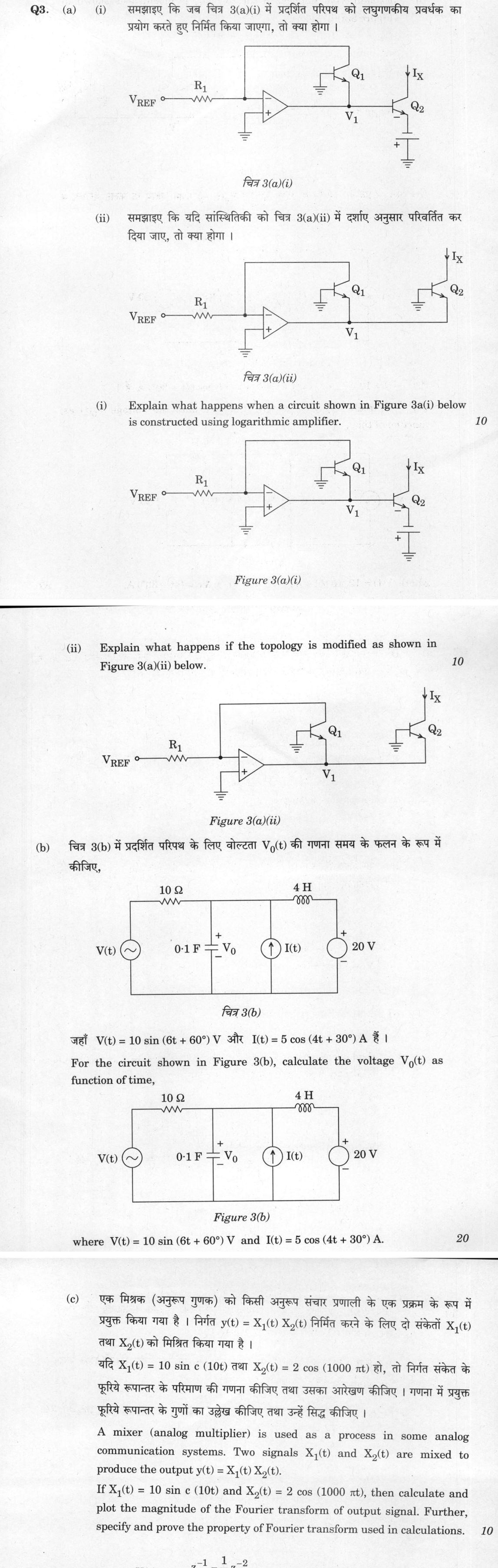
The figure this question refers to, in words
The question paper is a scan and the diagram did not survive as text. This is the figure as read from the original page — every component, value and label — so the question can be worked from the text below.
(a) Circuit diagram labeled Figure 3(a)(ii). An operational amplifier (op-amp) is shown with its non-inverting input (+) connected to ground. The inverting input (-) is connected to a node. A resistor R1 connects a terminal labeled V_REF to this inverting input node. The output of the op-amp is connected to a node labeled V1. Two NPN transistors, Q1 and Q2, are connected in parallel. The emitters of both Q1 and Q2 are connected to ground. The collectors of both Q1 and Q2 are connected to the node V1. The base of Q1 is connected to the inverting input node of the op-amp. The base of Q2 is connected to the collector of Q2 (node V1). An external current source labeled I_X is connected to the collector of Q2, with the arrow pointing into the collector.
(b) Circuit diagram labeled Figure 3(b). The circuit consists of three parallel branches connected between a top node and a bottom reference node. The voltage across the parallel branches is labeled V0 with the positive terminal at the top. The left branch contains an AC voltage source V(t) in series with a 10 Ohm resistor. The middle branch contains a 0.1 F capacitor in parallel with an AC current source I(t) pointing upwards. The right branch contains a 4 H inductor in series with a DC voltage source of 20 V, with the positive terminal of the DC source at the top.
What "Calculate" is asking you to do
Apply the standard formula or schedule to data the question has already supplied — a table of readings, cost records, a balance sheet — and produce the number. The method is rarely in doubt; the marks sit in the named intermediate quantities, each of which has to appear as a labelled line.
Structure that answers it
Data as given → formula or standard treatment, named → substitution → each intermediate, labelled → result with units
Where marks are lost
Omitting an intermediate the marking scheme pays for separately, or rounding at an intermediate line so the final figure drifts. In commerce and accountancy, any figure in a statement that no numbered working note supports is treated as unearned.
How this answer will be evaluated
Approach
(a(i)) explain: definition/context > points in order > small example > short close | (a(ii)) explain: definition/context > points in order > small example > short close | (b) calculate: given > formula > substitution > result with units > interpretation | (c) calculate: given > formula > substitution > result with units > interpretation Full marks: All parts answered with correct method, clear derivations, and accurate results.
Key points expected
- Identify the circuit as a logarithmic amplifier
- State the virtual ground condition at the inverting input
- Relate the output voltage to the logarithm of the input current
- Explain the role of the transistor in the feedback loop
- Identify the modified circuit as a current mirror
- Explain how the current is mirrored from Q1 to Q2
- State the condition for the currents to be equal
- Discuss the impact of the modification on the circuit's function
Evaluation rubric
Each sub-part is marked on its own, against the marks and word limit printed on the paper.
- (a(i)) Explain the operation of the circuit in Figure 3(a)(i) using a logarithmic amplifier. 10 marks
explain— definition/context → points in order → small example → short close
Must cover
- Identify the circuit as a logarithmic amplifier
- State the virtual ground condition at the inverting input
- Relate the output voltage to the logarithm of the input current
- Explain the role of the transistor in the feedback loop
Loses marks
- Treating the transistor as a linear resistor
- Ignoring the base-emitter voltage drop
- Confusing the input and output terminals
Earns more
- Derive the transfer function Vout = -Vt ln(Iin/I0)
- Mention the temperature dependence of the output
- Discuss the dynamic range of the amplifier
Extra mark
- Draw a block diagram of the log amplifier
- Provide a numerical example of the output voltage
- (a(ii)) Explain the effect of modifying the topology as shown in Figure 3(a)(ii). 10 marks
explain— definition/context → points in order → small example → short close
Must cover
- Identify the modified circuit as a current mirror
- Explain how the current is mirrored from Q1 to Q2
- State the condition for the currents to be equal
- Discuss the impact of the modification on the circuit's function
Loses marks
- Assuming the currents are always equal regardless of conditions
- Ignoring the base currents of the transistors
- Confusing the roles of Q1 and Q2
Earns more
- Derive the relationship between the input and output currents
- Mention the effect of the Early voltage on the current matching
- Compare the performance with the original circuit
Extra mark
- Draw a small-signal equivalent circuit of the current mirror
- Calculate the output resistance of the current mirror
- (b) Calculate the voltage V0(t) as a function of time for the circuit in Figure 3(b). 20 marks
calculate— given → formula → substitution → result with units → interpretation
Must cover
- Convert the circuit to the frequency domain (phasor domain)
- Calculate the impedance of the inductor and capacitor
- Apply nodal analysis or mesh analysis to find V0
- Convert the phasor V0 back to the time domain
Loses marks
- Using the wrong frequency for the inductor or capacitor
- Making sign errors in the nodal or mesh equations
- Forgetting to convert the final result back to the time domain
Earns more
- Show the step-by-step calculation of the impedances
- Draw the phasor diagram for the circuit
- Verify the result using another method (e.g., superposition)
Extra mark
- Calculate the power dissipated in the resistor
- Determine the power factor of the circuit
- (c) Calculate and plot the magnitude of the Fourier transform of the output signal y(t). 10 marks
calculate— given → formula → substitution → result with units → interpretation
Must cover
- Use the multiplication property of the Fourier transform
- Calculate the Fourier transform of X1(t) and X2(t)
- Convolve the Fourier transforms to find Y(f)
- Plot the magnitude of Y(f)
Loses marks
- Using the wrong property of the Fourier transform
- Making errors in the convolution calculation
- Plotting the wrong function (e.g., phase instead of magnitude)
Earns more
- State the multiplication property of the Fourier transform
- Show the convolution integral explicitly
- Label the key points on the plot (e.g., peaks, zeros)
Extra mark
- Calculate the energy of the output signal
- Discuss the bandwidth of the output signal
Model answer coming soon
Every evaluation on this site is marked against a verified model answer. This question's answer is still being written; evaluation opens the moment it lands.
More from Electrical Engineering 2021 Paper I
- Q1 (a) In Figure 1(a) shown below, the two-port network is characterized in terms of y-param…
- Q2 (a) Find the Thevenin's equivalent of the circuit shown in Figure 2(a) below as seen from…
- Q3 (a) (i) Explain what happens when a circuit shown in Figure 3(a)(i) below is constructed…
- Q4 (a) Consider a discrete time system with transfer function given by H(z) = Y(z)/R(z) = (z…
- Q5 (a) A step down dc chopper is feeding a load of R = 10 Ω and L = 20 mH. The dc supply vol…
- Q6 (a) The magnetic field intensity of a linearly polarized uniform plane wave propagating i…