Paper I — Q6
(a) The magnetic field intensity of a linearly polarized uniform plane wave propagating in the +Y-direction in sea water (ε_r =…
The magnetic field intensity of a linearly polarized uniform plane wave propagating in the +Y-direction in sea water (ε_r = 80, μ_r = 1, σ = 4 S/m) is H = 0·1 sin (10^10 πt - π/3) a_x A/m. At Y = 0, determine the following: (i) The attenuation constant, intrinsic impedance, the wavelength and skin depth. (ii) The location at which the amplitude of H is 0·01 A/m. (iii) The expression for E(y, t) and H(y, t) at Y = 0·5 (m) as functions of t. 20 marks
A three-phase bridge inverter shown in Figure 6(b) is used to feed a Y-connected resistive load with R = 10 Ω per phase. The dc input to the inverter V_S = 400 V and the output frequency is 50 Hz. If the inverter is operating with 180° conduction mode, (i) compute the rms value of the load current, (ii) compute the rms value of the current in each switching device, (iii) calculate the output power, and (iv) draw the waveforms of phase and line voltages. 20 marks
Let the measurement error of a physical quantity be defined by a random variable X and its density function as follows: f(x) = {K(3-x²) for -1≤x≤1, {0 elsewhere. Determine the value of 'K' and find the probability that a random error in measurement is less than 1/2. 10 marks
हिंदी में प्रश्न पढ़ें
समुद्र के जल (ε_r = 80, μ_r = 1, σ = 4 S/m) में +Y-दिशा में संचरित एक रेखीय ध्रुवित एकसमान समतल तरंग के चुंबकीय क्षेत्र की तीव्रता H = 0·1 sin (10^10 πt - π/3) a_x A/m है । Y = 0 पर निम्न का मान ज्ञात कीजिए : (i) शीणन स्थिरांक, नैज (इंट्रिंसिक) प्रतिबाधा, तरंगदैर्ध्य तथा सतही गहराई (स्किन डेप्थ) । (ii) वह स्थान जहाँ H का आयाम 0·01 A/m है । (iii) Y = 0·5 (m) पर t के फलन के रूप में E(y, t) तथा H(y, t) के लिए व्यंजक । (20 अंक)
चित्र 6(b) में प्रदर्शित एक त्रि-कला सेतु (ब्रिज) प्रतिलोमक (इन्वर्टर), एक Y-संयोजित R = 10 Ω प्रति कला वाले प्रतिरोधीय भार को भारित करने के लिए प्रयुक्त किया जाता है । प्रतिलोमक में dc निवेश V_S = 400 V तथा निगत आवृत्ति 50 Hz है । यदि प्रतिलोमक 180° चालकता विधा में कार्यशील है, तो (i) भार धारा का rms मान ज्ञात कीजिए, (ii) प्रत्येक स्विचिंग युक्ति में धारा का rms मान ज्ञात कीजिए, (iii) निर्गत शक्ति ज्ञात कीजिए, और (iv) कला वोल्टता तथा लाइन वोल्टता के तरंग रूपों को आरेखित कीजिए । (20 अंक)
मान लीजिए कि एक भौतिक राशि की मापन त्रुटि एक यादृच्छिक चर X तथा इसका घनत्व फलन निम्नलिखित है : f(x) = {K(3-x²) for -1≤x≤1, {0 अन्यथा । तो, 'K' के मान की गणना कीजिए तथा मापन में यादृच्छिक त्रुटि के 1/2 से कम होने की प्रायिकता ज्ञात कीजिए । (10 अंक)
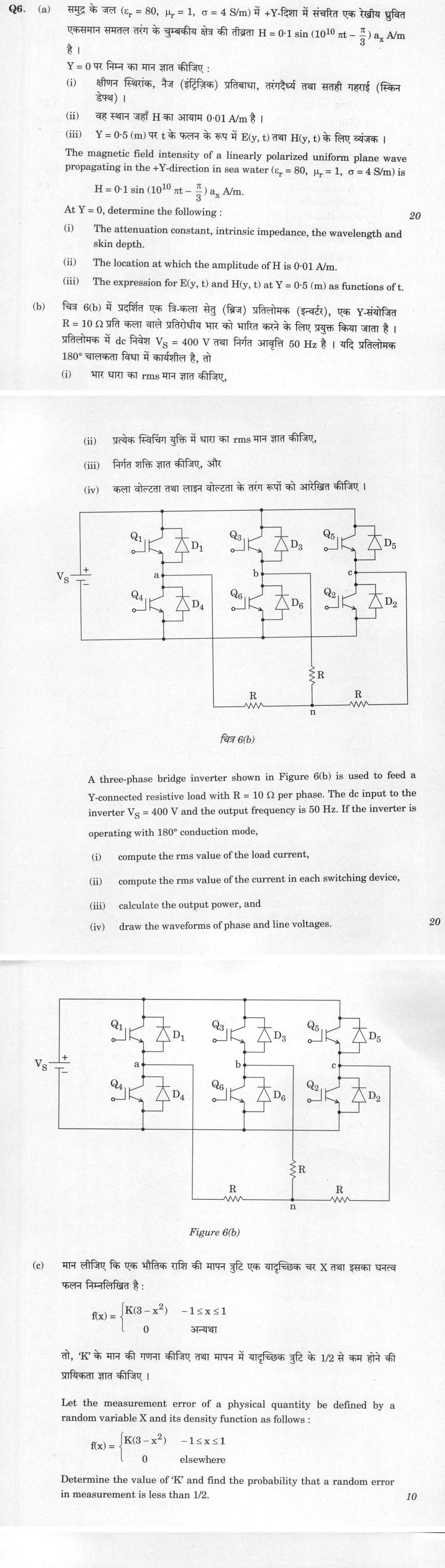
The figure this question refers to, in words
The question paper is a scan and the diagram did not survive as text. This is the figure as read from the original page — every component, value and label — so the question can be worked from the text below.
(b) Figure 6(b) shows a three-phase bridge inverter circuit. A DC voltage source Vs is connected to the top and bottom DC bus rails. The circuit consists of three vertical legs, each containing two NPN transistors (Q1, Q3, Q5 in the top half; Q4, Q6, Q2 in the bottom half) connected in series between the rails. Each transistor has a diode connected in anti-parallel (cathode to collector, anode to emitter). The junction between the top and bottom transistors of each leg forms a phase output terminal: node 'a' (between Q1 and Q4), node 'b' (between Q3 and Q6), and node 'c' (between Q5 and Q2). These three nodes connect to a Y-connected resistive load. The three resistors, each labeled R, are connected from nodes a, b, and c to a common neutral point labeled 'n'.
What "Solve" is asking you to do
Choose the method, then carry it through to a final answer. Identifying what kind of problem this is and why that method applies is the first thing marked; a correct figure arrived at invisibly earns almost nothing.
Structure that answers it
Given data and what is required → method chosen, with the reason it applies → set-up (equation, circuit, free body, trial balance) → working, step by step → answer with units and any condition of validity
Where marks are lost
Doing the middle steps mentally and writing only the result. In mathematics papers, a further loss comes from giving a decimal where the exact value in surds or fractions was wanted, or from skipping the justification a part explicitly asks for.
How this answer will be evaluated
Approach
(a) calculate: given > formula > substitution > result with units > interpretation | (b) calculate: given > formula > substitution > result with units > interpretation | (c) calculate: given > formula > substitution > result with units > interpretation Full marks: All calculations correct with proper units, complete waveforms, and clear probability derivation
Key points expected
- Calculate attenuation constant α and phase constant β
- Determine intrinsic impedance η and skin depth δ
- Calculate wavelength λ in the medium
- Find location y where H amplitude is 0.01 A/m
- Calculate rms load current for 180° conduction
- Calculate rms current in each switching device
- Calculate total output power delivered to load
- Draw phase voltage waveform (quasi-square)
Evaluation rubric
Each sub-part is marked on its own, against the marks and word limit printed on the paper.
- (a) Determine wave parameters, location, and field expressions in sea water. 20 marks
calculate— given → formula → substitution → result with units → interpretation
Must cover
- Calculate attenuation constant α and phase constant β
- Determine intrinsic impedance η and skin depth δ
- Calculate wavelength λ in the medium
- Find location y where H amplitude is 0.01 A/m
Loses marks
- Incorrect calculation of propagation constant γ
- Missing units in final answers
- Wrong phase shift sign in field expressions
Earns more
- Correct expression for E(y,t) and H(y,t) at y=0.5m
- Correct phase shift calculation for y=0.5m
- Proper use of complex propagation constant γ
Extra mark
- Verification of power flow direction
- Comparison of skin depth with wavelength
- (b) Compute inverter output parameters and draw voltage waveforms. 20 marks
calculate— given → formula → substitution → result with units → interpretation
Must cover
- Calculate rms load current for 180° conduction
- Calculate rms current in each switching device
- Calculate total output power delivered to load
- Draw phase voltage waveform (quasi-square)
Loses marks
- Incorrect rms current calculation method
- Missing or incorrect waveform shapes
- Wrong voltage level in waveforms
Earns more
- Draw line voltage waveform (6-step)
- Correct conduction sequence identification
- Proper waveform labeling with voltage levels
Extra mark
- Harmonic content analysis
- Efficiency calculation
- (c) Determine normalization constant K and probability P(X < 1/2). 10 marks
calculate— given → formula → substitution → result with units → interpretation
Must cover
- Integrate f(x) from -1 to 1 to find K
- Calculate K = 3/4
- Integrate f(x) from -1 to 1/2 for probability
- Calculate P(X < 1/2) = 13/32
Loses marks
- Incorrect integration limits
- Arithmetic errors in polynomial integration
- Missing probability calculation
Earns more
- Correct setup of definite integrals
- Proper evaluation of polynomial integral
- Clear statement of probability result
Extra mark
- Verification that f(x) is non-negative
- Graph of probability density function
Model answer coming soon
Every evaluation on this site is marked against a verified model answer. This question's answer is still being written; evaluation opens the moment it lands.
More from Electrical Engineering 2021 Paper I
- Q3 (a) (i) Explain what happens when a circuit shown in Figure 3(a)(i) below is constructed…
- Q4 (a) Consider a discrete time system with transfer function given by H(z) = Y(z)/R(z) = (z…
- Q5 (a) A step down dc chopper is feeding a load of R = 10 Ω and L = 20 mH. The dc supply vol…
- Q6 (a) The magnetic field intensity of a linearly polarized uniform plane wave propagating i…
- Q7 The following test data are obtained for a three-phase, 195 MVA, 15 kV, 50 Hz star connec…
- Q8 For an FM communication system with β = 2 and white channel noise with PSD Sₙ(ω) = 10⁻¹⁰,…