Paper II — Q1
(a) A system is described by the following state equations : dotx₁ = x₁ + x₂ + 3x₃ dotx₂ = 2x₁ + 3x₂ + u₁ dotx₃ = 2x₂ + x₃ +…
A system is described by the following state equations : dotx₁ = x₁ + x₂ + 3x₃ dotx₂ = 2x₁ + 3x₂ + u₁ dotx₃ = 2x₂ + x₃ + u₂ Check the controllability of the system. 10 marks
A single phase, single line diagram of a power system is shown in figure. Find the sending end voltage and the value of load resistance in p.u. referred to sending end if the voltage across load resistance is 9·8 KV. 10 marks
Explain the following related to computer programming : Machine Language (ii) Assembly Language (iii) Compiler
Interpreter (v) ASCII 10 marks
A current of (0·5 + 0·3 sinωt – 0·2 sin 2ωt) amps is passed through the circuit shown in figure. Determine the reading of each instrument if ω = 10⁶ rad/sec. 10 marks
A DPCM system uses a linear predictor with a single tap. The normalized autocorrelation function of the input signal for a lag of one sampling interval is 0·75. The predictor is designed to minimize the prediction error variance. Determine the processing gain attained by the use of this predictor. 10 marks
हिंदी में प्रश्न पढ़ें
एक तंत्र को निम्नलिखित अवस्था समीकरणों द्वारा वर्णित किया गया है : dotx₁ = x₁ + x₂ + 3x₃ dotx₂ = 2x₁ + 3x₂ + u₁ dotx₃ = 2x₂ + x₃ + u₂ तंत्र की नियंत्रणीयता की जाँच करें । (10 अंक)
एक एकल कला विद्युत शक्ति प्रणाली को एकल रेखीय आरेख द्वारा चित्र में दर्शाया गया है । यदि भार प्रतिरोध पर वोल्टता 9·8 KV हो तो प्रेषण सिरे की वोल्टता व प्रेषण सिरे के संदर्भ में भार प्रतिरोध का मान प्रति इकाई में ज्ञात करें । (10 अंक)
अभिकलित्र प्रक्रमण के संदर्भ में निम्नलिखित की व्याख्या करें : मशीन भाषा (ii) समन्वयोजन (असेंबली) भाषा (iii) संकलक (कम्पाइलर)
भाषांतरक (v) ASCII (10 अंक)
चित्र में दर्शाये गये परिपथ में (0·5 + 0·3 sinωt – 0·2 sin 2ωt) Amp विद्युत धारा का प्रवाह हो रहा है । यदि ω = 10⁶ rad/sec हो तो प्रत्येक मापन के पठन (रीडिंग) का निर्धारण करें । (10 अंक)
एक DPCM तंत्र एक रैखिक प्राक्सूचक को एकल टैप के साथ प्रयोग करता है । एक प्रतिचयन अंतराल पश्चता के लिए सामान्यीकृत स्वतः सह संबंध फलन के निवेश का मान 0·75 है । प्राक्सूचक को, पूर्वानुमान त्रुटि के प्रसरण को निम्नतम करने के लिए अभिकल्प किया गया है । इस प्राक्सूचक के प्रयोग करने से प्राप्त संसाधन लब्धि का निर्धारण करें । (10 अंक)
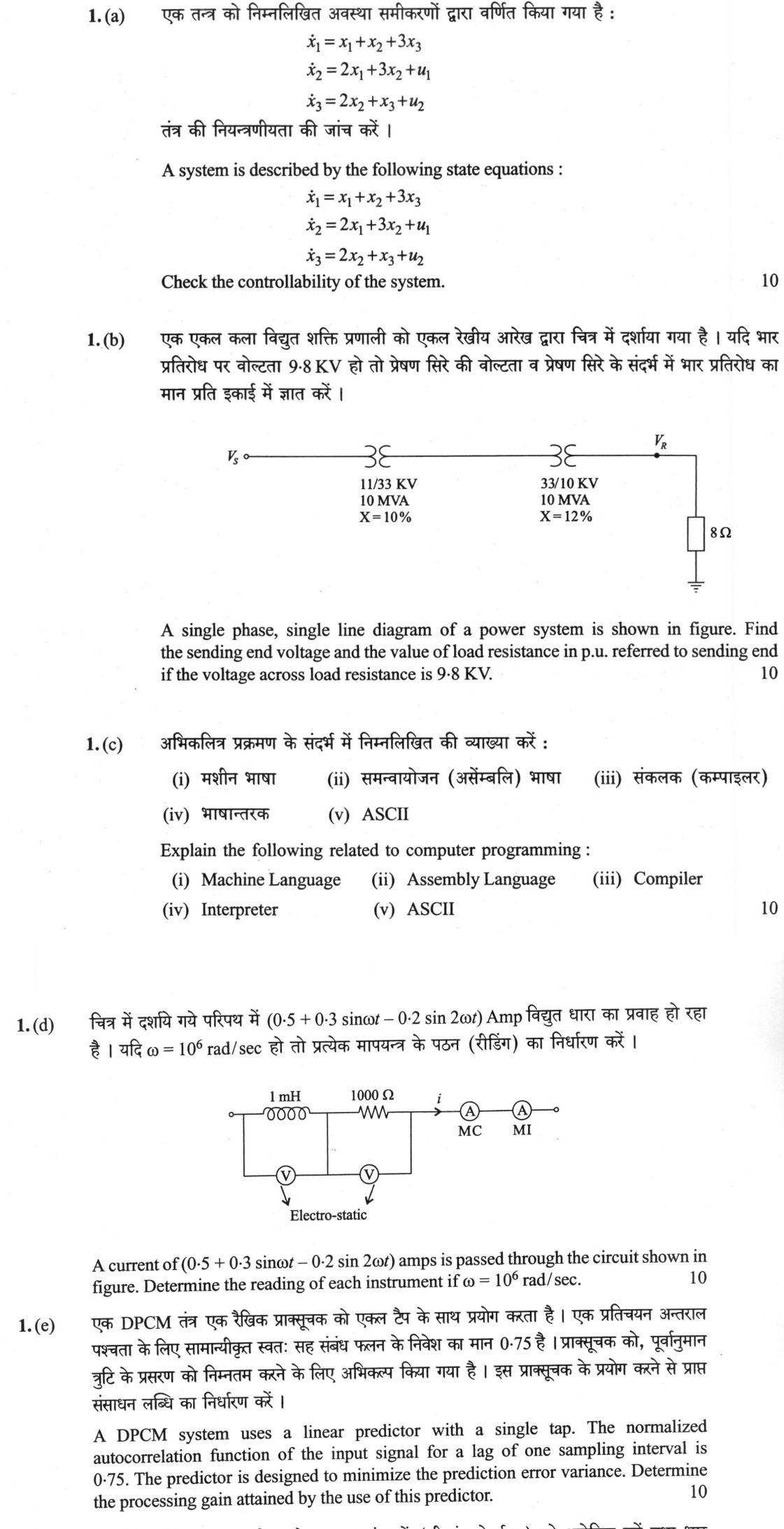
The figure this question refers to, in words
The question paper is a scan and the diagram did not survive as text. This is the figure as read from the original page — every component, value and label — so the question can be worked from the text below.
(b) A single-line diagram of a power system. On the left, a source terminal labeled Vs is connected to the primary side of a transformer. This transformer is labeled '11/33 KV', '10 MVA', and 'X = 10%'. The secondary side of this transformer is connected to the primary side of a second transformer. The second transformer is labeled '33/10 KV', '10 MVA', and 'X = 12%'. The secondary side of the second transformer is connected to a node labeled Vr. From node Vr, a load resistor with a value of 8 Ohms is connected to ground.
(d) A series circuit diagram. Starting from the left, a 1 mH inductor is connected in series with a 1000 Ohm resistor. The current 'i' flows through the circuit from left to right. An ammeter labeled 'MC' (Moving Coil) is connected in series with the resistor. Following the MC ammeter, another ammeter labeled 'MI' (Moving Iron) is connected in series. Below the inductor, a voltmeter labeled 'V' is connected in parallel across the inductor. Below the resistor, a second voltmeter labeled 'V' is connected in parallel across the resistor. Both voltmeters have an arrow pointing to the text 'Electro-static'.
What "Solve" is asking you to do
Choose the method, then carry it through to a final answer. Identifying what kind of problem this is and why that method applies is the first thing marked; a correct figure arrived at invisibly earns almost nothing.
Structure that answers it
Given data and what is required → method chosen, with the reason it applies → set-up (equation, circuit, free body, trial balance) → working, step by step → answer with units and any condition of validity
Where marks are lost
Doing the middle steps mentally and writing only the result. In mathematics papers, a further loss comes from giving a decimal where the exact value in surds or fractions was wanted, or from skipping the justification a part explicitly asks for.
How this answer will be evaluated
Approach
(a) calculate: given > formula > substitution > result with units > interpretation | (b) calculate: given > formula > substitution > result with units > interpretation | (c) explain: definition/context > points in order > small example > short close | (d) calculate: given > formula > substitution > result with units > interpretation | (e) calculate: given > formula > substitution > result with units > interpretation Full marks: Complete method with correct calculations and clear interpretation for all parts.
Key points expected
- Formulate A and B matrices from equations
- Construct controllability matrix [B AB A²B]
- Calculate determinant or rank of matrix
- State controllability conclusion based on rank
- Select base values (10 MVA, 11 kV)
- Convert transformer impedances to p.u.
- Calculate load resistance in p.u.
- Compute sending end voltage using circuit equation
Evaluation rubric
Each sub-part is marked on its own, against the marks and word limit printed on the paper.
- (a) Determine system controllability using the state-space model. 10 marks
calculate— given → formula → substitution → result with units → interpretation
Must cover
- Formulate A and B matrices from equations
- Construct controllability matrix [B AB A²B]
- Calculate determinant or rank of matrix
- State controllability conclusion based on rank
Loses marks
- Incorrect A or B matrix entries
- Missing rank calculation step
Earns more
- Correct matrix dimensions (3x3)
- Explicit calculation of AB and A²B
Extra mark
- Mention of Kalman's rank criterion
- (b) Find sending end voltage and load resistance in p.u. referred to sending end. 10 marks
calculate— given → formula → substitution → result with units → interpretation
Must cover
- Select base values (10 MVA, 11 kV)
- Convert transformer impedances to p.u.
- Calculate load resistance in p.u.
- Compute sending end voltage using circuit equation
Loses marks
- Incorrect base voltage selection
- Failure to refer load to sending end
Earns more
- Correct base voltage selection for each zone
- Clear per-unit conversion steps
Extra mark
- Drawing of equivalent per-unit circuit
- (c) Define and explain five computer programming concepts. 10 marks
explain— definition/context → points in order → small example → short close
Must cover
- Define Machine Language (binary)
- Define Assembly Language (mnemonics)
- Distinguish Compiler vs Interpreter
- Define ASCII (character encoding)
Loses marks
- Confusing compiler and interpreter
- Vague definitions without context
Earns more
- Mention of translation process for each
- Example of assembly instruction
Extra mark
- Comparison table of Compiler/Interpreter
- (d) Determine instrument readings for a non-sinusoidal current. 10 marks
calculate— given → formula → substitution → result with units → interpretation
Must cover
- Identify DC, fundamental, and 2nd harmonic components
- Calculate inductive reactance at ω and 2ω
- Determine RMS current for each instrument
- Determine RMS voltage for each instrument
Loses marks
- Ignoring DC component in RMS calculation
- Incorrect reactance calculation
Earns more
- Correct calculation of inductive reactance
- Proper handling of DC component
Extra mark
- Phasor diagram for AC components
- (e) Determine processing gain of a DPCM system with a single-tap predictor. 10 marks
calculate— given → formula → substitution → result with units → interpretation
Must cover
- Use given normalized autocorrelation (0.75)
- Calculate prediction error variance
- Calculate processing gain formula
- State final gain value
Loses marks
- Incorrect use of autocorrelation value
- Missing error variance calculation
Earns more
- Correct application of Wiener-Hopf equations
- Clear derivation of error variance
Extra mark
- Mention of signal-to-noise ratio improvement
Model answer coming soon
Every evaluation on this site is marked against a verified model answer. This question's answer is still being written; evaluation opens the moment it lands.
More from Electrical Engineering 2021 Paper II
- Q1 (a) A system is described by the following state equations : dotx₁ = x₁ + x₂ + 3x₃ dotx₂…
- Q2 (a) Draw the sequence networks and calculate the load sequence impedances of a load circu…
- Q3 3.(a) A solidly earthed 400 KV, 3 phase busbar system is connected with two incoming and…
- Q4 4.(a)(i) The configuration of a 400 KV 3 phase line is shown in figure. The radius of eac…