Paper II — Q2
(a) Draw the sequence networks and calculate the load sequence impedances of a load circuit as shown in figure. The load circuit…
Draw the sequence networks and calculate the load sequence impedances of a load circuit as shown in figure. The load circuit is connected to a balanced three phase supply. The value of z₁, z₂ and zₙ are (4 + j6) Ω, –j45 Ω and j4 Ω. 20 marks
For the network shown in figure, draw a block diagram representing each circuit element by a block. Use block diagram reduction technique to obtain the transfer function of the network. The voltage Vᵢ(t) is the applied input and the voltage across the capacitor Vₒ(t) is the output. 20 marks
A convolutional code is described by g₁ = [1 1 0], g₂ = [1 0 1], g₃ = [1 1 1]. Find the transfer function and the free distance for this code. Also verify whether or not this code is catastrophic. 10 marks
हिंदी में प्रश्न पढ़ें
चित्र में दर्शाये गये भार परिपथ के अनुक्रम संजालों (सीक्वेंस नेटवर्क्स) को आरेखित करें तथा भार अनुक्रम प्रतिबाधाओं की गणना करें । भार परिपथ को संतुलित तीन कलाओं की आपूर्ति से जोड़ा गया है । परिपथ की प्रतिबाधाओं का मान निम्न प्रकार है : z₁ = 4 + j6 Ω, z₂ = –j45 Ω, zₙ = j4 Ω. (20 अंक)
चित्र में दर्शाये गये परिपथ के लिए प्रत्येक परिपथ अंश को एक खण्ड से दर्शाते हुए खण्ड आरेखण करें । खण्ड आरेख लघुकरण तकनीक द्वारा संजाल (नेटवर्क) का अंतरण फलन प्राप्त करें । परिपथ की निवेश बोल्टता Vᵢ(t) तथा संधारित्र पर निर्गत बोल्टता Vₒ(t) है । (20 अंक)
एक संवलक कूट को निम्न प्रकार वर्णित किया गया है : g₁ = [1 1 0], g₂ = [1 0 1], g₃ = [1 1 1]. इस कूट के लिए अंतरण फलन व मुक्त दूरी ज्ञात करें । यह भी सत्यापित करें कि क्या यह कूट आपातपूर्ण (कैटास्ट्रोफिक) है या नहीं । (10 अंक)
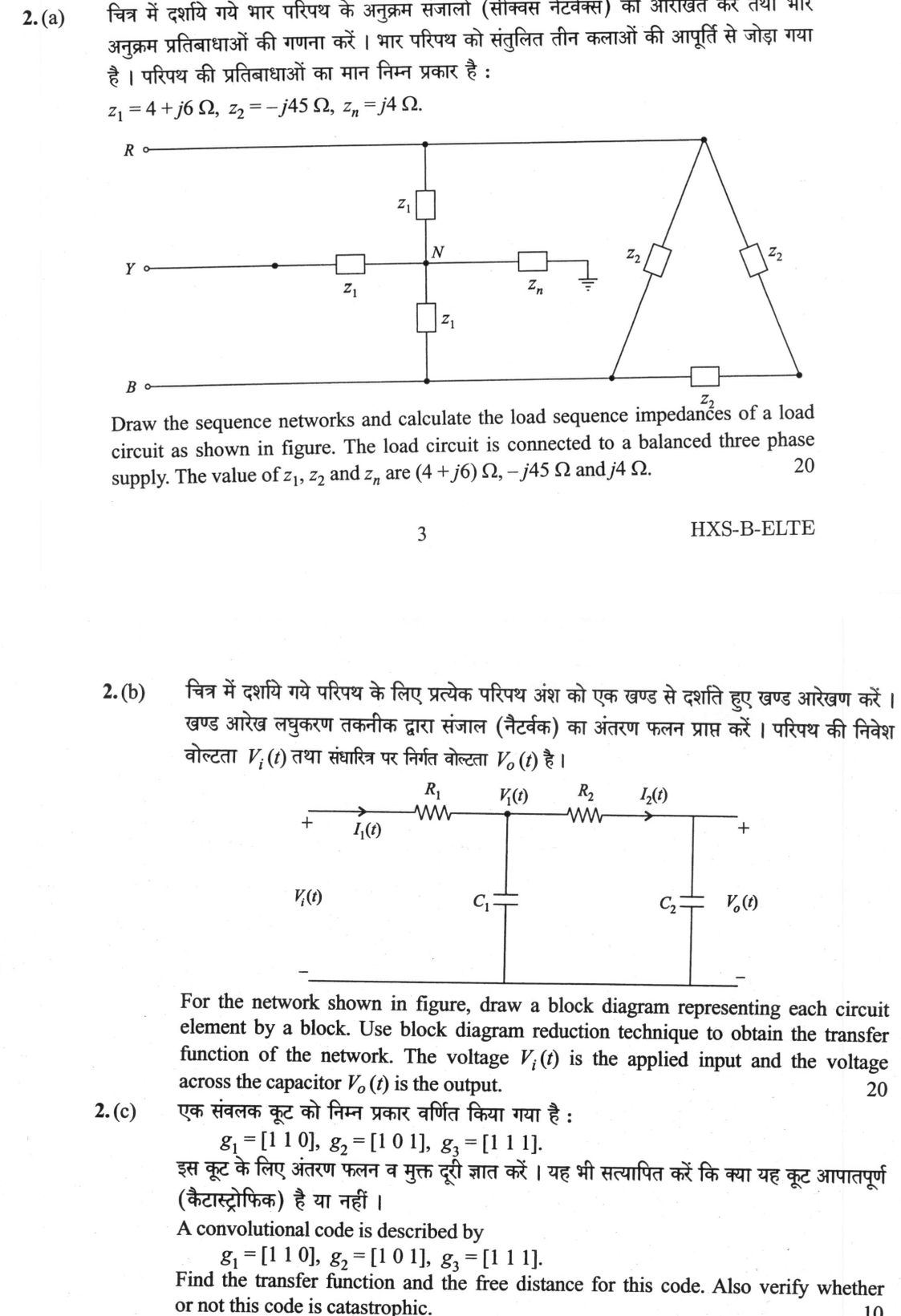
The figure this question refers to, in words
The question paper is a scan and the diagram did not survive as text. This is the figure as read from the original page — every component, value and label — so the question can be worked from the text below.
(a) A three-phase load circuit diagram connected to lines R, Y, and B. A star-connected load consists of three identical impedances z1 connected respectively to lines R, Y, and B, with their common point at neutral node N. The neutral node N is connected to ground through a neutral impedance zn. In parallel with the star load is a delta-connected load consisting of three identical impedances z2 forming a triangle. The top vertex of the delta is connected to line R, the left/bottom-left vertex is connected to line Y, and the bottom-right vertex is connected to line B.
(b) A two-stage RC ladder network. The input voltage Vi(t) is applied across the input terminals (+ at the top, - at the bottom rail). From the positive input terminal, current I1(t) flows to the right through a resistor R1 to an intermediate node labelled V1(t). A capacitor C1 is connected in shunt between the node V1(t) and the common bottom rail. From node V1(t), current I2(t) flows through a series resistor R2 to the output node. A capacitor C2 is connected in shunt between the output node and the bottom rail. The output voltage Vo(t) is taken across capacitor C2, with positive polarity at the top and negative at the bottom rail.
Model answer
Written by UPSC Answer Check against this question's marking rubric, to the expected length. UPSC does not publish answers for Mains — this is one way to score well, not an official key.
(a) For positive sequence, the neutral current is zero, so zn carries no current and the star neutral is effectively at ground potential. The delta load z₂ is replaced by its equivalent star impedance z₂/3. Hence the positive-sequence network is z₁ in parallel with z₂/3 between the line terminal and ground. The negative-sequence network is identical.
For zero sequence, the delta is open because zero-sequence line voltages produce zero line-to-line voltage across an ungrounded delta. The star phase current is I₀ and the neutral current is 3I₀, so the neutral impedance appears as 3zn in series with z₁. Thus the zero-sequence network is z₁ + 3zn between line and ground.
Given z₁ = 4 + j6 Ω, z₂ = –j45 Ω, zn = j4 Ω. Delta equivalent star: z₂/3 = –j45/3 = –j15 Ω.
Positive and negative sequence: Z₁ = Z₂ = z₁ || (z₂/3) = (4 + j6) || (–j15) = ((4 + j6)(–j15))/((4 + j6) + (–j15)) = (90 – j60)/(4 – j9) = (90 – j60)(4 + j9)/(4² + 9²) = (900 + j570)/97 Ω ≈ 9.28 + j5.88 Ω.
Zero sequence: Z₀ = z₁ + 3zn = (4 + j6) + 3(j4) = 4 + j18 Ω.
Final load sequence impedances: Z₁ = Z₂ = (900 + j570)/97 Ω ≈ 9.28 + j5.88 Ω, Z₀ = 4 + j18 Ω.
(b) Use Laplace transform and KCL. Let the node voltages be Vᵢ, V₁, V₀ and branch currents I₁, I₂.
Circuit equations: I₁ = (Vᵢ – V₁)/R₁ V₁ = (I₁ – I₂)/(sC₁) I₂ = (V₁ – V₀)/R₂ V₀ = I₂/(sC₂)
Block diagram:
- Vᵢ and –V₁ are summed, then passed through block 1/R₁ to give I₁.
- I₁ and –I₂ are summed, then passed through block 1/(sC₁) to give V₁.
- V₁ and –V₀ are summed, then passed through block 1/R₂ to give I₂.
- I₂ passes through block 1/(sC₂) to give V₀. Feedback lines: V₁ to the first summer, I₂ to the second summer, V₀ to the third summer.
Apply Mason’s gain formula to the equivalent signal-flow graph. Forward path: P₁ = (1/R₁)(1/(sC₁))(1/R₂)(1/(sC₂)) = 1/(s²R₁R₂C₁C₂).
Loops: L₁ = –(1/R₁)(1/(sC₁)) = –1/(sR₁C₁) L₂ = –(1/(sC₁))(1/R₂) = –1/(sR₂C₁) L₃ = –(1/R₂)(1/(sC₂)) = –1/(sR₂C₂)
Non-touching loop product: L₁L₃ = 1/(s²R₁R₂C₁C₂).
Determinant: Δ = 1 – (L₁ + L₂ + L₃) + L₁L₃ = 1 + 1/(sR₁C₁) + 1/(sR₂C₁) + 1/(sR₂C₂) + 1/(s²R₁R₂C₁C₂).
Cofactor of forward path: Δ₁ = 1. Therefore, H(s) = V₀(s)/Vᵢ(s) = P₁Δ₁/Δ = 1/[1 + s(R₁C₁ + R₂C₂ + R₁C₂) + s²R₁R₂C₁C₂].
Final transfer function: H(s) = 1/[1 + s(R₁C₁ + R₂C₂ + R₁C₂) + s²R₁R₂C₁C₂], for zero initial conditions.
(c)(i) Generator polynomials over GF(2): g₁(D) = 1 + D, g₂(D) = 1 + D², g₃(D) = 1 + D + D².
Encoder transfer matrix: G(D) = [1 + D, 1 + D², 1 + D + D²].
The state-diagram transfer function for error events is obtained from the four states 00, 10, 01, 11. Solving the state equations gives: T(D) = D⁷/(1 – D – D³).
(c)(ii) The first exponent in T(D) is 7, so the free distance is: d_free = 7.
Catastrophic check: g₂(D) = 1 + D² = (1 + D)² over GF(2). But g₃(1) = 1 + 1 + 1 = 1 ≠ 0 in GF(2), so g₃ is not divisible by 1 + D. Hence gcd(g₁, g₂, g₃) = 1. Since the generator polynomials have no common factor of positive degree, the code is not catastrophic.
What "Calculate" is asking you to do
Apply the standard formula or schedule to data the question has already supplied — a table of readings, cost records, a balance sheet — and produce the number. The method is rarely in doubt; the marks sit in the named intermediate quantities, each of which has to appear as a labelled line.
Structure that answers it
Data as given → formula or standard treatment, named → substitution → each intermediate, labelled → result with units
Where marks are lost
Omitting an intermediate the marking scheme pays for separately, or rounding at an intermediate line so the final figure drifts. In commerce and accountancy, any figure in a statement that no numbered working note supports is treated as unearned.
How this answer will be evaluated
Approach
(a) calculate: given > formula > substitution > result with units > interpretation | (b) derive: given > assumptions > stepwise derivation > result > check | (c) calculate: given > formula > substitution > result with units > interpretation Full marks: Complete sequence networks, correct block diagram reduction, accurate code analysis with all steps shown.
Key points expected
- Draw positive, negative, and zero sequence networks
- Calculate Z1, Z2, and Z0 using given z1, z2, zn
- Show impedance transformation for delta-wye conversion
- State final values with units (Ohms)
- Draw block diagram with each element as a block
- Apply block diagram reduction techniques
- Derive transfer function Vo(s)/Vi(s)
- Show intermediate reduction steps
Evaluation rubric
Each sub-part is marked on its own, against the marks and word limit printed on the paper.
- (a) Sequence networks and load sequence impedances for the given circuit. 20 marks
calculate— given → formula → substitution → result with units → interpretation
Must cover
- Draw positive, negative, and zero sequence networks
- Calculate Z1, Z2, and Z0 using given z1, z2, zn
- Show impedance transformation for delta-wye conversion
- State final values with units (Ohms)
Loses marks
- Missing sequence network diagrams
- Arithmetic errors in complex impedance calculation
- Confusion between positive and negative sequence networks
Earns more
- Correct identification of sequence components
- Clear labeling of network nodes
- Step-by-step arithmetic for complex numbers
Extra mark
- Phasor diagram illustrating sequence relationships
- (b) Block diagram and transfer function for the RC network. 20 marks
derive— given → assumptions → stepwise derivation → result → check
Must cover
- Draw block diagram with each element as a block
- Apply block diagram reduction techniques
- Derive transfer function Vo(s)/Vi(s)
- Show intermediate reduction steps
Loses marks
- Incorrect block diagram structure
- Algebraic errors in reduction process
- Missing intermediate steps in derivation
Earns more
- Correct representation of summing points
- Accurate algebraic manipulation of blocks
- Final simplified transfer function
Extra mark
- Verification of result using nodal analysis
- (c) Transfer function, free distance, and catastrophic check for convolutional code. 10 marks
calculate— given → formula → substitution → result with units → interpretation
Must cover
- Determine transfer function from generator polynomials
- Calculate free distance (dfree) of the code
- Verify if code is catastrophic
- Show state diagram or trellis for analysis
Loses marks
- Incorrect transfer function derivation
- Wrong free distance calculation
- Failure to check for catastrophic nature
Earns more
- Correct identification of generator polynomials
- Accurate calculation of minimum weight path
- Clear explanation of catastrophic condition
Extra mark
- Trellis diagram showing minimum weight path
Practice this exact question
Write your answer and it is marked point by point against the model answer above — what you covered, what you missed, what you got wrong.
Evaluate my answer →More from Electrical Engineering 2021 Paper II
- Q1 (a) A system is described by the following state equations : dotx₁ = x₁ + x₂ + 3x₃ dotx₂…
- Q2 (a) Draw the sequence networks and calculate the load sequence impedances of a load circu…
- Q3 3.(a) A solidly earthed 400 KV, 3 phase busbar system is connected with two incoming and…
- Q4 4.(a)(i) The configuration of a 400 KV 3 phase line is shown in figure. The radius of eac…
- Q5 (a) Explain the ratio error and phase angle error of current transformer. 10 marks (b) Th…