Paper II — Q3
3.(a) A solidly earthed 400 KV, 3 phase busbar system is connected with two incoming and four outgoing lines (feeders). A…
3.(a) A solidly earthed 400 KV, 3 phase busbar system is connected with two incoming and four outgoing lines (feeders). A differential protection is provided with switchgear of 4000 MVA capacity having the following parameters:
CT secondary resistance = 0.8 Ω Lead wire resistance = 1.2 Ω Relay load = 1.0 Ω CT magnetization current = 0.3 mA/V Max. full load current in one feeder = 100 A Voltage setting of over current relay = 100 V
If the O.C. relay in the spill path is set at 1.0 A, find the following:
The maximum 'through fault' current up to which the protection scheme remains stable. 20 marks
Whether the switchgear is capable to handle maximum through fault current. 20 marks
The value of minimum internal fault current that can be detected by protection scheme. 20 marks
The pick-up setting for detecting minimum internal fault current of 90 Amp. 20 marks
3.(b) Consider a signal detector with an input
r = ±A + n
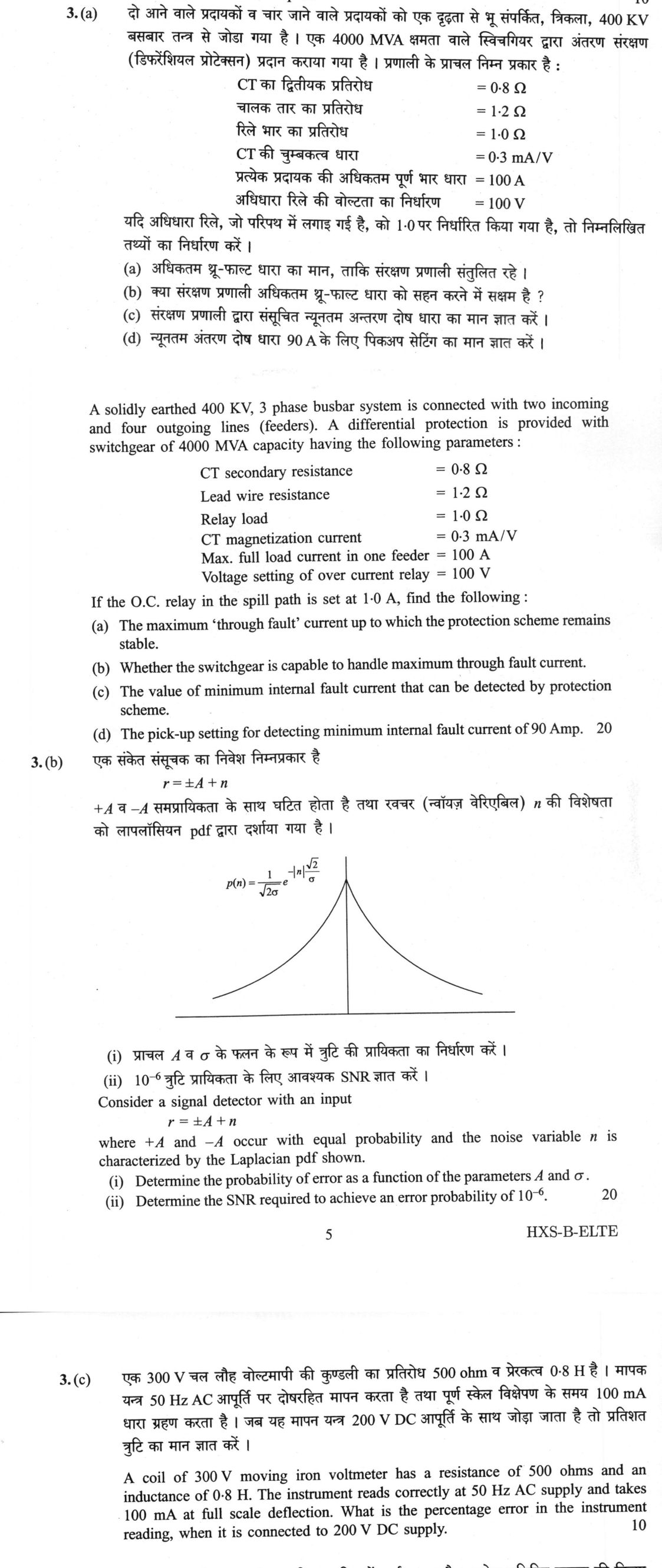
where +A and −A occur with equal probability and the noise variable n is characterized by the Laplacian pdf shown.
p(n) = (1/√2σ) e^(-|n|√2/σ)
Determine the probability of error as a function of the parameters A and σ. 20 marks
Determine the SNR required to achieve an error probability of 10^(-6). 20 marks
3.(c) A coil of 300 V moving iron voltmeter has a resistance of 500 ohms and an inductance of 0.8 H. The instrument reads correctly at 50 Hz AC supply and takes 100 mA at full scale deflection. What is the percentage error in the instrument reading, when it is connected to 200 V DC supply. 10 marks
हिंदी में प्रश्न पढ़ें
3.(a) दो आने वाले प्रदायकों व चार जाने वाले प्रदायकों को एक दृढ़ता से भू संपर्कित, त्रिकला, 400 KV बसबार तंत्र से जोड़ा गया है । एक 4000 MVA क्षमता वाले सिचंगियर द्वारा अंतरण संरक्षण (डिफरेंशियल प्रोटेक्शन) प्रदान कराया गया है । प्रणाली के प्राचल निम्न प्रकार हैं :
CT का द्वितीयक प्रतिरोध = 0.8 Ω चालक तार का प्रतिरोध = 1.2 Ω रिले भार का प्रतिरोध = 1.0 Ω CT की चुंबकत्व धारा = 0.3 mA/V प्रत्येक प्रदायक की अधिकतम पूर्ण भार धारा = 100 A अधिधारा रिले की बोल्टता का निर्धारण = 100 V
यदि अधिधारा रिले, जो परिपथ में लगाई गई है, को 1.0 पर निर्धारित किया गया है, तो निम्नलिखित तथ्यों का निर्धारण करें ।
अधिकतम शु-फाल्ट धारा का मान, ताकि संरक्षण प्रणाली संतुलित रहे । 20 marks
क्या संरक्षण प्रणाली अधिकतम शु-फाल्ट धारा को सहन करने में सक्षम है ? 20 marks
संरक्षण प्रणाली द्वारा संसूचित न्यूनतम अंतरण दोष धारा का मान ज्ञात करें । 20 marks
न्यूनतम अंतरण दोष धारा 90 A के लिए पिकअप सेटिंग का मान ज्ञात करें । 20 marks
3.(b) एक संकेत संसूचक का निवेश निम्नप्रकार है
r = ±A + n
+A व −A समप्रायिकता के साथ घटित होता है तथा रवर (नॉयज वेरिएबल) n की विशेषता को लाप्लासियन pdf द्वारा दर्शाया गया है ।
p(n) = (1/√2σ) e^(-|n|√2/σ)
प्राचल A व σ के फलन के रूप में त्रुटि की प्रायिकता का निर्धारण करें । 20 marks
10^(-6) त्रुटि प्रायिकता के लिए आवश्यक SNR ज्ञात करें । 20 marks
3.(c) एक 300 V चल लोहे वोल्टमापी की कुण्डली का प्रतिरोध 500 ohm व प्रेरकत्व 0.8 H है । मापक यंत्र 50 Hz AC आपूर्ति पर दोषरहित मापन करता है तथा पूर्ण स्केल विचेषण के समय 100 mA धारा ग्रहण करता है । जब यह मापन यंत्र 200 V DC आपूर्ति के साथ जोड़ा जाता है तो प्रतिशत त्रुटि का मान ज्ञात करें । 10 marks
Model answer
Written by UPSC Answer Check against this question's marking rubric, to the expected length. UPSC does not publish answers for Mains — this is one way to score well, not an official key.
3(a)(a) Using the high-impedance busbar differential stability criterion, the voltage setting is V_s = I_f,sec (R_CT + R_L + R_relay).
The CT ratio is taken as 100/1, since the maximum feeder full-load current is 100 A and the relay setting is in secondary amperes.
R_total = 0.8 Ω + 1.2 Ω + 1.0 Ω = 3.0 Ω.
Therefore, I_f,sec = V_s / R_total = 100 V / 3.0 Ω = 100/3 A = 33.333 A.
Primary through-fault current: I_f,primary = I_f,sec × CT ratio = (100/3) × 100 = 10000/3 A = 3333.33 A.
Final: maximum through-fault current up to which the protection remains stable = 3333.33 A ≈ 3.333 kA.
3(a)(b) The switchgear capacity is 4000 MVA at 400 kV. Its current capacity is I_sw = S / (√3 V) = (4000 × 10⁶) / (√3 × 400 × 10³) = 5773.5 A.
Comparing with the maximum stable through-fault current, I_sw = 5773.5 A > 3333.33 A.
Hence the switchgear can handle the maximum through-fault current.
Final: the switchgear is capable.
3(a)(c) At the voltage setting V_s = 100 V, the magnetizing current per CT is I_m = 0.3 mA/V × 100 V = 0.03 A.
Number of CTs = 2 incoming + 4 outgoing = 6.
Total CT magnetizing current: I_m,total = 6 × 0.03 A = 0.18 A.
The spill-path overcurrent relay is set at 1.0 A. Therefore, the minimum secondary differential current required to operate the relay is I_min,sec = 1.0 A + 0.18 A = 1.18 A.
Primary minimum internal fault current: I_min,primary = 1.18 × 100 = 118 A.
Final: minimum internal fault current detectable = 118 A.
3(a)(d) A minimum internal fault current of 90 A corresponds to secondary current I_sec = 90 / 100 = 0.90 A.
The CT magnetizing current to be supplied is 0.18 A. Hence the net relay current available is I_pick-up = 0.90 − 0.18 = 0.72 A.
Final: required pick-up setting = 0.72 A.
3(b)(i) The signal is antipodal: +A and −A with equal probability. The optimum decision threshold is zero. An error occurs when +A is sent and r < 0, i.e. n < −A, or when −A is sent and n > A. By symmetry, P_e = P(n > A) = ∫_A^∞ (1/√2 σ) e^(−√2 n/σ) dn.
Let α = √2/σ. Then P_e = (1/√2 σ) ∫_A^∞ e^(−α n) dn = (1/√2 σ) · (1/α) e^(−α A) = (1/√2 σ) · (σ/√2) e^(−√2 A/σ) = 0.5 e^(−√2 A/σ).
Final: P_e = 0.5 e^(−√2 A/σ).
3(b)(ii) Let the power SNR be SNR = A² / σ².
Then A/σ = √SNR, so P_e = 0.5 e^(−√(2 SNR)).
Set P_e = 10⁻⁶: 0.5 e^(−√(2 SNR)) = 10⁻⁶ e^(−√(2 SNR)) = 2 × 10⁻⁶ √(2 SNR) = ln(5 × 10⁵) = 13.12236.
Thus 2 SNR = (13.12236)² = 172.1964 SNR = 86.098 ≈ 86.10.
In decibels, SNR_dB = 10 log₁₀(86.10) = 19.35 dB.
Final: required SNR ≈ 86.10 (power ratio), i.e. 19.35 dB. Equivalently, A/σ ≈ 9.28.
3(c) At 50 Hz, X_L = 2π f L = 2π × 50 × 0.8 = 80π Ω ≈ 251.33 Ω.
At full-scale AC deflection, current = 100 mA = 0.1 A and voltage = 300 V. Hence total AC impedance is Z = 300 / 0.1 = 3000 Ω.
The total circuit resistance is R = √(Z² − X_L²) = √(3000² − (80π)²) = √(9,000,000 − 63165.47) = 2989.45 Ω.
On 200 V DC, the inductive reactance is zero. Therefore, I_DC = 200 / 2989.45 = 0.066902 A.
The AC-calibrated moving-iron instrument will indicate the equivalent AC voltage: V_ind = I_DC × Z = 0.066902 × 3000 = 200.706 V.
Percentage error: % error = (V_ind − 200) / 200 × 100 = (3000 / 2989.45 − 1) × 100 = 0.3528%.
Final: percentage error ≈ 0.353%, the reading being slightly high.
What "Calculate" is asking you to do
Apply the standard formula or schedule to data the question has already supplied — a table of readings, cost records, a balance sheet — and produce the number. The method is rarely in doubt; the marks sit in the named intermediate quantities, each of which has to appear as a labelled line.
Structure that answers it
Data as given → formula or standard treatment, named → substitution → each intermediate, labelled → result with units
Where marks are lost
Omitting an intermediate the marking scheme pays for separately, or rounding at an intermediate line so the final figure drifts. In commerce and accountancy, any figure in a statement that no numbered working note supports is treated as unearned.
How this answer will be evaluated
Approach
Framework: Electrical Engineering, Paper 2. (a) calculate: given > formula > substitution > result with units > interpretation | (b) evaluate: criteria > evidence > balanced judgment | (c) calculate: given > formula > substitution > result with units > interpretation | (d) calculate: given > formula > substitution > result with units > interpretation | (b(i)) derive: given > assumptions > stepwise derivation > result > check | (b(ii)) calculate: given > formula > substitution > result with units > interpretation | (c) calculate: given > formula > substitution > result with units > interpretation Full marks: All calculations correct with clear steps, proper units, and physical interpretation
Key points expected
- Calculate total secondary impedance (CT + lead + relay)
- Determine CT secondary voltage at 100V relay setting
- Calculate CT magnetization current at that voltage
- Subtract magnetization current from 1.0A spill setting
- Calculate switchgear rated current from 4000 MVA and 400 kV
- Compare rated current with maximum through fault current
- State clearly if switchgear is capable or not
- Determine relay pickup current (1.0 A)
Evaluation rubric
Each sub-part is marked on its own, against the marks and word limit printed on the paper.
- (a) Maximum through fault current for stability
calculate— given → formula → substitution → result with units → interpretation
Must cover
- Calculate total secondary impedance (CT + lead + relay)
- Determine CT secondary voltage at 100V relay setting
- Calculate CT magnetization current at that voltage
- Subtract magnetization current from 1.0A spill setting
Loses marks
- Omitting CT secondary resistance from total impedance
- Confusing primary and secondary current values
Earns more
- Explicit calculation of total secondary resistance (3.0 Ω)
- Correct unit conversion for magnetization current
Extra mark
- Sketch of differential protection circuit with spill path
- (b) Switchgear capability vs. calculated fault current
evaluate— criteria → evidence → balanced judgment
Must cover
- Calculate switchgear rated current from 4000 MVA and 400 kV
- Compare rated current with maximum through fault current
- State clearly if switchgear is capable or not
Loses marks
- Using single-phase power formula for 3-phase system
- Failing to state a clear conclusion
Earns more
- Correct use of 3-phase power formula for rated current
Extra mark
- Mention of standard switchgear breaking capacity limits
- (c) Minimum detectable internal fault current
calculate— given → formula → substitution → result with units → interpretation
Must cover
- Determine relay pickup current (1.0 A)
- Calculate CT magnetization current at relay voltage
- Add pickup and magnetization currents for minimum fault
Loses marks
- Subtracting instead of adding magnetization current
- Ignoring the 1.0A relay setting
Earns more
- Clear distinction between spill path and relay path currents
Extra mark
- Discussion of CT saturation effects on detection
- (d) Pick-up setting for 90A minimum fault
calculate— given → formula → substitution → result with units → interpretation
Must cover
- Determine required relay current for 90A fault
- Calculate magnetization current at new operating voltage
- Set relay pickup to ensure 90A fault detection
Loses marks
- Assuming magnetization current is constant
- Not accounting for the 90A target in calculation
Earns more
- Iterative calculation if voltage changes with setting
Extra mark
- Verification that new setting maintains stability
- (b(i)) Probability of error function for A and σ
derive— given → assumptions → stepwise derivation → result → check
Must cover
- Set up integral for error probability over Laplacian pdf
- Integrate from 0 to infinity for one error case
- Multiply by 1/2 for equal probability of ±A
- Express final result in terms of A and σ
Loses marks
- Incorrect integration limits for Laplacian pdf
- Forgetting the 1/2 factor for equal probability
Earns more
- Correct limits of integration for Laplacian distribution
- Clear step-by-step integration process
Extra mark
- Comparison with Gaussian noise error probability
- (b(ii)) SNR for 10^-6 error probability
calculate— given → formula → substitution → result with units → interpretation
Must cover
- Set derived error probability equal to 10^-6
- Solve for A/σ ratio
- Convert A/σ to SNR using appropriate definition
- Express final SNR in linear or dB form
Loses marks
- Incorrect SNR definition for Laplacian noise
- Algebraic errors in solving for A/σ
Earns more
- Correct definition of SNR for this signal model
- Clear algebraic steps to solve for A/σ
Extra mark
- Comparison with required SNR for Gaussian noise
- (c) Percentage error for 200V DC supply
calculate— given → formula → substitution → result with units → interpretation
Must cover
- Calculate AC impedance at 50Hz (R + jωL)
- Determine current at 300V AC for full scale
- Calculate DC current at 200V (R only)
- Compare DC current to full scale for percentage error
Loses marks
- Using AC impedance for DC calculation
- Incorrect percentage error formula
Earns more
- Correct calculation of inductive reactance at 50Hz
- Clear distinction between AC and DC impedance
Extra mark
- Discussion of why moving iron instruments differ on DC
Practice this exact question
Write your answer and it is marked point by point against the model answer above — what you covered, what you missed, what you got wrong.
Evaluate my answer →More from Electrical Engineering 2021 Paper II
- Q1 (a) A system is described by the following state equations : dotx₁ = x₁ + x₂ + 3x₃ dotx₂…
- Q2 (a) Draw the sequence networks and calculate the load sequence impedances of a load circu…
- Q3 3.(a) A solidly earthed 400 KV, 3 phase busbar system is connected with two incoming and…
- Q4 4.(a)(i) The configuration of a 400 KV 3 phase line is shown in figure. The radius of eac…
- Q5 (a) Explain the ratio error and phase angle error of current transformer. 10 marks (b) Th…
- Q6 (a) A synchronous machine is connected to an infinite bus through a transformer and a dou…