Paper II — Q7
(a) Discuss the percentage differential Relay with harmonic restraint with the help of diagram and also draw the conceptual…
Discuss the percentage differential Relay with harmonic restraint with the help of diagram and also draw the conceptual representation of it. 20 marks
A sinusoidal voltage of 10 V amplitude at 100 Hz is applied to a lead network shown in figure. The phase difference between the input voltage Vᵢ(t) and output voltage Vₒ(t) is 44.43°. If C = 0.1 μ F and R₁ = 100 kΩ, determine the value of R₂ and the magnitude of steady state output voltage. 20 marks
Consider a connected graph G = (N, A) with N nodes and A arcs, and a weight ωij for each arc (i, j)∈A.
Define minimum weight spanning tree (MST).
If all arc weights of G are distinct, prove that there exists a unique MST. 10 marks
हिंदी में प्रश्न पढ़ें
आरेख की सहायता से प्रतिशत विभेदी रिले का संयमित हार्मोनिक्स व्यवस्था समेत वर्णन करें व इसके संकल्पनात्मक प्रतिनिधित्व का आरेख बनाएं | (20 अंक)
चित्र में दर्शाए गए अग्रता संजाल में 10 V आयाम, 100 Hz की ज्यावक्रीय वोल्टता को अनुप्रयुक्त किया गया है | निवेश वोल्टता Vᵢ(t) व निर्गत वोल्टता Vₒ(t) में 44.43° का कलांतर है | यदि C = 0.1 μ F व R₁ = 100 kΩ है तो R₂ के मान का निर्धारण करें तथा स्थिर अवस्था में निर्गत वोल्टता के परिमाण की गणना करें | (20 अंक)
एक संयोजित आरेख (ग्राफ) G = (N, A) में N नोड्स, A चाप (आर्क) व प्रत्येक चाप का मान (वेट) ωij है (i, j)∈A |
न्यूनतम वेट स्पार्निंग ट्री (MST) को परिभाषित करें |
यदि G के सभी चाप का मान (वेट) भिन्न है तो सिद्ध करें कि एक विशिष्ट MST विद्यमान है | (10 अंक)
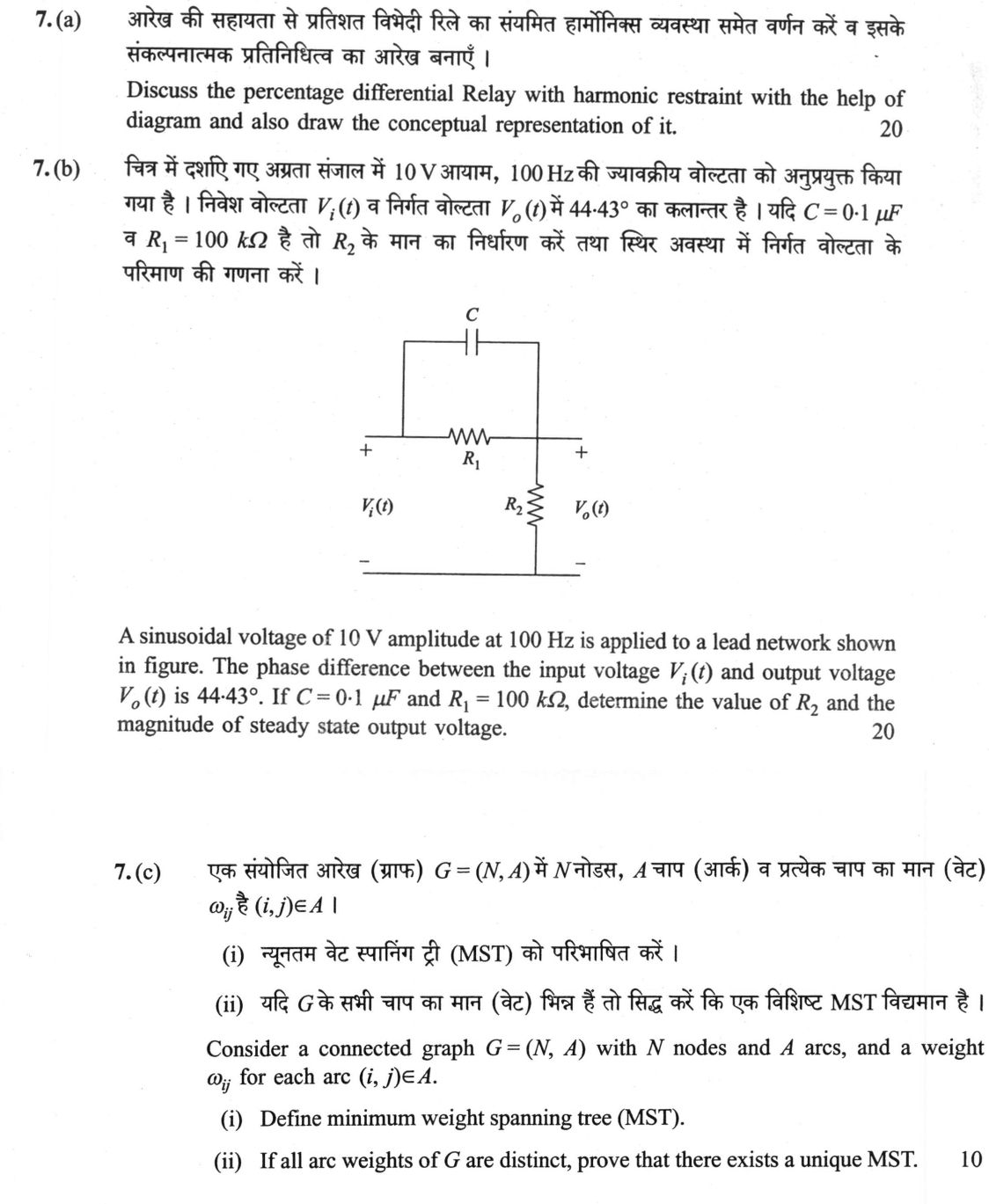
The figure this question refers to, in words
The question paper is a scan and the diagram did not survive as text. This is the figure as read from the original page — every component, value and label — so the question can be worked from the text below.
(b) A lead network circuit diagram. The input voltage Vi(t) is applied across a parallel combination of a capacitor C and a resistor R1. This parallel combination is connected in series with a resistor R2. The output voltage Vo(t) is measured across the resistor R2. The bottom wire serves as the common ground reference for both input and output. The components are labeled C, R1, and R2. The input terminals are marked with + and - signs, and the output terminals are marked with + and - signs.
Model answer
Written by UPSC Answer Check against this question's marking rubric, to the expected length. UPSC does not publish answers for Mains — this is one way to score well, not an official key.
Percentage differential relay with harmonic restraint. Differential protection compares the currents entering and leaving a protected zone. For a transformer, CTs on the HV and LV sides, after ratio correction, give I_HV and I_LV. The operating current is I_op = |I_HV - I_LV|, and the restraint current is Iᵣ = (I_HV + I_LV)/2. A percentage relay trips when I_op > I_set + k Iᵣ, where k is the slope. The slope is usually 15-20% because it must tolerate CT saturation, ratio error, tap-changer position and external faults, while retaining sensitivity to internal faults. The pickup setting is normally a small value, such as 0.2-0.5 A or 5-10% of rated current, so that the relay is secure for through faults but sensitive to internal faults. Conceptually, the characteristic is a straight line starting from the pickup point on the I_op axis and rising with slope k; below the line is the restraint/no-trip region, above it the operating/trip region. A sketch would plot I_op vertically and Iᵣ horizontally.
A block diagram would show CTs feeding a differential current transformer or digital comparator; the difference current drives the operating coil, while the sum current drives the restraint coil or bias winding. A second-harmonic filter, analogue or digital, samples the CT current and forms the ratio I₂/I₁. The trip logic is: trip only if (I_op > I_set + k Iᵣ) and (I₂/I₁ < 15-20%). During transformer energisation, magnetising inrush is large, unbalanced and rich in second harmonic; without restraint the relay would maloperate. Harmonic restraint therefore blocks the trip during inrush but remains available for genuine internal faults. This is standard in NTPC and state electricity board transformer protection, especially at 220 kV and 400 kV levels.
Lead network. For the described circuit, R₁ is in parallel with C, and this combination is in series with R₂, with Vₒ across R₂. Thus Z₁ = R₁ || 1/(jωC) = R₁/(1+jωCR₁). The transfer function is H = Vₒ/Vᵢ = R₂/(R₂+Z₁) = R₂(1+jωCR₁)/(R₁+R₂+jωCR_1R₂). Hence the output leads the input by φ = tan⁻¹[ωCR_1R₂/(R₁+R₂)]. Equivalently, the lag of Vᵢ relative to Vₒ has tangent (R₁+R₂)/(ωCR_1R₂). Given f = 100 Hz, ω = 2π100 = 628.3 rad/s, C = 0.1 μF, R₁ = 100 kΩ, so ωCR₁ = 6.283. With tan 44.43° ≈ 0.980, 6.283 R₂/(100+R₂) = 0.980, giving R₂ ≈ 18.5 kΩ. The magnitude is |H| = R₂ sqrt[1+(ωCR₁)²] / sqrt[(R₁+R₂)²+(ωCR_1R₂)²] ≈ 0.709. Therefore the steady-state output amplitude is |Vₒ| = 10 × 0.709 ≈ 7.09 V.
Minimum weight spanning tree. A spanning tree of a connected graph G = (N, A) is a connected, acyclic subgraph containing all N nodes and exactly N-1 arcs. A minimum weight spanning tree (MST) is a spanning tree whose total arc weight is minimum among all spanning trees.
If all arc weights are distinct, the MST is unique. Suppose two MSTs T₁ and T₂ exist. Since they differ, choose an arc e in T₁ but not T₂. Adding e to T₂ creates a unique cycle. This cycle must contain some arc f in T₂ but not T₁; otherwise T₁ would contain the same cycle. Because weights are distinct, either w(e) < w(f) or w(f) < w(e). If w(e) < w(f), replacing f by e in T₂ gives a lighter spanning tree, contradicting minimality of T₂. If w(f) < w(e), replacing e by f in T₁ gives a lighter spanning tree, contradicting minimality of T₁. Hence T₁ and T₂ cannot be distinct, so the MST is unique. In practice, Kruskal or Prim algorithms find the MST, and the uniqueness theorem assures that the least-cost connected topology is unambiguous when costs are distinct. This result supports least-cost transmission network planning, where utilities seek a connected, loop-free grid at minimum cost.
What "Discuss" is asking you to do
Lay the issue out from more than one side — how it arose, what is claimed for it, what is held against it, and where it now stands. UPSC attaches discuss to broad topics with several live dimensions, so coverage of the dimensions earns more than the strength of your opinion.
Structure that answers it
Set the issue up → the case as it is made → the case against → the dimension both sides leave out → where the balance now lies
Where marks are lost
Listing facts with no thread between them, or arguing one side throughout and calling it a discussion.
How this answer will be evaluated
Approach
(a) discuss: intro > 3-4 dimensions > example > balanced close | (b) calculate: given > formula > substitution > result with units > interpretation | (c(i)) define: precise definition > the distinguishing feature > one example | (c(ii)) justify: claim > 3-4 reasons > evidence > conclusion Full marks: Complete diagrams, correct calculations with units, rigorous proof of MST uniqueness.
Key points expected
- Diagram of relay with CTs and restraint coils
- Definition of percentage differential principle
- Explanation of harmonic restraint (2nd/3rd harmonic)
- Conceptual block diagram of the relay
- Circuit analysis using phasors or impedance
- Calculation of R2 from phase angle
- Calculation of output voltage magnitude
- Correct units for R2 and Vo
Evaluation rubric
Each sub-part is marked on its own, against the marks and word limit printed on the paper.
- (a) Explain percentage differential relay operation and harmonic restraint logic with diagrams. 20 marks
discuss— intro → 3-4 dimensions → example → balanced close
Must cover
- Diagram of relay with CTs and restraint coils
- Definition of percentage differential principle
- Explanation of harmonic restraint (2nd/3rd harmonic)
- Conceptual block diagram of the relay
Loses marks
- Missing restraint coil in diagram
- Confusing differential with overcurrent relay
Earns more
- Mention of CT saturation effects
- Explanation of 2nd harmonic ratio
Extra mark
- Comparison with non-percentage differential relay
- (b) Determine R2 and steady-state output voltage magnitude for the given lead network. 20 marks
calculate— given → formula → substitution → result with units → interpretation
Must cover
- Circuit analysis using phasors or impedance
- Calculation of R2 from phase angle
- Calculation of output voltage magnitude
- Correct units for R2 and Vo
Loses marks
- Incorrect impedance formula for lead network
- Missing units in final answer
Earns more
- Phasor diagram of input and output
- Step-by-step impedance calculation
Extra mark
- Verification of phase angle calculation
- (c(i)) Define minimum weight spanning tree (MST) for a connected graph.
define— precise definition → the distinguishing feature → one example
Must cover
- Definition of spanning tree
- Definition of minimum weight property
- Reference to connected graph G
Loses marks
- Confusing MST with shortest path
- Missing 'minimum weight' in definition
Earns more
- Mention of N-1 edges in MST
Extra mark
- Example of MST in a small graph
- (c(ii)) Prove uniqueness of MST when all arc weights are distinct.
justify— claim → 3-4 reasons → evidence → conclusion
Must cover
- Proof by contradiction or exchange argument
- Use of distinct weight assumption
- Logical conclusion of uniqueness
Loses marks
- Assuming uniqueness without proof
- Incorrect exchange argument
Earns more
- Clear step-by-step proof structure
- Reference to cut property or cycle property
Extra mark
- Example illustrating non-uniqueness with equal weights
Practice this exact question
Write your answer and it is marked point by point against the model answer above — what you covered, what you missed, what you got wrong.
Evaluate my answer →More from Electrical Engineering 2021 Paper II
- Q4 4.(a)(i) The configuration of a 400 KV 3 phase line is shown in figure. The radius of eac…
- Q5 (a) Explain the ratio error and phase angle error of current transformer. 10 marks (b) Th…
- Q6 (a) A synchronous machine is connected to an infinite bus through a transformer and a dou…
- Q7 (a) Discuss the percentage differential Relay with harmonic restraint with the help of di…
- Q8 (a)(i) Prove that the minimum distance of any linear (n, k) block code satisfies dmin ≤ 1…