Paper II — Q5
(a) Explain the ratio error and phase angle error of current transformer. 10 marks (b) The two top rows of a Routh table of a…
Explain the ratio error and phase angle error of current transformer. 10 marks
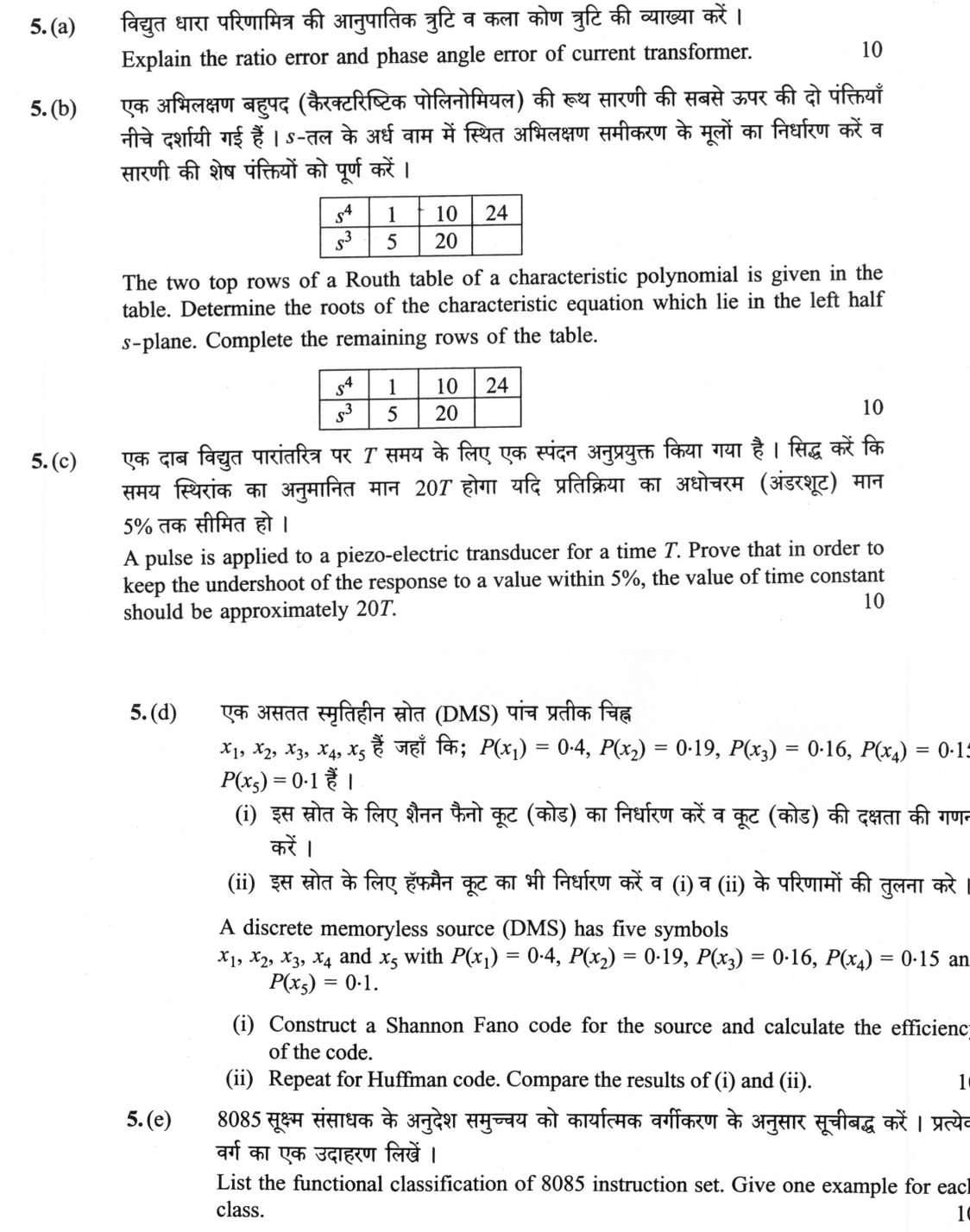
The two top rows of a Routh table of a characteristic polynomial is given in the table. Determine the roots of the characteristic equation which lie in the left half s-plane. Complete the remaining rows of the table. 10 marks
A pulse is applied to a piezo-electric transducer for a time T. Prove that in order to keep the undershoot of the response to a value within 5%, the value of time constant should be approximately 20T. 10 marks
A discrete memoryless source (DMS) has five symbols x₁, x₂, x₃, x₄ and x₅ with P(x₁) = 0·4, P(x₂) = 0·19, P(x₃) = 0·16, P(x₄) = 0·15 and P(x₅) = 0·1. Construct a Shannon Fano code for the source and calculate the efficiency of the code.
Repeat for Huffman code. Compare the results of (i) and (ii). 10 marks
List the functional classification of 8085 instruction set. Give one example for each class. 10 marks
हिंदी में प्रश्न पढ़ें
विद्युत धारा परिणामित्र की अनुपातिक त्रुटि व कला कोण त्रुटि की व्याख्या करें । 10
एक अभिलक्षण बहुपद (कैरेक्टरिस्टिक पॉलिनोमियल) की रूथ सारणी की सबसे ऊपर की दो पंक्तियाँ नीचे दर्शायी गई हैं । s-तल के अर्ध बाम में स्थित अभिलक्षण समीकरण के मूलों का निर्धारण करें व सारणी की शेष पंक्तियों को पूर्ण करें । 10
एक दाब विद्युत पारातंत्र पर T समय के लिए एक स्पंदन अनुप्रयुक्त किया गया है । सिद्ध करें कि समय स्थिरांक का अनुमानित मान 20T होगा यदि प्रतिक्रिया का अधोचरम (अंडरशूट) मान 5% तक सीमित हो । 10
एक असतत स्मृतिहीन स्रोत (DMS) पांच प्रतीक चिह्न x₁, x₂, x₃, x₄, x₅ हैं जहाँ कि; P(x₁) = 0·4, P(x₂) = 0·19, P(x₃) = 0·16, P(x₄) = 0·15, P(x₅) = 0·1 है । इस स्रोत के लिए शैनन फैनो कूट (कोड) का निर्धारण करें व कूट (कोड) की दक्षता की गणना करें ।
इस स्रोत के लिए हफमैन कूट का भी निर्धारण करें व (i) व (ii) के परिणामों की तुलना करें । 10
8085 सूक्ष्म संसाधक के अनुदेश समुच्चय को कार्यात्मक वर्गीकरण के अनुसार सूचीबद्ध करें । प्रत्येक वर्ग का एक उदाहरण लिखें । 10
The figure this question refers to, in words
The question paper is a scan and the diagram did not survive as text. This is the figure as read from the original page — every component, value and label — so the question can be worked from the text below.
(b) A table with two rows and three columns. The first column contains the row labels 's^4' and 's^3'. The second row of the table contains the values '1', '10', and '24'. The third row of the table contains the values '5', '20', and an empty cell.
Model answer
Written by UPSC Answer Check against this question's marking rubric, to the expected length. UPSC does not publish answers for Mains — this is one way to score well, not an official key.
(a) Current-transformer error A current transformer is not an ideal current source; its excitation current I0 distorts both the magnitude and phase of the secondary current. Let Ip be the primary current, Is the secondary current, and Kn the nominal ratio, so that ideally Kn Is = Ip. The ratio error is (Kn Is - Ip)/Ip × 100%. It is usually negative because a part of the primary ampere-turns is consumed by I0, making Is smaller than the ideal value. The phase angle error δ is the angle between Ip and the reversed secondary current -Is. It arises because I0 has a magnetizing component lagging the flux and a core-loss component in phase with the flux. In the phasor diagram, Ip is the vector sum of the ideal secondary component (Ns/Np)Is and I0; the small angle between Ip and -Is is δ. These errors are important in Indian power-grid metering and protection, where CT class affects revenue metering and relay operation. They are reduced by using a high-permeability core to lower I0, stranded conductors to reduce leakage and circulating effects, and minimizing the secondary burden to keep core loss and secondary voltage low.
(b) Routh table and left-half-plane roots Using the given top rows, the characteristic polynomial is s^4 + 5s^3 + 10s^2 + 20s + 24. The Routh recurrence gives the s^2 row as (5×10 - 1×20)/5 = 6 and (5×24 - 1×0)/5 = 24. The next row initially gives (6×20 - 5×24)/6 = 0, so the auxiliary polynomial is formed from the s^2 row: 6s^2 + 24 = 0. Its derivative, 12s, replaces the zero row. The completed table is: s^4 row 1, 10, 24; s^3 row 5, 20, 0; s^2 row 6, 24, 0; s^1 row 12, 0, 0; s^0 row 24, 0, 0. The first column has no sign change, so there are no right-half-plane roots. The auxiliary equation gives s = ±j2, two roots on the imaginary axis. Since the polynomial is fourth degree, the remaining two roots lie in the left half s-plane. Factoring confirms (s^2 + 4)(s^2 + 5s + 6) = 0, so the left-half-plane roots are s = -2 and s = -3.
(c) Piezoelectric transducer undershoot For a piezoelectric transducer, the generated charge is q = dF, and the equivalent parallel RC circuit gives C dv/dt + v/τ = dq/dt, where τ = RC. For a step force F0, the output is v(t) = dF0 e^(-t/τ). A rectangular pulse of duration T is a step applied at t = 0 and removed at t = T, so for t > T the response is v(t) = dF0(e^(-t/τ) - e^(-(t-T)/τ)). Immediately after the pulse ends, at t = T+, the response is v(T+) = dF0(e^(-T/τ) - 1) = -dF0(1 - e^(-T/τ)), which is the undershoot relative to the initial positive step dF0. To keep this undershoot within 5%, 1 - e^(-T/τ) ≤ 0.05. Hence e^(-T/τ) ≥ 0.95, so T/τ ≤ -ln 0.95 = 0.0513. Therefore τ ≥ T/0.0513 ≈ 19.5T, which is normally taken as τ ≈ 20T.
(d)(i) Shannon-Fano code Sort the probabilities as 0.40, 0.19, 0.16, 0.15, 0.10. The first split is after x2 because 0.40 + 0.19 = 0.59 is closer to 0.5 than 0.40 is; assign 0 to x1 and x2, and 1 to x3, x4 and x5. Subdividing gives x1 = 00, x2 = 01. In the 1-group, split after x3, giving x3 = 10 and x4, x5 = 11; then x4 = 110 and x5 = 111. The code lengths are 2, 2, 2, 3 and 3, so L = 0.40×2 + 0.19×2 + 0.16×2 + 0.15×3 + 0.10×3 = 2.25 bits/symbol. The entropy is H = -Σ p log2 p = 0.40 log2(1/0.40) + 0.19 log2(1/0.19) + 0.16 log2(1/0.16) + 0.15 log2(1/0.15) + 0.10 log2(1/0.10) ≈ 0.5288 + 0.4552 + 0.4230 + 0.4105 + 0.3322 = 2.1498 bits/symbol. The efficiency is H/L × 100 ≈ 2.1498/2.25 × 100 = 95.54%.
(d)(ii) Huffman code and comparison For Huffman coding, combine the two smallest probabilities: 0.10 + 0.15 = 0.25; then 0.16 + 0.19 = 0.35; then 0.25 + 0.35 = 0.60; finally 0.40 + 0.60 = 1.00. One valid prefix code is x1 = 0, x4 = 100, x5 = 101, x2 = 110 and x3 = 111. The lengths are 1, 3, 3, 3 and 3, so L = 0.40×1 + 0.19×3 + 0.16×3 + 0.15×3 + 0.10×3 = 2.20 bits/symbol. The efficiency is 2.1498/2.20 × 100 ≈ 97.72%. Huffman coding is therefore shorter by 0.05 bit/symbol and more efficient than Shannon-Fano coding. The reason is that Huffman coding is an optimal prefix code, while Shannon-Fano coding only approximates equal-probability bisection; in modern communication systems this small gain can reduce required bandwidth.
(e) 8085 instruction classes The 8085 instruction set is functionally classified as data transfer, arithmetic, logical, branch, stack, I/O and machine control. Examples are MOV A,B for data transfer; ADD B for arithmetic; ANA B for logical; JMP 2000H for branch; PUSH PSW for stack; IN 01H for I/O; and HLT for machine control. These classes cover the operations used in legacy industrial controllers and embedded instrumentation, where 8085-based designs still appear in Indian process-control panels.
Thus, CT error is caused by excitation current, the Routh table shows two left-half-plane roots, the piezoelectric undershoot condition follows from exponential decay, Huffman coding outperforms Shannon-Fano coding, and 8085 instructions are grouped by the operation they perform.
What "Explain" is asking you to do
Make the working of something clear — what sets it off, what follows from what, and what it produces. Explain is the Commission's mechanism word: it dominates the technical papers and the “explain why” stems, where the marks sit in the causal chain and not in the label.
Structure that answers it
State what it is → the initiating condition → the chain of cause, step by step → an instance where it plays out → what the chain produces
Where marks are lost
Describing what something looks like instead of why it works that way. Naming the stages without linking them reads as description too.
How this answer will be evaluated
Approach
(a) explain: definition/context > points in order > small example > short close | (b) calculate: given > formula > substitution > result with units > interpretation | (c) derive: given > assumptions > stepwise derivation > result > check | (d(i)) calculate: given > formula > substitution > result with units > interpretation | (d(ii)) compare: paired headings or table > key differences > significance > conclusion | (e) enumerate: list the items in order > one line each > no commentary Full marks: Complete derivations, correct calculations, clear diagrams, and thorough comparisons.
Key points expected
- Equivalent circuit with excitation branch
- Phasor diagram showing primary/secondary currents
- Derivation of ratio error formula
- Derivation of phase angle error formula
- Correct completion of s^2, s^1, s^0 rows
- Identification of auxiliary polynomial
- Derivation of auxiliary equation
- Calculation of roots of auxiliary equation
Evaluation rubric
Each sub-part is marked on its own, against the marks and word limit printed on the paper.
- (a) Define and derive ratio and phase angle errors of a current transformer. 10 marks
explain— definition/context → points in order → small example → short close
Must cover
- Equivalent circuit with excitation branch
- Phasor diagram showing primary/secondary currents
- Derivation of ratio error formula
- Derivation of phase angle error formula
Loses marks
- Missing phasor diagram
- Sign errors in error formulas
Earns more
- Mention of magnetizing and core loss components
- Discussion of error reduction methods
Extra mark
- Numerical example of error calculation
- (b) Complete Routh table and determine roots in the left half s-plane. 10 marks
calculate— given → formula → substitution → result with units → interpretation
Must cover
- Correct completion of s^2, s^1, s^0 rows
- Identification of auxiliary polynomial
- Derivation of auxiliary equation
- Calculation of roots of auxiliary equation
Loses marks
- Arithmetic errors in table completion
- Incorrect auxiliary polynomial formation
Earns more
- Correct identification of RHP/LHP roots
- Stability conclusion based on sign changes
Extra mark
- Verification of root locations
- (c) Prove time constant is approx 20T for 5% undershoot in piezo-electric transducer. 10 marks
derive— given → assumptions → stepwise derivation → result → check
Must cover
- Model of piezo-electric transducer as RC circuit
- Expression for response to pulse input
- Derivation of undershoot formula
- Solving for time constant with 5% limit
Loses marks
- Missing circuit model
- Incorrect application of exponential decay
Earns more
- Clear definition of undershoot
- Step-by-step algebraic manipulation
Extra mark
- Graphical representation of response
- (d(i)) Construct Shannon Fano code and calculate its efficiency.
calculate— given → formula → substitution → result with units → interpretation
Must cover
- Correct partitioning of symbols by probability
- Assignment of binary codes
- Calculation of average code length
- Calculation of entropy and efficiency
Loses marks
- Incorrect partitioning logic
- Arithmetic errors in efficiency
Earns more
- Clear tabulation of code assignment
- Correct entropy calculation
Extra mark
- Comparison with theoretical limit
- (d(ii)) Construct Huffman code and compare with Shannon Fano results.
compare— paired headings or table → key differences → significance → conclusion
Must cover
- Correct Huffman tree construction
- Assignment of binary codes
- Calculation of average code length
- Comparison of efficiencies
Loses marks
- Incorrect tree construction
- Missing comparison with part (i)
Earns more
- Visual representation of Huffman tree
- Clear comparison table
Extra mark
- Discussion of optimality of Huffman code
- (e) List functional classification of 8085 instruction set with examples. 10 marks
enumerate— list the items in order → one line each → no commentary
Must cover
- Data transfer instructions with example
- Arithmetic instructions with example
- Logic instructions with example
- Control flow instructions with example
Loses marks
- Missing instruction classes
- Incorrect examples
Earns more
- Mention of machine control instructions
- Correct examples for each class
Extra mark
- Brief explanation of each instruction class
Practice this exact question
Write your answer and it is marked point by point against the model answer above — what you covered, what you missed, what you got wrong.
Evaluate my answer →More from Electrical Engineering 2021 Paper II
- Q2 (a) Draw the sequence networks and calculate the load sequence impedances of a load circu…
- Q3 3.(a) A solidly earthed 400 KV, 3 phase busbar system is connected with two incoming and…
- Q4 4.(a)(i) The configuration of a 400 KV 3 phase line is shown in figure. The radius of eac…
- Q5 (a) Explain the ratio error and phase angle error of current transformer. 10 marks (b) Th…
- Q6 (a) A synchronous machine is connected to an infinite bus through a transformer and a dou…
- Q7 (a) Discuss the percentage differential Relay with harmonic restraint with the help of di…
- Q8 (a)(i) Prove that the minimum distance of any linear (n, k) block code satisfies dmin ≤ 1…