Paper II — Q4
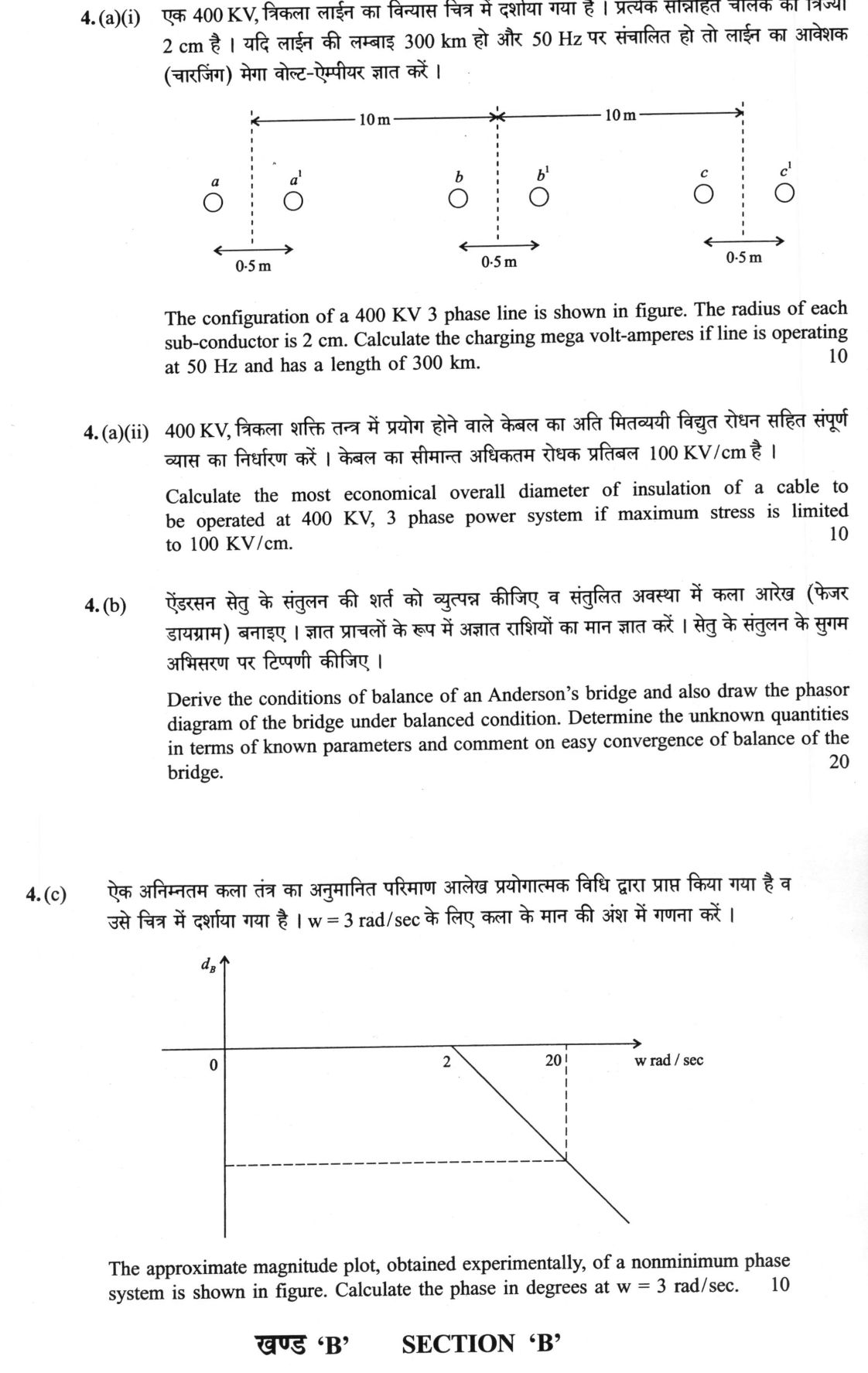
4.(a)(i) The configuration of a 400 KV 3 phase line is shown in figure. The radius of each sub-conductor is 2 cm. Calculate the…
4.(a)(i) The configuration of a 400 KV 3 phase line is shown in figure. The radius of each sub-conductor is 2 cm. Calculate the charging mega volt-amperes if line is operating at 50 Hz and has a length of 300 km. 10 marks
4.(a)(ii) Calculate the most economical overall diameter of insulation of a cable to be operated at 400 KV, 3 phase power system if maximum stress is limited to 100 KV/cm. 10 marks
4.(b) Derive the conditions of balance of an Anderson's bridge and also draw the phasor diagram of the bridge under balanced condition. Determine the unknown quantities in terms of known parameters and comment on easy convergence of balance of the bridge. 20 marks
4.(c) The approximate magnitude plot, obtained experimentally, of a nonminimum phase system is shown in figure. Calculate the phase in degrees at w = 3 rad/sec. 10 marks
हिंदी में प्रश्न पढ़ें
4.(a)(i) एक 400 KV, त्रिकला लाइन का विन्यास चित्र में दर्शाया गया है । प्रत्येक सहिषित चालक की त्रिज्या 2 cm है । यदि लाइन की लम्बाई 300 km हो और 50 Hz पर संचालित हो तो लाइन का आवेशक (चार्जिंग) मेगा वोल्ट-एम्पीयर ज्ञात करें । 10 marks
4.(a)(ii) 400 KV, त्रिकला शक्ति तंत्र में प्रयोग होने वाले केबल का अति मितव्ययी विद्युत रोधन सहित संपूर्ण व्यास का निर्धारण करें । केबल का सीमान्त अधिकतम रोधक प्रतिबल 100 KV/cm है । 10 marks
4.(b) ऐण्डरसन सेतु के संतुलन की शर्त को व्युत्पन्न कीजिए व संतुलित अवस्था में कला आरेख (फेजर डायग्राम) बनाइए । ज्ञात प्राचलों के रूप में अज्ञात राशियों का मान ज्ञात करें । सेतु के संतुलन के सुगम अभिसरण पर टिप्पणी कीजिए । 20 marks
4.(c) एक अनिम्नतम कला तंत्र का अनुमानित परिमाण आलेख प्रयोगात्मक विधि द्वारा प्राप्त किया गया है व जैसे चित्र में दर्शाया गया है । w = 3 rad/sec के लिए कला के मान की अंश में गणना करें । 10 marks
The figure this question refers to, in words
The question paper is a scan and the diagram did not survive as text. This is the figure as read from the original page — every component, value and label — so the question can be worked from the text below.
(a) A plan view of a 400 kV, 3-phase transmission line conductor configuration. Three horizontal phase positions are shown, each consisting of a pair of sub-conductors. The left phase has sub-conductors labelled a and a' separated by 0.5 m. The middle phase has sub-conductors labelled b and b' separated by 0.5 m. The right phase has sub-conductors labelled c and c' separated by 0.5 m. The horizontal spacing between the centres of adjacent phase bundles is 10 m (from the midpoint of a-a' to the midpoint of b-b' is 10 m, and from the midpoint of b-b' to the midpoint of c-c' is 10 m). The sub-conductors are shown as small circles. The radius of each sub-conductor is 2 cm. The line operates at 50 Hz and has a length of 300 km. The quantity to be calculated is the charging mega volt-amperes (MVAR) of the line.
(a(i)) A schematic diagram of a 3-phase transmission line configuration. Three groups of conductors are arranged horizontally. Each group consists of two circular sub-conductors. The left group is labeled 'a' and 'a1', the middle group 'b' and 'b1', and the right group 'c' and 'c1'. The horizontal distance between the center of the left group and the middle group is 10 m. The horizontal distance between the center of the middle group and the right group is 10 m. Within each group, the horizontal distance between the two sub-conductors is 0.5 m. Dashed vertical lines indicate the center of each group.
(a(i)) A schematic diagram of a 3-phase transmission line configuration. Three groups of conductors are arranged horizontally. Each group consists of two circular sub-conductors. The left group is labeled 'a' and 'a1', the middle group 'b' and 'b1', and the right group 'c' and 'c1'. The horizontal distance between the center of the left group and the middle group is 10 m. The horizontal distance between the center of the middle group and the right group is 10 m. Within each group, the horizontal distance between the two sub-conductors is 0.5 m. Dashed vertical lines indicate the center of each group.
(c) A Bode magnitude plot graph. The vertical axis is labeled 'dB' and the horizontal axis is labeled 'w rad / sec'. The plot shows a straight line segment starting at the point (2, 0) on the horizontal axis. The line slopes downwards to the right, passing through a point at w = 20 rad/sec. A dashed vertical line drops from the point on the line at w = 20 to the horizontal axis, and a dashed horizontal line extends from that point to the left, indicating the magnitude value at that frequency.
Model answer
Written by UPSC Answer Check against this question's marking rubric, to the expected length. UPSC does not publish answers for Mains — this is one way to score well, not an official key.
4.(a)(i) For the two-conductor bundle, the equivalent capacitance radius is Ds = √(r d) = √(0.02 m × 0.5 m) = 0.1 m. The phase-centre distances are Dab = 10 m, Dbc = 10 m, Dca = 20 m, so GMD = ∛(10 × 10 × 20) = 12.599 m. For a long 3-phase line, neglecting earth, the capacitance per phase to neutral is C = 2π ε₀ / ln(GMD/Ds) per metre. This formula is valid for a long line with earth neglected and for RMS voltage; the bundle spacing is small compared with phase spacing. Here ln(12.599/0.1) = ln(125.992) = 4.836, so C = 2π(8.854×10⁻¹² F/m)/4.836 = 1.150×10⁻¹¹ F/m. For 300 km, Cph = 1.150×10⁻¹¹ × 3.00×10⁵ = 3.45×10⁻⁶ F. At 400 kV line-to-line and 50 Hz, ω = 100π rad/s, and total charging reactive power is Q = 3Vph²ωCph = VLL²ωCph. Thus Q = (4.00×10⁵ V)² × 100π × 3.45×10⁻⁶ F = 1.73×10⁸ var = 173 MVAR.
4.(a)(ii) For a single-core cable, radial electric stress at radius x is E(x) = V/(x ln(b/a)), where a is conductor radius, b is outer insulation radius, and V is phase voltage. The maximum stress is at the conductor: g = V/(a ln(b/a)). Using the full limit g, b = a exp(V/(g a)). Let y = V/(g a); then b = (V/g)e^y/y. Minimizing b gives db/dy = 0, so y = 1. The second derivative is positive at y = 1, so this is a minimum. Hence a = V/g, b = eV/g, and the most economical overall insulation diameter is D = 2b = 2eV/g. For 3-phase 400 kV, V = 400/√3 kV; g = 100 kV/cm. Therefore D = 2e(400/√3)/100 cm = (8e/√3) cm = 12.54 cm. D = 12.5 cm.
4.(b) Let the bridge source be A-C and detector B-D. The arms are Z₁ = R + jωL (unknown), Z₂ = R₂, Z₃ = 1/(jωC₁), Z₄ = R₃ + 1/(jωC₂). All elements are linear, so the bridge balance theorem applies. With A at voltage V and C at 0, V_B = V Z₂/(Z₁ + Z₂), V_D = V Z₃/(Z₃ + Z₄). Balance requires V_B = V_D, so Z₂(Z₃ + Z₄) = Z₃(Z₁ + Z₂), hence Z₁Z₃ = Z₂Z₄. Substituting, (R + jωL)/(jωC₁) = R₂(R₃ + 1/(jωC₂)). Multiplying by jωC₁, R + jωL = R₂C₁/C₂ + jωR₂R₃C₁. Equating real and imaginary parts gives R = R₂C₁/C₂ and L = R₂R₃C₁. The known parameters are R₂, R₃, C₁ and C₂.
Phasor diagram under balance: take I₂, the current in the R₃-C₂-C₁ branch, as horizontal reference. Since VBC = VDC, the drop I₁R₂ is vertical downward; hence I₁ is 90° behind I₂. Draw I₂R₃ to the right and I₂/(ωC₂) downward to form VAD; draw ωL I₁ to the right and I₁R downward to form VAB. These coincide. Add I₁R₂, or equivalently I₂/(ωC₁), downward to get the common VAC. The detector is between B and D; because VAB and VAD are equal phasors from the same node A, B and D are at the same potential. The balance equations are independent of ω, and R₃ adjusts L while C₂ adjusts R independently; hence convergence is easy, especially for low inductance.
4.(c) The asymptote has a break at 2 rad/s and a break at 20 rad/s; the downward slope between them is -20 dB/dec, so it corresponds to a pole at 2 and a zero at 20. Nonminimum phase means the zero is right-half-plane, so take G(s) = (1 - s/20)/(1 + s/2). The gain is chosen so that the low-frequency magnitude is 0 dB, as shown. The phase is φ = -tan⁻¹(ω/2) - tan⁻¹(ω/20). At ω = 3 rad/s, φ = -tan⁻¹(3/2) - tan⁻¹(3/20) = -56.31° - 8.53° = -64.8°.
What "Solve" is asking you to do
Choose the method, then carry it through to a final answer. Identifying what kind of problem this is and why that method applies is the first thing marked; a correct figure arrived at invisibly earns almost nothing.
Structure that answers it
Given data and what is required → method chosen, with the reason it applies → set-up (equation, circuit, free body, trial balance) → working, step by step → answer with units and any condition of validity
Where marks are lost
Doing the middle steps mentally and writing only the result. In mathematics papers, a further loss comes from giving a decimal where the exact value in surds or fractions was wanted, or from skipping the justification a part explicitly asks for.
How this answer will be evaluated
Approach
Framework: Electrical Engineering, Paper 2. (a(i)) calculate: given > formula > substitution > result with units > interpretation | (a(ii)) calculate: given > formula > substitution > result with units > interpretation | (b) derive: given > assumptions > stepwise derivation > result > check | (c) calculate: given > formula > substitution > result with units > interpretation Full marks: Rigorous derivations, correct phasor diagrams, and precise unit handling.
Key points expected
- Calculate equivalent radius (GMR) of bundle
- Determine geometric mean distance (GMD)
- Calculate capacitance per unit length
- Compute total reactive power in MVA
- State condition for most economical ratio (e/b = e)
- Relate phase voltage to maximum stress
- Calculate core diameter (b)
- Calculate overall diameter (d)
Evaluation rubric
Each sub-part is marked on its own, against the marks and word limit printed on the paper.
- (a(i)) Charging MVA of a 400 kV, 300 km line with bundled conductors. 10 marks
calculate— given → formula → substitution → result with units → interpretation
Must cover
- Calculate equivalent radius (GMR) of bundle
- Determine geometric mean distance (GMD)
- Calculate capacitance per unit length
- Compute total reactive power in MVA
Loses marks
- Ignoring bundle effect on GMR
- Unit conversion errors (cm to m)
Earns more
- Correct use of log formulas for C
- Consistent units (km, cm, Hz)
Extra mark
- Sketch of the 3-phase line configuration
- (a(ii)) Most economical overall insulation diameter for 400 kV cable. 10 marks
calculate— given → formula → substitution → result with units → interpretation
Must cover
- State condition for most economical ratio (e/b = e)
- Relate phase voltage to maximum stress
- Calculate core diameter (b)
- Calculate overall diameter (d)
Loses marks
- Using line voltage instead of phase voltage
- Incorrect application of stress formula
Earns more
- Correct conversion of line voltage to phase voltage
Extra mark
- Diagram of cable cross-section with dimensions
- (b) Balance conditions and phasor diagram for Anderson's bridge. 20 marks
derive— given → assumptions → stepwise derivation → result → check
Must cover
- Draw circuit diagram of Anderson's bridge
- Derive balance equation using KVL/KCL
- Draw phasor diagram for balanced condition
- Express unknown L and R in terms of knowns
Loses marks
- Missing phasor diagram
- Algebraic errors in derivation
Earns more
- Comment on ease of convergence
- Clear labeling of all bridge arms
Extra mark
- Mention of specific applications (e.g., low inductance)
- (c) Phase angle at w = 3 rad/sec for a non-minimum phase system. 10 marks
calculate— given → formula → substitution → result with units → interpretation
Must cover
- Identify poles/zeros from magnitude plot
- Determine transfer function form
- Calculate phase contribution of each term
- Sum phases to find total angle
Loses marks
- Ignoring the non-minimum phase zero
- Incorrect sign for phase lag/lead
Earns more
- Correct identification of non-minimum phase zero
- Step-by-step phase calculation
Extra mark
- Sketch of the Bode phase plot
Practice this exact question
Write your answer and it is marked point by point against the model answer above — what you covered, what you missed, what you got wrong.
Evaluate my answer →More from Electrical Engineering 2021 Paper II
- Q1 (a) A system is described by the following state equations : dotx₁ = x₁ + x₂ + 3x₃ dotx₂…
- Q2 (a) Draw the sequence networks and calculate the load sequence impedances of a load circu…
- Q3 3.(a) A solidly earthed 400 KV, 3 phase busbar system is connected with two incoming and…
- Q4 4.(a)(i) The configuration of a 400 KV 3 phase line is shown in figure. The radius of eac…
- Q5 (a) Explain the ratio error and phase angle error of current transformer. 10 marks (b) Th…
- Q6 (a) A synchronous machine is connected to an infinite bus through a transformer and a dou…
- Q7 (a) Discuss the percentage differential Relay with harmonic restraint with the help of di…